
As we came into last year the rally in gold was already well-built, with a bull pennant forming in the final two months of last year following an almost 40% rally from February into October. But it was around the US election that something began to shift, and it wasn’t the first time we had seen something of that nature as flows drove into Bitcoin rather than gold and the cryptocurrency was pushing into the New Year with a full head of steam.
It was right around President Trump’s inauguration that we saw change hitting markets, with the USD hitting a high and EUR/USD crafting a low. Gold broke out in a big way from the bull pennant formation and Bitcoin dropped by more than $30k over the next couple of months until eventually finding support at the $75k level.
With all that said, it was an even bigger year for silver. After holding at the $35/oz level last year, price showed another resistance reaction there in late-March and early-April; but it was the next test that led to breakout and bulls went on a rip-roaring run thereafter, and silver futures are currently sitting on a 142.6% gain for 2025.
What’s Behind the Push?
Covid was a game-changer in several ways for markets and really, we can drive back to the financial collapse to make a similar statement. That’s when Central Bank policy became a major driving point with the Fed accumulating a balance sheet by keeping rates artificially low to try to boost the economy.
Gold was the natural outlet for that, and we can see the rally in response to the financial collapse reaction as illustrative of that. And over the past 15 years there’s been more and more of that pricing in, with a common driver of low or lower rates boosting the long side of the market. Over the past 40 years, there’ve been multiple phases were gold prices rallied in a very big way as the Fed pushed loose monetary policy, with the current run continuing to show in a parabolic manner after the Fed started to slow rate hikes in 2022.
Gold Futures – Monthly Chart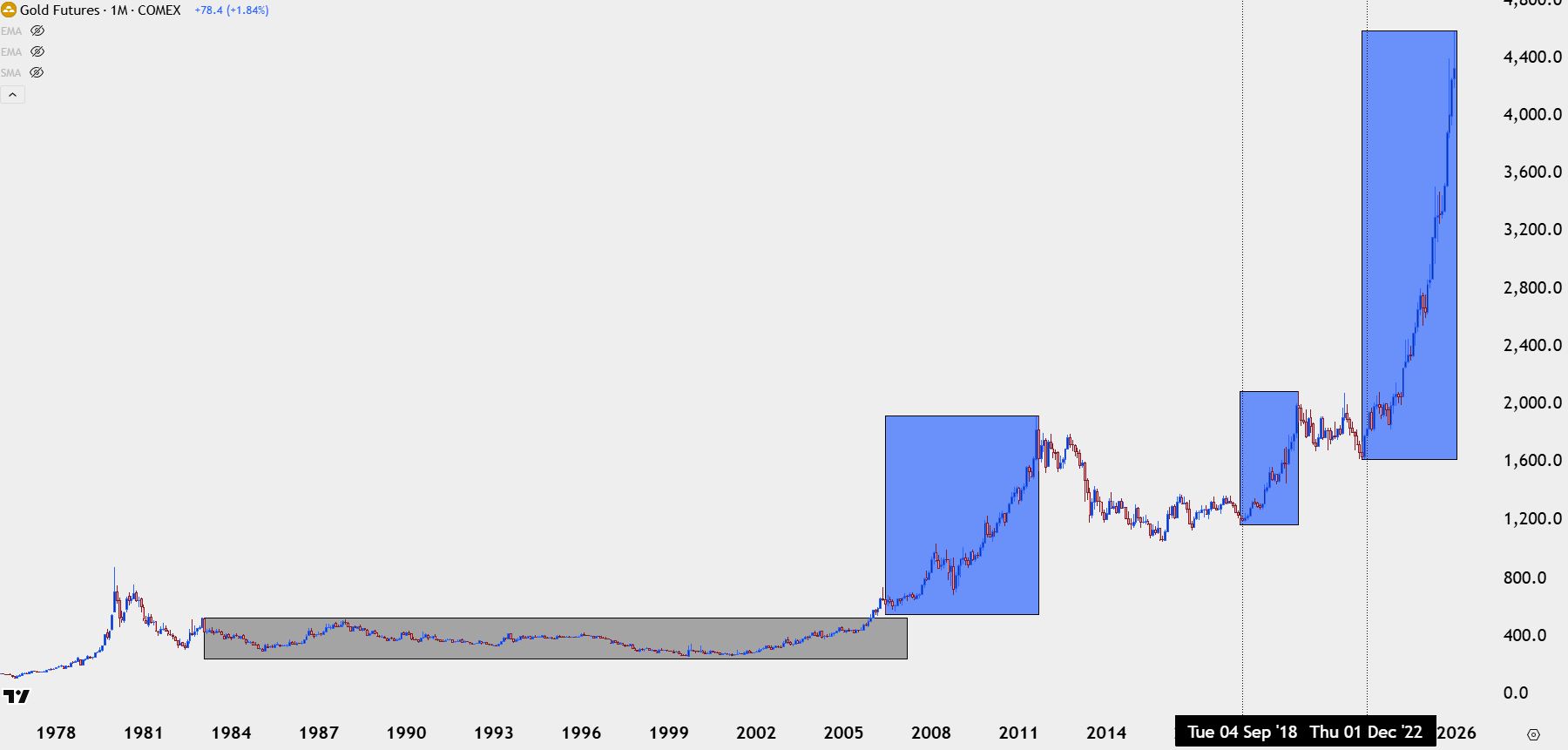
Chart prepared by James Stanley; data derived from Tradingview
Despite the Drive, Positioning Still Matters
Fundamentals and ‘reasons’ are an important driver for price changes in markets, but if we reduce matters to the lowest common denominator, it’s not the only reason, or the ‘real’ driver, even.
The only thing that pushes prices in a true market is buyers and sellers, supply and demand; and while those forces are often governed or dictated by those reasons, it’s not always lock step, especially when a trend has been priced aggressively for a prolonged period of time.
Frankly, if anyone and everyone in a market wanting or willing to be long already is, well then even the greatest news in the world will fail to push prices higher, because there’s simply no demand left. The very act of price not reacting to otherwise bullish stimuli can be enough to compel profit taking in a one-sided market, and that supply leads to lower prices. And then as price drops, more longs get concerned or worried about getting caught near a high, and that can compel even more profit taking.

This can last until price drops to a point that becomes attractive for buyers to re-enter the market again and this helps to explain the three different bull pennant formations that have formed in gold over the past year.
But – importantly – this also helps to explain why major trends have shown in alternative markets for anti-fiat flows, such as Bitcoin and, from this year, silver.
Gold Weekly Chart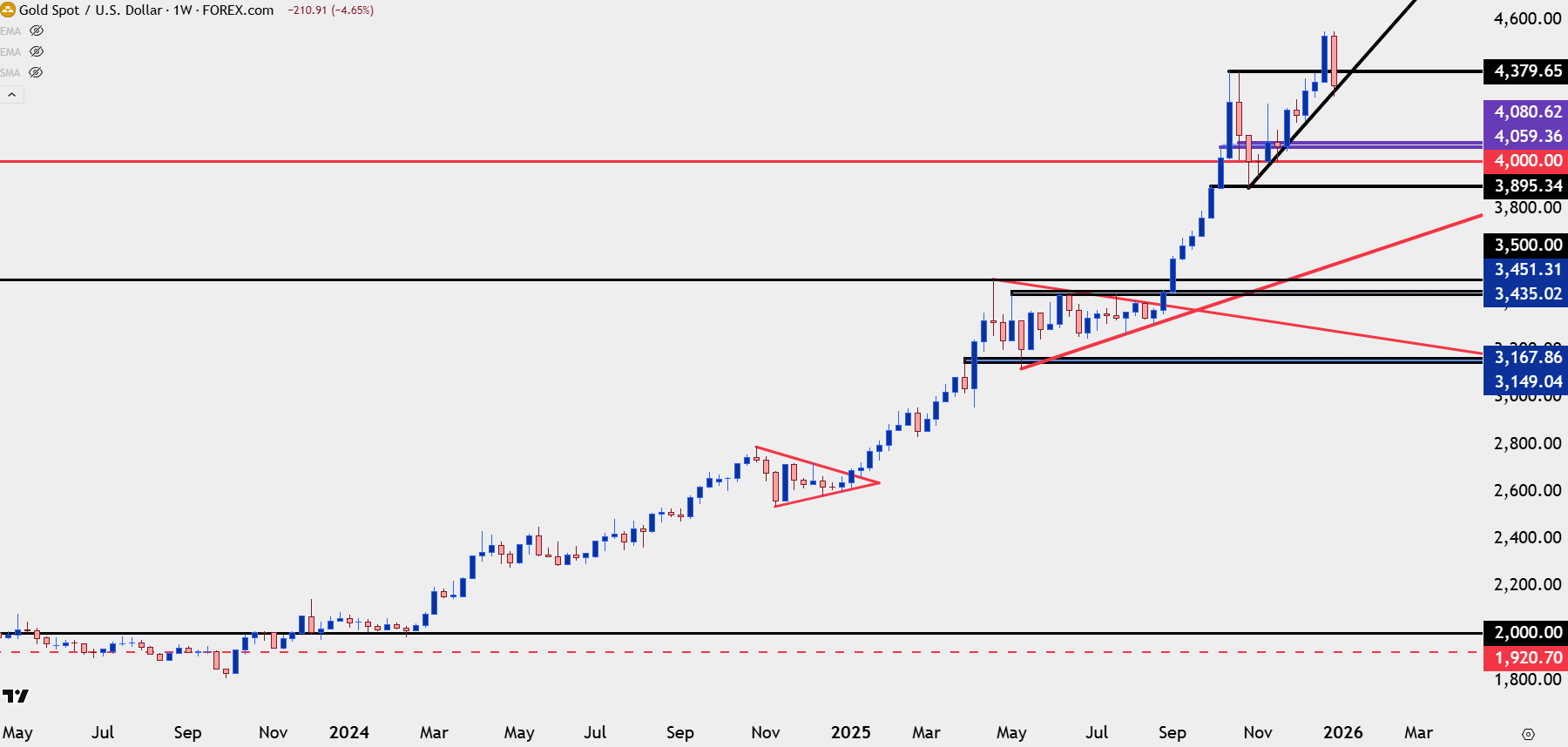
Chart prepared by James Stanley; data derived from Tradingview
The Anti-Fiat Drive
As the gold rally has taken further hold over the past 15 years, in varying ways, there’s been another anti-fiat market that’s gained considerable attention, and that’s Bitcoin.
While there’s a few different reasons for gold prices to remain strong, from industrial usage to commercial purposes, Bitcoin cuts to the heart of the matter with probably the more important financial driver behind gold with scarcity.
Currencies are unique in that they’re the foundation of the global economic system, so the only way to value a currency is with another currency. If we’re seeing governments similarly engage in dilutionary tactics, with ballooning budget deficits and more and more spending fueled by artificially low interest rates, well, that can be difficult to see if we’re simply evaluating currencies because the dilution is similar between compared variables.
And if we’re monitoring a market like stocks which is largely driven by that currency, both in share price terms as well as underlying fundamentals of the companies being traded, this again becomes a difficult relationship to notice as the ‘rising tide lifts all boats.’
But gold is unique from currencies or stocks in that supply isn’t determined by the stroke of a pen and the passing of a budget in Congress. So, if we are in an environment where the perceived dilution of fiat currencies is taking over or front-and-center, a market like gold becomes an attractive alternative.
As a case in point, we can go back to what started this entire bull run in gold back in February of 2024. I’ve discussed this quite a bit as Chicago Fed President Austan Goolsbee seemingly shrugged off elevated inflation readings in February of 2024 to instead highlight the Fed’s desire to cut interest rates, which happened later in the year. The day after he made those comments, which was just a day after an above-target CPI print, gold pushed above $2k and didn’t stop for eight months, eventually consolidating into the bull flag that ran into the end of last year.
But, again, positioning matters, and once a market gets heavily long or one-sided, investors are going to look for alternatives and that’s where Bitcoin comes into play.
Gold Daily Chart – The Goolsbee Comment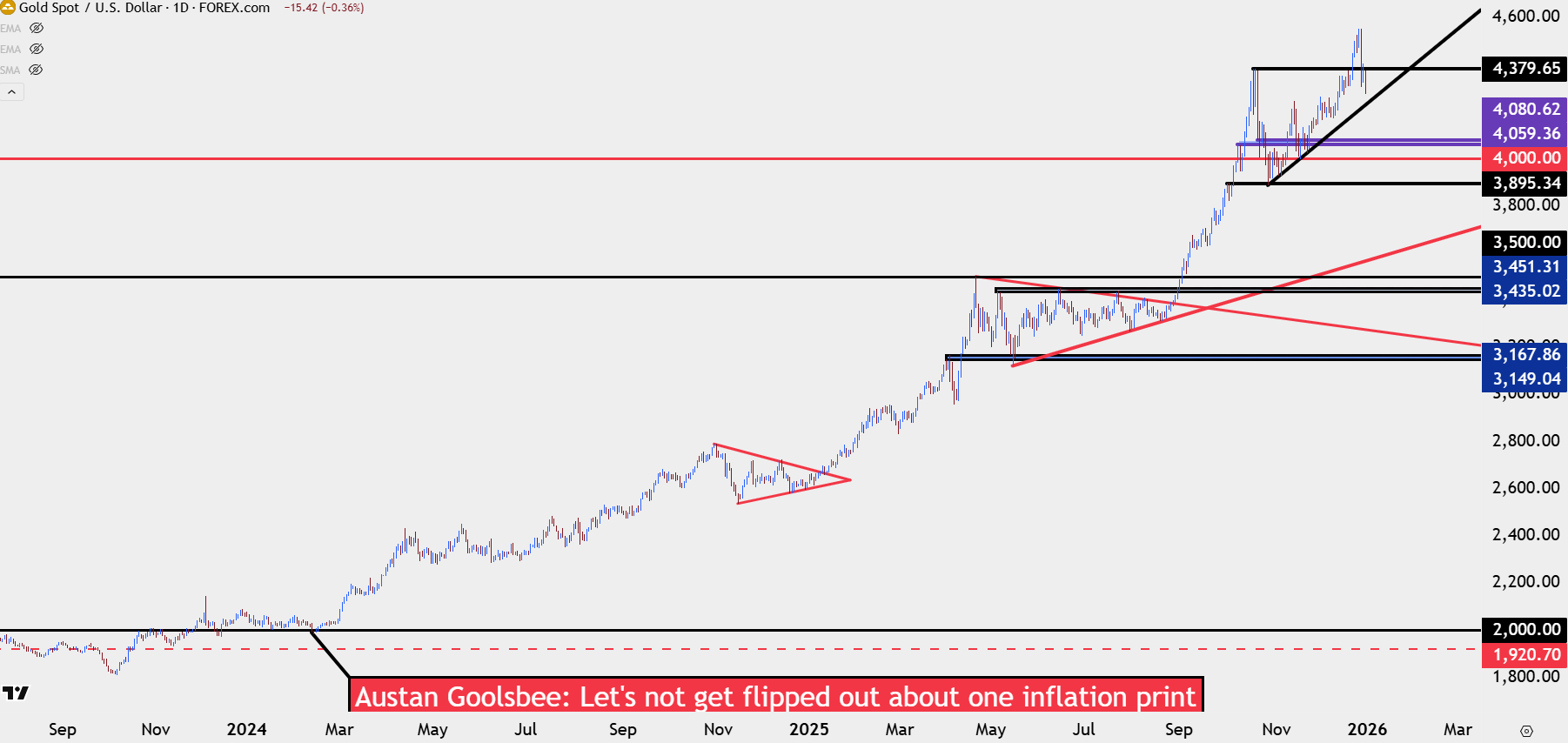
Chart prepared by James Stanley; data derived from Tradingview
Bitcoin as a Gold Alternative
There was a similar scenario back in the summer of 2020. At the time the global economy remained in shutdown due to the pandemic and Central Banks were pedal-to-the-floor with accommodation.
In August, gold hit $2k for the first time ever following a massive run in the prior few months. At the time, Bitcoin was struggling to get back above the $12k level after having topped below $20k less than two years earlier.
But as gold then spent the next three-and-a-half years range bound, with multiple resistance holds at $2k, Bitcoin went on a wild ride, eventually reaching the $69k level. As the Fed began to set the table for rate hikes, BTC sold off, and as the rate hike regime took over in 2022, it showed a dramatic fall. But it was around late 2022 and into 2023 as the Fed softened their approach that Bitcoin began to come back to life.
This seemed a pretty clear illustration of market participants pushing into a different anti-fiat vehicle in the summer of 2020; and this was again illustrated in the final two months of last year when gold went into its bull pennant formation.
The driver at that point was the US election, and a crypto-friendly President was set to be inaugurated. This helped Bitcoin to rally above the $100k level for the first time ever and this took place as gold price action was narrowing into a symmetrical triangle.
When gold went into another bull pennant between April and August of this year, again, gold rallied up to a fresh high, this time finding resistance at $125k in October before profit taking took over.
This is, perhaps coincidentally, when gold prices finally broke above the $4k level and continued to push to fresh higher-highs, eventually testing above $4500.
But then that’s around the time that another market started to gain traction in a very big way…
Bitcoin Weekly Chart
Chart prepared by James Stanley; data derived from Tradingview
Silver Enters Center Stage
Until this year, silver was a laggard.
After the metal came close to the $50 handle back in 2011, it was largely subdued as we came into 2025, almost 40% below that prior high. Meanwhile gold had flew above its own 2011 high and Bitcoin had come to life in a very big way.
But what’s taken over in silver over the past year and, more dominantly, over the past few months, has been a stark change-of-pace. The weekly chart below shows just how parabolic this move has become.
Silver Futures – Weekly Chart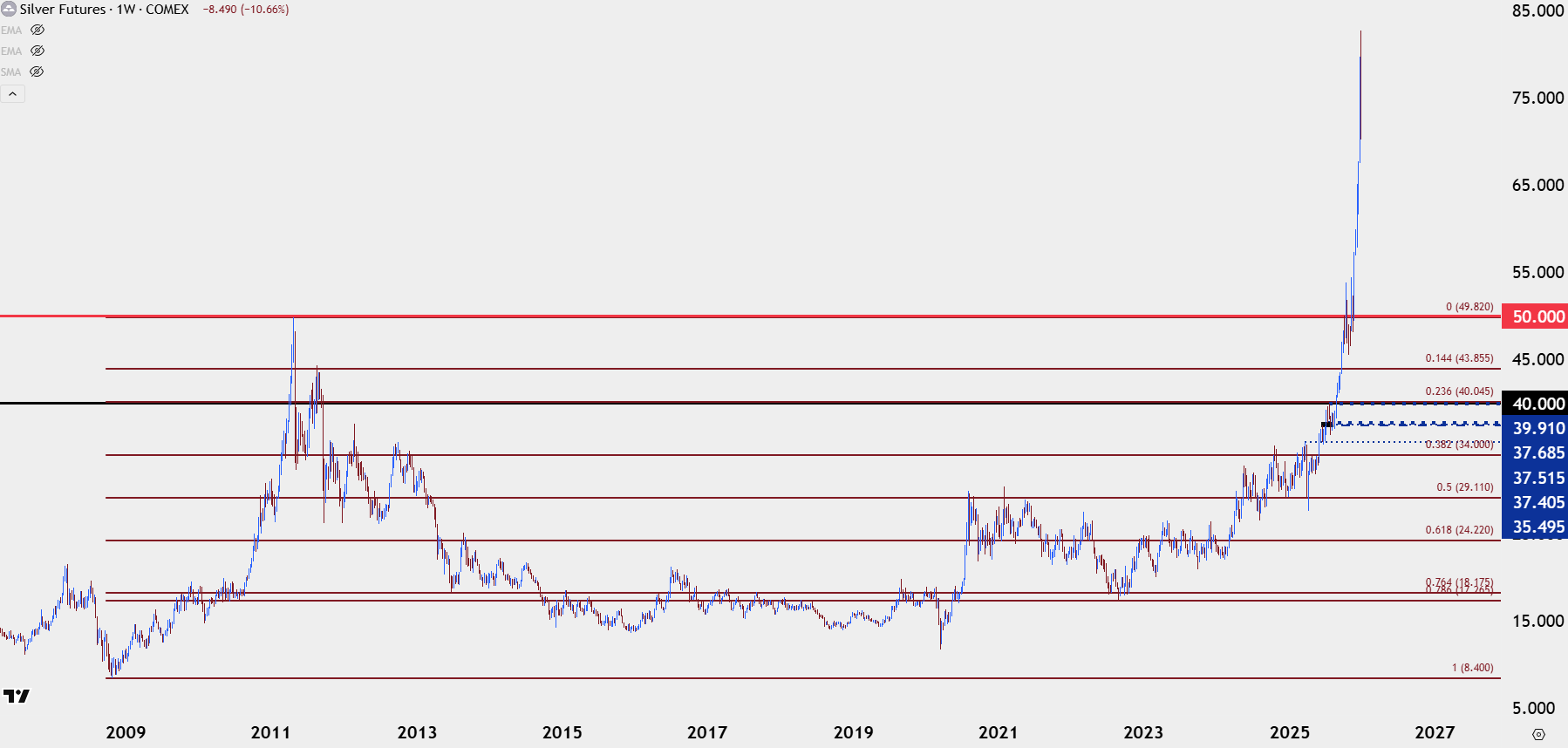
Chart prepared by James Stanley; data derived from Tradingview
Silver Mania
What we have now is a mania-like situation where prices have moved so quickly and so fast that trend setups can be a challenge.
That positioning item mentioned earlier in this article, that definitely matters, as bulls that got long even in November at sub-50 prices are now sitting on a 40% gain, or perhaps even higher, and that can be an attractive time to start taking profits. I looked at this on Monday when the 70-level had led to a bounce, and this can be categorized as bulls taking another shot following a sizable pullback. But the fact that price failed to hit 80 and has retreated back to support suggests that we may be in for a deeper drop, at least in early-2026 trade, as profit taking further takes over.
The one thing that is clear is that the anti-fiat drive that’s pushed gold and Bitcoin and now silver remains alive and well, and there’s expectation for that to continue as the US government pushes a potent combo of lower interest rates and looser monetary policy alongside fiscal stimulus measures set to come online next year with the Big Beautiful Bill.
There is risk, to be sure, and that takes on the form of inflation, and similar to what we saw in both gold and Bitcoin in 2021 and 2022, this can lead to weakness and profit taking in both markets. But, unless we’re looking at a regime of austerity or balanced budgets or some element of economic prudence in the U.S., it doesn’t seem as though the bullish arguments behind any of these markets will die completely.
Instead, it simply comes down to a matter of positioning and patience, and, like we saw in late-2022 or in February of last year or again a month ago with the breakout in silver, there’s potential for alignment of the bigger picture theme and shorter-term market sentiment.
As we go into next year, a flare of inflation could actually be a positive for those looking to pick on this theme in the years to come, as the pullbacks produced by that scenario can allow for more attractive entry prices that can lead to stronger big picture trends.
In silver, at least on a short-term basis, the next key area of support potential is around the 65 handle and a show of support there opens the door for bulls to take another shot.
Silver Four-Hour Chart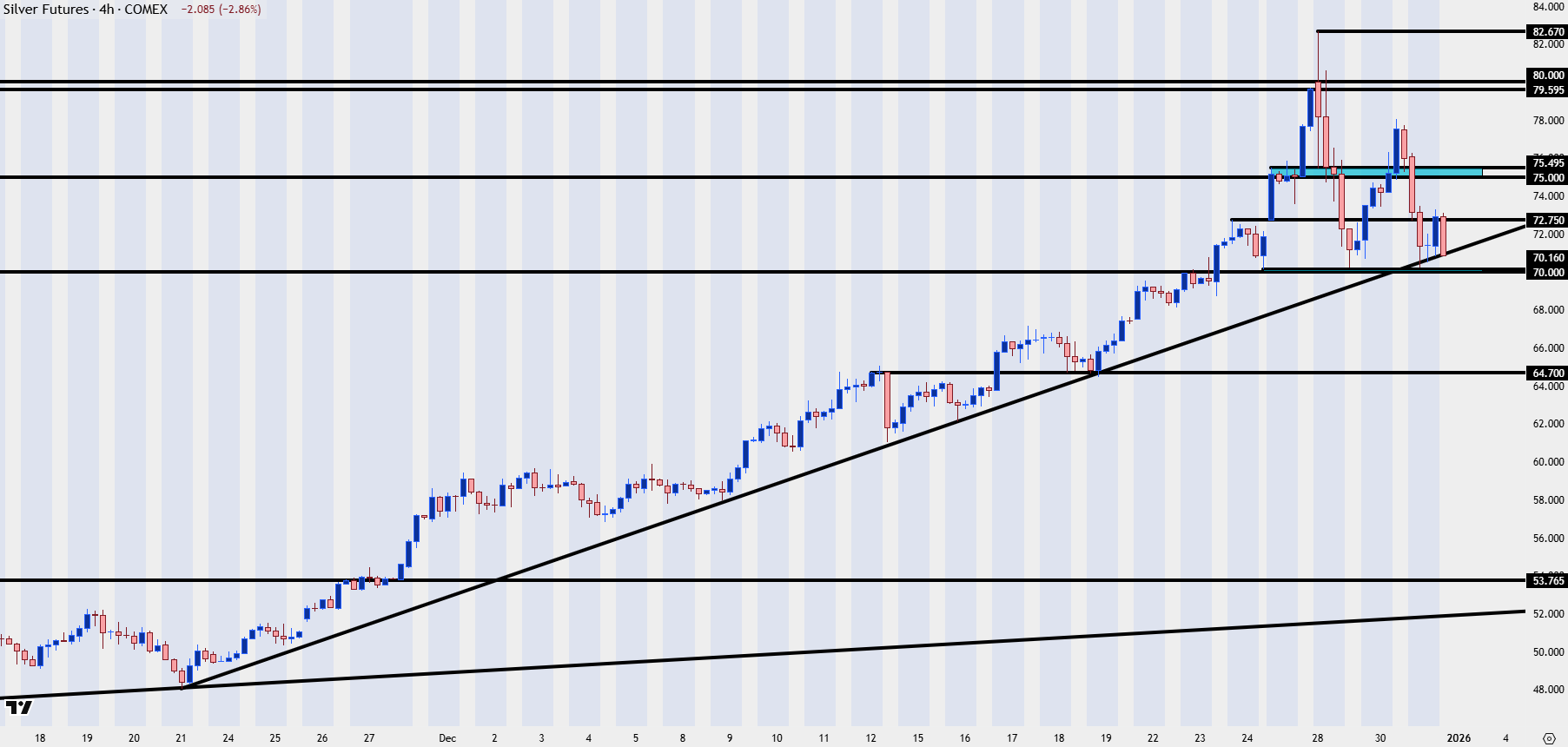
Chart prepared by James Stanley; data derived from Tradingview
--- written by James Stanley, Senior Market Analyst, Global Macro