



A peek at (peak?) inflation
US Inflation may have softened to a degree in April, but traders really want to see further evidence that inflation is pointing lower to call ‘peak inflation’ with more confidence.
Share this:

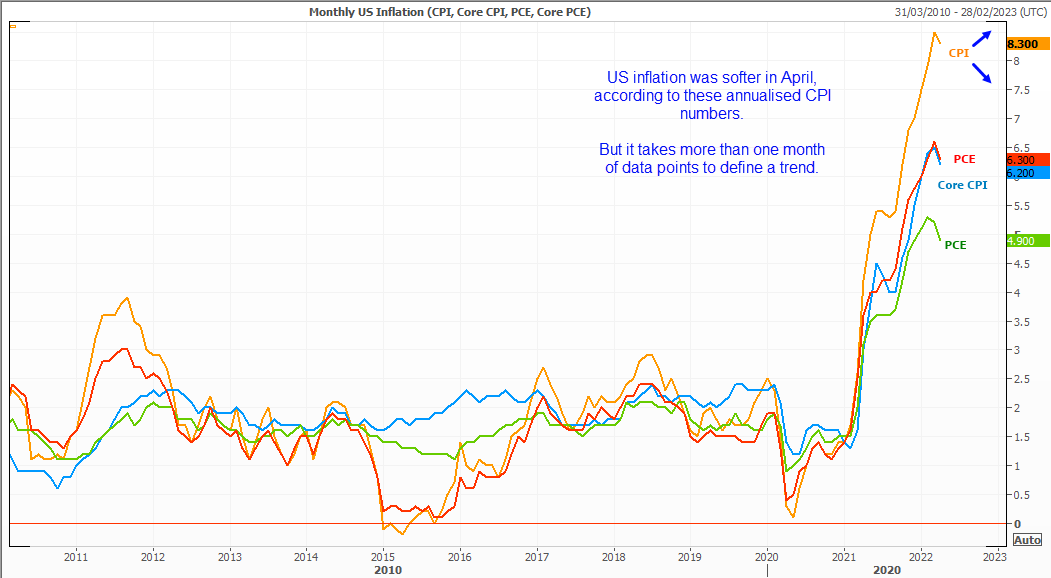
We knew going into last month’s inflation report that it was likely to be followed by a slew of ‘peak inflation’ headlines. CPI was forecast to soften from multi-decade highs and, when it did, the headlines did not disappoint.
Annualised prints of CPI, core CPI, PCE and core PCE all softened in April, and that’s an important first step to identifying a peak. But a month’s worth of data points don’t define a trend. Therefore, Friday’s inflation report is really about convincing us that the worst of eye-watering levels of inflation really are behind us. We simply need to see is soften again. And if we look through some inflation inputs, it’s beginning to look promising that it is.
Some inflationary inputs are pointing lower
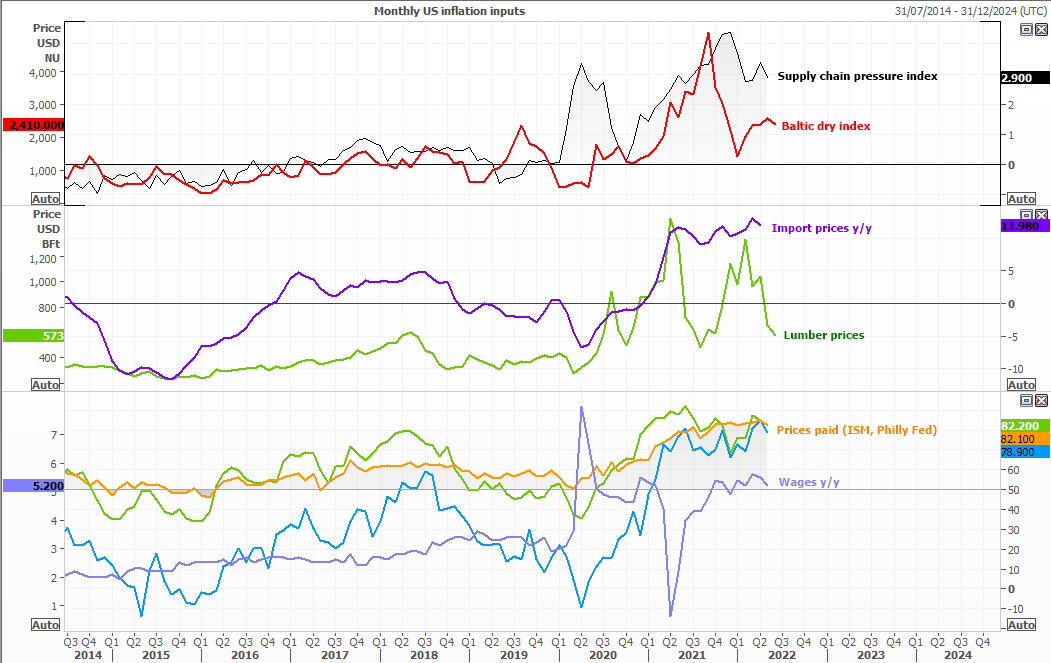
‘Prices paid’ by services and manufacturing companies also fell in April according to the ISM and Philly Fed reports. Import prices (effectively imported inflation) and wages also fell on an annualised basis, whilst lumber prices have plummeted from this year’s high. There are also signs that bottlenecks are easing with the supply chain pressure index falling lower in March, and sitting quite a bit beneath its December peak. The Baltic dry index – the cost of sea freight – has also turned lower. And earlier this week US retailer Target (TGT) warned they will have to slash prices due to a large build-up of inventory (low demand).
When things get too hot, they also get ‘sticky’
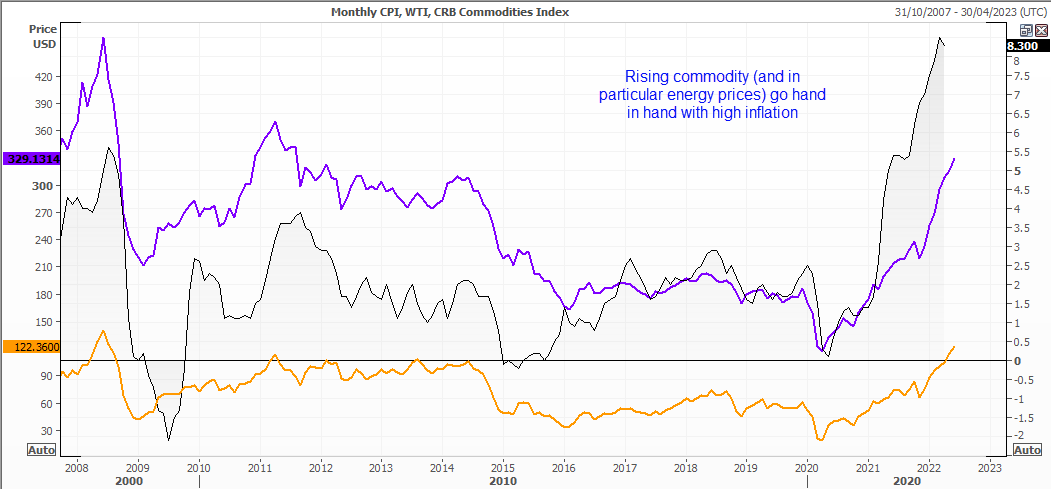
As nice as that is to see, it doesn’t escape the fact that commodities (and energy in particular) are soaring. High energy prices make an impact globally for consumers and businesses, whether it be manufacturing, transportation or simply heating your home. Oil prices continue to rise with US driving season underway and China’s reopening supporting its trend. Oil therefore remains a major inflationary input for policy makers to mull over. Earlier this week, US Secretary of the Treasury Janet Yellen said inflation is at “unacceptable levels” and likely to remain high. We suspect most agree. Going forward it is not so much the absolute level of inflation that matters so much as its direction and rate of change.
Ultimately the fear going forward is that inflation has become so hot that it will become ‘sticky’ at higher levels. The longer prices remain high the more of a drag it becomes on consumption, consumer and business sentiment and therefore growth.
So let’s face the fact that central banks are behind the curve and there was no need for inflation to get to such levels. It surely would have been better to feel short-term pain (higher rates, sooner) for long-term gain (lower rates than we’re now likely to have going forward). The cost of delaying these hikes is likely to put a further strain on consumer sentiment and housing sector, of which cracks are already appearing.
Economists are expecting inflation to fall in May 2022
- Core CPI is forecast to fall to 0.5% m/m in May, down from 0.6% in April.
- Annual core CPI is forecast to fall to 5.9% from 6.2% y/y.
- CPI (which includes food and energy) is expected to rise to 0.7% m/m from 0.3%.
- Annual CPI is expected to remain flat at the giddy height of 8.3%.
With CPI expected to rise to 0.7% m/m (from 0.3%), anything less is a bonus. Clearly the nest outcome for peak inflation is 0.2% or low, whilst 0.3% would still be seen as a victory. But with energy prices soaring this seems unlikely. Core CPI is expected to fall to 0.5% (from 0.6%), so 0.5% or lower for core CPI is a result for the ‘peak inflation’ crowd.
How might markets react around the US inflation report?
Wall Street’s major indices have been confined within a range for the past 8-days, and it seems clear that the US inflation report is a likely catalyst to make it break out of that range – one way or another. A softer data set could help equity traders rejoice and break indices out of their ranges, and with some volatility for decent measure.
A softer inflation report could also weigh on the dollar for the same reasons equities rally; softer inflation removes some pressure for the Fed to act so aggressively with higher interest rates. We’ve already heard murmurs of the Fed potentially pausing rates around September after a series of 50-bps hikes. And a soft inflation print would certainly help with that case.
Of course, should inflation unexpectedly rise then it could wreak havoc across markets. Equities could embark upon their next leg lower, and the US dollar catch a fresh bid as the case for aggressive hike to continue from the Fed retake centre stage.
How to trade with City Index
You can easily trade with City Index by using these four easy steps:
- Open an account, or log in if you’re already a customer
• Open an account in the UK
• Open an account in Australia
• Open an account in Singapore
- Search for the company you want to trade in our award-winning platform
- Choose your position and size, and your stop and limit levels
- Place the trade
How to trade with FOREX.com
Follow these easy steps to start trading with FOREX.com today:
- Open a Forex.com account, or log in if you’re already a customer.
- Search for the pair you want to trade in our award-winning platform.
- Choose your position and size, and your stop and limit levels.
- Place the trade.
Latest market news




The complete CFD trading experience
Award-winning platforms, competitive spreads, low commissions and dedicated support.
We live and breathe the markets and are dedicated to helping traders realise their ambitions as we continue to set the industry bar.
Economic calendar
Web Trader platform
Our sophisticated web-based platform is packed with features.
Related articles

DAX Climbs After Fed Move, Eyes Break Above 26,000 Resistance
The DAX has opened significantly higher following the Federal Reserve's delivery of its first interest rate hike since 2023. Although the Fed signaled further tightening, the market reaction was surprisingly positive, as much of the hawkish expectation had already been priced in. Attention now shifts to the 25,900–26,000 point range, which will likely determine whether the current recovery evolves into a new upward wave or remains merely a short-covering rally.


FOMC Meeting Preview: Three Questions for Chairman Warsh
Assuming the Fed delivers the expected hike, traders will want to know WHAT could prompt another hike, WHY they hiked this time, and HOW to interpret the dot plot.


Crude Oil Price Outlook: WTI and Brent Lead the Market Narrative
Crude Oil Price Outlook: Crude oil remains the market’s dominant narrative despite conflicting headline signals

StoneX Europe Ltd may make third party material available on this website which may contain information included but not limited to the conditions of financial markets. The material is for information purposes only and does not contain, and should not be construed as containing, investment advice and/or investment recommendation and/or an investment research and/or an offer of or solicitation for any transactions in financial instruments; any decision to enter into a specific transaction shall be made by the client following an assessment by him/her of their situation.
StoneX Europe Ltd makes no representation or warranty and assumes no liability as to the accuracy or completeness of the information provided, nor any loss arising from any investment based on a recommendation, forecast or other information supplied. You should always seek independent advice as to your suitability to speculate in any related markets and your ability to assume the associated risks, if you are at all unsure. We are not under any obligation to update any such material. Any opinion made may be personal to the author and may not reflect the opinion of StoneX Europe Ltd.