




FOMC Preview One or Two and Done
In order to support inflation, we expect the central bank to cut interest rates by just 25bps this week and leave the door open to another small cut in September. Beyond correcting the over-ambitious last rate hike or two from late last year, the Fed will likely prefer to remain on sidelines unless the economy takes a sharp turn lower.
Share this:

The Federal Reserve has been within its pre-meeting “blackout period” for more than a week now, but that restriction doesn’t apply to President Trump. Yesterday, the President tweeted that “quantitative tightening was a big mistake” and that the “Fed has made all of the wrong moves. A small rate cut is not enough…”
Of course, there’s a long history of political leaders trying to intervene into central bank policy. By contrast, less biased, more informed sources have recently argued for a more measured approach. Yesterday, former Fed Chairwoman Yellen endorsed a 25bps rate cut, but stated that she “wouldn’t see [it] as the beginning… of a major easing cycle.” Similarly, former New York Fed President Dudley wrote this morning that he thinks “there’s a good chance the Fed won’t be cutting further anytime soon” (after today). In other words, arguably the two people on the planet that are most well-connected to current Fed governors (and are legally allowed to speak about it) have both suggested that the Fed is likely to be conservative and is unlikely to embark on a prolonged easing cycle this week.
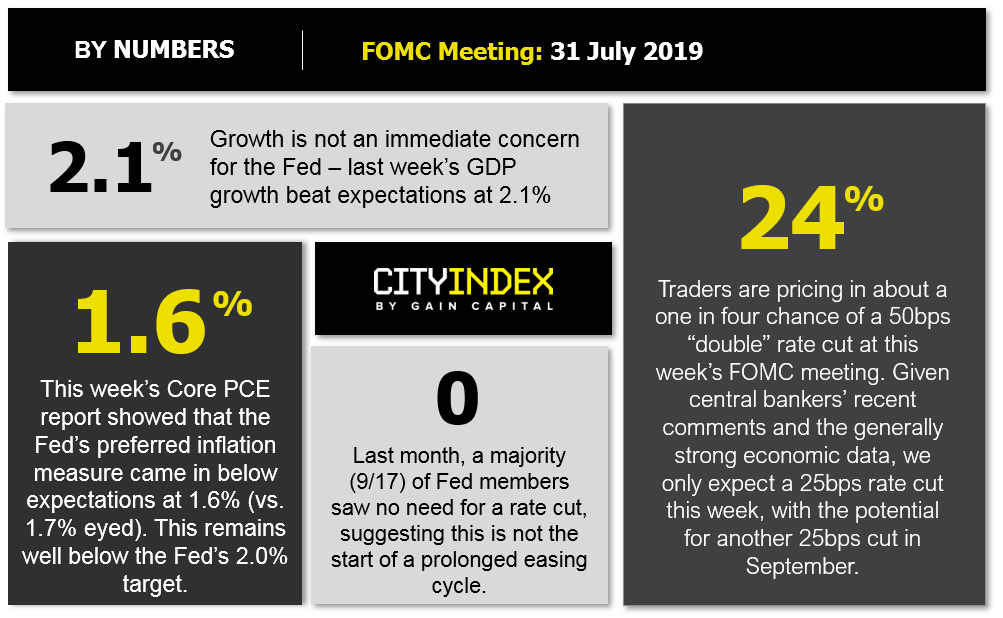
Meanwhile, the US economy continues to chug along at a steady, if unimpressive rate. Last week’s GDP report printed better than anticipated, showing 2.1% annualized growth in Q2, and more recent PMI figures remain among the strongest in the world, despite a small dip of late. The only sore spot for the Fed is inflation, which remains stubbornly below the central bank’s 2.0% target, with this morning’s Core PCE report printing at just 1.6% y/y.
Source: TradingView, City Index
In order to support inflation, we expect the central bank to cut interest rates by just 25bps this week and leave the door open to another small cut in September. Beyond correcting the over-ambitious last rate hike or two from late last year, the Fed will likely prefer to remain on sidelines unless the economy takes a sharp turn lower. Essentially, the central bank may opt for one or two “insurance cuts,” but the market should not view this as the start of a prolonged easing cycle yet.
Market Impact
A small rate cut will have only a limited impact on the US economy, which is balancing solid domestic growth against headwinds from global trade and geopolitical uncertainty.
By this point, the interest rate decision itself (assuming it’s for a 25bps cut) has already been discounted by the market, so the forward-looking outlook and the tone of Chairman Powell’s press conference will be the major driver for markets. As it stands, the market is expecting 3-4 interest rate reductions by this time next year; if the Fed is able to communicate a “one-(or two-)and-done” approach to rate cuts, the US dollar would likely rally, while US stocks may fall.
The Federal Reserve has been within its pre-meeting “blackout period” for more than a week now, but that restriction doesn’t apply to President Trump. Yesterday, the President tweeted that “quantitative tightening was a big mistake” and that the “Fed has made all of the wrong moves. A small rate cut is not enough…”
Of course, there’s a long history of political leaders trying to intervene into central bank policy. By contrast, less biased, more informed sources have recently argued for a more measured approach. Yesterday, former Fed Chairwoman Yellen endorsed a 25bps rate cut, but stated that she “wouldn’t see [it] as the beginning… of a major easing cycle.” Similarly, former New York Fed President Dudley wrote this morning that he thinks “there’s a good chance the Fed won’t be cutting further anytime soon” (after today). In other words, arguably the two people on the planet that are most well-connected to current Fed governors (and are legally allowed to speak about it) have both suggested that the Fed is likely to be conservative and is unlikely to embark on a prolonged easing cycle this week.
Meanwhile, the US economy continues to chug along at a steady, if unimpressive rate. Last week’s GDP report printed better than anticipated, showing 2.1% annualized growth in Q2, and more recent PMI figures remain among the strongest in the world, despite a small dip of late. The only sore spot for the Fed is inflation, which remains stubbornly below the central bank’s 2.0% target, with this morning’s Core PCE report printing at just 1.6% y/y.
Source: TradingView, FOREX.com
In order to support inflation, we expect the central bank to cut interest rates by just 25bps this week and leave the door open to another small cut in September. Beyond correcting the over-ambitious last rate hike or two from late last year, the Fed will likely prefer to remain on sidelines unless the economy takes a sharp turn lower. Essentially, the central bank may opt for one or two “insurance cuts,” but the market should not view this as the start of a prolonged easing cycle yet.
Market Impact
A small rate cut will have only a limited impact on the US economy, which is balancing solid domestic growth against headwinds from global trade and geopolitical uncertainty.
By this point, the interest rate decision itself (assuming it’s for a 25bps cut) has already been discounted by the market, so the forward-looking outlook and the tone of Chairman Powell’s press conference will be the major driver for markets. As it stands, the market is expecting 3-4 interest rate reductions by this time next year; if the Fed is able to communicate a “one-(or two-)and-done” approach to rate cuts, the US dollar would likely rally, while US stocks may fall.
Latest market news



The complete CFD trading experience
Award-winning platforms, competitive spreads, low commissions and dedicated support.
We live and breathe the markets and are dedicated to helping traders realise their ambitions as we continue to set the industry bar.
Economic calendar
Web Trader platform
Our sophisticated web-based platform is packed with features.
Related articles

USD/JPY Q4 2026 Outlook: Hawkish Fed Pricing Clashes With Intervention Risk
The year-end tug-of-war is clear: hawkish Fed pricing supports USD/JPY, while intervention risk limits the upside.


USD/CAD and USD/MXN Q4 2026 Outlook: Will the U.S. Dollar Dominate North America Again?
The final stretch of 2026 is approaching, and North America's major currencies have begun to show a shift in the strength dynamics seen earlier in the year. New expectations of a more aggressive monetary policy stance, particularly in the United States, could be significantly reshaping the outlook for the region. At the same time, this backdrop, combined with potential trade tensions across North America, may become one of the most important drivers of currency performance in the months ahead.


Gold Analysis: Rising Yields and Dollar Strength Weigh on XAU/USD
The trading week continues, and for now gold remains under notable pressure in the short term. This can be seen in the performance of XAU/USD over the last three trading sessions, where the metal has declined by more than 2.00%, bringing a bearish bias back into focus after it had lost momentum in recent weeks.
StoneX Europe Ltd may make third party material available on this website which may contain information included but not limited to the conditions of financial markets. The material is for information purposes only and does not contain, and should not be construed as containing, investment advice and/or investment recommendation and/or an investment research and/or an offer of or solicitation for any transactions in financial instruments; any decision to enter into a specific transaction shall be made by the client following an assessment by him/her of their situation.
StoneX Europe Ltd makes no representation or warranty and assumes no liability as to the accuracy or completeness of the information provided, nor any loss arising from any investment based on a recommendation, forecast or other information supplied. You should always seek independent advice as to your suitability to speculate in any related markets and your ability to assume the associated risks, if you are at all unsure. We are not under any obligation to update any such material. Any opinion made may be personal to the author and may not reflect the opinion of StoneX Europe Ltd.