



GBP/USD forecast: Forex Friday | February 6, 2025
With equity futures sharply off their weekly lows and volatility easing, sterling has found some breathing space, after that double whammy on Thursday’s risk-off trade that had triggered a modest dollar rally and the pound getting pounded by a dovish Bank of England. Looking ahead, next week’s US jobs report and CPI, alongside UK GDP data, are likely to be the main catalysts for the GBP/USD forecast
Share this:

- GBP/USD forecast: Calmer markets have helped sterling stabilise after a brief dollar-led risk-off move
- A more dovish-than-expected Bank of England has shifted rate cut expectations towards March
- Weakening US labour data is raising questions about how long the dollar can stay supported
After Thursday’s brutal sell-off in cryptos and metals, which also caused stocks to tumble and the dollar to find haven flows, things have been quite different in the first half of Friday’s session. Calmer tone across markets was not what you would have expected to see after that plunge, but it has exactly been that. This has allowed FX majors to rebound, including the GBP/USD. With equity futures sharply off their weekly lows and volatility easing, sterling has found some breathing space, after that double whammy on Thursday’s risk-off trade that had triggered a modest dollar rally and the pound getting pounded by a dovish Bank of England. Looking ahead, next week’s US jobs report and CPI, alongside UK GDP data, are likely to be the main catalysts for the GBP/USD forecast. At midday in London, precious metals were firmer, equities had stabilised, and even Bitcoin had found some buyers. Part of that calm reflects a growing belief that the Federal Reserve is edging closer to its next easing cycle, with employment data being quite soft this week. But whether the turmoil ill make an unwelcome return later on remains to be seen. IF it does, the dollar could yet find renewed support.
GBP/USD forecast: Non-farm payrolls and UK GDP to come next week
The focus will turn back to data from around the middle of next week, starting with the release on Wednesday of the US nonfarm payrolls report, followed a day later by UK GDP and then finally US CPI on Friday.
This week, US interest rates have been repriced lower, helped by some surprisingly soft US labour market data. The spotlight now shifts firmly to next week’s US non-farm payrolls report, which includes annual benchmark revisions. That could be a bigger event than usual. The January jobs report has been delayed by the brief government shutdown. Following a weak ADP private payrolls report, as well as hugely disappointing readings on JOLTS Job Openings and Challenger Job Cuts, expectations are running low. It will therefore need to surprise to the upside to keep the dollar’s recent recovery alive. Otherwise, any dollar strength will likely come from further turbulence in other financial markets like stocks, crypto or commodities. Meanwhile, CPI is unlikely to provide too much driving power for the dollar, as the focus has shifted to employment.
The latest JOLTS data was particularly ugly. December job openings collapsed to 6.54 million from a revised 6.93 million previously, well below expectations. This is not just a one-off. ISM employment, ADP, initial jobless claims and Challenger layoffs all told a similar story this week: the US labour market is cooling, and quite quickly. Hires are flat, quits are drifting lower, and the momentum clearly isn’t what it was a year ago.
UK GDP in focus after a dovish BoE hold
Sandwiched between US nonfarm payrolls and CPI, we have UK GDP due for release on Thursday, along with a handful of other macro pointers.
The Bank of England surprised markets on Thursday by how dovish they were relative to expectations. No less than four officials voted for a rate cut, although they fell short of majority as the other 5, including the Governor, opted for no change. The bank cut its inflation and growth forecasts. The latest quarterly GDP data will tell us whether the Bank got it right with their cautious outlook.
Interest rate expectations have now shifted to marginally favour the first cut as early as March, although markets are still more comfortable pricing the initial move in Q2, when there should be clearer evidence that disinflation is firmly entrenched. But I think March is certainly live.
Technical GBP/USD forecast: Key levels to watch
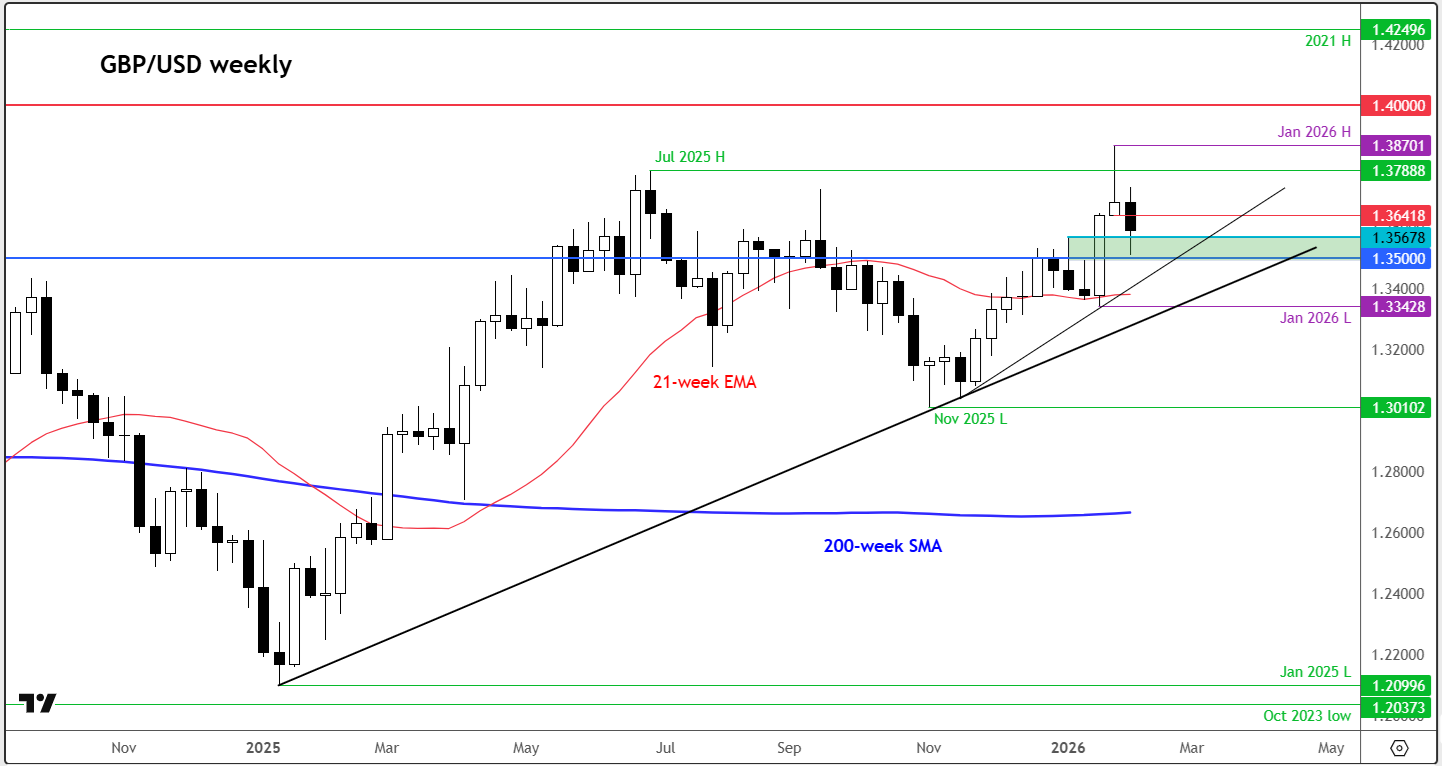
Last week’s inverted hammer candle after a brief break above the July 2025 high of 1.3789 means price may have formed at least a near-term peak. But key support, which sits around 1.3500-1.3565 on the GBP/USD chart, has been defended so far this week. This area was a prior resistance range. In the event of a breakdown below it, we could see a potential drop to test the January lows near 1.3350, where we also have a bullish trend line coming into play.
Putting it all together, the GBP/USD forecast looks increasingly like a range trade rather than a directional one. The pound is facing a dovish BoE and rising political uncertainty, while the dollar is starting to feel the weight of a slowing labour market and growing Fed cut expectations, yet the risk-off tone that has been evident for much of this week provides it support. Near term, UK GDP, US CPI and next week’s payrolls will be crucial. Weak US data would tilt risks back towards a softer dollar and allow GBP/USD to grind higher. But with sterling’s own fundamentals deteriorating, any rallies are likely to be shallow and vulnerable.

-- Written by Fawad Razaqzada, Market Analyst
Follow Fawad on Twitter @Trader_F_R
Related tags:
Latest market news




The complete CFD trading experience
Award-winning platforms, competitive spreads, low commissions and dedicated support.
We live and breathe the markets and are dedicated to helping traders realise their ambitions as we continue to set the industry bar.
Economic calendar
Web Trader platform
Our sophisticated web-based platform is packed with features.
Related articles
Gold Q4 2026 outlook: Resilience in the face of rallying dollar and yields
As we headed towards the latter stages of Q3 and into Q4, the Fed had just hiked rates in a hawkish FOMC meeting, while the likes of the ECB and BoJ had also tightened their respective policies. Oil prices remained elevated amid the prolonged US-Iran conflict. Meanwhile, bond yields were breaking out, and the dollar was higher across the board. Yet, remarkably, gold was still holding in the positive territory for the third quarter, even if it had weakened somewhat in September.
EUR/USD Q4 2026 Outlook: Euro at a Crossroads as Fed, ECB Tighten 9 25 2026
EUR/USD enters Q4 at a pivotal inflection point as competing Fed-ECB policy paths and persistent inflation risks collide with major technical support.


USD/JPY Q4 2026 Outlook: Hawkish Fed Pricing Clashes With Intervention Risk
The year-end tug-of-war is clear: hawkish Fed pricing supports USD/JPY, while intervention risk limits the upside.

StoneX Europe Ltd may make third party material available on this website which may contain information included but not limited to the conditions of financial markets. The material is for information purposes only and does not contain, and should not be construed as containing, investment advice and/or investment recommendation and/or an investment research and/or an offer of or solicitation for any transactions in financial instruments; any decision to enter into a specific transaction shall be made by the client following an assessment by him/her of their situation.
StoneX Europe Ltd makes no representation or warranty and assumes no liability as to the accuracy or completeness of the information provided, nor any loss arising from any investment based on a recommendation, forecast or other information supplied. You should always seek independent advice as to your suitability to speculate in any related markets and your ability to assume the associated risks, if you are at all unsure. We are not under any obligation to update any such material. Any opinion made may be personal to the author and may not reflect the opinion of StoneX Europe Ltd.