



If the US Dollars Going to Bounce It Better Do It Here
The narrative of the US dollar as the “cleanest dirty shirt” amongst a slow-growth global economy has been ripped to shreds...
Share this:

The high-volatility, alternating up-down rollercoaster in risk appetite that has characterized this week’s trade has seemingly broken on the final trading day of the week; that is, markets remain highly volatile, but we’re not seeing a recovery in risk assets after yesterday’s drubbing. Instead, equity indices across the globe are trading another 2-4% lower, while global bond yields collapse and gold tacks on another 1%.
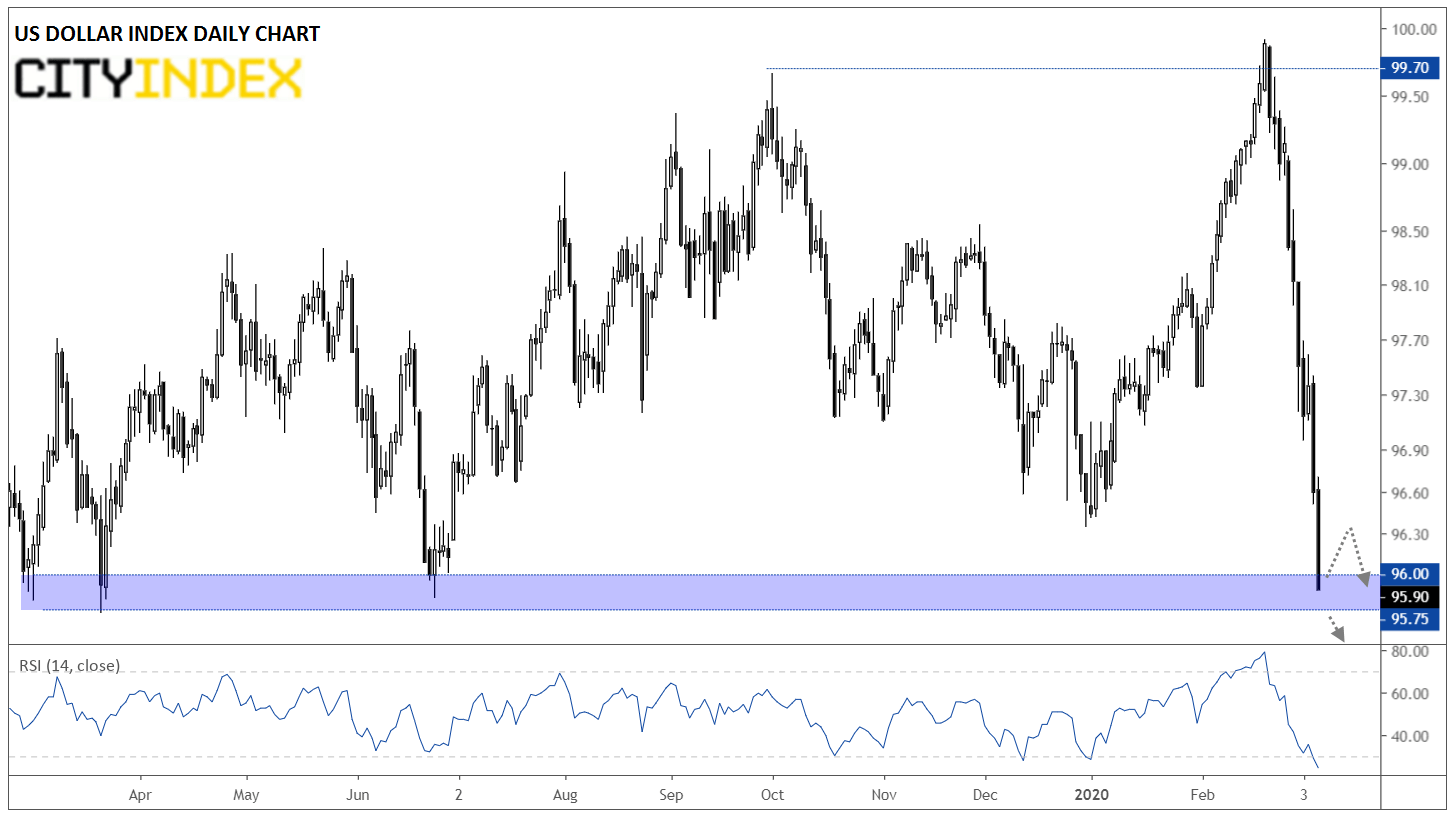
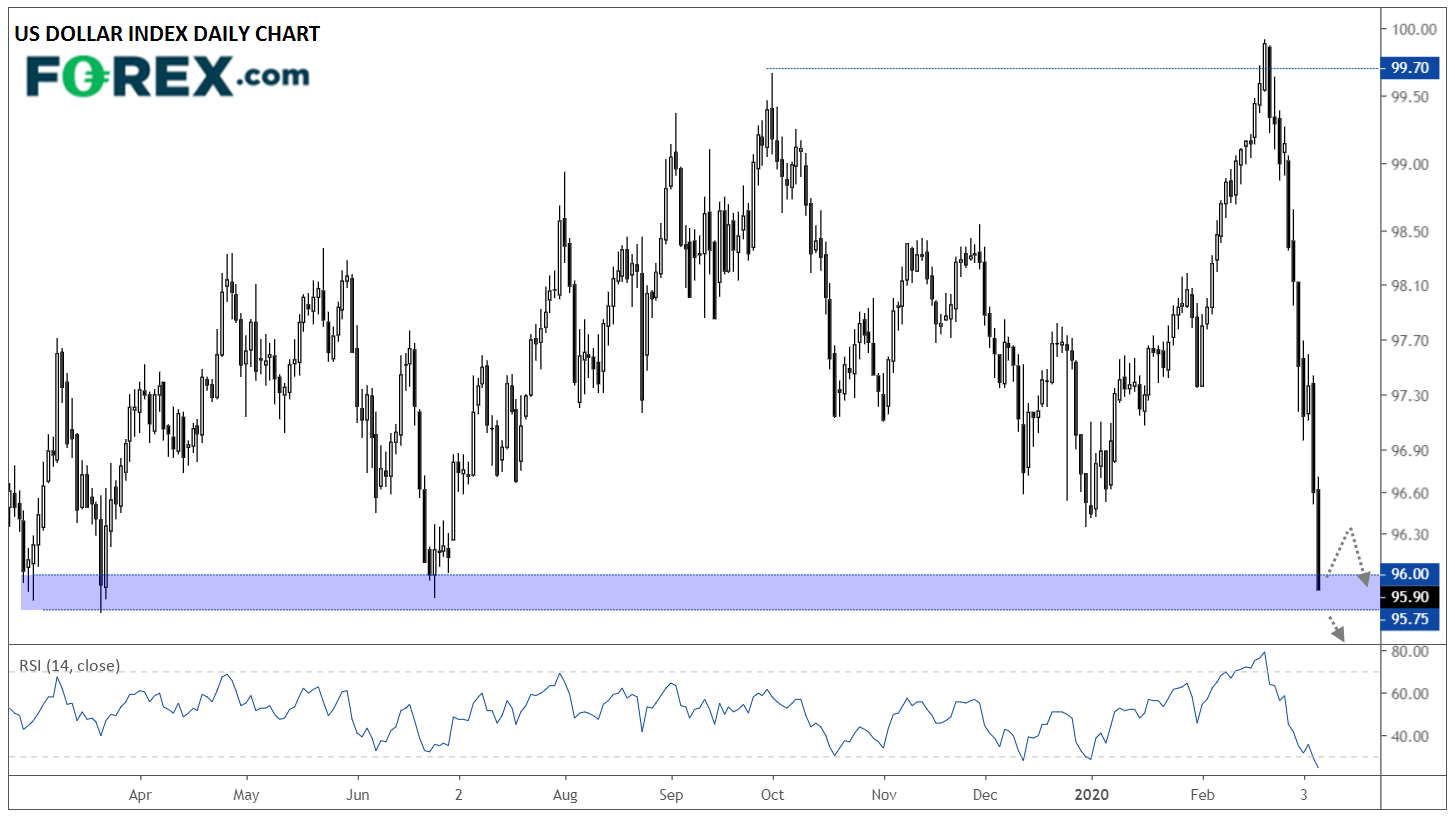
Meanwhile, the US dollar just can’t seem to get up off the proverbial mat. Looking at the widely-followed US dollar index, the world’s reserve currency has lost 4% of its value in a little over two weeks, and the currency is now testing a massive support level in the 95.75-96.00 range:
Source: TradingView, GAIN Capital
After such a dramatic drop, it’s no surprise that the RSI indicator for the dollar index is deeply oversold, raising the probability of a bounce off this key support zone. That said, the narrative of the US dollar as the “cleanest dirty shirt” amongst a slow-growth global economy has been ripped to shreds.
For years, buck bulls have pointed at the US dollar’s relative yield advantage over its zero- and negative-yielding rivals, but with the yield on the benchmark 2- and 10-year treasury bonds falling to just 0.49% and 0.76% respectively, that comparative advantage has all but disappeared. Indeed, traders are now pricing in at least another 50bps of interest rate cuts from the Federal Reserve at its meeting in the middle of the month, meaning that the central bank will likely lower its benchmark rate by a full 1% in just two weeks.
In the short term, today’s Non-Farm Payroll report may have some bearing on the greenback, with the potential for a stronger-than-expected report to lead to a recovery rally off support in the greenback (see our full NFP preview report). Nonetheless, the technical and fundamental momentum in the US dollar index remains strongly bearish, so traders may look at any short-term bounces as an opportunity to add new shorts at a more favorable price.
The high-volatility, alternating up-down rollercoaster in risk appetite that has characterized this week’s trade has seemingly broken on the final trading day of the week; that is, markets remain highly volatile, but we’re not seeing a recovery in risk assets after yesterday’s drubbing. Instead, equity indices across the globe are trading another 2-4% lower, while global bond yields collapse and gold tacks on another 1%.
Meanwhile, the US dollar just can’t seem to get up off the proverbial mat. Looking at the widely-followed US dollar index, the world’s reserve currency has lost 4% of its value in a little over two weeks, and the currency is now testing a massive support level in the 95.75-96.00 range:
Source: TradingView, GAIN Capital
After such a dramatic drop, it’s no surprise that the RSI indicator for the dollar index is deeply oversold, raising the probability of a bounce off this key support zone. That said, the narrative of the US dollar as the “cleanest dirty shirt” amongst a slow-growth global economy has been ripped to shreds.
For years, buck bulls have pointed at the US dollar’s relative yield advantage over its zero- and negative-yielding rivals, but with the yield on the benchmark 2- and 10-year treasury bonds falling to just 0.49% and 0.76% respectively, that comparative advantage has all but disappeared. Indeed, traders are now pricing in at least another 50bps of interest rate cuts from the Federal Reserve at its meeting in the middle of the month, meaning that the central bank will likely lower its benchmark rate by a full 1% in just two weeks.
In the short term, today’s Non-Farm Payroll report may have some bearing on the greenback, with the potential for a stronger-than-expected report to lead to a recovery rally off support in the greenback. Nonetheless, the technical and fundamental momentum in the US dollar index remains strongly bearish, so traders may look at any short-term bounces as an opportunity to add new shorts at a more favorable price.
Latest market news




The complete CFD trading experience
Award-winning platforms, competitive spreads, low commissions and dedicated support.
We live and breathe the markets and are dedicated to helping traders realise their ambitions as we continue to set the industry bar.
Economic calendar
Web Trader platform
Our sophisticated web-based platform is packed with features.
Related articles
EUR/USD weekly outlook: Oil, inflation and NFP in focus
After coming under significant pressure in recent weeks, the EUR/USD came off its lows to finish the week on a positive note on Friday, albeit with only a mild rebound. That was not enough to prevent the exchange rate falling for the third consecutive week, as the US dollar and bond yields rallied across the board.


EUR/USD Q4 2026 Outlook: Euro at a Crossroads as Fed, ECB Tighten 9 25 2026
EUR/USD enters Q4 at a pivotal inflection point as competing Fed-ECB policy paths and persistent inflation risks collide with major technical support.

USD/JPY Q4 2026 Outlook: Hawkish Fed Pricing Clashes With Intervention Risk
The year-end tug-of-war is clear: hawkish Fed pricing supports USD/JPY, while intervention risk limits the upside.

StoneX Europe Ltd may make third party material available on this website which may contain information included but not limited to the conditions of financial markets. The material is for information purposes only and does not contain, and should not be construed as containing, investment advice and/or investment recommendation and/or an investment research and/or an offer of or solicitation for any transactions in financial instruments; any decision to enter into a specific transaction shall be made by the client following an assessment by him/her of their situation.
StoneX Europe Ltd makes no representation or warranty and assumes no liability as to the accuracy or completeness of the information provided, nor any loss arising from any investment based on a recommendation, forecast or other information supplied. You should always seek independent advice as to your suitability to speculate in any related markets and your ability to assume the associated risks, if you are at all unsure. We are not under any obligation to update any such material. Any opinion made may be personal to the author and may not reflect the opinion of StoneX Europe Ltd.