



Lyft Q4 Results Preview
The pressure is on Lyft to speed up to profitability
Share this:

When:
Tuesday 11th February after US market close
Tuesday 11th February after US market close
Expectations:
- Losses $1.38 cents per share
- Revenue: +47% $984 billion vs 63% increase in Q3
Look back at Q3
Lyft’s Q3 revenue soared 63% to $955.6 million. Active riders climbed 28% yet it still posted a net loss of $463.5 million, significantly worse that the $249.2 million from the same period a year earlier. Yet despite eye watering losses Lyft remained confident, announcing it expected to be profitable (EBITDA) basis by Q4 2021.
Lyft’s Q3 revenue soared 63% to $955.6 million. Active riders climbed 28% yet it still posted a net loss of $463.5 million, significantly worse that the $249.2 million from the same period a year earlier. Yet despite eye watering losses Lyft remained confident, announcing it expected to be profitable (EBITDA) basis by Q4 2021.
Profitable?
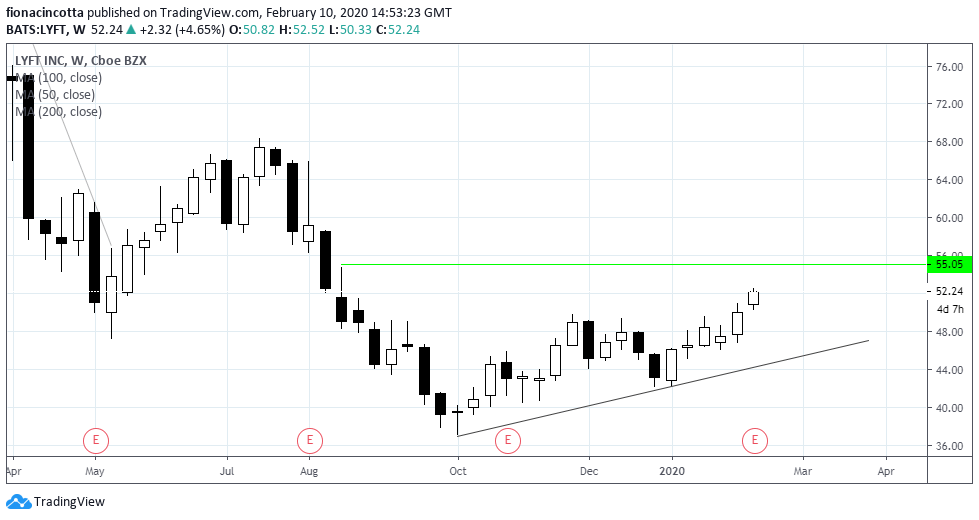
So far Lyft has failed to live up to its IPO hype. As the ride sharing business continues to lose money, traders will be paying particular attention to the firms progress towards profitability goals. Lyft has lost around 1/3 of its value since its IPO last March as management attempt to convince investors that it can keep driving growth whilst gradually shrinking losses. Lyft highlights modest price increases and focus on high value modes as means to arrive at profitability faster. Traders will scrutinize growth in the core ride hailing segment as well as segments that Lyft believes will drive profits.
So far Lyft has failed to live up to its IPO hype. As the ride sharing business continues to lose money, traders will be paying particular attention to the firms progress towards profitability goals. Lyft has lost around 1/3 of its value since its IPO last March as management attempt to convince investors that it can keep driving growth whilst gradually shrinking losses. Lyft highlights modest price increases and focus on high value modes as means to arrive at profitability faster. Traders will scrutinize growth in the core ride hailing segment as well as segments that Lyft believes will drive profits.
Restructuring
Days ago, Lyft announced that it was laying off around 90 worker (2% of its workforce) as it restructures its sales and marketing team, in order to reach its 2020 business goals. Across 2019 Lyft underwent several rounds of job cuts, slimming down the business. Traders will be looking for more details on the restructuring and what it means for profitability.
Days ago, Lyft announced that it was laying off around 90 worker (2% of its workforce) as it restructures its sales and marketing team, in order to reach its 2020 business goals. Across 2019 Lyft underwent several rounds of job cuts, slimming down the business. Traders will be looking for more details on the restructuring and what it means for profitability.
Lyft vs Uber
Comparisons will of course be drawn between Uber and Lyft. Last week Uber said that it expected to report adjusted profit in Q4 2020, ahead of its previous projection following a narrower than expected loss in Q4. The share price soared 10%.
So the pressure is on Lyft to follow Uber’s path to quicker profitability. Failure to do so could hit Lyft’s share price.
Regulation
Lyft, like Uber, must address regulatory issues. California recently enacted a new law which is currently being challenged, which raises questions over the standards at which a worker is considered an employee and is entitled to sick pay and benefits. If this results in a change to the Lyft business model consumers could face 100% of the bill increase. Traders will be keen to hear Lyft elaborate on the potential impact to the business. A cautious tone could send the share price lower.
When:
Tuesday 11th February after US market close
Tuesday 11th February after US market close
Expectations:
- Losses $1.38 cents per share
- Revenue: +47% $984 billion vs 63% increase in Q3
Look back at Q3
Lyft’s Q3 revenue soared 63% to $955.6 million. Active riders climbed 28% yet it still posted a net loss of $463.5 million, significantly worse that the $249.2 million from the same period a year earlier. Yet despite eye watering losses Lyft remained confident, announcing it expected to be profitable (EBITDA) basis by Q4 2021.
Lyft’s Q3 revenue soared 63% to $955.6 million. Active riders climbed 28% yet it still posted a net loss of $463.5 million, significantly worse that the $249.2 million from the same period a year earlier. Yet despite eye watering losses Lyft remained confident, announcing it expected to be profitable (EBITDA) basis by Q4 2021.
Profitable?
So far Lyft has failed to live up to its IPO hype. As the ride sharing business continues to lose money, traders will be paying particular attention to the firms progress towards profitability goals. Lyft has lost around 1/3 of its value since its IPO last March as management attempt to convince investors that it can keep driving growth whilst gradually shrinking losses. Lyft highlights modest price increases and focus on high value modes as means to arrive at profitability faster. Traders will scrutinize growth in the core ride hailing segment as well as segments that Lyft believes will drive profits.
So far Lyft has failed to live up to its IPO hype. As the ride sharing business continues to lose money, traders will be paying particular attention to the firms progress towards profitability goals. Lyft has lost around 1/3 of its value since its IPO last March as management attempt to convince investors that it can keep driving growth whilst gradually shrinking losses. Lyft highlights modest price increases and focus on high value modes as means to arrive at profitability faster. Traders will scrutinize growth in the core ride hailing segment as well as segments that Lyft believes will drive profits.
Restructuring
Days ago, Lyft announced that it was laying off around 90 worker (2% of its workforce) as it restructures its sales and marketing team, in order to reach its 2020 business goals. Across 2019 Lyft underwent several rounds of job cuts, slimming down the business. Traders will be looking for more details on the restructuring and what it means for profitability.
Days ago, Lyft announced that it was laying off around 90 worker (2% of its workforce) as it restructures its sales and marketing team, in order to reach its 2020 business goals. Across 2019 Lyft underwent several rounds of job cuts, slimming down the business. Traders will be looking for more details on the restructuring and what it means for profitability.
Lyft vs Uber
Comparisons will of course be drawn between Uber and Lyft. Last week Uber said that it expected to report adjusted profit in Q4 2020, ahead of its previous projection following a narrower than expected loss in Q4. The share price soared 10%.
So the pressure is on Lyft to follow Uber’s path to quicker profitability. Failure to do so could hit Lyft’s share price.
Regulation
Lyft, like Uber, must address regulatory issues. California recently enacted a new law which is currently being challenged, which raises questions over the standards at which a worker is considered an employee and is entitled to sick pay and benefits. If this results in a change to the Lyft business model consumers could face 100% of the bill increase. Traders will be keen to hear Lyft elaborate on the potential impact to the business. A cautious tone could send the share price lower.
Related tags:
Latest market news




The complete CFD trading experience
Award-winning platforms, competitive spreads, low commissions and dedicated support.
We live and breathe the markets and are dedicated to helping traders realise their ambitions as we continue to set the industry bar.
Economic calendar
Web Trader platform
Our sophisticated web-based platform is packed with features.
Related articles

Nikkei threatens breakout as tech rebound broadens
Breakouts across the SOX and Nasdaq are being matched by rebounds across Asia, with the Nikkei now threatening to join the move.

S&P 500, Nasdaq 100 Forecast for the Week Ahead
A hawkish Fed and 10-Year Notes on the verge of a push above 5%, yet stocks have so far shrugged off that fear. But can it continue?


Hang Seng Tech rout nears make-or-break zone
The technical damage is clear, but with Hang Seng Tech now deeply stretched and approaching major support, the risk-reward is becoming more two-sided.
StoneX Europe Ltd may make third party material available on this website which may contain information included but not limited to the conditions of financial markets. The material is for information purposes only and does not contain, and should not be construed as containing, investment advice and/or investment recommendation and/or an investment research and/or an offer of or solicitation for any transactions in financial instruments; any decision to enter into a specific transaction shall be made by the client following an assessment by him/her of their situation.
StoneX Europe Ltd makes no representation or warranty and assumes no liability as to the accuracy or completeness of the information provided, nor any loss arising from any investment based on a recommendation, forecast or other information supplied. You should always seek independent advice as to your suitability to speculate in any related markets and your ability to assume the associated risks, if you are at all unsure. We are not under any obligation to update any such material. Any opinion made may be personal to the author and may not reflect the opinion of StoneX Europe Ltd.