



NFP preview Wages in focus as rate cut looms
Wages have missed the mark for the past three months, and the last 5 out of 7 months. If the trend continues, we could have another disappointing wage growth in June, too.
Share this:

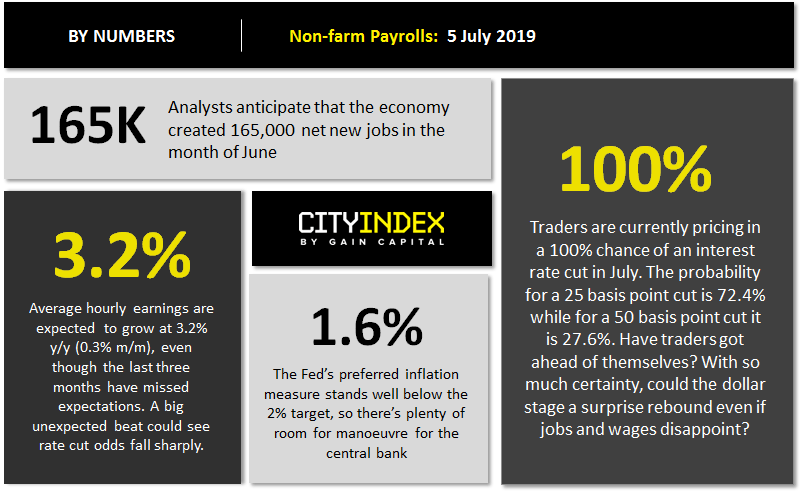
With the US celebrating Independence Day, many investors might be away for a long weekend break. This increases the potential for a sharp spike when the monthly non-farm payrolls (NFP) report is published on Friday, as volumes could be lower than on a normal NFP day. This would especially be the case in the event of a major surprise. The key numbers traders will be watching in tomorrow’s NFP release are as follows:
Source: City Index
But will we get a surprise and if so in which direction?
Well, the answer is not a simple one as investors’ focus is clearly on wages rather than just the employment change. Indeed, while some traders love to watch the month-to-month fluctuations in the aggregate number of jobs created, most of those fluctuations are mere noise. The 3-month moving average of US job creation has been remarkably steady in the 150k-250k range since 2015! This increases the focus on the wages aspect of the report, especially as everyone is hyper-focused on the monetary policy stance of the Federal Reserve and that of other major central banks, who in turn monitor changes in actual and inflation expectations like hawks. Logically, it follows that any data around inflation will be critically important for global markets. And when it comes to inflation data, one of the best leading indicators is employee wages.
So, we have to take into account both jobs and wages when determining whether the data has surprised or not.
Wages have recently disappointed more often than not
Unfortunately it is almost impossible to predict the change in wages, so it is just a case of wait and see. But the recent trend has been bad: Wages have missed the mark for the past three months, and the last 5 out of 7 months. If the trend continues, we could have another disappointing wage growth in June, too.
NFP Forecast: We could see disappointment
With regards to jobs, we can look at a few usual pre-NFP leading indicators to come up with a forecast of some sort.
- One of the key pre-NFP indicators is the change in the employment component of the services sector PMI. According to the Institute for Supply Management (ISM), economic activity in the sector fell to its lowest level in almost 2 years in June. This helped to reinforce market expectations of a rate cut by the Federal Reserve later this month. Although the sub-indices for prices and backlog of orders rose, new orders and more crucially employment fell with the latter sliding by 3.1 percentage points.
- This comes on the back of a disappointing payrolls data from ADP report (which excludes the farming industry and government) showing a 102K increase in private payrolls compared to 140K expected by analysts.
- However, the employment component of the ISM manufacturing PMI came in a touch higher than the previous month at 54.5 versus 53.7 last
- Meanwhile, the 4-week moving average of initial unemployment claims rose slightly further in June to just above 222K from 215K in May.
With just one indicator (employment sub-index of manufacturing PMI) showing a slight improvement while all the other pre-NFP indicators pointing to deteriorating conditions in employment, there’s an increased chance that jobs growth will disappoint expectations. That said, the dollar could still push higher should we have a much stronger wages figure — unlikely in our view. So, we are leaning towards the lower end of average expectations based on the above pre-NFP leading indicators.
NFP Trade Ideas
See possible wage and job creation figures, along with the potential bias for the USD dollar below:
| Earnings < 0.1% | Earnings = 0.2% | Earnings > 0.3% | |
| < 150k Jobs | Bearish USD | Slightly Bearish USD | Slightly Bullish USD |
| 150k-200k Jobs | Bearish USD | Neutral USD | Bullish USD |
| > 200k Jobs | Slightly Bearish USD | Slightly Bullish USD | Strongly Bullish USD |
In the event the jobs and the wage data beat expectations, then we would favour looking for short-term bullish setups on the dollar against the likes of the British pound given the ongoing Brexit uncertainty in the UK and the fact data has taken a sharp downturn here. But if the jobs data misses expectations, then we would favour looking for bearish setups on the dollar against a currency like the Aussie dollar, as it could serve as a catalyst for more “risk on” sentiment on the theory that the Fed may have to cut interest rates later this month.
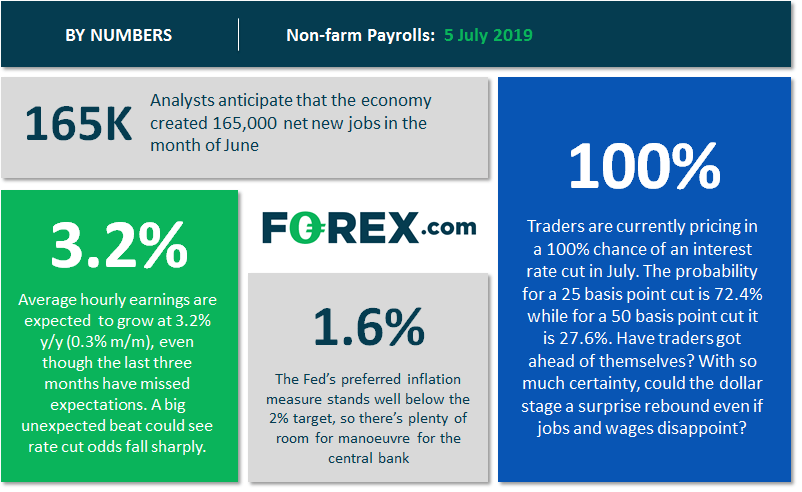
With the US celebrating Independence Day, many investors might be away for a long weekend break. This increases the potential for a sharp spike when the monthly non-farm payrolls (NFP) report is published on Friday, as volumes could be lower than on a normal NFP day. This would especially be the case in the event of a major surprise. The key numbers traders will be watching in tomorrow’s NFP release are as follows:
Source: FOREX.com
But will we get a surprise and if so in which direction?
Well, the answer is not a simple one as investors’ focus is clearly on wages rather than just the employment change. Indeed, while some traders love to watch the month-to-month fluctuations in the aggregate number of jobs created, most of those fluctuations are mere noise. The 3-month moving average of US job creation has been remarkably steady in the 150k-250k range since 2015! This increases the focus on the wages aspect of the report, especially as everyone is hyper-focused on the monetary policy stance of the Federal Reserve and that of other major central banks, who in turn monitor changes in actual and inflation expectations like hawks. Logically, it follows that any data around inflation will be critically important for global markets. And when it comes to inflation data, one of the best leading indicators is employee wages.
So, we have to take into account both jobs and wages when determining whether the data has surprised or not.
Wages have recently disappointed more often than not
Unfortunately it is almost impossible to predict the change in wages, so it is just a case of wait and see. But the recent trend has been bad: Wages have missed the mark for the past three months, and the last 5 out of 7 months. If the trend continues, we could have another disappointing wage growth in June, too.
NFP Forecast: We could see disappointment
With regards to jobs, we can look at a few usual pre-NFP leading indicators to come up with a forecast of some sort.
- One of the key pre-NFP indicators is the change in the employment component of the services sector PMI. According to the Institute for Supply Management (ISM), economic activity in the sector fell to its lowest level in almost 2 years in June. This helped to reinforce market expectations of a rate cut by the Federal Reserve later this month. Although the sub-indices for prices and backlog of orders rose, new orders and more crucially employment fell with the latter sliding by 3.1 percentage points.
- This comes on the back of a disappointing payrolls data from ADP report (which excludes the farming industry and government) showing a 102K increase in private payrolls compared to 140K expected by analysts.
- However, the employment component of the ISM manufacturing PMI came in a touch higher than the previous month at 54.5 versus 53.7 last
- Meanwhile, the 4-week moving average of initial unemployment claims rose slightly further in June to just above 222K from 215K in May.
With just one indicator (employment sub-index of manufacturing PMI) showing a slight improvement while all the other pre-NFP indicators pointing to deteriorating conditions in employment, there’s an increased chance that jobs growth will disappoint expectations. That said, the dollar could still push higher should we have a much stronger wages figure — unlikely in our view. So, we are leaning towards the lower end of average expectations based on the above pre-NFP leading indicators.
NFP Trade Ideas
See possible wage and job creation figures, along with the potential bias for the USD dollar below:
| Earnings < 0.1% | Earnings = 0.2% | Earnings > 0.3% | |
| < 150k Jobs | Bearish USD | Slightly Bearish USD | Slightly Bullish USD |
| 150k-200k Jobs | Bearish USD | Neutral USD | Bullish USD |
| > 200k Jobs | Slightly Bearish USD | Slightly Bullish USD | Strongly Bullish USD |
In the event the jobs and the wage data beat expectations, then we would favour looking for short-term bullish setups on the dollar against the likes of the British pound given the ongoing Brexit uncertainty in the UK and the fact data has taken a sharp downturn here. But if the jobs data misses expectations, then we would favour looking for bearish setups on the dollar against a currency like the Aussie dollar, as it could serve as a catalyst for more “risk on” sentiment on the theory that the Fed may have to cut interest rates later this month.


The complete CFD trading experience
Award-winning platforms, competitive spreads, low commissions and dedicated support.
We live and breathe the markets and are dedicated to helping traders realise their ambitions as we continue to set the industry bar.
Economic calendar
Web Trader platform
Our sophisticated web-based platform is packed with features.
Related articles

Euro Short-term Outlook: EUR/USD Selloff Nears Critical Yearly Support 9 23 2026
Euro has fallen seven of the past nine sessions, with stretched momentum raising the stakes as EUR/USD closes in on a major inflection zone.


GBP/USD forecast: US dollar surges as bonds implode
The US dollar continued to press higher deep into the European session, supported by the slump in the bond markets as yields broke out across the curve. Following the recent hawkish Fed rate hike, yield spreads between the US and the rest of the world has continually increased, and that motion continued today, helped in part by some forecast-beating US macro data and hawkish Fed commentary.


Australian Dollar Technical Outlook: AUD/USD Breakdown Threatens Deeper Correction 9 23 2026
AUD/USD remains under pressure after breaking key trend support, with the latest decline putting the focus on the next major downside pivot.
StoneX Europe Ltd may make third party material available on this website which may contain information included but not limited to the conditions of financial markets. The material is for information purposes only and does not contain, and should not be construed as containing, investment advice and/or investment recommendation and/or an investment research and/or an offer of or solicitation for any transactions in financial instruments; any decision to enter into a specific transaction shall be made by the client following an assessment by him/her of their situation.
StoneX Europe Ltd makes no representation or warranty and assumes no liability as to the accuracy or completeness of the information provided, nor any loss arising from any investment based on a recommendation, forecast or other information supplied. You should always seek independent advice as to your suitability to speculate in any related markets and your ability to assume the associated risks, if you are at all unsure. We are not under any obligation to update any such material. Any opinion made may be personal to the author and may not reflect the opinion of StoneX Europe Ltd.