




Recent economic data shows its the US consumer vs the Fed
Either the consumer has to cut back expectations of higher inflation or the Fed has to begin to offer signs of tapering monetary policy.
Share this:

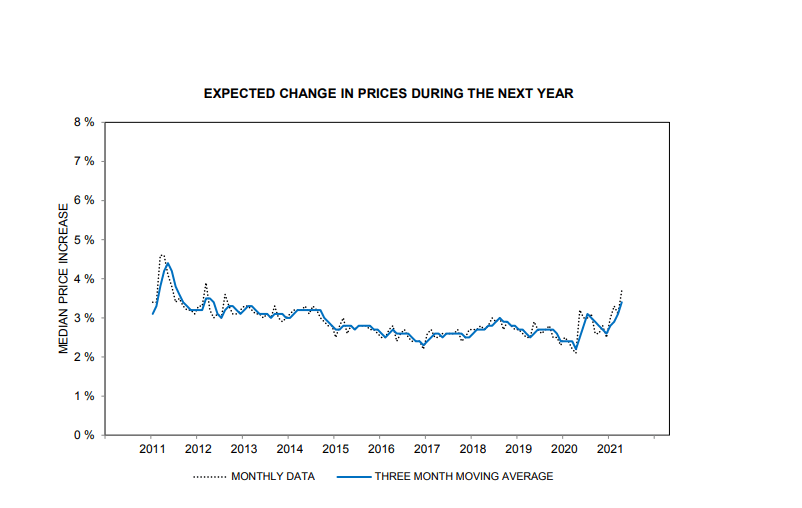
The University of Michigan conducts a poll twice a month on consumer sentiment, which includes both a current sentiment and an expectations sentiment. The Preliminary numbers are released in the middle of the month and the final results are released at the end of the month. Aside from providing insight as to how consumers are feeling about the economy, it also provides inflation expectations for 1 year and 5 years. The consumer sentiment numbers missed expectations; however, they were still the highest they have been since the pandemic began. What is of more interest, though, is the Inflation expectations data. The 1-year inflation expectation was 3.7% vs 3.2% expected and 2.7% for March. This is the highest reading since 2012!
Source: University of Michigan
As evidenced, the stock market is forward looking, meaning they price in future earnings of companies. Today, the S&P 500, the Nasdaq 100, and the Dow Jones have all made all-time new highs. The VIX, which measures volatility of the S&P 500, is trading at pre-pandemic levels, and below the “line in the sand” 20.00 level, near 16.42.
Source: Tradingview, CBOE, City Index
When one looks at recent activity in meme stocks such as GME and AME, the recent fund blowup by Archegos (which not only blew up the fund but cost $10 billion in losses to banks), and recent activity in volatile instruments that are traded on exchanges such as Coinbase, its easy to tell the markets are awash with cash. Why isn’t the Fed pumping the brakes?
Fed Chairman Powell was upbeat at his interview on “60 Minutes” earlier in the week, yet he still uses words such as transitory and unsustainable to describe inflation expectations and bond yields. But the consumer isn’t believing him. With stimulus checks in hand, retail sales skyrocketing, and non-farm payrolls approaching 1 million for the month of March, why wouldn’t consumers expect inflation to be much higher in 1 year? That is the multitrillion dollar question!
Everything you need to know about the Federal Reserve
There are 2 sayings that are battling it out at the moment. One is “Don’t fight the Fed” and the other is “Never underestimate the US consumer”. Something has to give. Either the consumer has to cut back expectations of higher inflation or the Fed has to begin to offer signs of tapering monetary policy. The winner of this battle is the one that will determine the next direction for monetary policy!
Learn more about forex trading opportunities.
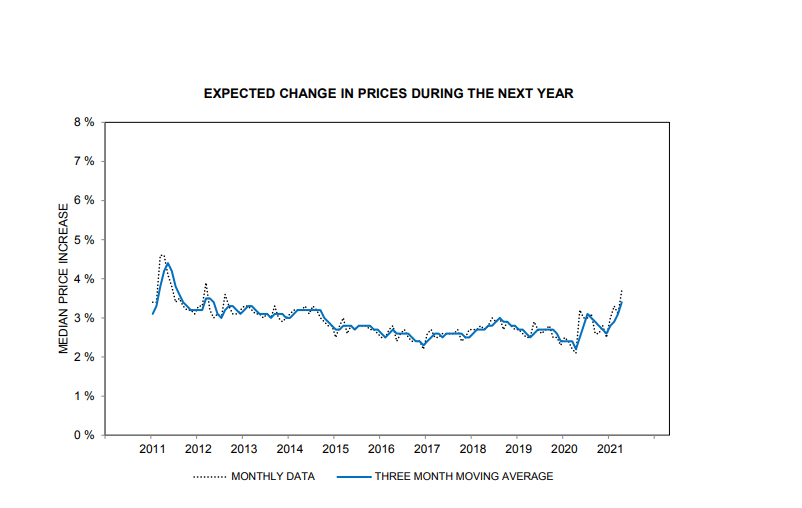
The University of Michigan conducts a poll twice a month on consumer sentiment, which includes both a current sentiment and an expectations sentiment. The Preliminary numbers are released in the middle of the month and the final results are released at the end of the month. Aside from providing insight as to how consumers are feeling about the economy, it also provides inflation expectations for 1 year and 5 years. The consumer sentiment numbers missed expectations; however, they were still the highest they have been since the pandemic began. What is of more interest, though, is the Inflation expectations data. The 1-year inflation expectation was 3.7% vs 3.2% expected and 2.7% for March. This is the highest reading since 2012!
Source: University of Michigan
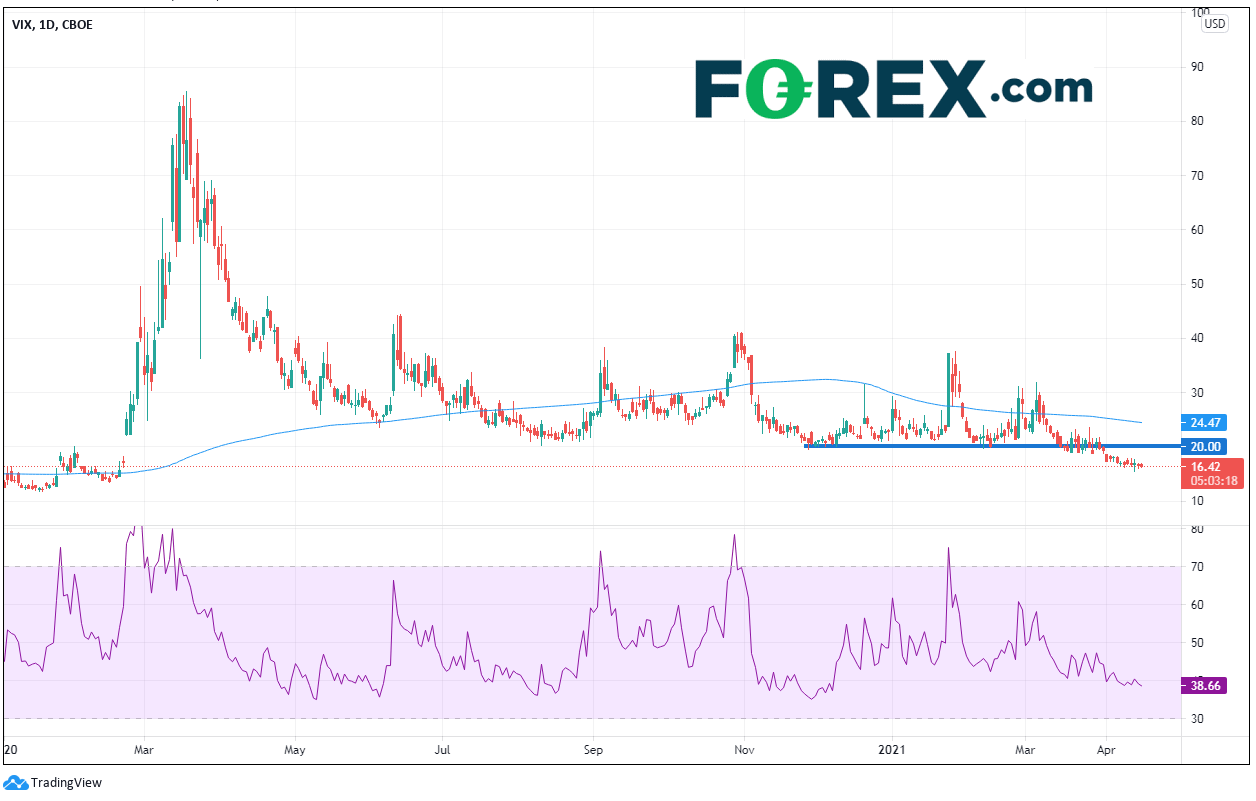
As evidenced, the stock market is forward looking, meaning they price in future earnings of companies. Today, the S&P 500, the Nasdaq 100, and the Dow Jones have all made all-time new highs. The VIX, which measures volatility of the S&P 500, is trading at pre-pandemic levels, and below the “line in the sand” 20.00 level, near 16.42.
Source: Tradingview, CBOE, FOREX.com
When one looks at recent activity in meme stocks such as GME and AME, the recent fund blowup by Archegos (which not only blew up the fund but cost $10 billion in losses to banks), and recent activity in volatile instruments that are traded on exchanges such as Coinbase, its easy to tell the markets are awash with cash. Why isn’t the Fed pumping the brakes?
Fed Chairman Powell was upbeat at his interview on “60 Minutes” earlier in the week, yet he still uses words such as transitory and unsustainable to describe inflation expectations and bond yields. But the consumer isn’t believing him. With stimulus checks in hand, retail sales skyrocketing, and non-farm payrolls approaching 1 million for the month of March, why wouldn’t consumers expect inflation to be much higher in 1 year? That is the multitrillion dollar question!
There are 2 sayings that are battling it out at the moment. One is “Don’t fight the Fed” and the other is “Never underestimate the US consumer”. Something has to give. Either the consumer has to cut back expectations of higher inflation or the Fed has to begin to offer signs of tapering monetary policy. The winner of this battle is the one that will determine the next direction for monetary policy!
Learn more about forex trading opportunities.
Related tags:




The complete CFD trading experience
Award-winning platforms, competitive spreads, low commissions and dedicated support.
We live and breathe the markets and are dedicated to helping traders realise their ambitions as we continue to set the industry bar.
Economic calendar
Web Trader platform
Our sophisticated web-based platform is packed with features.
Related articles

USD/JPY Q4 2026 Outlook: Hawkish Fed Pricing Clashes With Intervention Risk
The year-end tug-of-war is clear: hawkish Fed pricing supports USD/JPY, while intervention risk limits the upside.


USD/CAD and USD/MXN Q4 2026 Outlook: Will the U.S. Dollar Dominate North America Again?
The final stretch of 2026 is approaching, and North America's major currencies have begun to show a shift in the strength dynamics seen earlier in the year. New expectations of a more aggressive monetary policy stance, particularly in the United States, could be significantly reshaping the outlook for the region. At the same time, this backdrop, combined with potential trade tensions across North America, may become one of the most important drivers of currency performance in the months ahead.


Gold Analysis: Rising Yields and Dollar Strength Weigh on XAU/USD
The trading week continues, and for now gold remains under notable pressure in the short term. This can be seen in the performance of XAU/USD over the last three trading sessions, where the metal has declined by more than 2.00%, bringing a bearish bias back into focus after it had lost momentum in recent weeks.
StoneX Europe Ltd may make third party material available on this website which may contain information included but not limited to the conditions of financial markets. The material is for information purposes only and does not contain, and should not be construed as containing, investment advice and/or investment recommendation and/or an investment research and/or an offer of or solicitation for any transactions in financial instruments; any decision to enter into a specific transaction shall be made by the client following an assessment by him/her of their situation.
StoneX Europe Ltd makes no representation or warranty and assumes no liability as to the accuracy or completeness of the information provided, nor any loss arising from any investment based on a recommendation, forecast or other information supplied. You should always seek independent advice as to your suitability to speculate in any related markets and your ability to assume the associated risks, if you are at all unsure. We are not under any obligation to update any such material. Any opinion made may be personal to the author and may not reflect the opinion of StoneX Europe Ltd.