




Soured sentiment keeps AUD/JPY on the ropes
Concerns that the US is headed for stagflation weighed on sentiment yesterday, which has placed AUD/JPY back onto our bearish watchlist.
Share this:

A combination of weak earnings and housing data fanned concerns of stagflation in the world’s largest economy. Building permits – a leading indicator of economic health – fell -3.2% m/m, which was its weakest print since September. And to add to the fears was Target’s (TGT) profit warning which resulted in the stock plunging -25%. The Nasdaq fell over 5% for the second time since the pandemic and Wall Street was broadly lower.
Wage growth miss overshadows record unemployment for Australia
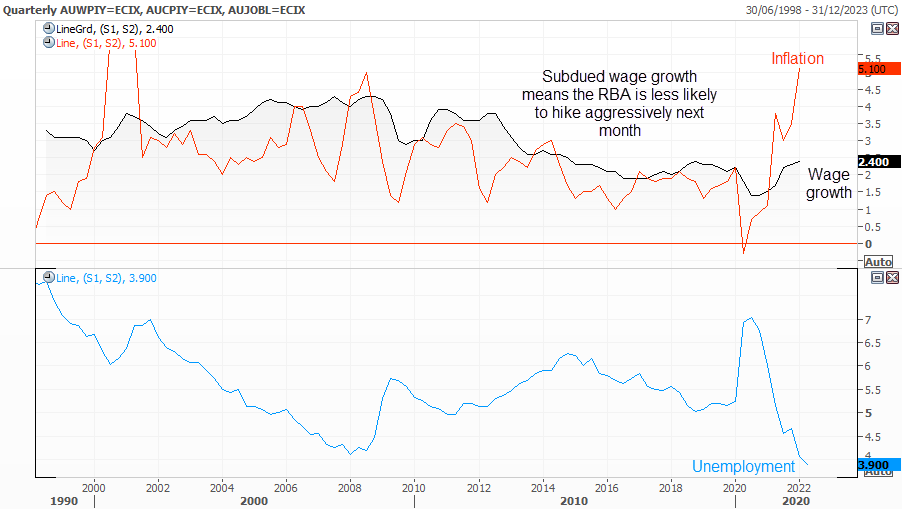
And this has put AUD/JPY back onto our radar. If we go back a couple of days there was hope that the RBA would hike by 40-bps. Yet softer-than-expected wage growth means this is now looking less likely and helps with potential bearish setups on AUD/JPY.
Yesterday’s wage data – which missed the mark – also removed some of the sparkle from today’s employment report. Which is a shame because unemployment hit a record low of 3.9%, even if headline employment underwhelmed. But ultimately, we do not think today’ report moves the needle much for the RBA.
It is wage growth that now needs to excel to convince the RBA that inflation will remain ‘sustainable’ and force them to hike more aggressively. Yesterday’s wage data miss means they’re more likely to raise by 25 bps, and not the 40-bps traders had hoped for.
What are economic indicators?
Implied volatility remains elevated for AUD pairs
On the 6th of May we said to “keep an eye on AUD/JPY with sentiment on the back ropes” ahead of its next leg lower. And it didn’t disappoint. The currency cross has fallen over -8.8% since the April high and over -7% since the May high. 1-week implied volatility (IV) for the Australian dollar has risen above the 1-month IV which shows investors remain. And with sentiment once again on the back ropes it remains a cross to watch for further declines.
On the 6th of May we said to “keep an eye on AUD/JPY with sentiment on the back ropes” ahead of its next leg lower. And it didn’t disappoint. The currency cross has fallen over -8.8% since the April high and over -7% since the May high. 1-week implied volatility (IV) for the Australian dollar has risen above the 1-month IV which shows investors remain. And with sentiment once again on the back ropes it remains a cross to watch for further declines.
AUD/JPY daily chart:
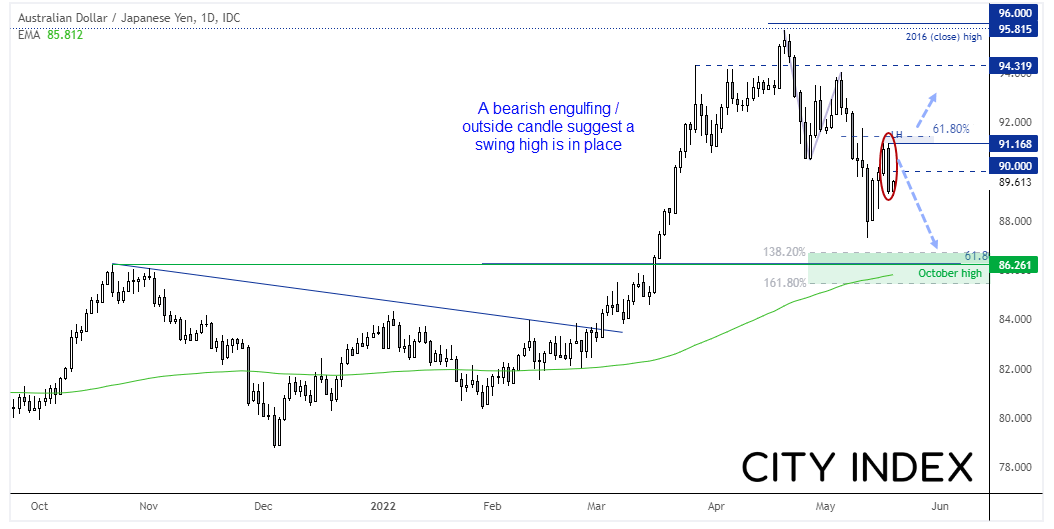
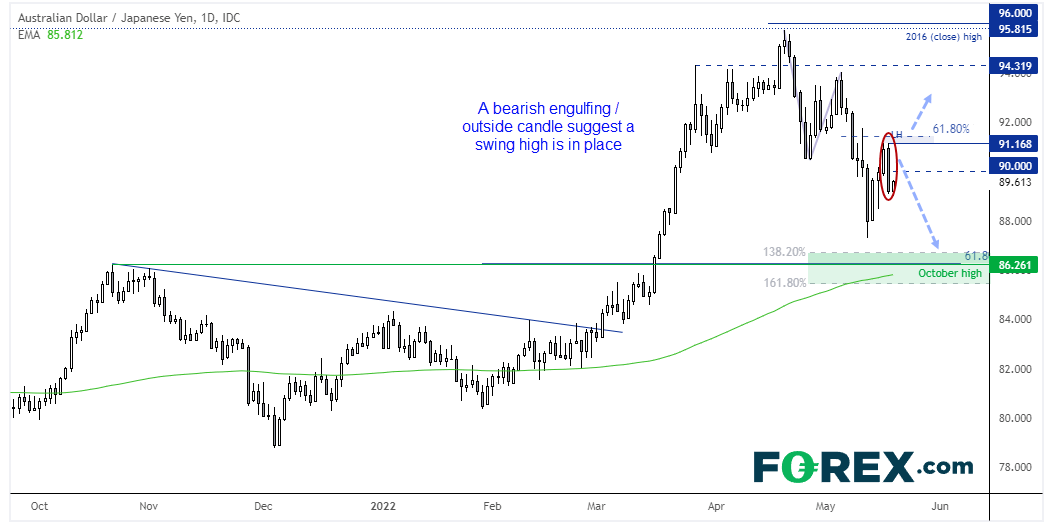
We can see on the daily chart that AUD/JPY has seen a 3-wave move which began just beneath the 2016 high / 96.00. Yesterday produced a bearish engulfing (and outside) day to suggest a swing high is now in place, just below a 61.8% Fibonacci retracement level.
A wider trade deficit from Japan helped the yen to catch a bid today, so prices are now retracing within yesterday’s candle. Our bias remains bearish beneath yesterday’s high so looking to fade into such moves to increase the potential reward to risk ratio. Perhaps we’ll see a reversal pattern on an intraday timeframe around 90 which we could consider. At which point the initial target would be 88 (just above last week’s low) then down to the 88.50 area, near the October high, 200-day eMA and Fibonacci projection levels.
How to trade with City Index
You can easily trade with City Index by using these four easy steps:
- Open an account, or log in if you’re already a customer
• Open an account in the UK
• Open an account in Australia
• Open an account in Singapore
- Search for the company you want to trade in our award-winning platform
- Choose your position and size, and your stop and limit levels
- Place the trade
How to trade with FOREX.com
Follow these easy steps to start trading with FOREX.com today:
- Open a Forex.com account, or log in if you’re already a customer.
- Search for the pair you want to trade in our award-winning platform.
- Choose your position and size, and your stop and limit levels.
- Place the trade.
Latest market news




The complete CFD trading experience
Award-winning platforms, competitive spreads, low commissions and dedicated support.
We live and breathe the markets and are dedicated to helping traders realise their ambitions as we continue to set the industry bar.
Economic calendar
Web Trader platform
Our sophisticated web-based platform is packed with features.
Related articles
S&P 500, Nasdaq, Dow Forecast: Wall Street Split Widens Into Month-End 9 26 2026
Nasdaq strength contrasts with mounting Dow pressure as rising Treasury yields raise the stakes for stocks heading into the monthly close.

EUR/USD weekly outlook: Oil, inflation and NFP in focus
After coming under significant pressure in recent weeks, the EUR/USD came off its lows to finish the week on a positive note on Friday, albeit with only a mild rebound. That was not enough to prevent the exchange rate falling for the third consecutive week, as the US dollar and bond yields rallied across the board.


USD/JPY Weekly Outlook: Payrolls loom as US rates remain the dominant driver
Strong US growth and hawkish Fed pricing continue to support USD/JPY, while intervention risk appears to be kicking in at lower levels

StoneX Europe Ltd may make third party material available on this website which may contain information included but not limited to the conditions of financial markets. The material is for information purposes only and does not contain, and should not be construed as containing, investment advice and/or investment recommendation and/or an investment research and/or an offer of or solicitation for any transactions in financial instruments; any decision to enter into a specific transaction shall be made by the client following an assessment by him/her of their situation.
StoneX Europe Ltd makes no representation or warranty and assumes no liability as to the accuracy or completeness of the information provided, nor any loss arising from any investment based on a recommendation, forecast or other information supplied. You should always seek independent advice as to your suitability to speculate in any related markets and your ability to assume the associated risks, if you are at all unsure. We are not under any obligation to update any such material. Any opinion made may be personal to the author and may not reflect the opinion of StoneX Europe Ltd.