






The Week Head CB Meetings and NFP
RBA and BOC hold meeting, AU release GDP and NFP is on Friday for US and Canada
Share this:

Monday 2nd September
- AU manufacturing PMI, company profits, business inventories
- NZ trade balance
- JP business capex, manufacturing PMI
- CN manufacturing PMI
- EZ, FR, DE, UK manufacturing PMI (final reads)
Tuesday 3nd September
- South Korean CPI and GDP
- AU current account, retail sales, RBA cash rate decision
- UK construction PMI
- EZ producer prices
- CA manufacturing PMI
- US ISM Manufacturing
Wednesday 4nd September
- AU services PMI, GDP
- CN Services PMI
- EZ, FR, DE, UK services PMI, EZ retail sales
- CA trade balance, BOC cash rate decision
Thursday 5nd September
- AU trade balance
- DE industrial orders
- US ADP employment/jobless claims, services PMI, ISM non-manufacturing PMI
Friday 6nd September
- AU construction
- JP household spending, leading/coincident indicator
- DE industrial output
- EZ employment (final), GDP (revised)
- US Nonfarm payroll
- CA employment
Chinese Manufacturing PMI: USD/CNH, AUD, NZD and JPY pairs, Copper, China A50, Hang Seng
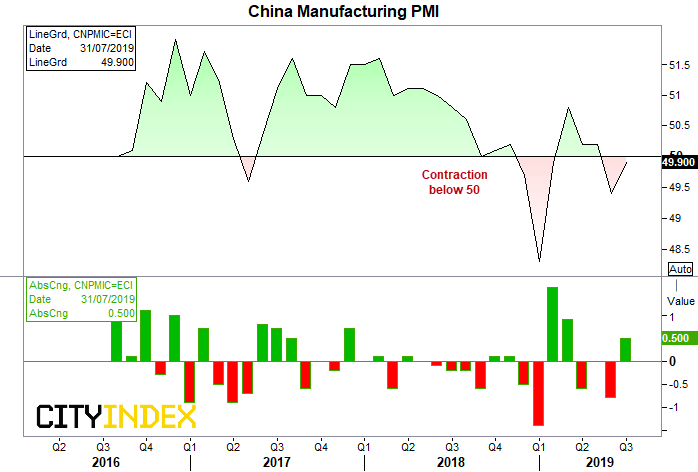
China’s manufacturing sector has contracted two consecutive months, adding to the chorus of calls for a global slowdown. That said, the rate of contraction slowed in July, and if PMI is to climb back above 50, we’d expect a bout of risk-on for the session. AUD pairs are particularly sensitive to the data as they’re key trade partners, but Chinese indices and copper also make decent markets to monitor around the data’s release.
RBA Cash Rate Decision and Q3 GDP: AUD pairs, ASX200
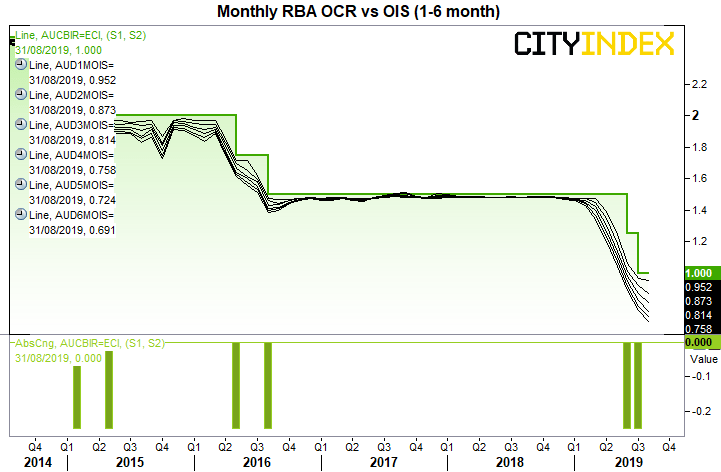
At time of writing, the RBA rate indicator expects just an 11% chance of a 25 cut on Tuesday. This moves to 74% for a cut in October and a 115% cut (ie fully priced in) for November. This is no major surprise, given they cut by 25 bps in June and July and their August minutes provided a ‘steady as she goes’ approach, whilst emphasising external risks such as the trade war. Moreover, GDP data is out on Wednesday and they’d likely want this data on hand before easing further. Yet this still could be a high volatility event if there is a notable shift in tone with their statement.
As for GDP, RBA expect growth to average around 2.5% this year. With Q1 GDP hitting 1.8%, it’s not off to a great start and, with ANZ expecting it to drop to 1.1% in Q2 and the consensus at 1.4%, economists seem doubtful that RBA are on track to achieve their 2019 growth target. Expect AUD to remain under pressure and bring forward easing expectation should it hit 1.3% YoY or less.
BoC Rate Decision
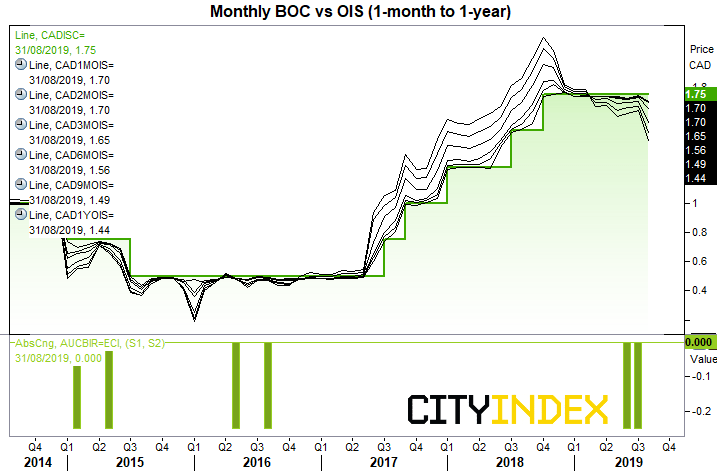
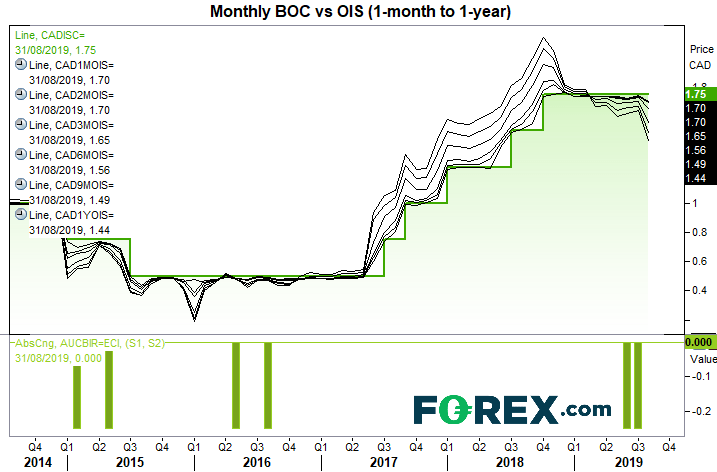
It’s unlikely BoC will change policy next week, given inflation remains around 2% has not ‘dipped’ as expected. Moreover, the 1-month OIS suggests less than a 20% chance of a cut at their next meeting. Still, markets suspect the next direction will be a cut, with 6-month OIS pricing in around 74% chance and a 25bps cut being bullish priced in by April next year. So we’ll keep a close eye on the statement to see if there is a dovish twist, although chances are it will reiterate their need to monitor the energy sector and the impact of ‘trade conflicts’ whilst remaining optimistic over domestic growth.
US ISM Manufacturing: USD pairs, US indices, WTI, Gold, Silver
Global PMI remain under pressure and traders are waiting to see if manufacturing PMI dips below the 50% threshold to show the sector contracting. It’s an important gauge for markets as it can lead GDP by 6-9 months, so any weakness here will translate to lower growth expectations, earnings for companies and therefor prices.
US and CA Nonfarm payroll: USD and CAD pairs, US indices, WTI, Gold, Silver
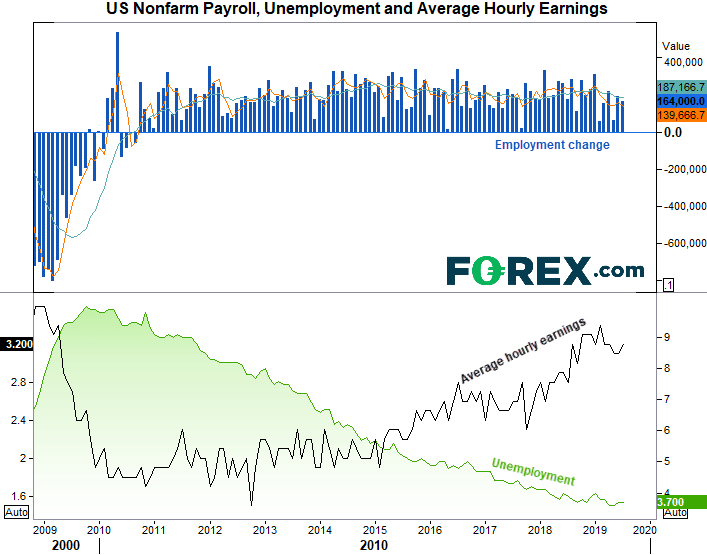
Employment is expected to soften to 155k, well below the 1-month average of 187.16 and unemployment is expected to hold steady at 3.7%. With ADP employment released on Thursday, and a 3-month correlation of 0.81, we could see NFP revised if ADP misses expectations. However, average hourly earnings may be the better read to follow as it has been trending notably higher on an annualised basis, so traders use it as an inflationary gauge (and therefor, a better read of how the Fed are likely to react). That said, as the CME FedWatch tool suggests 95.8% chance for Fed to cut 25bps in September, it’s hard to see any such data will remove this almost given event. For that, we’d need to see a solid breakthrough in trade talks which, at present, appear unlikely to appear on the horizon.
Take note that Canada release employment data alongside NFP, which places USD/CAD in the sights of the volatility crossbow. CAD/CHF and CAD/JPY are also pairs to consider, if you want to focus on the Canadian employment side of things.
Monday 2nd September
- AU manufacturing PMI, company profits, business inventories
- NZ trade balance
- JP business capex, manufacturing PMI
- CN manufacturing PMI
- EZ, FR, DE, UK manufacturing PMI (final reads)
Tuesday 3nd September
- South Korean CPI and GDP
- AU current account, retail sales, RBA cash rate decision
- UK construction PMI
- EZ producer prices
- CA manufacturing PMI
- US ISM Manufacturing
Wednesday 4nd September
- AU services PMI, GDP
- CN Services PMI
- EZ, FR, DE, UK services PMI, EZ retail sales
- CA trade balance, BOC cash rate decision
Thursday 5nd September
- AU trade balance
- DE industrial orders
- US ADP employment/jobless claims, services PMI, ISM non-manufacturing PMI
Friday 6nd September
- AU construction
- JP household spending, leading/coincident indicator
- DE industrial output
- EZ employment (final), GDP (revised)
- US Nonfarm payroll
- CA employment
Chinese Manufacturing PMI: USD/CNH, AUD, NZD and JPY pairs, Copper, China A50, Hang Seng
China’s manufacturing sector has contracted two consecutive months, adding to the chorus of calls for a global slowdown. That said, the rate of contraction slowed in July, and if PMI is to climb back above 50, we’d expect a bout of risk-on for the session. AUD pairs are particularly sensitive to the data as they’re key trade partners, but Chinese indices and copper also make decent markets to monitor around the data’s release.
RBA Cash Rate Decision and Q3 GDP: AUD pairs, ASX200
At time of writing, the RBA rate indicator expects just an 11% chance of a 25 cut on Tuesday. This moves to 74% for a cut in October and a 115% cut (ie fully priced in) for November. This is no major surprise, given they cut by 25 bps in June and July and their August minutes provided a ‘steady as she goes’ approach, whilst emphasising external risks such as the trade war. Moreover, GDP data is out on Wednesday and they’d likely want this data on hand before easing further. Yet this still could be a high volatility event if there is a notable shift in tone with their statement.
As for GDP, RBA expect growth to average around 2.5% this year. With Q1 GDP hitting 1.8%, it’s not off to a great start and, with ANZ expecting it to drop to 1.1% in Q2 and the consensus at 1.4%, economists seem doubtful that RBA are on track to achieve their 2019 growth target. Expect AUD to remain under pressure and bring forward easing expectation should it hit 1.3% YoY or less.
BoC Rate Decision
It’s unlikely BoC will change policy next week, given inflation remains around 2% has not ‘dipped’ as expected. Moreover, the 1-month OIS suggests less than a 20% chance of a cut at their next meeting. Still, markets suspect the next direction will be a cut, with 6-month OIS pricing in around 74% chance and a 25bps cut being bullish priced in by April next year. So we’ll keep a close eye on the statement to see if there is a dovish twist, although chances are it will reiterate their need to monitor the energy sector and the impact of ‘trade conflicts’ whilst remaining optimistic over domestic growth.
US ISM Manufacturing: USD pairs, US indices, WTI, Gold, Silver
Global PMI remain under pressure and traders are waiting to see if manufacturing PMI dips below the 50% threshold to show the sector contracting. It’s an important gauge for markets as it can lead GDP by 6-9 months, so any weakness here will translate to lower growth expectations, earnings for companies and therefor prices.
US and CA Nonfarm payroll: USD and CAD pairs, US indices, WTI, Gold, Silver
Employment is expected to soften to 155k, well below the 1-month average of 187.16 and unemployment is expected to hold steady at 3.7%. With ADP employment released on Thursday, and a 3-month correlation of 0.81, we could see NFP revised if ADP misses expectations. However, average hourly earnings may be the better read to follow as it has been trending notably higher on an annualised basis, so traders use it as an inflationary gauge (and therefor, a better read of how the Fed are likely to react). That said, as the CME FedWatch tool suggests 95.8% chance for Fed to cut 25bps in September, it’s hard to see any such data will remove this almost given event. For that, we’d need to see a solid breakthrough in trade talks which, at present, appear unlikely to appear on the horizon.
Take note that Canada release employment data alongside NFP, which places USD/CAD in the sights of the volatility crossbow. CAD/CHF and CAD/JPY are also pairs to consider, if you want to focus on the Canadian employment side of things.
Related tags:




The complete CFD trading experience
Award-winning platforms, competitive spreads, low commissions and dedicated support.
We live and breathe the markets and are dedicated to helping traders realise their ambitions as we continue to set the industry bar.
Economic calendar
Web Trader platform
Our sophisticated web-based platform is packed with features.
Related articles

Gold Update: XAU/USD Shows Neutrality Following Friday's NFP Report
The trading week is getting underway and, for now, gold has struggled to maintain the strength that characterized its performance in previous weeks. Average price action over the last two sessions shows a decline of roughly 1.5%, reflecting a loss of momentum that has started to highlight a more neutral market environment.

USD/JPY forecast: All eyes on US jobs with CPI next week – FOREX Friday
The NFP arrives today with the odds of a rate hike from the Fed slipping back to around 50% and correspondingly the dollar sold off again yesterday. That was due to comments from Fed’s Waller who said next week’s CPI could determine whether he votes for a hike or hold. He was thus a lot less hawkish than the Fed Chair Kevin Warsh.


Yen Shock Hits the Dollar Just Before the U.S. Jobs Report
Speculation about yen intervention followed a sudden drop in dollar yen, yet the selling that came after was smooth and steady rather than sharp and disorderly. Markets now carry far more Bank of Japan tightening for this year than before the late July episode. A reverse carry trade sits behind it, alongside a dollar slipping against the euro, the Australian dollar, and gold.
StoneX Europe Ltd may make third party material available on this website which may contain information included but not limited to the conditions of financial markets. The material is for information purposes only and does not contain, and should not be construed as containing, investment advice and/or investment recommendation and/or an investment research and/or an offer of or solicitation for any transactions in financial instruments; any decision to enter into a specific transaction shall be made by the client following an assessment by him/her of their situation.
StoneX Europe Ltd makes no representation or warranty and assumes no liability as to the accuracy or completeness of the information provided, nor any loss arising from any investment based on a recommendation, forecast or other information supplied. You should always seek independent advice as to your suitability to speculate in any related markets and your ability to assume the associated risks, if you are at all unsure. We are not under any obligation to update any such material. Any opinion made may be personal to the author and may not reflect the opinion of StoneX Europe Ltd.