







USDCLP Approaching Highs after Protests
This move is really part of a longer-term structural issue for Emerging Markets in general
Share this:

The Chilean Peso took a hit today after a violent weekend of protests, in which 11 people died according to the Karla Rubilar, the mayor of Santiago. Cost and living and inequality sent people to the streets last week after the government said they were going to increase the price of public transportation. The President of Chile, Sebastian Pinera, declared a State of Emergency and noted that the price increase was due to currency exchange fluctuations.
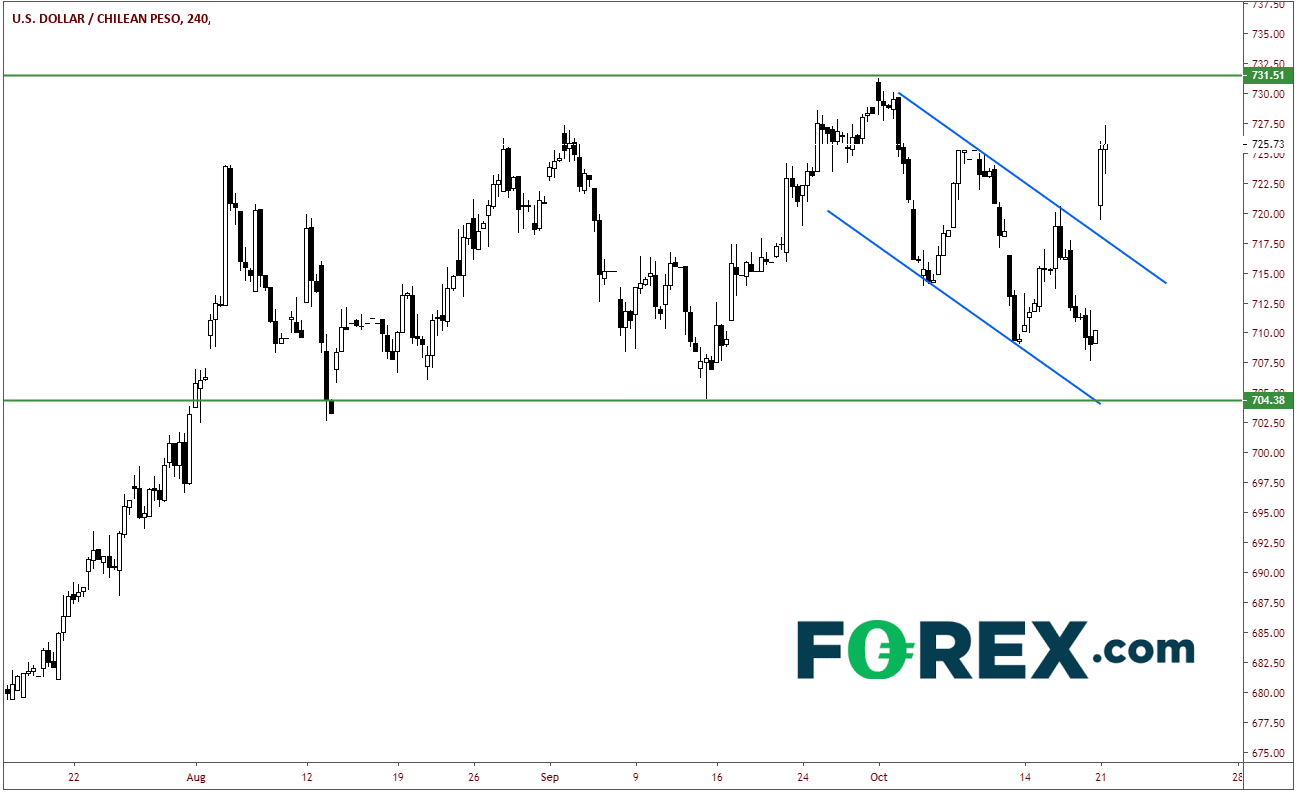
USD/CLP gapped higher today to 720.63 after closing Friday at 710.19. The pair is up 2.2% today, closing near 725.73 The Emerging Market pair has been trading in a sideways trading range since August, however the pair appears likely to test the highs at 731.24 from not only October 1st, 2019, but also December 2015. Resistance above that isn’t until 761.00, the all-time highs from 2002. First support is at the broken trendline near 717.75, and then the gap fill at 710.29. A rising trendline comes in below that on the weekly timeframe near 700 (see weekly chart below).
Source: Tradingview, City Index
However, this move is really part of a longer-term structural issue for Emerging Markets (EMs) in general, rather than just the violence over the last week. As the Fed began its tightening policy in 2012, the USD has been strengthening and EMs are the ones who have taken the brunt of it. On the weekly chart, USD/CLP was at 455.25 in July 2011 and rose to a high 731.74 in January 2016. After retracing 50% of that move, price is testing the 2016 highs and threaten to break out. Bulls may want to consider waiting for a break above 731.74, and buying a retest of that level, as price is currently in an ascending wedge and is diverging with RSI, an indication price may pull back in the short-term.
Source: Tradingview, City Index
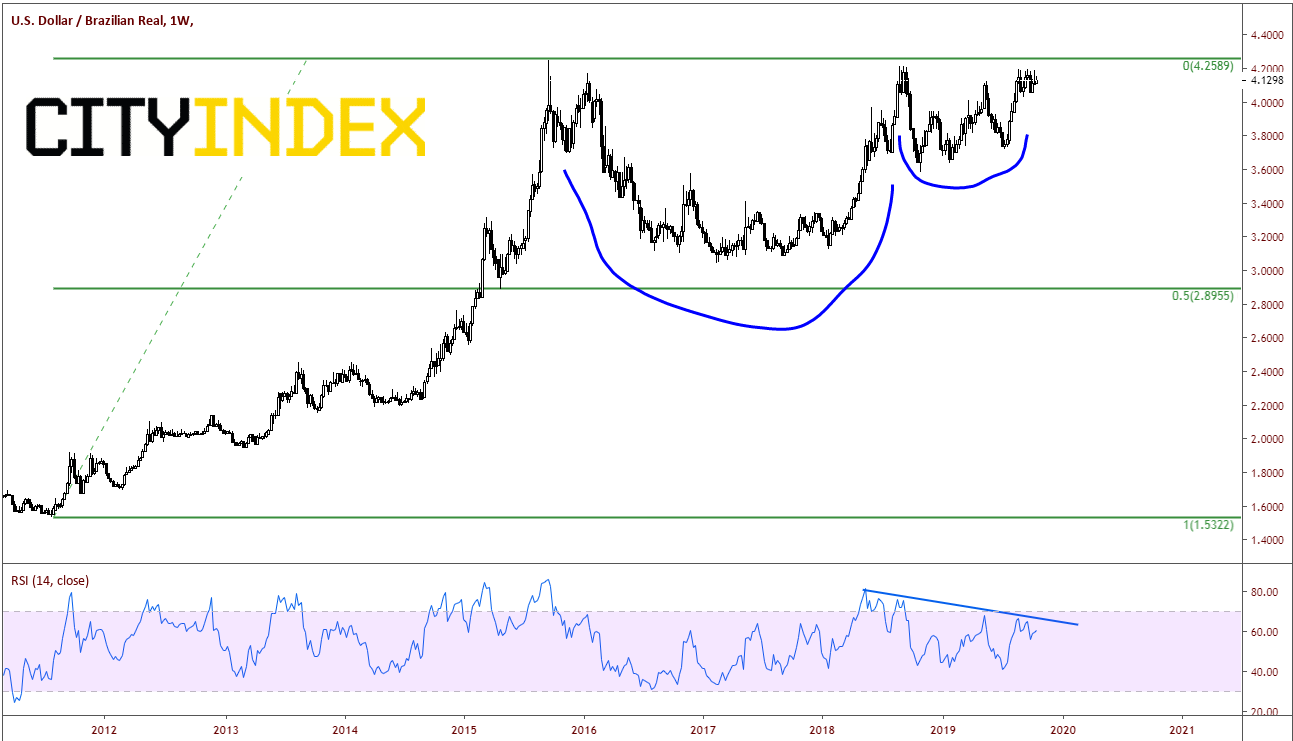
The Brazilian Real is another currency that has been hit by the strengthening US Dollar since 2012. USD/BRL was at 1.5322 in August 2011 when the pair began its ascent to 4.2589 in September 2015. The pair pulled back, just as USD/CLP had, however not as deep, and formed a rounding bottom formation. After testing the highs in mid-2018, USD/BRL pulled back slightly and now appears ready to break out above 4.2589, as it is testing that level for the third time. The price action appears to be putting in a long-term cup and handle formation. However, as with USD/CLP, bulls may want to wait for a break above 4.25 and a retest to enter the market, as the RSI is diverging with price as well.
Source: Tradingview, City Index
Patience is key for those who wish to get involved with these EM pairs, as market participants may wait to see how the shorter-term patterns play out if the pairs do not immediately break higher. Its usually not a good thing when everyone jumps in the pool all at once!
The Chilean Peso took a hit today after a violent weekend of protests, in which 11 people died according to the Karla Rubilar, the mayor of Santiago. Cost and living and inequality sent people to the streets last week after the government said they were going to increase the price of public transportation. The President of Chile, Sebastian Pinera, declared a State of Emergency and noted that the price increase was due to currency exchange fluctuations.
USD/CLP gapped higher today to 720.63 after closing Friday at 710.19. The pair is up 2.2% today, closing near 725.73 The Emerging Market pair has been trading in a sideways trading range since August, however the pair appears likely to test the highs at 731.24 from not only October 1st, 2019, but also December 2015. Resistance above that isn’t until 761.00, the all-time highs from 2002. First support is at the broken trendline near 717.75, and then the gap fill at 710.29. A rising trendline comes in below that on the weekly timeframe near 700 (see weekly chart below).
Source: Tradingview, FOREX.com
However, this move is really part of a longer-term structural issue for Emerging Markets (EMs) in general, rather than just the violence over the last week. As the Fed began its tightening policy in 2012, the USD has been strengthening and EMs are the ones who have taken the brunt of it. On the weekly chart, USD/CLP was at 455.25 in July 2011 and rose to a high 731.74 in January 2016. After retracing 50% of that move, price is testing the 2016 highs and threaten to break out. Bulls may want to consider waiting for a break above 731.74, and buying a retest of that level, as price is currently in an ascending wedge and is diverging with RSI, an indication price may pull back in the short-term.
Source: Tradingview, FOREX.com
The Brazilian Real is another currency that has been hit by the strengthening US Dollar since 2012. USD/BRL was at 1.5322 in August 2011 when the pair began its ascent to 4.2589 in September 2015. The pair pulled back, just as USD/CLP had, however not as deep, and formed a rounding bottom formation. After testing the highs in mid-2018, USD/BRL pulled back slightly and now appears ready to break out above 4.2589, as it is testing that level for the third time. The price action appears to be putting in a long-term cup and handle formation. However, as with USD/CLP, bulls may want to wait for a break above 4.25 and a retest to enter the market, as the RSI is diverging with price as well.
Source: Tradingview, FOREX.com
Patience is key for those who wish to get involved with these EM pairs, as market participants may wait to see how the shorter-term patterns play out if the pairs do not immediately break higher. Its usually not a good thing when everyone jumps in the pool all at once!
Related tags:
Latest market news




The complete CFD trading experience
Award-winning platforms, competitive spreads, low commissions and dedicated support.
We live and breathe the markets and are dedicated to helping traders realise their ambitions as we continue to set the industry bar.
Economic calendar
Web Trader platform
Our sophisticated web-based platform is packed with features.
Related articles
EUR/USD weekly outlook: Oil, inflation and NFP in focus
After coming under significant pressure in recent weeks, the EUR/USD came off its lows to finish the week on a positive note on Friday, albeit with only a mild rebound. That was not enough to prevent the exchange rate falling for the third consecutive week, as the US dollar and bond yields rallied across the board.


EUR/USD Q4 2026 Outlook: Euro at a Crossroads as Fed, ECB Tighten 9 25 2026
EUR/USD enters Q4 at a pivotal inflection point as competing Fed-ECB policy paths and persistent inflation risks collide with major technical support.


USD/JPY Q4 2026 Outlook: Hawkish Fed Pricing Clashes With Intervention Risk
The year-end tug-of-war is clear: hawkish Fed pricing supports USD/JPY, while intervention risk limits the upside.

StoneX Europe Ltd may make third party material available on this website which may contain information included but not limited to the conditions of financial markets. The material is for information purposes only and does not contain, and should not be construed as containing, investment advice and/or investment recommendation and/or an investment research and/or an offer of or solicitation for any transactions in financial instruments; any decision to enter into a specific transaction shall be made by the client following an assessment by him/her of their situation.
StoneX Europe Ltd makes no representation or warranty and assumes no liability as to the accuracy or completeness of the information provided, nor any loss arising from any investment based on a recommendation, forecast or other information supplied. You should always seek independent advice as to your suitability to speculate in any related markets and your ability to assume the associated risks, if you are at all unsure. We are not under any obligation to update any such material. Any opinion made may be personal to the author and may not reflect the opinion of StoneX Europe Ltd.