




Week Ahead More Downside for the Euro
Often, when price fails to breakout of one side, it tries to retest the other side.
Share this:

This past week, markets seemingly have pushed past the number of new “adjusted” number Coronavirus cases. Although the number increased dramatically, these were cases that were under suspicion already, but could not be verified due to lack of testing equipment. Once the WHO arrived, they were able to verify these cases. Now that most of the suspected cases have been verified, China began pumping stimulus into the economy to try and get things back to “normal”. US stock indices traded to new highs this week; they don’t seem worried about contagion of the Coronavirus.
Fed’s Powell stayed the course during his Humphrey Hawkins testimony this week. Lower for longer, which made his testimony relatively uneventful.
The Euro, on the other hand, had quite and eventful week. Whether you blame it on poor data out of Europe, the unwind of the carry trade, or the Coronavirus, the Euro was under serious pressure this week. EUR/USD is down over 2% over the last 2 weeks, while EUR/JPY and EUR/GBP played catchup this week, both down .8% and 1.83%, respectively. There looks to be more downside in the Euro ahead for this week.
As far as the primary elections in the US are concerned, there are no primaries or caucuses until next Saturday, February 22nd, when the Nevada caucuses will be held. However, candidates are gearing up for Super Tuesday on March 3rd, when 15 primaries will be held. The race for the Democratic nomination is currently neck and neck between Bernie Sanders and Pete Buttigeg, however Michael Bloomberg will first appear on ballots on Super Tuesday. His entrance into the race is expected to disrupt the current leaderboard. There are already heated exchanges between Bloomberg and President Trump, and Bloomberg hasn’t even been on a ballot yet!
Earnings reports next week include WMT, DE, HSBC and LLOY
Expected economic highlights include:
Monday
- Japan: GDP
- US Holiday – President’s Day **markets closed**
Tuesday
- Australia: RBA Minutes
- UK: Claimant Count Change
- Germany: ZEW Economic Sentiment Index
- EU: ZEW Economic Sentiment Index
Wednesday
- UK: Inflation Data
- Canada: Inflation Data
- US: Housing Starts
- US: Building Permits
- US: PPI
- US: FOMC Minutes
Thursday
- Australia: Employment Change
- Germany: GKF Consumer Confidence
- Germany: PPI
- UK: Retail Sales
- Canada: New Housing Price Index
- US: Philly Fed Manufacturing
- Crude Oil Inventories
Friday
- Global Flash PMIs
- EU: Inflation Rate
- Canada: Retail Sales
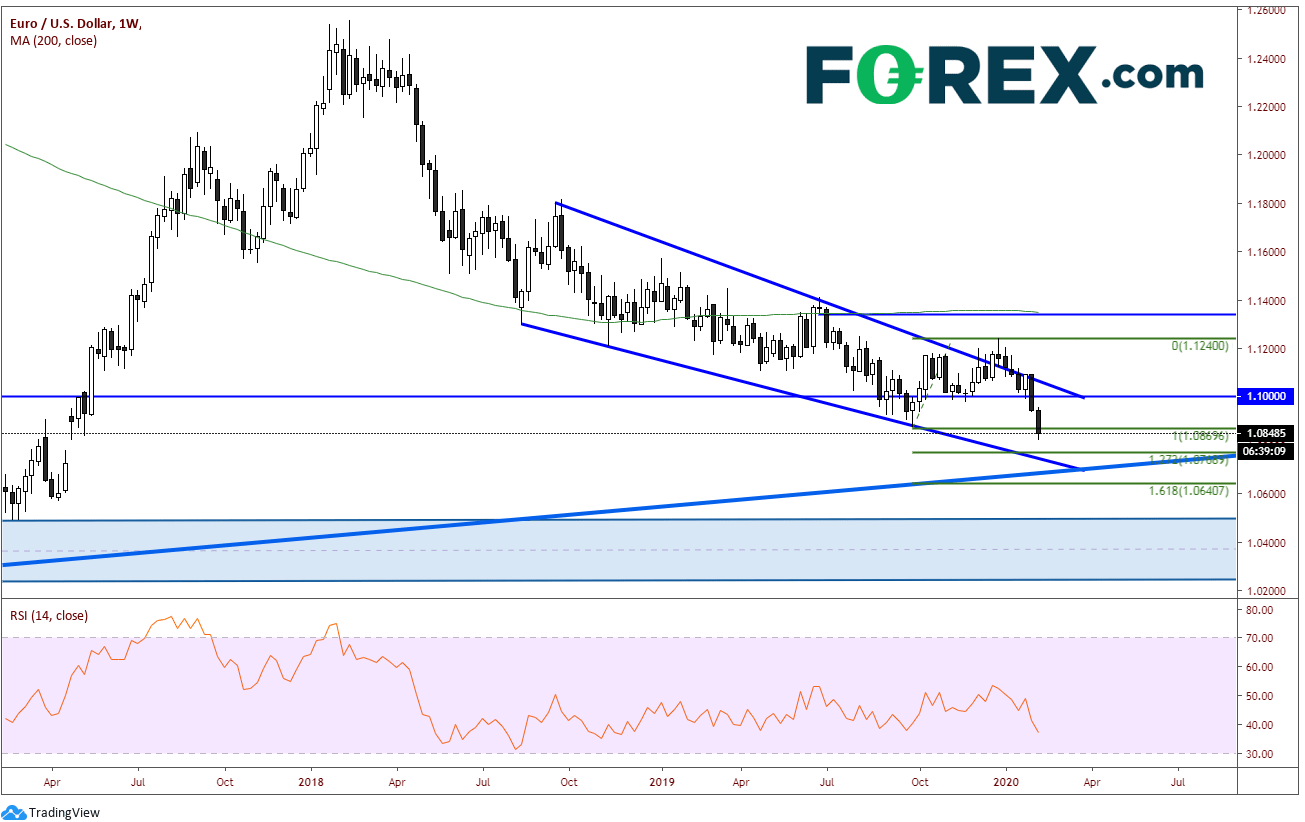
Chart to Watch: Weekly EUR/USD
Source: Tradingview, City Index
EUR/USD has been in a falling wedge since the summer of 2018. In December 2019, price tried to breakout to the upside, only to fail to move higher during the last week of 2019. In 2020, price reversed course and began trading lower back inside the wedge. Often, we see that when price fails to breakout of one side of the wedge, it tries to retest the other side of the wedge. EUR/USD has currently taken out prior lows at 1.0879. First support is a gap from 2017, between 1.0775 and 1.0820. Below there is a strong cluster of support between 1.0700 and 1.0750, which includes:
- The 127.2% extension from the September 2019 lows to the December 2019 highs
- The bottom trendline of the falling wedge
- An upward sloping trendline dating back to 2000!!
This past week, markets seemingly have pushed past the number of new “adjusted” number Coronavirus cases. Although the number increased dramatically, these were cases that were under suspicion already, but could not be verified due to lack of testing equipment. Once the WHO arrived, they were able to verify these cases. Now that most of the suspected cases have been verified, China began pumping stimulus into the economy to try and get things back to “normal”. US stock indices traded to new highs this week; they don’t seem worried about contagion of the Coronavirus.
Fed’s Powell stayed the course during his Humphrey Hawkins testimony this week. Lower for longer, which made his testimony relatively uneventful.
The Euro, on the other hand, had quite and eventful week. Whether you blame it on poor data out of Europe, the unwind of the carry trade, or the Coronavirus, the Euro was under serious pressure this week. EUR/USD is down over 2% over the last 2 weeks, while EUR/JPY and EUR/GBP played catchup this week, both down .8% and 1.83%, respectively. There looks to be more downside in the Euro ahead for this week.
As far as the primary elections in the US are concerned, there are no primaries or caucuses until next Saturday, February 22nd, when the Nevada caucuses will be held. However, candidates are gearing up for Super Tuesday on March 3rd, when 15 primaries will be held. The race for the Democratic nomination is currently neck and neck between Bernie Sanders and Pete Buttigeg, however Michael Bloomberg will first appear on ballots on Super Tuesday. His entrance into the race is expected to disrupt the current leaderboard. There are already heated exchanges between Bloomberg and President Trump, and Bloomberg hasn’t even been on a ballot yet!
Earnings reports next week include WMT, DE, HSBC and LLOY
Expected economic highlights include:
Monday
- Japan: GDP
- US Holiday – President’s Day **markets closed**
Tuesday
- Australia: RBA Minutes
- UK: Claimant Count Change
- Germany: ZEW Economic Sentiment Index
- EU: ZEW Economic Sentiment Index
Wednesday
- UK: Inflation Data
- Canada: Inflation Data
- US: Housing Starts
- US: Building Permits
- US: PPI
- US: FOMC Minutes
Thursday
- Australia: Employment Change
- Germany: GKF Consumer Confidence
- Germany: PPI
- UK: Retail Sales
- Canada: New Housing Price Index
- US: Philly Fed Manufacturing
- Crude Oil Inventories
Friday
- Global Flash PMIs
- EU: Inflation Rate
- Canada: Retail Sales
Chart to Watch: Weekly EUR/USD
Source: Tradingview, FOREX.com
EUR/USD has been in a falling wedge since the summer of 2018. In December 2019, price tried to breakout to the upside, only to fail to move higher during the last week of 2019. In 2020, price reversed course and began trading lower back inside the wedge. Often, we see that when price fails to breakout of one side of the wedge, it tries to retest the other side of the wedge. EUR/USD has currently taken out prior lows at 1.0879. First support is a gap from 2017, between 1.0775 and 1.0820. Below there is a strong cluster of support between 1.0700 and 1.0750, which includes:
- The 127.2% extension from the September 2019 lows to the December 2019 highs
- The bottom trendline of the falling wedge
- An upward sloping trendline dating back to 2000!!
Latest market news




The complete CFD trading experience
Award-winning platforms, competitive spreads, low commissions and dedicated support.
We live and breathe the markets and are dedicated to helping traders realise their ambitions as we continue to set the industry bar.
Economic calendar
Web Trader platform
Our sophisticated web-based platform is packed with features.
Related articles
EUR/USD Q4 2026 Outlook: Euro at a Crossroads as Fed, ECB Tighten 9 25 2026
EUR/USD enters Q4 at a pivotal inflection point as competing Fed-ECB policy paths and persistent inflation risks collide with major technical support.


USD/JPY Q4 2026 Outlook: Hawkish Fed Pricing Clashes With Intervention Risk
The year-end tug-of-war is clear: hawkish Fed pricing supports USD/JPY, while intervention risk limits the upside.


Japanese Yen Forecast: USD/JPY 4% Rally Challenges Post-Intervention Downtrend 9 24 2026
USD/JPY momentum has shifted sharply higher, putting a major resistance confluence in focus as U.S. and Japanese event risk builds.
StoneX Europe Ltd may make third party material available on this website which may contain information included but not limited to the conditions of financial markets. The material is for information purposes only and does not contain, and should not be construed as containing, investment advice and/or investment recommendation and/or an investment research and/or an offer of or solicitation for any transactions in financial instruments; any decision to enter into a specific transaction shall be made by the client following an assessment by him/her of their situation.
StoneX Europe Ltd makes no representation or warranty and assumes no liability as to the accuracy or completeness of the information provided, nor any loss arising from any investment based on a recommendation, forecast or other information supplied. You should always seek independent advice as to your suitability to speculate in any related markets and your ability to assume the associated risks, if you are at all unsure. We are not under any obligation to update any such material. Any opinion made may be personal to the author and may not reflect the opinion of StoneX Europe Ltd.