



Why USDJPY Could See a Big Breakout Around Mondays LDP Election
On Monday 14 September, the LDP is expected to hold its leadership election three days before the National Diet will elect a new Prime Minister.
Share this:

As if 2020 wasn’t already tumultuous enough, Shinzō Abe, Japan’s longest-serving Prime Minister, unexpectedly resigned on 28 August, citing health issues. Abe will remain in office until a successor is chosen by the country’s ruling Liberal Democratic Party (LDP).
On Monday 14 September, the LDP is expected to hold its leadership election three days before the National Diet will elect a new Prime Minister. Though Abe refused to endorse a preferred successor, Chief Cabinet Secretary Yoshihide Suga is the clear frontrunner and has reportedly solidified his support within the LDP; former Defense Minister Shigeru Ishiba and ex-Foreign Minister Fumio Kishida will also vie for the election. The winner of the election will serve out the rest of Abe’s term, through September 2021.
If Suga secures the election, he has pledged to continue the former PM’s “Abenomics” economic policy, anchored by monetary easing from the Bank of Japan, fiscal stimulus through government spending, and structural reforms. In recent interviews, Suga has also cited deregulation as a key policy goal. While continuity in economic policies should benefit Japanese businesses, there is a risk that Suga could dissolve parliament and call a snap election to solidify his support, which could introduce an extended period of uncertainty and volatility for Japanese assets, including the yen.
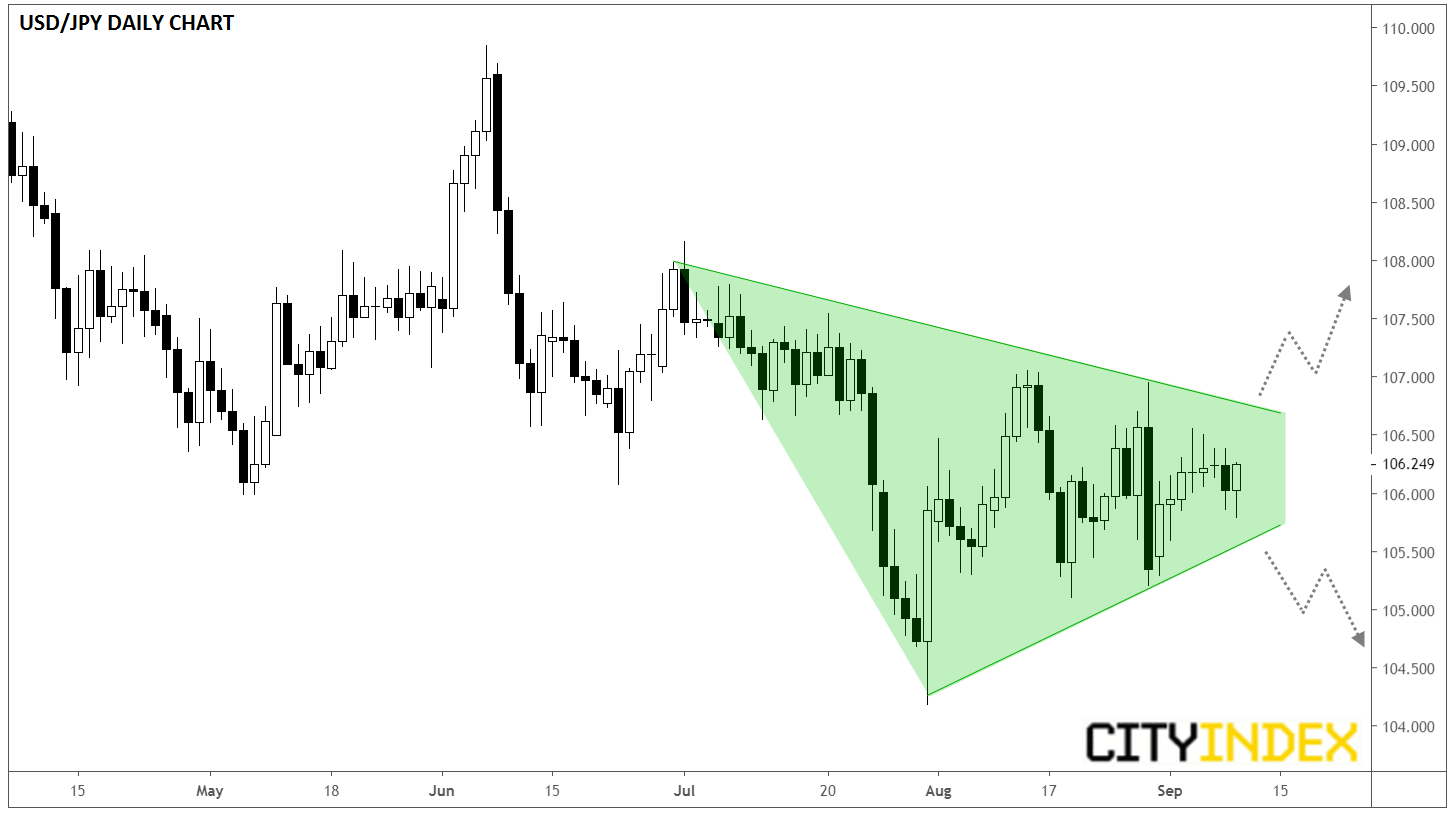
Speaking of the yen, Japan’s currency surprisingly saw notable strength against the US dollar on the day Abe announced his resignation, though USD/JPY has since retraced most of that move. Taking a step back, USD/JPY sits near the middle of a “symmetrical triangle” pattern created by a series of lower highs and higher lows in price. For the uninitiated, this pattern is similar to a person compressing a coiled spring: as the range continues to contract, energy builds up within the spring. When one of the pressure points is eventually removed, the spring will explode in that direction.
It’s notoriously difficult to predict the direction of a symmetrical triangle breakout in advance, but markets tend to see large moves following a breakout in either direction. Accordingly, readers may want to wait for a potential breakout around the election and then hop aboard the new trend on any pullbacks. To the topside, USD/JPY could rally up to 108.00, whereas a downside break could target the late July lows near 104.00.
Source: TradingView, GAIN Capital
As if 2020 wasn’t already tumultuous enough, Shinzō Abe, Japan’s longest-serving Prime Minister, unexpectedly resigned on 28 August, citing health issues. Abe will remain in office until a successor is chosen by the country’s ruling Liberal Democratic Party (LDP).
On Monday 14 September, the LDP is expected to hold its leadership election three days before the National Diet will elect a new Prime Minister. Though Abe refused to endorse a preferred successor, Chief Cabinet Secretary Yoshihide Suga is the clear frontrunner and has reportedly solidified his support within the LDP; former Defense Minister Shigeru Ishiba and ex-Foreign Minister Fumio Kishida will also vie for the election. The winner of the election will serve out the rest of Abe’s term, through September 2021.
If Suga secures the election, he has pledged to continue the former PM’s “Abenomics” economic policy, anchored by monetary easing from the Bank of Japan, fiscal stimulus through government spending, and structural reforms. In recent interviews, Suga has also cited deregulation as a key policy goal. While continuity in economic policies should benefit Japanese businesses, there is a risk that Suga could dissolve parliament and call a snap election to solidify his support, which could introduce an extended period of uncertainty and volatility for Japanese assets, including the yen.
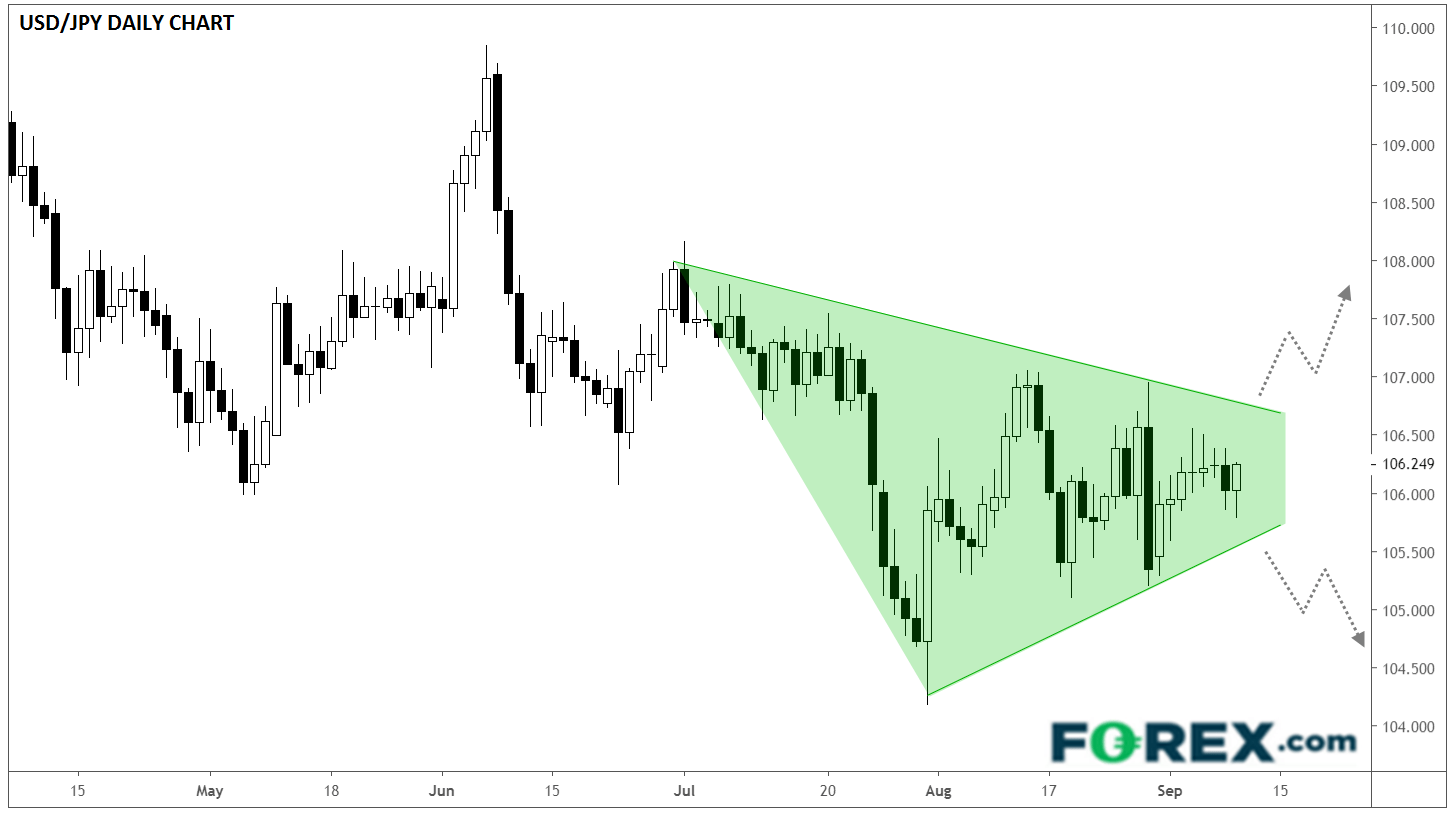
Speaking of the yen, Japan’s currency surprisingly saw notable strength against the US dollar on the day Abe announced his resignation, though USD/JPY has since retraced most of that move. Taking a step back, USD/JPY sits near the middle of a “symmetrical triangle” pattern created by a series of lower highs and higher lows in price. For the uninitiated, this pattern is similar to a person compressing a coiled spring: as the range continues to contract, energy builds up within the spring. When one of the pressure points is eventually removed, the spring will explode in that direction.
It’s notoriously difficult to predict the direction of a symmetrical triangle breakout in advance, but markets tend to see large moves following a breakout in either direction. Accordingly, readers may want to wait for a potential breakout around the election and then hop aboard the new trend on any pullbacks. To the topside, USD/JPY could rally up to 108.00, whereas a downside break could target the late July lows near 104.00.
Source: TradingView, GAIN Capital
Related tags:
Latest market news




The complete CFD trading experience
Award-winning platforms, competitive spreads, low commissions and dedicated support.
We live and breathe the markets and are dedicated to helping traders realise their ambitions as we continue to set the industry bar.
Economic calendar
Web Trader platform
Our sophisticated web-based platform is packed with features.
Related articles
EUR/USD, USD/JPY Outlook: Oil, yields and an FX identity crisis
Crude oil is setting the tone across rates and FX, leaving EUR/USD vulnerable and USD/JPY caught between higher Treasury yields and the growing threat of intervention
AUD/USD Analysis: What's Next for the Australian Dollar After the RBA Decision?
Recent trading sessions have reflected a more neutral tone around the Australian dollar. This can be seen in AUD/USD price action, which has posted moves of roughly 0.2% over the last two sessions without establishing a clear direction. Much of this lack of momentum is linked to expectations surrounding the next policy moves from both the Reserve Bank of Australia (RBA) and the Federal Reserve.

USD into a Massive Week as Yields Fly and Gold Breaks
It’s a huge week with PCE and NFP, but it’s what’s happening off of the calendar that demands attention with US yields flying to fresh multi-decade highs.

StoneX Europe Ltd may make third party material available on this website which may contain information included but not limited to the conditions of financial markets. The material is for information purposes only and does not contain, and should not be construed as containing, investment advice and/or investment recommendation and/or an investment research and/or an offer of or solicitation for any transactions in financial instruments; any decision to enter into a specific transaction shall be made by the client following an assessment by him/her of their situation.
StoneX Europe Ltd makes no representation or warranty and assumes no liability as to the accuracy or completeness of the information provided, nor any loss arising from any investment based on a recommendation, forecast or other information supplied. You should always seek independent advice as to your suitability to speculate in any related markets and your ability to assume the associated risks, if you are at all unsure. We are not under any obligation to update any such material. Any opinion made may be personal to the author and may not reflect the opinion of StoneX Europe Ltd.