



Will Germany’s August ZEW Index break through the 3-Year High?
Germany’s July 2025 ZEW Economic Sentiment Index jumped to 52.7—its highest since early 2022, Tomorrow we get the August ZEW Economic sentiment release. Will there be a growing shift in market expectations toward recovery? While current conditions are still negative, they’re improving fast. Eurozone sentiment also ticked up. With industrial momentum, trade optimism, and ECB policy in play, all eyes are now on whether this upbeat outlook translates into actual growth.
Share this:

German and European ZEW Economic Sentiment Indexes: July 2025 Snapshot and Future Outlook
The ZEW Economic Sentiment Index, one of Germany and Europe’s most influential leading indicators, has offered encouraging signals in July 2025. With global uncertainties still looming, markets and policymakers are carefully watching these data points for signs of sustained recovery. Here’s a detailed analysis of the latest figures and what they may signal for the months ahead.
Understanding the ZEW Index
The ZEW (Zentrum für Europäische Wirtschaftsforschung) Economic Sentiment Index is a monthly survey of institutional investors and analysts conducted in Germany. Participants are asked about their expectations for the economy, inflation, interest rates, and stock markets for the next six months. The survey provides two primary indicators:
- Economic Sentiment: A forward-looking measure of expectations.
- Current Conditions: A more immediate assessment of the current economic situation.
Both indexes are essential in gauging investor and analyst sentiment and are closely followed by market participants as early indicators of economic direction.
Germany’s ZEW Index in July 2025: A Positive Turn
In July 2025, the German ZEW Economic Sentiment Index surged to 52.7 points, marking its third consecutive monthly increase and the highest level since February 2022. The reading significantly beat analyst forecasts of 50.3 and follows June's already optimistic level of 47.5. This marked uptick in sentiment suggests that a growing majority of experts now expect the German economy to improve over the coming six months.
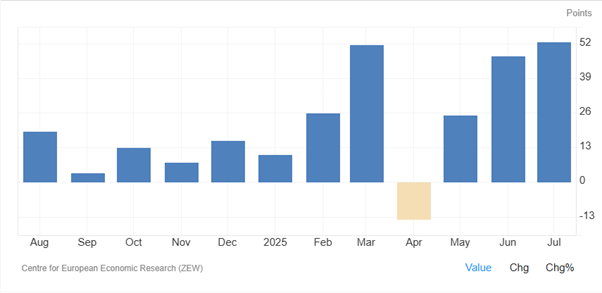
According to ZEW President Prof. Achim Wambach, the improvement is driven by a combination of external and internal factors. Notably:
- Expectations of a resolution in the US-EU trade tensions are improving confidence in export-driven industries.
- Hopes are high regarding the German government’s emergency investment program, which is seen as a potential catalyst for near-term growth.
- Sector-specific optimism has been most pronounced in mechanical engineering, metal production, and electrical engineering, reflecting expectations of increased industrial activity.
Current Conditions: Still Negative, But Improving
While sentiment is clearly on an upward trend, the ZEW Current Conditions Index remains in negative territory. That said, July’s reading of -59.5 represents a marked improvement from June’s -72 and is the best reading since June 2023. It also outperformed expectations of -66.
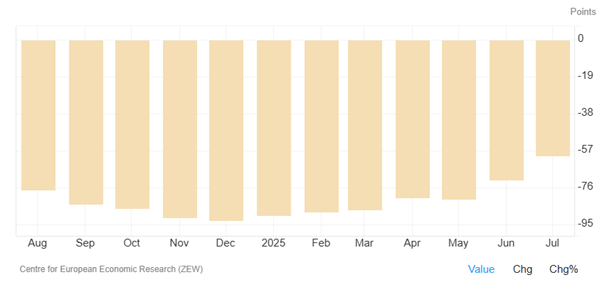
To put this in historical perspective, the index has averaged -13.56 since 1991 and reached its all-time high of 95.2 in January 2018. Though far from positive, the steady recovery in current conditions hints at a bottoming-out process, suggesting that the German economy may be transitioning from contraction to early recovery.
ZEW Sentiment Across the Euro Area: Gradual Improvement
At the broader European level, the ZEW Economic Sentiment Index for the Euro Area climbed modestly to 36.1 in July 2025. Although this was the highest reading in four months, it came in slightly below the market forecast of 37.8. Still, the steady month-on-month increase signals a cautiously optimistic mood among analysts.
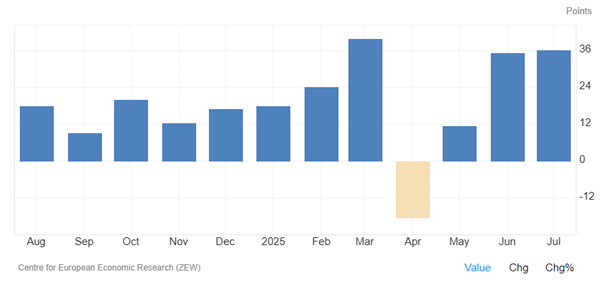
Breakdown of the survey responses reveals:
- 44% of analysts expect economic improvement in July.
- 48.1% foresee no change.
- Only 7.9% expect deterioration, underscoring a low level of bearishness.
Meanwhile, the Euro Area Current Conditions Index also showed signs of improvement, rising by 6.5 points to -24.2. Though still negative, the move confirms that pessimism regarding present conditions is slowly easing.
Interestingly, inflation expectations across the eurozone ticked up slightly, with the inflation sentiment index moving from -14.7 to -5.8, hinting that price stability concerns are abating but not gone. This could impact the European Central Bank's (ECB) future monetary policy decisions, as they weigh economic support against inflation containment.
Forward-Looking Expectations and Implications
The strong rebound in sentiment across both Germany and the broader Euro Area offers some much-needed optimism especially if tomorrows numbers exceed expectations.
1. Economic Growth Rebound Expected
If the sentiment indicators are to be trusted, markets are pricing in a modest but sustained recovery. Analysts are expecting more industrial output and possibly higher business investment, particularly if the government’s emergency investment initiatives take effect as planned.
2. Sector-Specific Strength
Manufacturing and industrial sectors appear to be recovering, particularly in engineering, electrical components, and metalwork. Export-oriented businesses may also benefit from resolving trade disputes and a potential rebound in global demand making tomorrows ZEW report so much more useful to give us an idea of the future perception.
3. Cautious Optimism in Broader Europe
Though Germany leads the rebound, sentiment across the Eurozone remains positive, albeit more subdued. With fewer structural challenges than earlier in the year and slight improvements in current conditions, the euro area may follow Germany’s lead into a recovery phase, although geopolitical uncertainties and weak consumer demand in certain countries remain.
4. ECB and Monetary Policy Watch
The rise in inflation expectations, albeit still in negative territory, could complicate the ECB’s monetary policy path. If economic activity and prices rise faster than expected, markets may have to recalibrate rate-cut expectations.
Conclusion: A Tentative Turn Toward Recovery
The July 2025 ZEW data presented an encouraging picture for Germany and the eurozone. Therefore, expectations are high for the August release too. The strong improvement in forward-looking sentiment indexes, especially in Germany, reflects increased optimism around political resolutions, government stimulus, and sector-specific tailwinds. Although current conditions remain subdued, the trajectory appears upward biased.
Investors, analysts, and policymakers will now look toward upcoming industrial production, retail sales, and GDP growth figures to confirm whether this sentiment-driven optimism is being matched by hard economic data.
If current trends continue, the latter half of 2025 could see Germany regaining its economic footing, pulling much of the eurozone with it. However, caution is needed especially in this environment where Tariff uncertainties are still on the table.
I wish you all the best,
Kind regards,
Philip J Papageorgiou – Market Analyst - X: @PhilipForexCom
Latest market news




The complete CFD trading experience
Award-winning platforms, competitive spreads, low commissions and dedicated support.
We live and breathe the markets and are dedicated to helping traders realise their ambitions as we continue to set the industry bar.
Economic calendar
Web Trader platform
Our sophisticated web-based platform is packed with features.
Related articles

GBP/USD, DAX Forecast Two trades to watch 220926
GBP/USD struggles as UK government borrowing exceeds forecasts, putting pressure on Healey ahead of the Budget. DAX eases back after yesterday's gains as oil prices and political headwinds rise.


USD/CAD Analysis: Is the Canadian Dollar Running Out of Support?
A new trading week is underway, and the Canadian dollar continues to show signs of weakening momentum. This can be seen in recent USD/CAD price action, with the pair gaining nearly 0.7% over the last four trading sessions.


DAX Climbs After Fed Move, Eyes Break Above 26,000 Resistance
The DAX has opened significantly higher following the Federal Reserve's delivery of its first interest rate hike since 2023. Although the Fed signaled further tightening, the market reaction was surprisingly positive, as much of the hawkish expectation had already been priced in. Attention now shifts to the 25,900–26,000 point range, which will likely determine whether the current recovery evolves into a new upward wave or remains merely a short-covering rally.
StoneX Europe Ltd may make third party material available on this website which may contain information included but not limited to the conditions of financial markets. The material is for information purposes only and does not contain, and should not be construed as containing, investment advice and/or investment recommendation and/or an investment research and/or an offer of or solicitation for any transactions in financial instruments; any decision to enter into a specific transaction shall be made by the client following an assessment by him/her of their situation.
StoneX Europe Ltd makes no representation or warranty and assumes no liability as to the accuracy or completeness of the information provided, nor any loss arising from any investment based on a recommendation, forecast or other information supplied. You should always seek independent advice as to your suitability to speculate in any related markets and your ability to assume the associated risks, if you are at all unsure. We are not under any obligation to update any such material. Any opinion made may be personal to the author and may not reflect the opinion of StoneX Europe Ltd.