- EUR/USD opens lower following widespread civil unrest in France
- French sovereign spreads widened sharply before stabilising last week
- Net short positioning approached the extremes reached in July
- Hot US inflation failed to produce sustained dollar strength
- Buyers have repeatedly emerged on EUR/USD dips beneath 1.1200
EUR/USD opened lower in Asia on Monday following scenes of widespread civil unrest across France over the weekend, with some of the most violent clashes, looting and vandalism taking place in Paris.
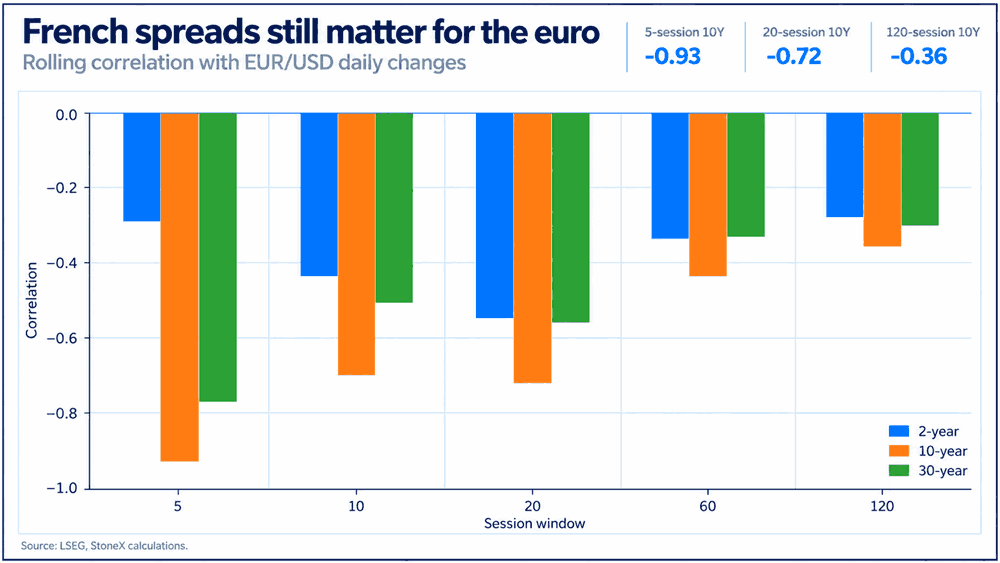
However, it's been the performance of French government debt, rather than political headlines alone, that's had a more powerful influence on the euro recently, as seen in the graphic below tracking the rolling correlation between French OAT-German bunds.
While we won't get a proper assessment of how bond traders are responding to the weekend's developments until European markets open, there's a reasonable question to ask: what exactly have we learned that we didn't already know?
Source: LSEG
France's deteriorating fiscal position, political fragmentation and difficulties pushing through meaningful budget consolidation have been apparent for years, even if they've attracted renewed scrutiny over recent months. French government bond spreads have already widened substantially relative to German Bunds, with political uncertainty hardly a new consideration ahead of next year's presidential election.
While that doesn't mean the situation can't deteriorate further, for the latest unrest to drive a sustained reassessment of the euro, markets arguably need evidence that France's fiscal or political outlook is becoming materially worse than investors had already anticipated.
And when you consider this pair faces political uncertainty not only in Europe but also in the United States ahead of the US midterm elections, it's difficult to see why this weekend's unrest alone would justify another sustained bout of aggressive euro selling.
French spreads show stress, but little fresh deterioration
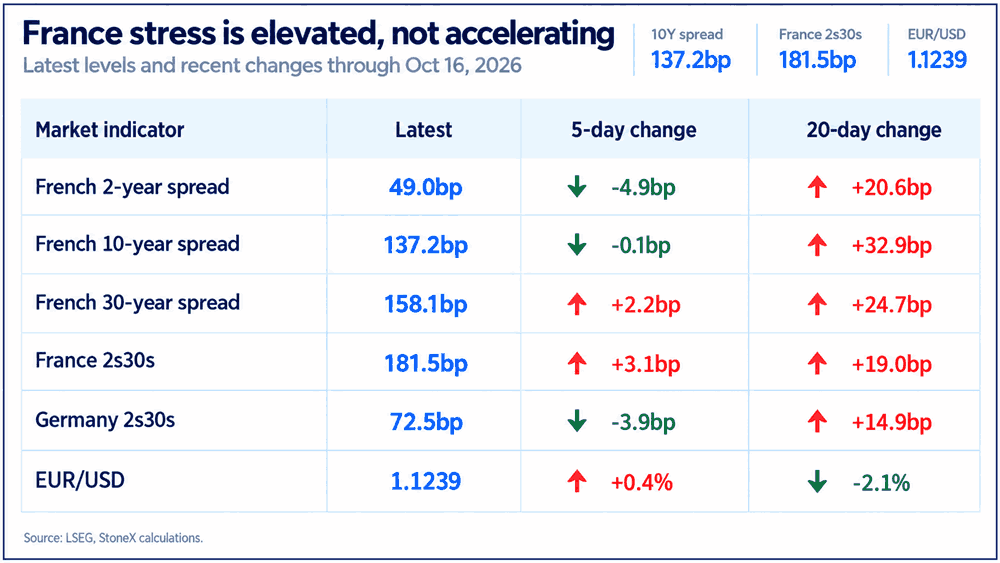
There's no question French debt has been under the pump recently. Over the past 20 sessions, the yield premium to own French bonds over comparable German Bunds has widened by roughly 21, 33 and 25 basis points at the two, 10 and 30-year tenors respectively.
However, that deteriorating trend stalled last week, with the two-year spread narrowing by around five basis points and the 10-year tenor virtually unchanged.
Source: LSEG
One week's price action always needs to be treated with caution, but at face value, it suggests renewed French fiscal concerns and political uncertainty may already be largely baked into the price.
If the weekend's developments fail to spark another meaningful widening in French sovereign spreads, the latest unrest may not lead to an extension of the euro's early weakness in Asia, especially with bearish positioning among leveraged traders already sitting at fairly extreme levels.
Leveraged funds pile into euro shorts
Source: LSEG
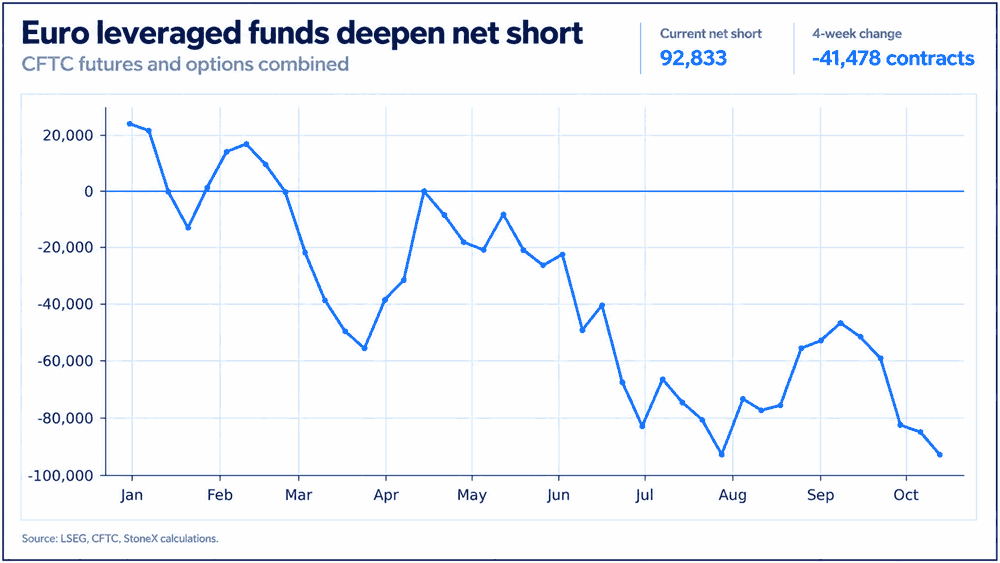
According to CFTC data, leveraged funds increased their net short euro exposure by 41,478 contracts over the four weeks to October 13, a shift ranking among the most bearish 5.6% of comparable periods since 2006.
That left net short positioning at 92,833 contracts, almost identical to the levels reached in late July.
Importantly, those figures predate the weekend's unrest, providing a snapshot of positioning as of Tuesday afternoon in New York last week.
But with leveraged funds already heavily positioned short, extending the euro's decline will require existing bears to become even more bearish, or fresh sellers to enter the market. Neither is out of the realms of possibility, clearly, but it does raise the question of how much additional selling pressure the latest developments will generate.
US dollar bulls had their chances
It's not just positioning that raises questions about the potential for a resumption of EUR/USD downside, with the US dollar's performance last week revealing in its own right.
US CPI and PPI data for September both came out way hotter than expected, while sharp declines in tech stocks, driven by renewed AI doubts, provided another source of safe-haven demand, which was seen in Treasury markets.
Yet despite those apparent tailwinds, the dollar struggled, particularly towards the back end of the week, ultimately resulting in EUR/USD breaking out of the downtrend running from the early September highs.
If the dollar is unable to rally on obvious fundamental catalysts, perhaps that's the strongest message of all in terms of its near-term directional risk.
EUR/USD technical analysis
Source: TradingView
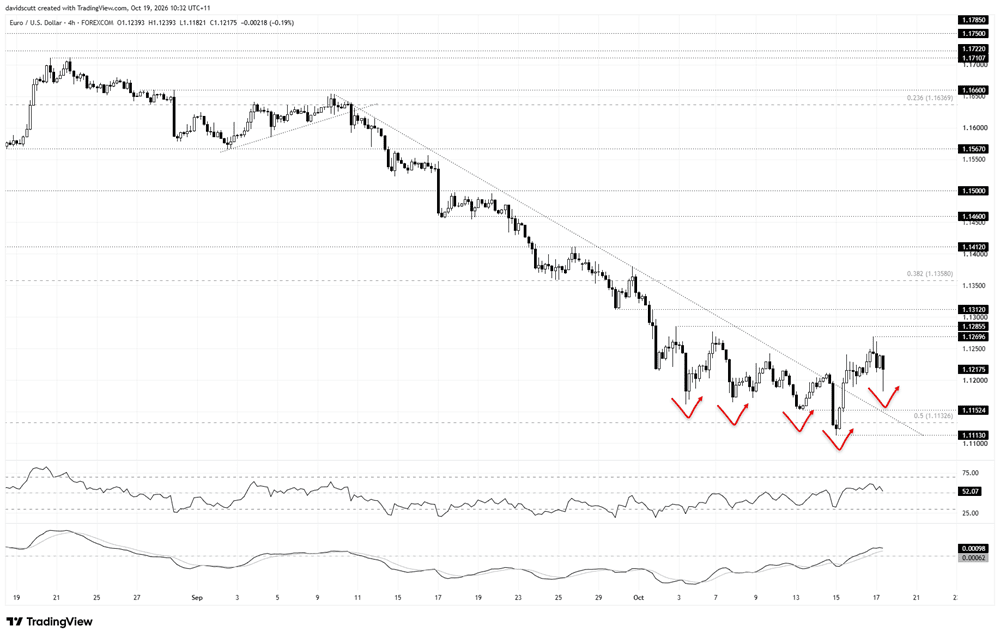
EUR/USD broke the downtrend running from the early September highs last week, bouncing strongly from just above 1.1100, which coincides with the 50% retracement of the January 2025 to January 2026 bull move.
From there, the price reclaimed 1.1200 before stalling around 1.1270 late last week. The opening four-hourly candle in Asia on Monday saw EUR/USD dip back beneath 1.1200, but as was the case towards the back end of last week, buyers stepped in aggressively, pushing the pair back above that level.
While the momentum indicators are warning bulls against chasing the move higher, they're not providing a definitively bearish signal either. RSI (14) has been setting lower highs and is back around the neutral 50 level, while MACD is converging towards its signal line but remains in positive territory.
Looking at the price action, what's clear is that dips beneath 1.1200 have been well supported recently, with buyers repeatedly stepping in following sharp declines since the beginning of October.
On the downside, 1.1152 is a minor level to watch beneath Monday's earlier low, followed by 1.1113, the swing low set last week.
Overhead, last week's high around 1.1270 is the first level to watch, followed by minor resistance at 1.1285 and 1.1312, before the 38.2% Fibonacci retracement of the January 2025 to January 2026 bull move at 1.1358.
With little on the economic calendar this week, political headlines could play a larger role in driving short-term price action than would ordinarily be the case, at least until Friday's flash PMI releases.