
- Hang Seng Tech underperforms despite improving forward earnings expectations
- Median forward valuations contract sharply over the past quarter
- AI capex concerns, higher yields, weak Chinese consumer weigh
- Breakdown below 4,200–4,250 puts further losses in play
While technology indices across much of the developed world have been powering higher, even allowing for some weakness over the past couple of weeks, China's Hang Seng Tech Index has been the polar opposite, extending a prolonged period of underperformance.
The index has fallen nearly 14% over the past three months, with the latest leg lower producing a breakdown through key technical levels.
What makes the performance unusual is that the selling has continued despite improving earnings expectations across many of the index's largest constituents. Rather than being driven by a deteriorating profit outlook, the persistent weakness appears to reflect investors becoming increasingly reluctant to pay up for future earnings growth.
That raises two important questions: what's behind the change in sentiment, and what would be needed to turn it around?
Valuations contract despite improving earnings expectations
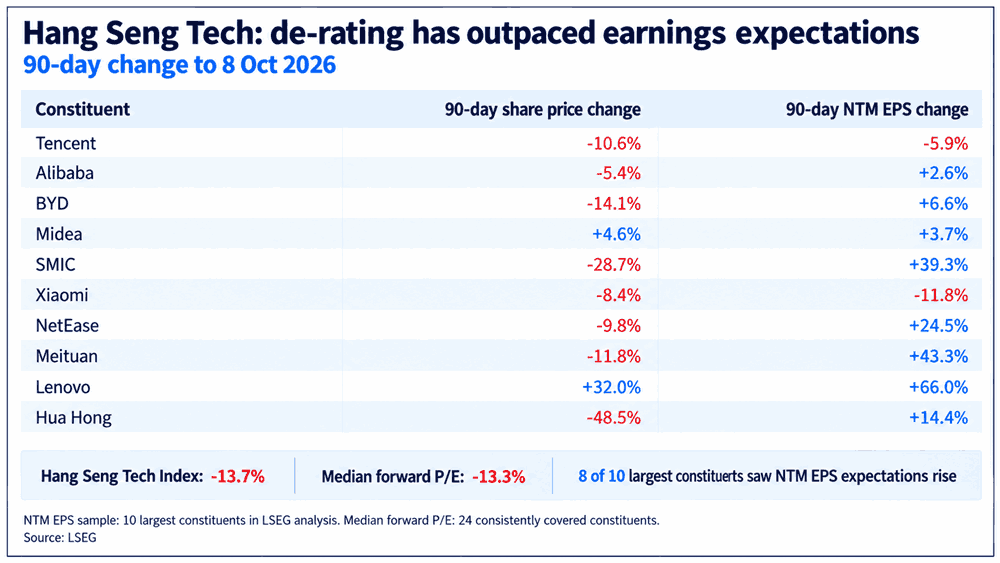
Looking at the table below, it reinforces that Hang Seng Tech's recent decline has occurred at the same time when earnings expectations have generally been improving.
Source: LSEG
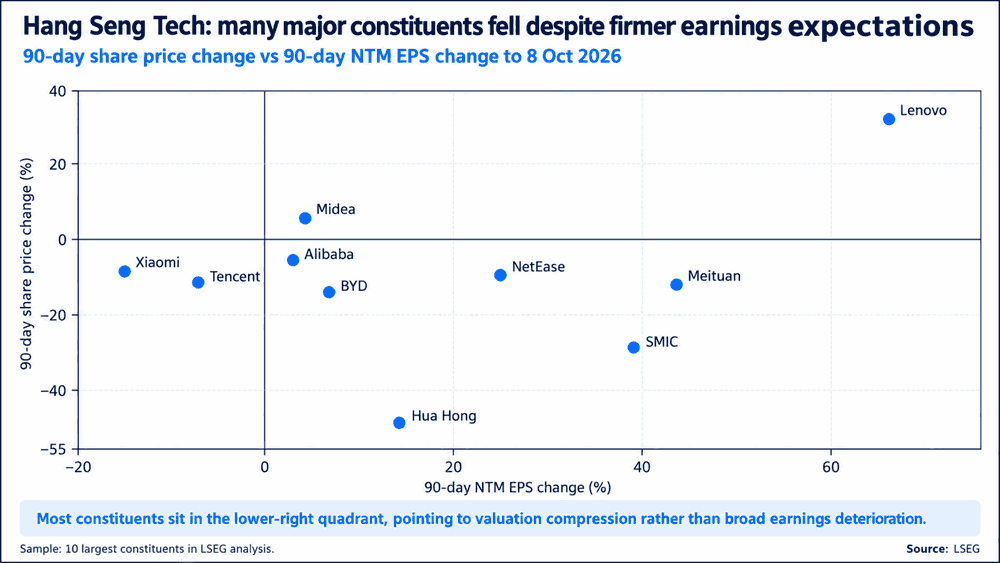
Analysis of LSEG data reveals that eight of the ten largest index constituents have seen their expected earnings per share over the coming 12 months increase over the past quarter, yet most of those companies have experienced falling share prices over the same period.
That disconnect is also seen in valuations. Across 24 index constituents that have consistent data to interpret, the median forward price-to-earnings ratio has contracted 13.3%, closely matching the index's 13.7% decline.
While I don't pretend that these figures represent an official index-level earnings measure, they suggest something akin to a buyers' strike is taking place, with investors unwilling to pay up for expected higher earnings in the future.
Source: LSEG
What's behind the buyers' strike?
There are several possible explanations for why investors have become so reluctant to pay for anticipated earnings growth.
One is the growing concern globally about the enormous sums being poured into AI infrastructure and whether that investment will ultimately deliver sufficient returns to justify the spending. Those concerns were reinforced by a Financial Times report on Thursday about OpenAI's annualised revenue, which was enough to trigger broad-based weakness across the US and European technology sectors.
We've also seen a sharp rise in global bond yields, which may be another contributing factor, putting additional pressure on equity valuations, particularly for long-duration companies whose valuations have historically been tied heavily to future earnings growth.
Then, of course, there are China's domestic challenges. Economic growth remains sluggish, particularly in the household sector, where a prolonged property market downturn continues to weigh on consumer confidence and spending. For an index like Hang Seng Tech, which has substantial exposure to consumer-facing internet and technology businesses, there's a clear fundamental connection.
While it's difficult to determine how much each factor has contributed to Hang Seng Tech's underperformance, collectively they provide important context for why investors may be demanding an even greater discount for anticipated earnings growth.
Sellers remain firmly in control
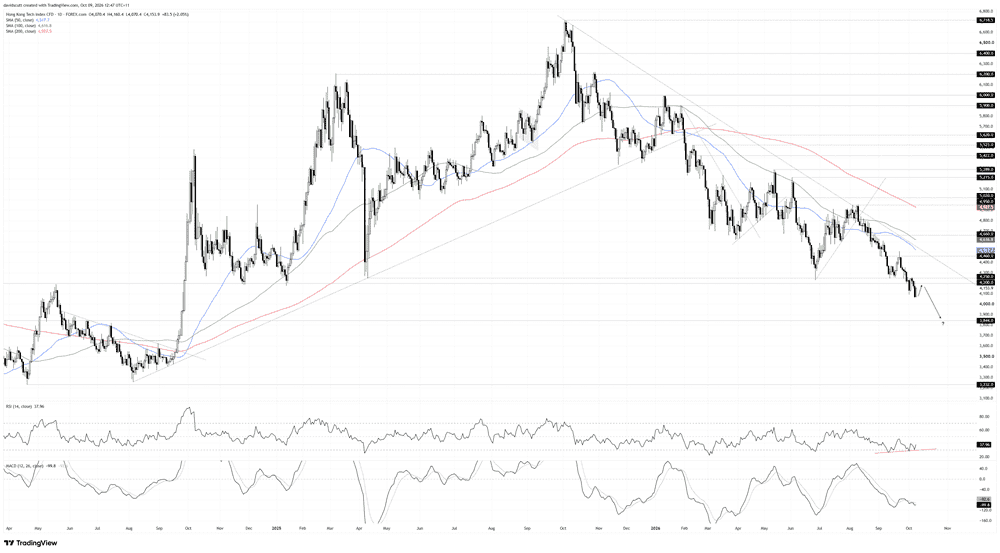
A reversal of the factors discussed above could help turn sentiment around, while an improvement in relations between the US and China may provide another catalyst. However, one look at the technical picture below suggests there's little evidence yet that a meaningful turnaround is on the cards.
Source: TradingView
The index remains in a strong bearish trend, trading beneath its key medium and long-term moving averages, all of which carry a negative slope. The latest leg lower has taken the price to levels not seen since September 2024, breaking beneath a key support zone between 4,200 and 4,250.
The upper end of that zone coincides with the April swing low that sparked a savage rebound, subsequently acting as support on several occasions, particularly over recent months. The lower boundary at 4,200 has acted as both support and resistance at various points dating back to 2023, making the entire zone an important area to watch overhead.
Today's modest rebound has taken the index back towards the lower end of that former support zone, presenting a potential entry point for shorts for those seeking an extension of the prevailing bearish trend. A back test and rejection would bolster the merits of the setup, allowing for a stop to be placed above the resistance zone for protection, with Thursday's low at 4,059.4 back in focus.
Below that, there's something of a vacuum, with little meaningful support evident until 3,844, a level that acted as both support and resistance on numerous occasions during late 2023 and the first half of 2024. That screens as the next downside target.
Both momentum oscillators favour short setups over longs, although there's a cautionary signal emerging. While RSI (14) sits around 35, bullish divergence is developing, suggesting downside pressure may be ebbing rather than building. MACD has yet to confirm that signal, remaining beneath its signal line deep in negative territory.
Of course, we've seen multiple countertrend rallies since the October 2025 highs, meaning a reversal of the latest breakdown cannot be ruled out. Should the price reclaim 4,250 and hold above it, long setups could also be considered, targeting 4,460 initially, a minor level that has acted as both support and resistance over recent months.
Beyond that, the 50-day and 100-day moving averages loom overhead, with downtrend resistance extending from the October 2025 highs sandwiched in between.