



2025’s Biggest Surprise: The (Lack of) Market Impact from Economic Policy and Data
From the US tariff policy to central bank meetings to the US government shutdown, seemingly major traditional economic developments were less impactful than in previous years - what does it mean moving forward?
Share this:
2025’s Biggest Surprise: The (Lack of) Market Impact from Economic Policy and Data
Key Points
- My biggest surprise in 2025 was the lack of impact from economic data and policy decisions on markets.
- From the US tariff policy to central bank meetings to the US government shutdown, seemingly major traditional economic developments were less impactful than in previous years.
- Traders may want to take any official policy announcements and data with a grain of salt and at least become more aware of alternative data sources in 2026.
While there were plenty of surprising market moves in 2025 (the big rally to record highs in Gold and Silver, multi-year lows in oil, the continued march higher in equity indices all come to mind), my biggest surprise in 2025 was the lack of impact from economic data and policy decisions on markets.
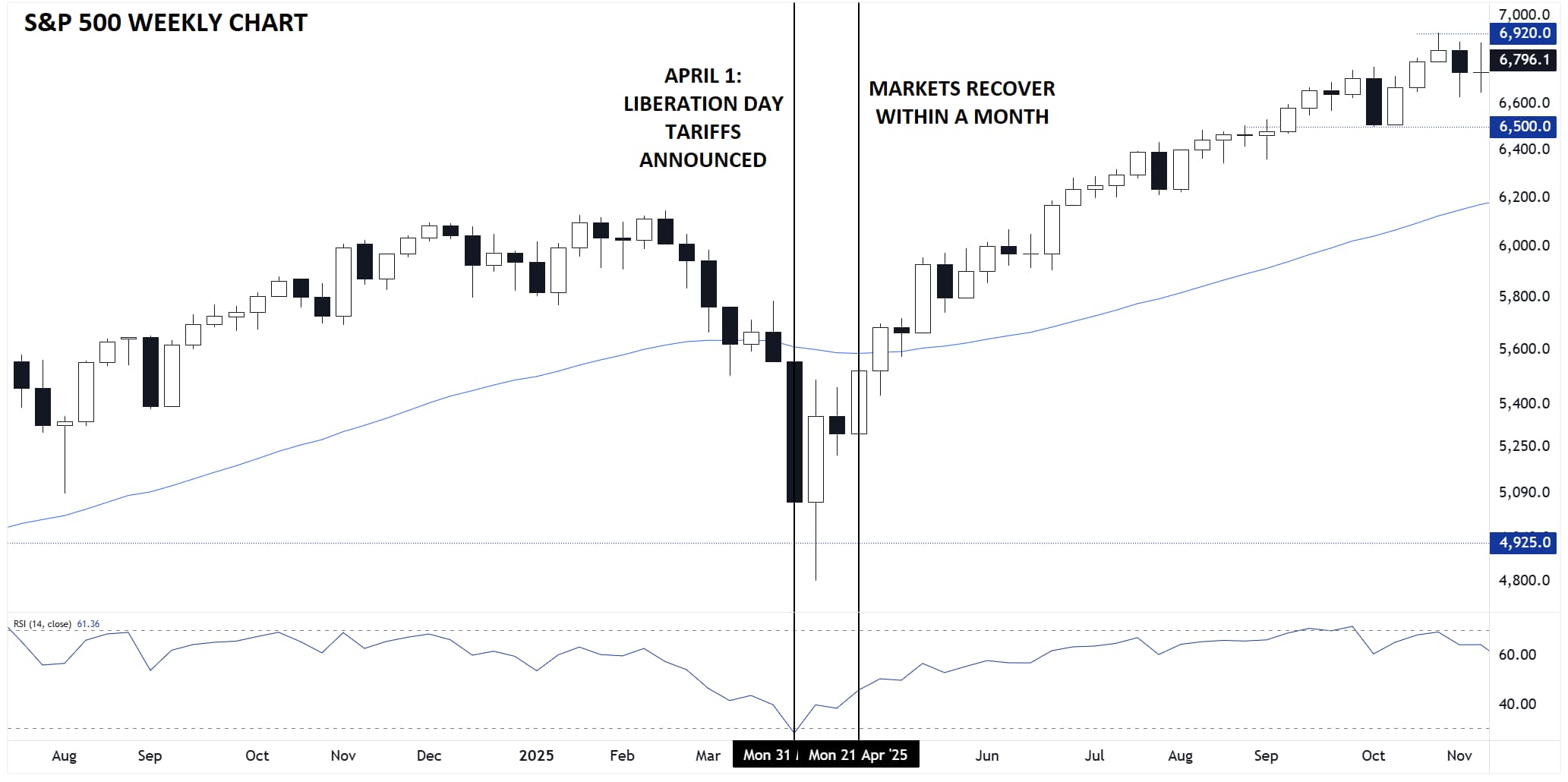
The clearest example of this phenomenon comes from the US’s impositions of the highest tariffs in a century, a policy that many economists suggested would tip the world’s largest economy into a recession, with obvious implications for markets. As the chart below shows, the S&P 500 did see a quick decline on the release, but that move was rapidly reversed, before the imposition of most of the tariffs, and powered onward to new highs in short order:
Source: StoneX, TradingView

Of course, there were ostensibly logical explanations ex-post: The tariffs ultimately haven’t been implemented to the extent outlined on the world’s second-largest economy, companies have used alternative shipping points to sidestep the tariffs, carve outs have limited their impact, the impact hasn’t fully emerged due to inventory cycles, etc. Regardless, the ultimate impact for any traders who viewed this shift as anything but a couple week blip was that they overreacted
This same dynamic has played out in other policy announcements, from tax cuts to increased fiscal spending to central bank interest rate decisions to the longest government shutdown in US history.
Likewise, we’ve seen a widespread decline in the impact of historically significant economic data. Especially in the US, but to an extent in other countries as well, traders have quickly shrugged off “surprising” readings on inflation, jobs, GDP, and sentiment.
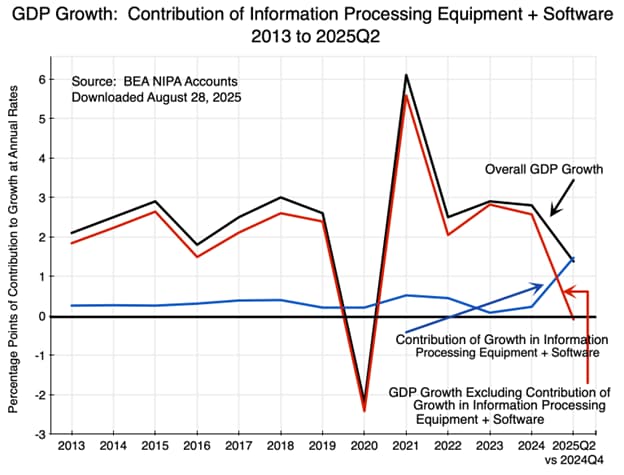
From my perspective, there are at least two reasons why we’ve seen this dynamic play out. Most importantly, the dominant theme of the rise of AI and the associated wealth effect have rendered more traditional economic measures less significant. As long as the AI “Hyperscalers” continue to invest in building data centers, the other aspects of economic growth and other data will continue to take a back seat:
Source: BEA, AnEconomicSense
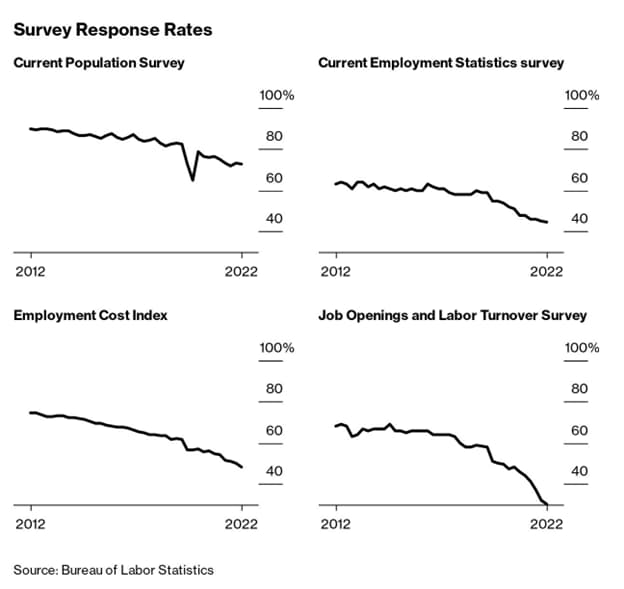
The other reason traders have mostly disregarded economic surprises is that there are reasons to believe that the underlying data is increasingly not representative of the underlying economic conditions. Most economic data has been compiled via surveys for decades…and post-COVID, fewer and fewer people are responding to those very surveys:
Source: BLS, Bloomberg
Tautologically, a survey with fewer respondents is inevitably going to be less precise and indicative of the underlying conditions. At the same time, the widening political gulf is leading more and more consumers to evaluate the economy through their own political lens, rather than an objective view of the underlying business conditions. The UofM Consumer Sentiment survey, for example, has documented wild fluctuations in sentiment around elections, based solely on the current occupant of the White House:
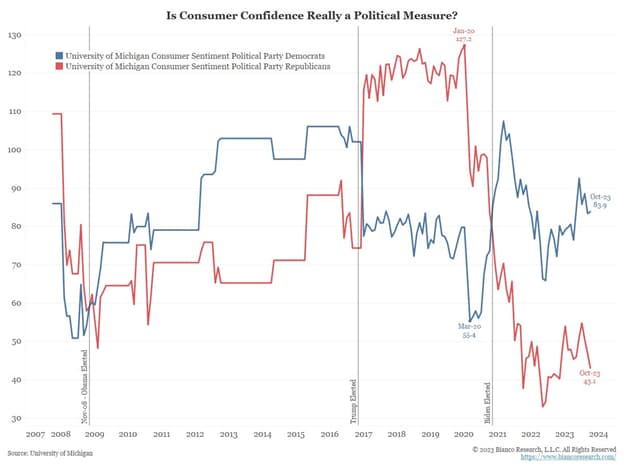
Source: UofM, Jim Bianco
The good news, at least for news- and data-focused traders, is that this surprise may not be permanent. If the AI trade cools down or political biases become less salient in the coming years, traditional economic policy and data could quickly regain its previous importance for markets. Additionally, as we saw during the US government shutdown, alternative forms of data can help fill the gaps and provide a more holistic view of economic conditions, even if the standard data is marred by issues with response rates and political biases.
One key takeaway for traders heading into 2026 would be to take any official policy announcements and data with a grain of salt and at least become more aware of alternative data sources to help inform their trades and maximize their chances of success.
-- Written by Matt Weller, Global Head of Research
Check out Matt’s Daily Market Update videos on YouTube and be sure to follow Matt on Twitter: @MWellerFX
Related tags:
Open an account in minutes
Experience award-winning platforms with fast and secure execution, and enjoy tight spreads from 0.5 pts on FX and 0.3 pts on indices.
Economic calendar
Web Trader platform
Our sophisticated web-based platform is packed with features.
Related articles
AUD/USD Bulls Fight Back After Australian Jobs Shock
AUD/USD has been hit by another ugly Australian employment report, sending RBA rate hike expectations sharply lower. Yet the relationships driving the currency have shifted since quarter-end, and improving risk appetite could provide the fuel for a recovery.

USD/JPY Update: Can the Japanese Yen Sustain Its Recovery?
Short-term price action around the Japanese yen has started to show some relative improvement over recent sessions. This can be seen in the recent performance of USD/JPY, which has now recorded three consecutive daily declines in favor of the Japanese currency, resulting in a depreciation of roughly 0.35% over the period.


US Dollar Technical Outlook: DXY, Treasury Yields Retreat Despite Hot CPI 10 15 2026
The US Dollar is testing major support despite hotter inflation as Fed pushback cools yields and forces markets to reassess the path for tightening.

This report is intended for general circulation only. It should not be construed as a recommendation, or an offer (or solicitation of an offer) to buy or sell any financial products. The information provided does not take into account your specific investment objectives, financial situation or particular needs. Before you act on any recommendation that may be contained in this report, independent advice ought to be sought from a financial adviser regarding the suitability of the investment product, taking into account your specific investment objectives, financial situation or particular needs.
StoneX Financial Pte. Ltd., may distribute reports produced by its respective foreign entities or affiliates within the StoneX group of companies or third parties pursuant to an arrangement under Regulation 32C of the Financial Advisers Regulations. Where the report is distributed to a person in Singapore who is not an accredited investor, expert investor or an institutional investor (as defined in the Securities Futures Act), StoneX Financial Pte. Ltd. accepts legal responsibility to such persons for the contents of the report only to the extent required by law. Singapore recipients should contact StoneX Financial Pte. Ltd. at 6826 9988 for matters arising from, or in connection with the report.
In the case of all other recipients of this report, to the extent permitted by applicable laws and regulations neither StoneX Financial Pte. Ltd. nor its associated companies will be responsible or liable for any loss or damage incurred arising out of, or in connection with, any use of the information contained in this report and all such liability is hereby expressly disclaimed. No representation or warranty is made, express or implied, that the content of this report is complete or accurate.
StoneX Financial Pte. Ltd. is not under any obligation to update this report.
Trading CFDs carries a high level of risk that may not be suitable for some investors. Consider your investment objectives, level of experience, financial resources, risk appetite and other relevant circumstances carefully. The possibility exists that you could lose some or all of your investments, including your initial deposits. If in doubt, please seek independent expert advice. Visit www.forex.com/en-sg/terms-and-policies for the complete Risk Disclosure Statement.