



AUD/USD Forecast: Labour data may force RBA rate rethink
Australian wages and jobs data will test a market narrative built around RBA patience. Firm outcomes may quickly reshape expectations for Australia’s interest rate outlook.
Share this:

- WPI expected to show steady wage growth
- Labour Force Survey seen driving market reaction
- RBA continues to flag labour tightness
- RBA March hike risks remain lightly priced
- AUD/USD bullish trend intact near resistance
Summary
Markets see limited urgency for additional RBA tightening near term, but incoming wages and employment data may challenge that view. The RBA continues to describe labour market conditions as tight, while unit labour costs remain elevated. Should the data reinforce that assessment, expectations for March meeting skip may need another rethink.
Labour market report card due
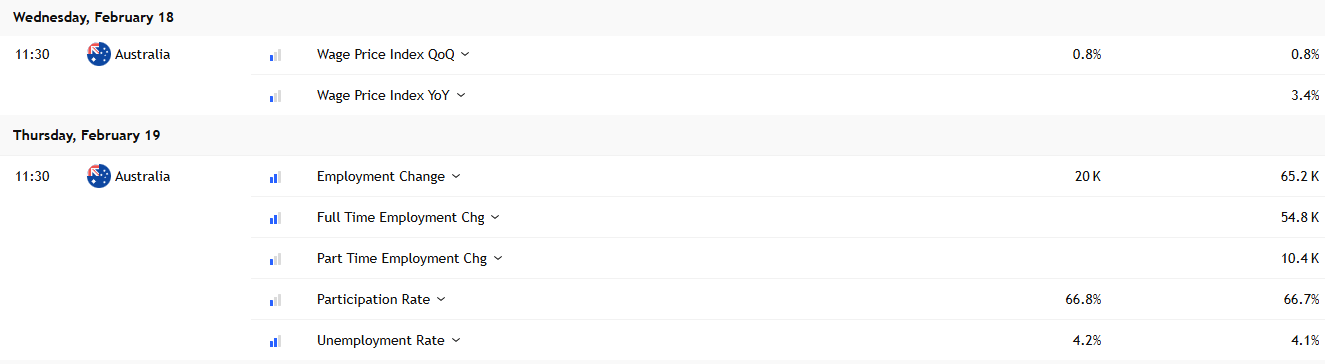
Today’s focus will be on Australia's Wage Price Index. Quarterly growth of 0.8% is expected, an outcome that would leave the annual pace unchanged at 3.4%, assuming no meaningful revisions.
Historically, this release has a strong track record of landing close to consensus, meaning it rarely generates sustained market reactions. On that basis, it may prove to be a nothingburger. However, with uncertainty lingering over whether we’re at the start of a policy recalibration or a tightening cycle from the RBA, any surprise could deliver ripple effects across Australian markets far larger than usual.
The private sector component will warrant most attention. It underwhelmed in the September quarter, rising 0.7% and leaving annual growth at 3.2%, notably trailing the public sector by six tenths. Whether that softness persists or begins to reverse will offer useful insight into underlying economic momentum.
At face value, wages growth around 3.4%, alongside reasonable productivity gains, would be broadly consistent with the RBA returning inflation to its 2.5% midpoint over time. The complication, as has been the case for some time, is Australia’s weak productivity performance, particularly within the public sector.
Source: TradingView
Thursday’s Labour Force Survey is undeniably the more important of the two releases. Unemployment is expected to partially reverse December’s stunning decline, lifting a tenth to 4.2%. That remains the key number to watch.
Participation is seen edging higher to 66.8%, although the broader trend has been drifting lower for some time. Should that persist, it would help keep unemployment relatively steady even if employment growth continues to soften, as recent data have suggested.
Employment is forecast to increase by 20,000, a notable step down from December’s outsized 65,200 gain. The split between full-time and part-time hiring, while often attracting attention, tends to behave like a random number generator and frequently reverses prior moves. It rarely carries strong policy signal.
Realistically, the focus remains squarely on unemployment. Beyond that, the RBA will also be monitoring broader measures of labour demand, including hours worked, underemployment and underutilisation, along with trends in youth unemployment which often respond more quickly to shifts in underlying economic momentum.
These releases take on added significance when viewed alongside the RBA’s latest assessment of labour market conditions and wage dynamics outlined in the February minutes.
RBA takeaways
The minutes made clear that board members remain relatively comfortable with the current state of Australia's labour market. Conditions were again described as “a little tighter than consistent with full employment”, language that implicitly acknowledges the risk that wage pressures may prove firmer than otherwise.
That assessment was reinforced by its broader characterisation of the labour market. Measures of unemployment and underemployment were seen as broadly steady, while the labour market is forecast to remain “a little tight in the near term”. Wages signals aligned with that narrative. Wages growth was seen as slowing only gradually, while unit labour costs growth remained high, underscoring the view that labour-related inflation pressures have not eased decisively.
Against that backdrop, a wages print in line with forecasts and no meaningful reversal of December’s employment strength would leave March very live for a follow-up hike. That combination would likely support the Australian dollar while weighing on short-dated Australian bonds and equities.
Rate pricing reality check?
Source: Bloomberg
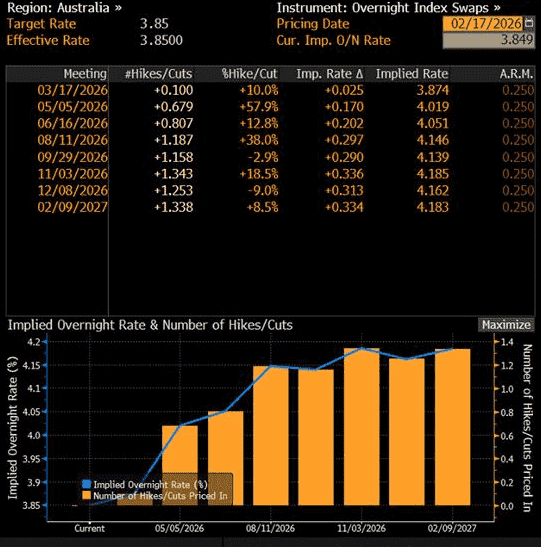
Market pricing continues to lean towards patience rather than urgency from the RBA. Implied probabilities from swaps suggest a 25 basis point hike in March is viewed as a remote possibility at around 10%, with May seen as the next genuinely live meeting, carrying roughly a two-in-three chance of a move. That profile likely reflects the RBA’s preference for adjusting policy after updated quarterly trimmed mean inflation data.
Even so, the pricing looks conservative. Momentum across cyclical parts of the economy has shown few convincing signs of fatigue, raising questions as to why only one full hike is priced by August.
Recent data have made it clear that Australia continues to grapple with an inflation problem. The RBA’s own forecasts last month implicitly suggested at least two additional hikes would likely be required to guide trimmed mean inflation back towards target. Therefore, should incoming data again surprise on the firm side, the risk is that the RBA moves earlier than markets currently anticipate.
Global crosswinds stir
Although Australian data and RBA pricing remain the focus near-term, offshore factors look set to dominate later in the week.
Attention may shift to the United States where the data flow begins to accelerate towards the weekend. Several potentially market-moving releases are scheduled, including the core PCE deflator, income and consumption data for December, and the advance estimate of Q4 GDP. Markets may also be alert to a possible ruling from the US Supreme Court on the legality of Donald Trump’s reciprocal tariffs. More details can be found here.
AUD/USD technical picture
Source: TradingView
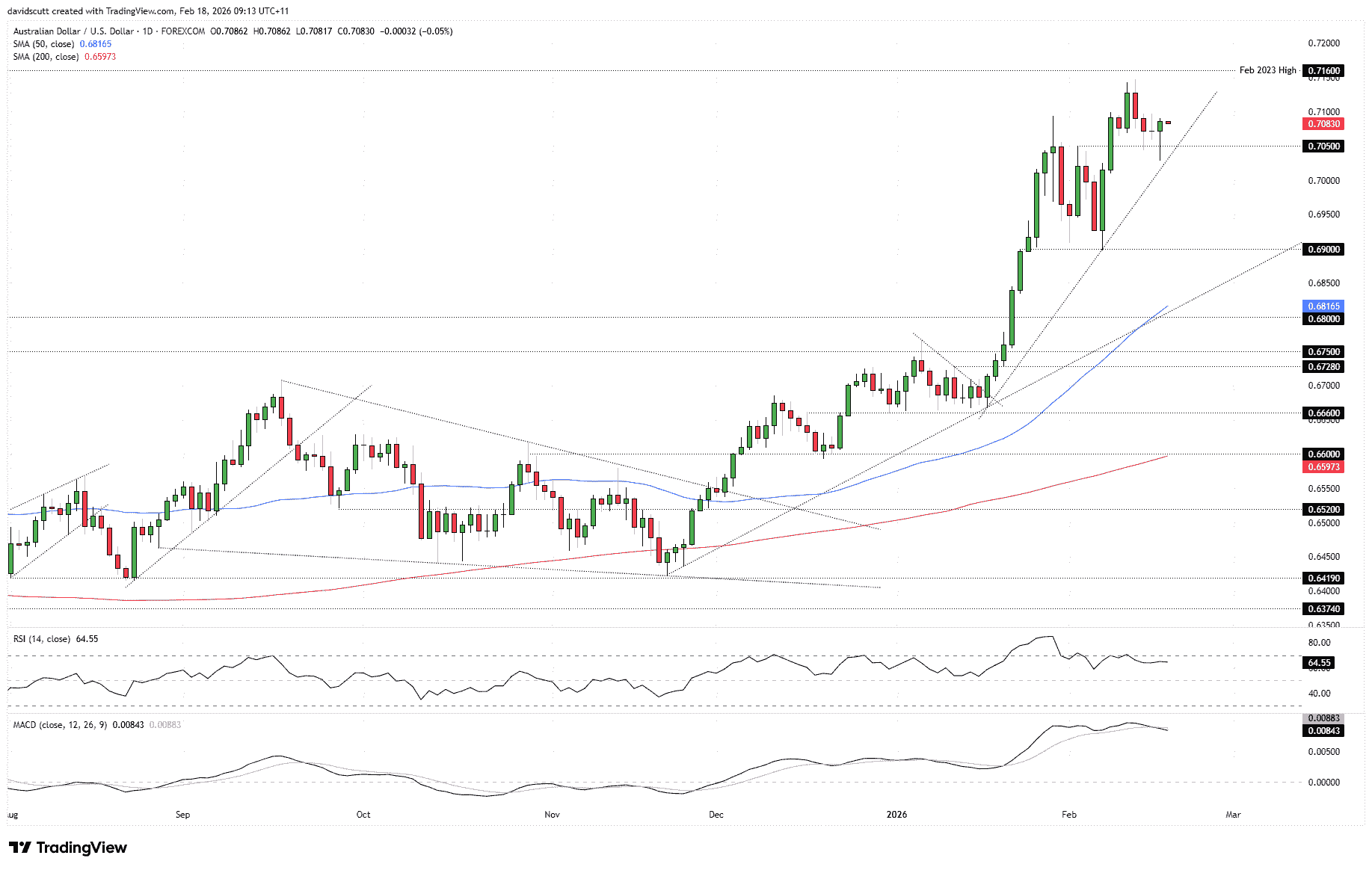
On the daily chart, AUD/USD remains in a bullish trend, although RSI (14) and MACD are flashing early warning signals that upside momentum may be gradually fading. This is not a bearish signal, but it does suggest gains may be harder won from current levels.
In terms of levels to watch, the pair has attracted bids on dips below .7050 in two of the past three sessions, placing that level firmly on the radar. Beneath it, the January 2026 uptrend is located around .7025. A convincing break of both would shift attention towards .7000 and .6900.
On the topside, the recent advance stalled just beneath the February 2023 high earlier this month, leaving both levels relevant for those maintaining a bullish bias. A clean break above would signal a resumption of the broader uptrend and place a retest of the June 2022 high at .7282 on the table.
With key moving averages sloping higher, price holding within multiple uptrend structures, and oscillators still favouring long setups over shorts, that remains the directional bias I’m running with for now, especially should broader risk appetite strengthen.
Latest market news




Open an account in minutes
Experience award-winning platforms with fast and secure execution, and enjoy tight spreads from 0.5 pts on FX and 0.3 pts on indices.
Economic calendar
Web Trader platform
Our sophisticated web-based platform is packed with features.
Related articles
Fed, DXY, EUR/USD, GBP/USD, USD/CAD, Gold Weekly Technical Outlook 10 26 2026
Sr. Technical Strategist Michael Boutros highlights the levels that matter on the USD Majors, commodities, and equity indices charts this week.

EUR/USD Update: Euro Weakness Returns Ahead of Central Bank Decisions
A new trading week is underway and the euro continues to show signs of weakness in the short term. This can be seen in the recent performance of EUR/USD, which has fallen nearly 0.5% over the last three trading sessions, reflecting a relatively consistent loss of momentum in the European currency.


Crude Oil Weekly Outlook: Elections Test Brent–WTI Resistance Levels
Crude Oil Weekly Outlook: Brent–WTI spread tests long-term resistance as monthly RSI reaches overbought territory and key elections approach. Brent and WTI levels and risks ahead.

This report is intended for general circulation only. It should not be construed as a recommendation, or an offer (or solicitation of an offer) to buy or sell any financial products. The information provided does not take into account your specific investment objectives, financial situation or particular needs. Before you act on any recommendation that may be contained in this report, independent advice ought to be sought from a financial adviser regarding the suitability of the investment product, taking into account your specific investment objectives, financial situation or particular needs.
StoneX Financial Pte. Ltd., may distribute reports produced by its respective foreign entities or affiliates within the StoneX group of companies or third parties pursuant to an arrangement under Regulation 32C of the Financial Advisers Regulations. Where the report is distributed to a person in Singapore who is not an accredited investor, expert investor or an institutional investor (as defined in the Securities Futures Act), StoneX Financial Pte. Ltd. accepts legal responsibility to such persons for the contents of the report only to the extent required by law. Singapore recipients should contact StoneX Financial Pte. Ltd. at 6826 9988 for matters arising from, or in connection with the report.
In the case of all other recipients of this report, to the extent permitted by applicable laws and regulations neither StoneX Financial Pte. Ltd. nor its associated companies will be responsible or liable for any loss or damage incurred arising out of, or in connection with, any use of the information contained in this report and all such liability is hereby expressly disclaimed. No representation or warranty is made, express or implied, that the content of this report is complete or accurate.
StoneX Financial Pte. Ltd. is not under any obligation to update this report.
Trading CFDs carries a high level of risk that may not be suitable for some investors. Consider your investment objectives, level of experience, financial resources, risk appetite and other relevant circumstances carefully. The possibility exists that you could lose some or all of your investments, including your initial deposits. If in doubt, please seek independent expert advice. Visit www.forex.com/en-sg/terms-and-policies for the complete Risk Disclosure Statement.