



Cerebras (CBRS) IPO: Everything You Need to Know About Cerebras
The Cerebras IPO it offers public investors direct exposure to an alternative AI chip architecture and a test of investor appetite for AI names ahead of potentially larger IPOs like SpaceX, Anthropic, or OpenAI later this year.
Share this:

Cerebras Systems is a fast-rising AI hardware company that designs wafer-scale chips and sells full AI “supercomputer” systems aimed at speeding up model training and inference.
In May 2026, Cerebras moved from long-running IPO speculation to an active offering process, positioning itself as a rare public-market pure play in AI chips outside of the incumbent giants.
Source: CNBC
What Does Cerebras Do?
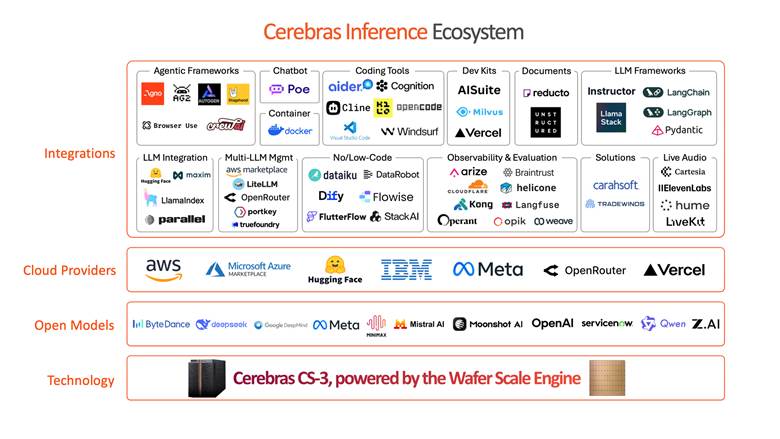
Cerebras builds AI compute systems powered by its Wafer-Scale Engine (WSE), a processor that uses an entire silicon wafer as a single chip rather than slicing it into many smaller dies. The company’s third-generation WSE-3 and CS-3 system are marketed as simplifying large-scale AI training by reducing the complexity of distributed computing.
Cerebras sells:
- On-premise systems (CS-3 and clustered “wafer-scale” deployments)
- Cloud access (Cerebras Cloud)
- Software tooling for training and inference workflows
A major theme in its go-to-market strategy is pairing its hardware with large-scale deployments through partners and customers, including the “Condor Galaxy” AI supercomputer network announced with UAE-based G42.
Source: Cerebras
Is Cerebras Going Public?
Yes. Cerebras filed an S-1 with the US SEC on April 17, 2026 for a proposed IPO, and it is seeking to list on Nasdaq under the ticker CBRS.
Ahead of the offering, the company updated its offering terms, reflecting strong demand during marketing. Cerebras is expected to price its IPO on Wednesday, May 13, 2026 with trading expected to begin Thursday, May 14, 2026 on Nasdaq under CBRS.
Why Is Cerebras Doing an IPO?
An IPO would give Cerebras:
- More capital to scale manufacturing, R&D, and cloud capacity
- A public currency for partnerships and talent retention
- Greater visibility and credibility with enterprise and government buyers
- Liquidity for early investors and employees
More importantly for traders, it also serves as a public-market test for a key question: can a specialized AI chip and systems company compete at scale in a market dominated by Nvidia?
Cerebras IPO Valuation
Cerebras raised its indicated IPO price range to $150 to $160 per share and increased the deal size to 30 million shares, implying up to about $4.8 billion in proceeds at the top of the range (before any overallotment).
If Cerebras prices near the top end and raises ~$4.8B, it would be larger than Lineage (the biggest IPO of 2024) and essentially neck-and-neck with Arm (2023’s largest IPO), making it one of the biggest IPOs in years.
Cerebras IPO Financial Profile: Revenue and Profitability
Cerebras disclosed rapid recent growth, including 2025 revenue of $510 million, up 76% year over year. Kiplinger reported Cerebras posted GAAP net income of $237.8 million in 2025, following a large loss in the prior year.
As with any IPO, investors will want to understand how repeatable that profitability is, how much depends on customer mix and large contracts, and how margins behave as the company scales deployments.
Cerebras IPO: Customer Concentration and Contract Exposure
A central issue in the Cerebras story is customer concentration. Barron’s reported that a very large share of revenue has come from two UAE-based clients, and it also referenced a large backlog that includes major commitments.
This matters because public-market investors typically discount businesses where a small number of customers drive most revenue, even if growth is fast.
Who Owns Cerebras?
Cerebras is venture-backed and has raised substantial private capital over multiple rounds. Tracxn estimates roughly $2.55 billion raised across 8 rounds, including a reported $1.0 billion round in February 2026 and a $1.1 billion round in September 2025.
Post-IPO voting control is another topic investors should watch. Barron’s noted a dual-class style structure where insiders retain outsized voting power.
Who Are Cerebras’s Competitors?
Cerebras competes across AI compute, where alternatives include:
- Nvidia GPU platforms (and the surrounding CUDA software ecosystem)
- AMD and Intel accelerators in data centers
- Custom silicon from hyperscalers (TPUs and in-house accelerators)
- Other AI chip startups targeting training and inference
Cerebras’s differentiation is its wafer-scale architecture and full-system approach, which aims to reduce the complexity and bottlenecks of large distributed GPU clusters for certain workloads.
Cerebras IPO Leadership Team
Cerebras was founded in 2016 and is led by CEO Andrew Feldman. Feldman is a longtime semiconductor and systems executive and is the most visible public face of the company, including throughout the IPO process.
Cerebras IPO: Key Risks to Understand Before Trading
Cerebras’s IPO may be exciting, but it is not necessarily as simple as “AI equals up” story. Key risks include:
- Customer concentration and geopolitical exposure tied to large customers and contracts
- Competitive pressure from Nvidia and hyperscaler custom silicon
- Hardware scaling risk, including supply chain and manufacturing execution
- Share structure and insider control that may limit shareholder influence
- IPO volatility, especially for richly priced, high-momentum AI names
Cerebras IPO: The Bottom Line
Cerebras is attempting to break into one of the hardest markets in tech: AI compute hardware at global scale. Even if you have no intention of trading it directly, its IPO is notable because it offers public investors direct exposure to an alternative AI chip architecture and a test of investor appetite for AI names ahead of potentially larger IPOs like SpaceX, Anthropic, or OpenAI that are rumored for later this year.
Related tags:
Latest market news




Open an account in minutes
Experience award-winning platforms with fast and secure execution, and enjoy tight spreads from 0.5 pts on FX and 0.3 pts on indices.
Economic calendar
Web Trader platform
Our sophisticated web-based platform is packed with features.
Related articles
US Midterm Fallout: What Does the “Blue Tsunami” Mean for the S&P 500?
Democrats made sweeping gains in the US midterm elections, winning control of both the House and Senate - what does it mean for the S&P 500 and the AI trade?

Blue wave adds to Nikkei’s AI troubles
The Nikkei 225 has taken another beating as a Democratic sweep adds to concerns about AI investment returns. But after the scale of the earlier declines, how much bad news is already priced in?

Gold, silver outlook: Sandwiched between bullish bonds and AI angst
XAU/USD and XAG/USD may be approaching a bullish turning point as Treasury futures threaten a breakout. The problem? Both metals have recently been trading more like tech stocks than havens.
This report is intended for general circulation only. It should not be construed as a recommendation, or an offer (or solicitation of an offer) to buy or sell any financial products. The information provided does not take into account your specific investment objectives, financial situation or particular needs. Before you act on any recommendation that may be contained in this report, independent advice ought to be sought from a financial adviser regarding the suitability of the investment product, taking into account your specific investment objectives, financial situation or particular needs.
StoneX Financial Pte. Ltd., may distribute reports produced by its respective foreign entities or affiliates within the StoneX group of companies or third parties pursuant to an arrangement under Regulation 32C of the Financial Advisers Regulations. Where the report is distributed to a person in Singapore who is not an accredited investor, expert investor or an institutional investor (as defined in the Securities Futures Act), StoneX Financial Pte. Ltd. accepts legal responsibility to such persons for the contents of the report only to the extent required by law. Singapore recipients should contact StoneX Financial Pte. Ltd. at 6826 9988 for matters arising from, or in connection with the report.
In the case of all other recipients of this report, to the extent permitted by applicable laws and regulations neither StoneX Financial Pte. Ltd. nor its associated companies will be responsible or liable for any loss or damage incurred arising out of, or in connection with, any use of the information contained in this report and all such liability is hereby expressly disclaimed. No representation or warranty is made, express or implied, that the content of this report is complete or accurate.
StoneX Financial Pte. Ltd. is not under any obligation to update this report.
Trading CFDs carries a high level of risk that may not be suitable for some investors. Consider your investment objectives, level of experience, financial resources, risk appetite and other relevant circumstances carefully. The possibility exists that you could lose some or all of your investments, including your initial deposits. If in doubt, please seek independent expert advice. Visit www.forex.com/en-sg/terms-and-policies for the complete Risk Disclosure Statement.