



Crude Oil Update: WTI Maintains a Bullish Bias and Attempts to Revisit $100
At the start of the trading session, WTI crude posted a gain of more than 7.7%, bringing price action once again close to the $100 per barrel level in the short term. The renewed buying pressure is mainly driven by fresh updates from the Middle East conflict, which continue to raise concerns about global supply dynamics.
Share this:

At the start of the trading session, WTI crude posted a gain of more than 7.7%, bringing price action once again close to the $100 per barrel level in the short term.
The renewed buying pressure is mainly driven by fresh updates from the Middle East conflict, which continue to raise concerns about global supply dynamics. As long as this risk bias remains in place, it could translate into sustained buying pressure that continues to drive oil price movements in the coming sessions.


The Conflict Shows No Signs of Ending
Now entering day 13 of the conflict in the Middle East, concerns about disruptions in the Strait of Hormuz have become increasingly evident in the short term, as more than 20% of global oil supply transits through this route.
Although the United States has mentioned the release of strategic crude reserves, totaling approximately 172 million barrels, the process could take at least 120 days, which is being perceived as a temporary rather than structural solution to the supply dynamics that could impact 2026.
In fact, the International Energy Agency has stated that this represents one of the largest supply disruptions in recent oil market history and that it may take considerable time before operations return to pre-conflict levels. This has raised doubts as to whether reserve releases will be sufficient to mitigate the short-term supply impact.
Under this scenario, activity in the oil market does not appear to be slowing. Looking at flows in the United States Oil Fund ETF, there has been consistent capital inflow since March 5, and on March 10 alone, flows exceeded $250 million, demonstrating that demand has not yet been exhausted and that activity remains strong, particularly in the absence of expectations for a rapid conflict resolution.

Source: ETFDB
Given this backdrop, the main catalyst behind oil’s recent strength continues to be the Middle East conflict and the potential disruption of global crude supply. Unless a short-term agreement is reached or consistent reopening of the Strait of Hormuz occurs, the market is likely to remain under upward pressure, with demand continuing to influence WTI price movements in the coming sessions.
Is Higher Volatility Expected?
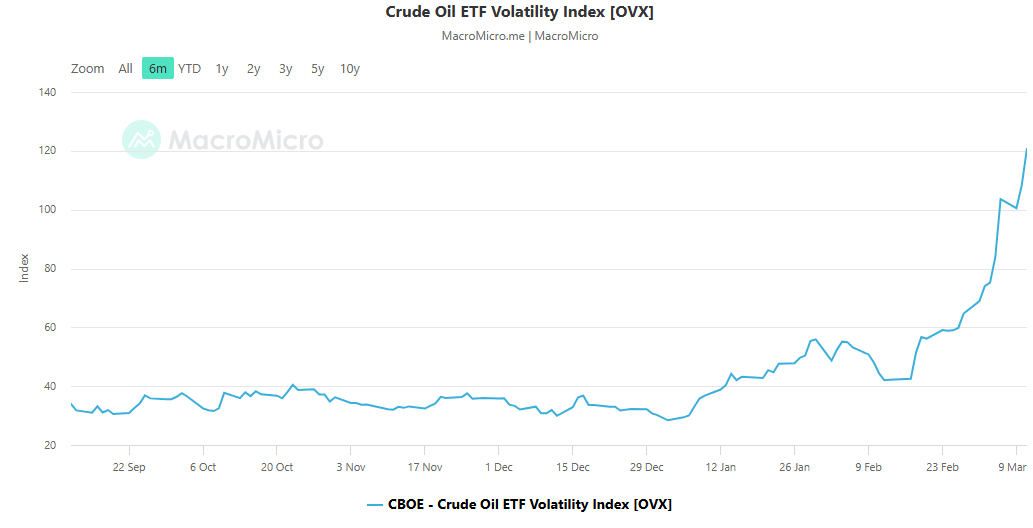
The OVX index, which measures implied volatility in options on oil ETFs, serves as a benchmark for market movement expectations. Currently, OVX continues to rise and, based on data as of March 11, stands near 120 points, a level not observed in several years. This reflects a significant increase in implied volatility expectations for the next 30 days.
Source: Macromicro
The steady increase in OVX suggests that the market is preparing for aggressive price movements in crude oil in the short term. This may increase the geopolitical risk premium and generate stronger demand for hedging among institutional investors.
While this environment may support further price advances, it also implies elevated risk, which could lead to sharp declines if sentiment shifts abruptly. Therefore, as long as OVX remains at elevated levels, a more pronounced indecision bias could develop in WTI price action over the coming sessions.
Technical Outlook for WTI

Source: StoneX, Tradingview
- Aggressive Trend Attempts to Hold: Recent sessions have marked a significant shift in WTI’s short-term dynamics, as bullish momentum has been dominant and has given rise to the potential formation of a more aggressive upward trendline. This reinforces the idea of short-term buying dominance. However, it is important to consider that this trendline may not remain fully stable in the coming sessions. The recent overextension in buying pressure could also open the door for short-term corrective pullbacks.
- RSI: The RSI remains above the 70 level, which corresponds to overbought territory. This indicates a possible imbalance in price momentum due to excessive buying pressure. As long as this behavior persists, room may remain for corrective downside moves in the coming sessions.
- ADX: The ADX line remains at elevated levels, reflecting that average volatility over the past 14 sessions has been significant. If the indicator continues to rise, it could reinforce the probability of aggressive price movements, maintaining a high-volatility environment.
Key Levels:
- $100 – Key Resistance: A major psychological level in current price movements. Sustained moves above this level could reinforce buying dominance and extend the aggressive upward trend in the coming sessions.
- $84 – Near-Term Barrier: Corresponds to the most recent short-term support level and may act as a reference point for potential corrective pullbacks.
- $76 – Key Support: Level corresponding to the most relevant recent lows and the main bearish barrier to monitor. Moves toward this area could invalidate the current aggressive trend formation and give way to a more consistent phase of indecision in crude oil prices.
Written by Julian Pineda, CFA, CMT – Market Analyst
Follow him on: @julianpineda25
Related tags:
Latest market news



Open an account in minutes
Experience award-winning platforms with fast and secure execution, and enjoy tight spreads from 0.5 pts on FX and 0.3 pts on indices.
Economic calendar
Web Trader platform
Our sophisticated web-based platform is packed with features.
Related articles
Crude Oil Weekly Outlook: Houthi Attacks vs. a Double Top?
Crude oil weekly outlook: The Democratic win triggered a steep sell-off across crude oil charts, pushing WTI toward the neckline of a potential major double-top pattern. However, the new Congress does not take office until January, while persistent geopolitical risks—including the latest Houthi escalations—continue to keep a risk premium embedded in oil prices.

Crude Oil, DXY Outlook: Geopolitical Risks Halt Sell-Offs in the Dollar and Oil
The U.S. Dollar Index, Brent and WTI are rebounding from key support levels and oversold conditions after steep sell-offs. U.S.–Iran tensions, inflation risks and rate expectations remain in focus.

Silver's bullish breakout case builds as bond yields retreat
The Democratic blue wave has sent crude and Treasury yields sharply lower, improving the outlook for precious metals. With gold already breaking higher, could silver be next?

This report is intended for general circulation only. It should not be construed as a recommendation, or an offer (or solicitation of an offer) to buy or sell any financial products. The information provided does not take into account your specific investment objectives, financial situation or particular needs. Before you act on any recommendation that may be contained in this report, independent advice ought to be sought from a financial adviser regarding the suitability of the investment product, taking into account your specific investment objectives, financial situation or particular needs.
StoneX Financial Pte. Ltd., may distribute reports produced by its respective foreign entities or affiliates within the StoneX group of companies or third parties pursuant to an arrangement under Regulation 32C of the Financial Advisers Regulations. Where the report is distributed to a person in Singapore who is not an accredited investor, expert investor or an institutional investor (as defined in the Securities Futures Act), StoneX Financial Pte. Ltd. accepts legal responsibility to such persons for the contents of the report only to the extent required by law. Singapore recipients should contact StoneX Financial Pte. Ltd. at 6826 9988 for matters arising from, or in connection with the report.
In the case of all other recipients of this report, to the extent permitted by applicable laws and regulations neither StoneX Financial Pte. Ltd. nor its associated companies will be responsible or liable for any loss or damage incurred arising out of, or in connection with, any use of the information contained in this report and all such liability is hereby expressly disclaimed. No representation or warranty is made, express or implied, that the content of this report is complete or accurate.
StoneX Financial Pte. Ltd. is not under any obligation to update this report.
Trading CFDs carries a high level of risk that may not be suitable for some investors. Consider your investment objectives, level of experience, financial resources, risk appetite and other relevant circumstances carefully. The possibility exists that you could lose some or all of your investments, including your initial deposits. If in doubt, please seek independent expert advice. Visit www.forex.com/en-sg/terms-and-policies for the complete Risk Disclosure Statement.