



EUR/USD Outlook: The Euro Maintains a Bullish Bias Ahead of the Federal Reserve Decision
The EUR/USD pair has posted a five-session winning streak, establishing a defined bullish bias in favor of the euro in the short term as key monetary policy decisions approach in both the United States and Europe.
Share this:

The EUR/USD pair has posted a five-session winning streak, establishing a defined bullish bias in favor of the euro in the short term as key monetary policy decisions approach in both the United States and Europe. For now, buying pressure remains firm amid expectations that the Fed’s rate-cut cycle will continue, which could reduce the attractiveness of the U.S. dollar. Meanwhile, the European Central Bank (ECB) is expected to maintain a neutral stance. If this monetary policy divergence persists, a stronger buying bias could develop in the EUR/USD pair in the short term.


What’s the Current Central Bank Dynamic?
The Federal Reserve is set to announce its policy decision on October 29, followed by the European Central Bank meeting on October 30, marking this week as a crucial one for both the euro and the dollar. Any comments related to monetary policy could have a significant impact on the performance of both currencies in the coming weeks.
In the case of the United States, expectations point toward another rate cut, bringing the current level down from 4.25% to around 4.00%, according to data from the CME Group, which assigns a 96.7% probability to a 25-basis-point reduction. It is unlikely that the decision will differ from expectations, mainly because the Fed has been unable to fully assess recent labor market data due to the government shutdown. Therefore, the central bank is expected to maintain its plan for gradual rate cuts until new economic data suggest otherwise. In fact, the probability of another reduction to 3.75% for the December 10 meeting stands at 87.9%, reinforcing the view that interest rates will continue to decline into late 2025.
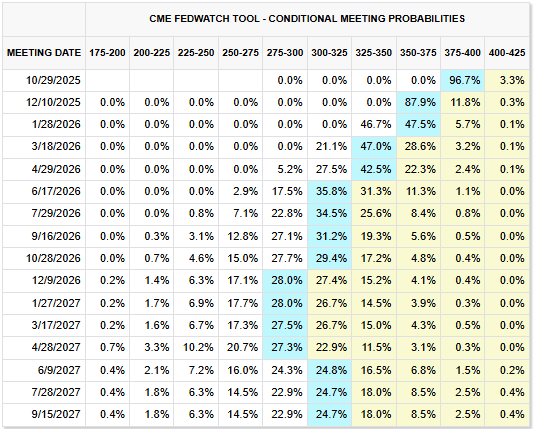
Source: CMEGROUP
In Europe, the outlook differs. For the October 30 meeting, the market assigns a 94.7% probability that the deposit rate will remain unchanged at 2.00%. The ECB has repeatedly emphasized that any future rate cuts will depend on further evidence of slowing inflation, allowing room for a more accommodative stance. For now, the ECB appears to have adopted a neutral position, in contrast to the Federal Reserve, which is clearly leaning toward a more dovish policy path.
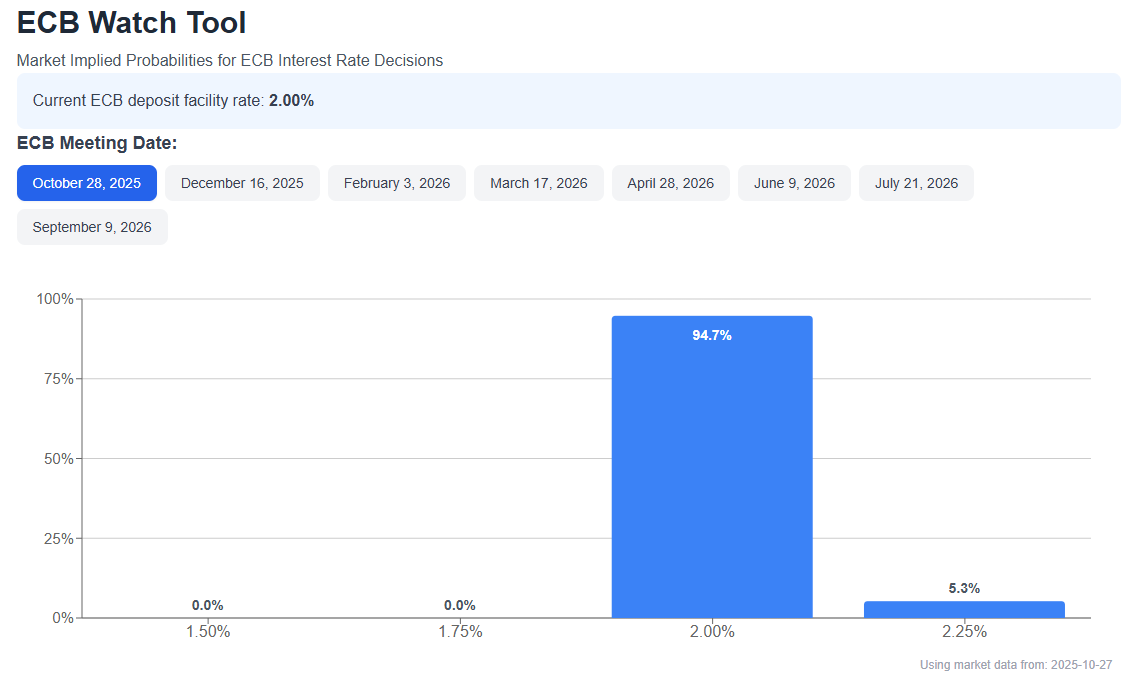
Source: ECB Watch
For several months, the Fed and the ECB have maintained an interest rate differential that favored U.S. investments. However, as the United States begins its rate-cutting cycle, this gap has started to narrow, benefiting euro-denominated investments. As the appeal of U.S. bonds diminishes, capital flows could shift toward more stable markets such as Europe. This could reduce demand for the dollar and support the euro in the short term.
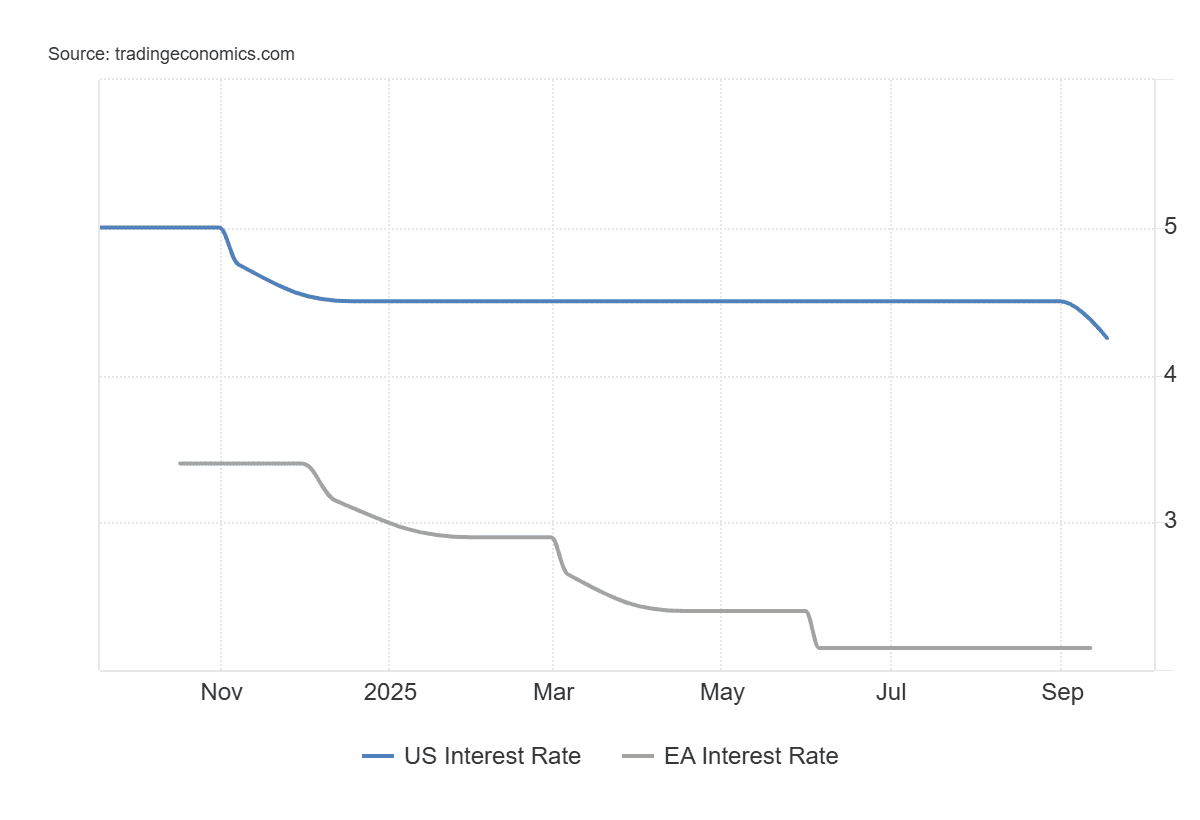
Source: Tradingeconomics
Finally, if both central banks confirm their respective stances — with the Fed maintaining lower rates and the ECB remaining neutral — the rate differential between both regions may continue to narrow, reducing the appeal of dollar-based investments. This scenario could result in sustained buying pressure on the EUR/USD, provided there are no unexpected policy shifts as 2025 draws to a close.
EUR/USD Technical Outlook
Source: StoneX, Tradingview
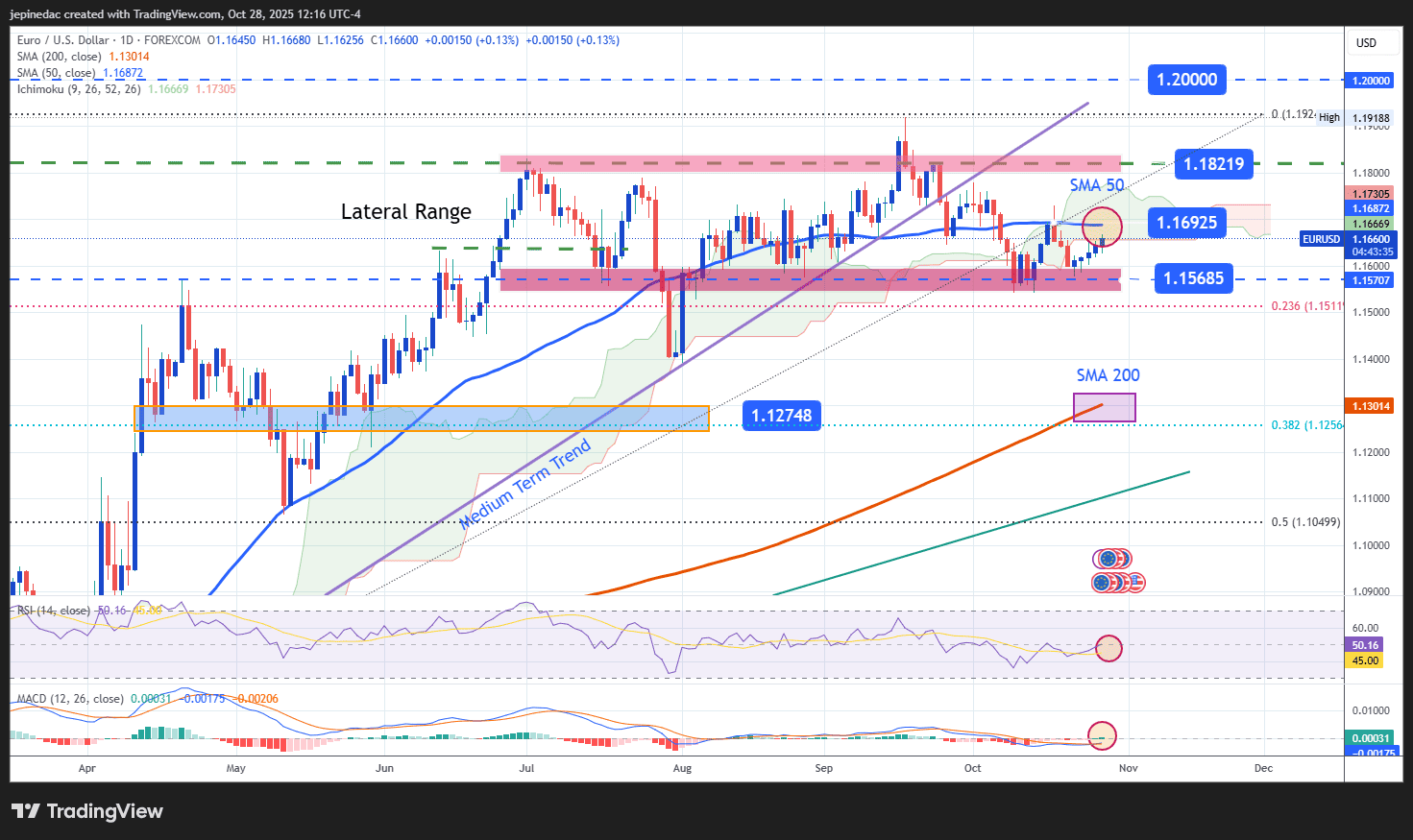
- Sideways Range: Since July 1, the EUR/USD has been trading within a sideways range, with resistance near 1.18219 and support around 1.15685. So far, price movements have not been strong enough to break this structure, which remains the dominant technical formation. As long as the pair stays within this range, it is unlikely to establish a clear directional trend in the coming weeks.
- RSI: The RSI line continues to fluctuate around the neutral 50 level, indicating a balance between bullish and bearish momentum over the past 14 sessions. This behavior suggests a more pronounced neutrality in the short term until new fundamental catalysts emerge to drive a clearer directional bias.
- MACD: The MACD histogram oscillates around the neutral line (0), reflecting a technical equilibrium in short-term moving averages. As long as this condition persists, indecision may continue to dominate price behavior until fundamental drivers come into play and trigger stronger directional movement.
Key Levels:
- 1.16925 – Current Barrier: A retracement zone aligned with the 50-period moving average and the Ichimoku cloud. A break above this level could trigger short-term bullish momentum, potentially driving the pair toward the upper boundary of the sideways channel.
- 1.18219 – Major Resistance: This marks the upper boundary of the current range and the yearly highs for the EUR/USD. A sustained breakout above this level could reactivate the medium-term uptrend, pushing the pair closer to the 1.2000 psychological zone.
- 1.15685 – Key Support: This represents the lower boundary of the range and coincides with the 23.6% Fibonacci retracement. A decisive break below this level could initiate a new bearish trend in the short term.
Written by Julian Pineda, CFA – Market Analyst
Follow him on: @julianpineda25


Open an account in minutes
Experience award-winning platforms with fast and secure execution, and enjoy tight spreads from 0.5 pts on FX and 0.3 pts on indices.
Economic calendar
Web Trader platform
Our sophisticated web-based platform is packed with features.
Related articles
EUR/USD forecast remains tilted lower with French bond troubles ahead of US jobs report
The EUR/USD has tagged a fresh year-to-date low as French public-finance concerns trigger a government bond sell-off. Today's US jobs report may change little, with resilient activity, elevated energy prices and hawkish Fed bets keeping the greenback supported. With the pair trapped below resistance at 1.1410, the risk to the near-term EUR/USD forecast is tilted to the downside.

What Stretched 10-Year Yields Mean for Major Currency Pairs in Q4
U.S. 10-year Treasury yields are nearing a long-term resistance zone with overbought RSI readings, raising near-term pullback risk for the dollar.


USD/CAD shooting star puts September surge on notice
USD/CAD has printed a clear bearish reversal pattern after an extraordinary September surge, but confirmation may depend heavily on how US Treasury yields react to Friday’s payrolls report.

This report is intended for general circulation only. It should not be construed as a recommendation, or an offer (or solicitation of an offer) to buy or sell any financial products. The information provided does not take into account your specific investment objectives, financial situation or particular needs. Before you act on any recommendation that may be contained in this report, independent advice ought to be sought from a financial adviser regarding the suitability of the investment product, taking into account your specific investment objectives, financial situation or particular needs.
StoneX Financial Pte. Ltd., may distribute reports produced by its respective foreign entities or affiliates within the StoneX group of companies or third parties pursuant to an arrangement under Regulation 32C of the Financial Advisers Regulations. Where the report is distributed to a person in Singapore who is not an accredited investor, expert investor or an institutional investor (as defined in the Securities Futures Act), StoneX Financial Pte. Ltd. accepts legal responsibility to such persons for the contents of the report only to the extent required by law. Singapore recipients should contact StoneX Financial Pte. Ltd. at 6826 9988 for matters arising from, or in connection with the report.
In the case of all other recipients of this report, to the extent permitted by applicable laws and regulations neither StoneX Financial Pte. Ltd. nor its associated companies will be responsible or liable for any loss or damage incurred arising out of, or in connection with, any use of the information contained in this report and all such liability is hereby expressly disclaimed. No representation or warranty is made, express or implied, that the content of this report is complete or accurate.
StoneX Financial Pte. Ltd. is not under any obligation to update this report.
Trading CFDs carries a high level of risk that may not be suitable for some investors. Consider your investment objectives, level of experience, financial resources, risk appetite and other relevant circumstances carefully. The possibility exists that you could lose some or all of your investments, including your initial deposits. If in doubt, please seek independent expert advice. Visit www.forex.com/en-sg/terms-and-policies for the complete Risk Disclosure Statement.