



EUR/USD Update: Bearish bias takes over the market after Powell’s speech
The week has not been favorable for euro price action in the short term. This is mainly due to the fact that, shortly after the Federal Reserve’s decision, EURUSD began to show renewed weakness.
Share this:

The week has not been favorable for euro price action in the short term. This is mainly due to the fact that, shortly after the Federal Reserve’s decision, EURUSD began to show renewed weakness, with the pair posting a decline of more than 0.8% on the day, bringing a bearish bias back into focus.
For now, the central bank decision appears to have triggered a renewed strength in the U.S. dollar, pushing the euro lower. This development could remain relevant in the coming sessions, maintaining a downward bias in EURUSD. However, the market is still awaiting the European Central Bank’s policy decision, scheduled for tomorrow.


Federal Reserve Day
Earlier today, the Federal Reserve announced its monetary policy decision, keeping the interest rate unchanged at 3.75%, in line with expectations and reinforcing its current neutral stance.
Following the decision, Jerome Powell’s speech gained particular attention, as he highlighted that inflation remains above the 2.00% target. He also pointed to potential inflationary pressures, driven by rising oil prices and ongoing uncertainty linked to the Middle East conflict.
Although Powell maintained a cautious tone, he made it clear that rate cuts are not guaranteed in the short term, and that the Fed will continue to closely monitor incoming data before adjusting its policy stance.
This message had a direct impact on the Fed’s probability outlook. Prior to the speech, markets expected rate cuts to begin around December 2026. However, expectations have now shifted, with a higher probability that rates will remain unchanged even until March 2027.
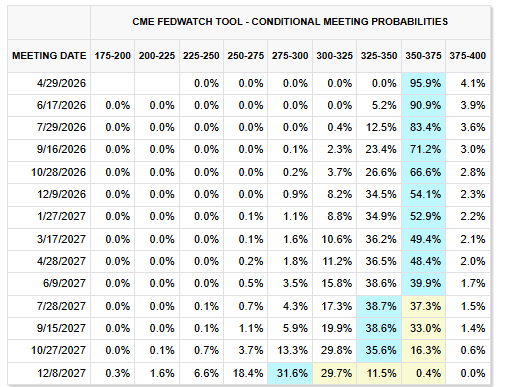
Source: CMEGROUP
This shift in expectations has supported the U.S. dollar, as it has boosted the U.S. bond market, with the 10-year yield moving closer to 4.3%, restoring attractiveness and encouraging capital inflows.
This effect is already visible in the DXY (U.S. Dollar Index), which measures the strength of the U.S. dollar against a basket of major currencies. The index has regained the 100 level, showing renewed buying pressure in the dollar in the short term.
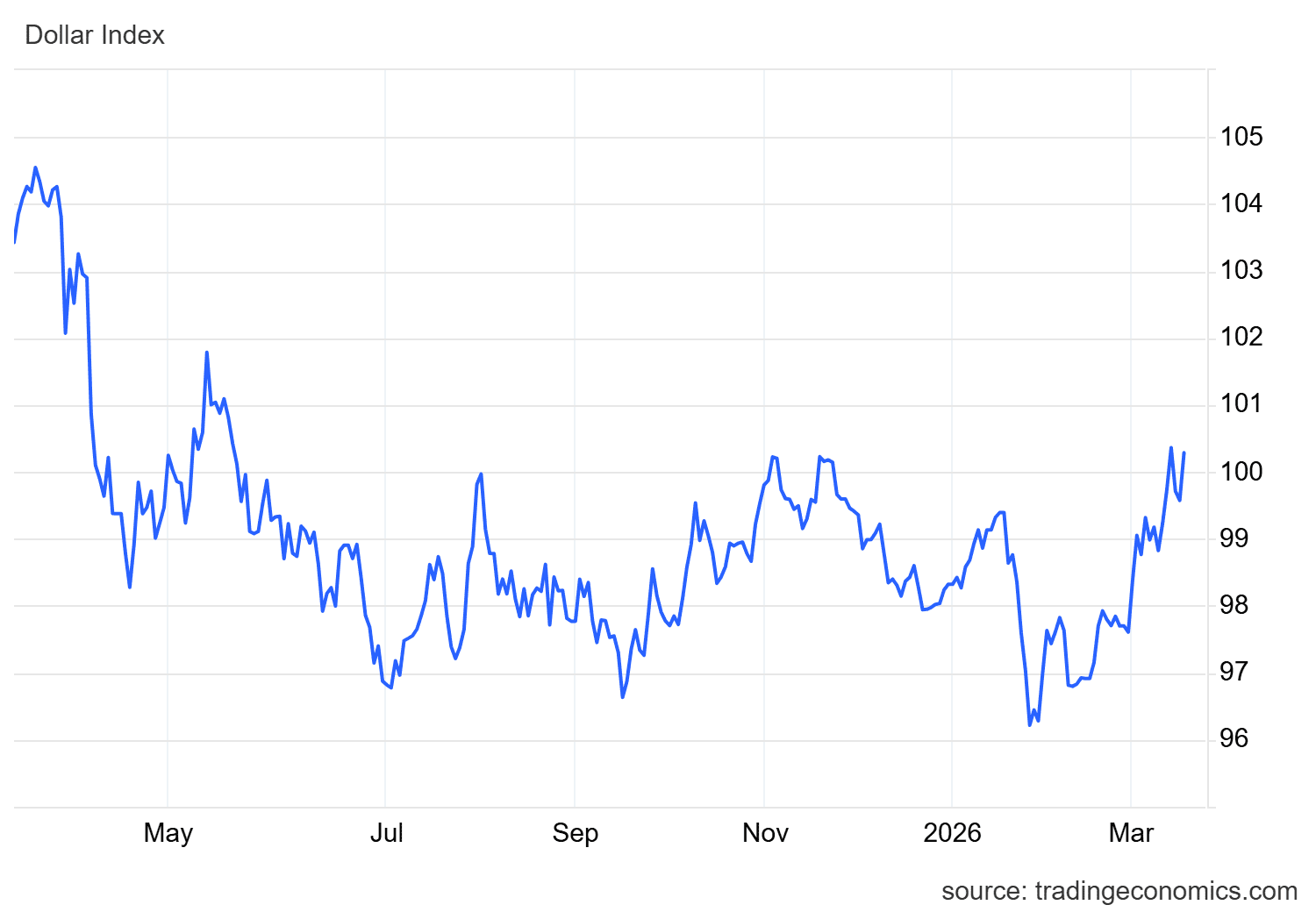
Source: Tradingeconomics
With this in mind, the Federal Reserve decision stands out as a key catalyst for dollar strength, which could continue to weigh on EURUSD in the coming sessions.
Will the European Central Bank decision matter?
The European Central Bank is also set to announce its decision tomorrow, with expectations pointing to no change in the 2.15% refinancing rate, with a probability close to 98.0%.
For now, the ECB appears to be aligned with the Fed’s cautious stance, maintaining close attention on inflation dynamics. However, even if the ECB holds rates steady, the rate differential with the U.S. remains significant.
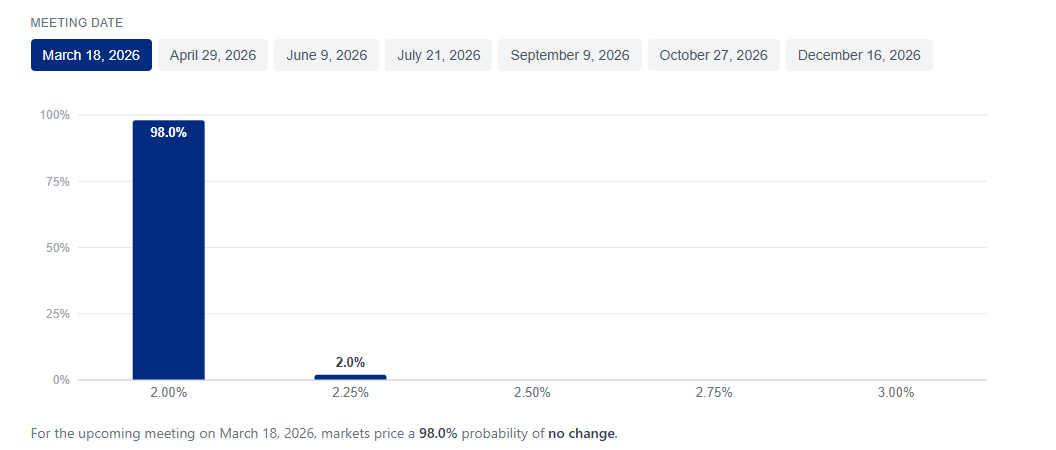
Source: ECBWATCH
As long as this differential persists, dollar-denominated assets are likely to remain more attractive than euro-denominated ones. Therefore, the ECB decision alone may not be enough to reverse the bearish bias in EURUSD in the short term.
EUR/USD Technical Outlook
Fuente: StoneX, Tradingview
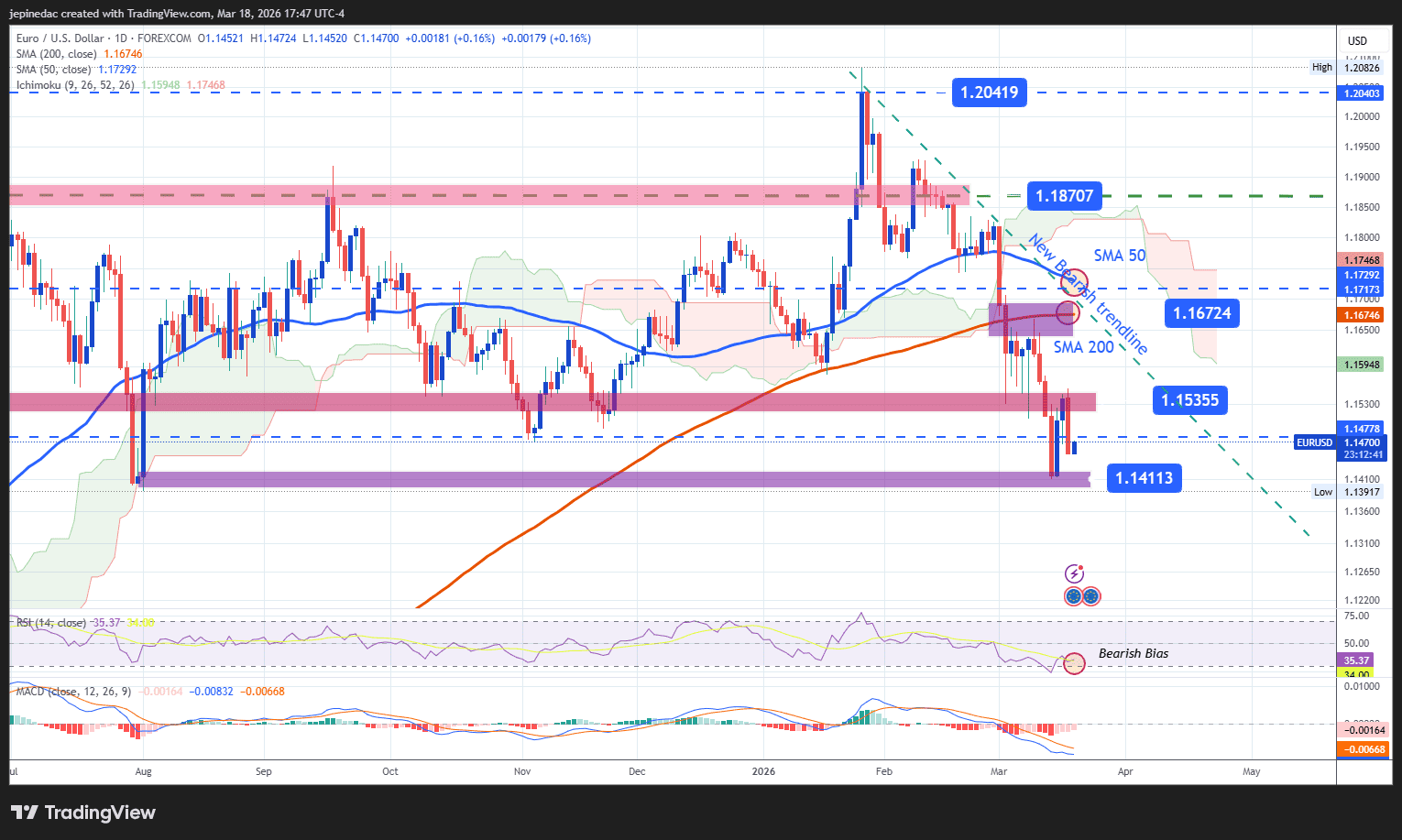
- The new downtrend remains firm: Since January, EURUSD has been showing a consistent bearish structure, with progressively lower lows forming a more defined downward trendline. This remains the dominant technical structure, and as long as selling pressure persists, it is likely to continue guiding price action.
- RSI: The RSI indicator remains below the 50 level, confirming that bearish momentum is still dominant. However, it is approaching the oversold zone (30), which could signal potential short-term corrective rebounds.
- MACD: The MACD is currently near the zero line, suggesting a balance between buying and selling forces. This could open the door to a consolidation or corrective phase in the short term.
Key levels:
- 1.16724 – Key resistance: Level aligned with recent highs and the 200-period moving average. A break above this area could invalidate the current downtrend and trigger a more sustained bullish bias.
- 1.15355 – Near-term barrier: A recent neutrality zone that could act as tentative barrier during potential short-term bullish rebounds in the EUR/USD.
- 1.14113 – Key support: A level not seen since August 2025. A break below this zone could reinforce the bearish bias and extend the current downtrend in the coming sessions.
Written by Julian Pineda, CFA, CMT – Market Analyst
Follow him on: @julianpineda25


Open an account in minutes
Experience award-winning platforms with fast and secure execution, and enjoy tight spreads from 0.5 pts on FX and 0.3 pts on indices.
Economic calendar
Web Trader platform
Our sophisticated web-based platform is packed with features.
Related articles

AUD/USD Outlook: Historic yield squeeze leaves Aussie bears in control
Australian bond yields have fallen below their US equivalents as the Fed's hawkish repricing gathers momentum. With the Aussie weakening broadly, technical signals suggest sellers remain in control.


Gold, EUR/USD hit 2026 lows as US yields erupt
US Treasury yields have staged one of their largest four-session increases in decades, hammering EUR/USD and gold. But while the euro's decline makes sense, gold's reaction has been extraordinary.

US Dollar Forecast: AUD/USD, Gold, EUR/USD Under Pressure
Could the US dollar rally accelerate? Matt Simpson examines the outlook for DXY, AUD/USD, EUR/USD and gold, plus key technical levels across forex markets.

This report is intended for general circulation only. It should not be construed as a recommendation, or an offer (or solicitation of an offer) to buy or sell any financial products. The information provided does not take into account your specific investment objectives, financial situation or particular needs. Before you act on any recommendation that may be contained in this report, independent advice ought to be sought from a financial adviser regarding the suitability of the investment product, taking into account your specific investment objectives, financial situation or particular needs.
StoneX Financial Pte. Ltd., may distribute reports produced by its respective foreign entities or affiliates within the StoneX group of companies or third parties pursuant to an arrangement under Regulation 32C of the Financial Advisers Regulations. Where the report is distributed to a person in Singapore who is not an accredited investor, expert investor or an institutional investor (as defined in the Securities Futures Act), StoneX Financial Pte. Ltd. accepts legal responsibility to such persons for the contents of the report only to the extent required by law. Singapore recipients should contact StoneX Financial Pte. Ltd. at 6826 9988 for matters arising from, or in connection with the report.
In the case of all other recipients of this report, to the extent permitted by applicable laws and regulations neither StoneX Financial Pte. Ltd. nor its associated companies will be responsible or liable for any loss or damage incurred arising out of, or in connection with, any use of the information contained in this report and all such liability is hereby expressly disclaimed. No representation or warranty is made, express or implied, that the content of this report is complete or accurate.
StoneX Financial Pte. Ltd. is not under any obligation to update this report.
Trading CFDs carries a high level of risk that may not be suitable for some investors. Consider your investment objectives, level of experience, financial resources, risk appetite and other relevant circumstances carefully. The possibility exists that you could lose some or all of your investments, including your initial deposits. If in doubt, please seek independent expert advice. Visit www.forex.com/en-sg/terms-and-policies for the complete Risk Disclosure Statement.