







Forex Seasonality – February 2025: Trade War to “Trump” Seasonality?
The budding trade war and developments on the tariff front could well outweigh the modest historical seasonal tendencies in February for forex pairs like EUR/USD, GBP/USD, and USD/JPY.
Share this:

February Forex Seasonality Key Points
- Most major currency pairs have seen quieter moves in February on average since 1971.
- The budding trade war and developments on the tariff front could well outweigh the modest historical seasonal tendencies in February.
The beginning of a new month marks a good opportunity to review the seasonal patterns that have influenced the forex market over the 50+ years since the Bretton Woods system was dismantled in 1971, ushering in the modern foreign exchange market.
As always, these seasonal tendencies are just historical averages, and any individual month or year may vary from the historic average, so it’s important to complement these seasonal leans with alternative forms of analysis to create a long-term successful trading strategy. In other words, past performance is not necessarily indicative of future results.
Euro Forex Seasonality – EUR/USD Chart
Source: TradingView, StoneX. Please note that past performance is not necessarily indicative of future results.
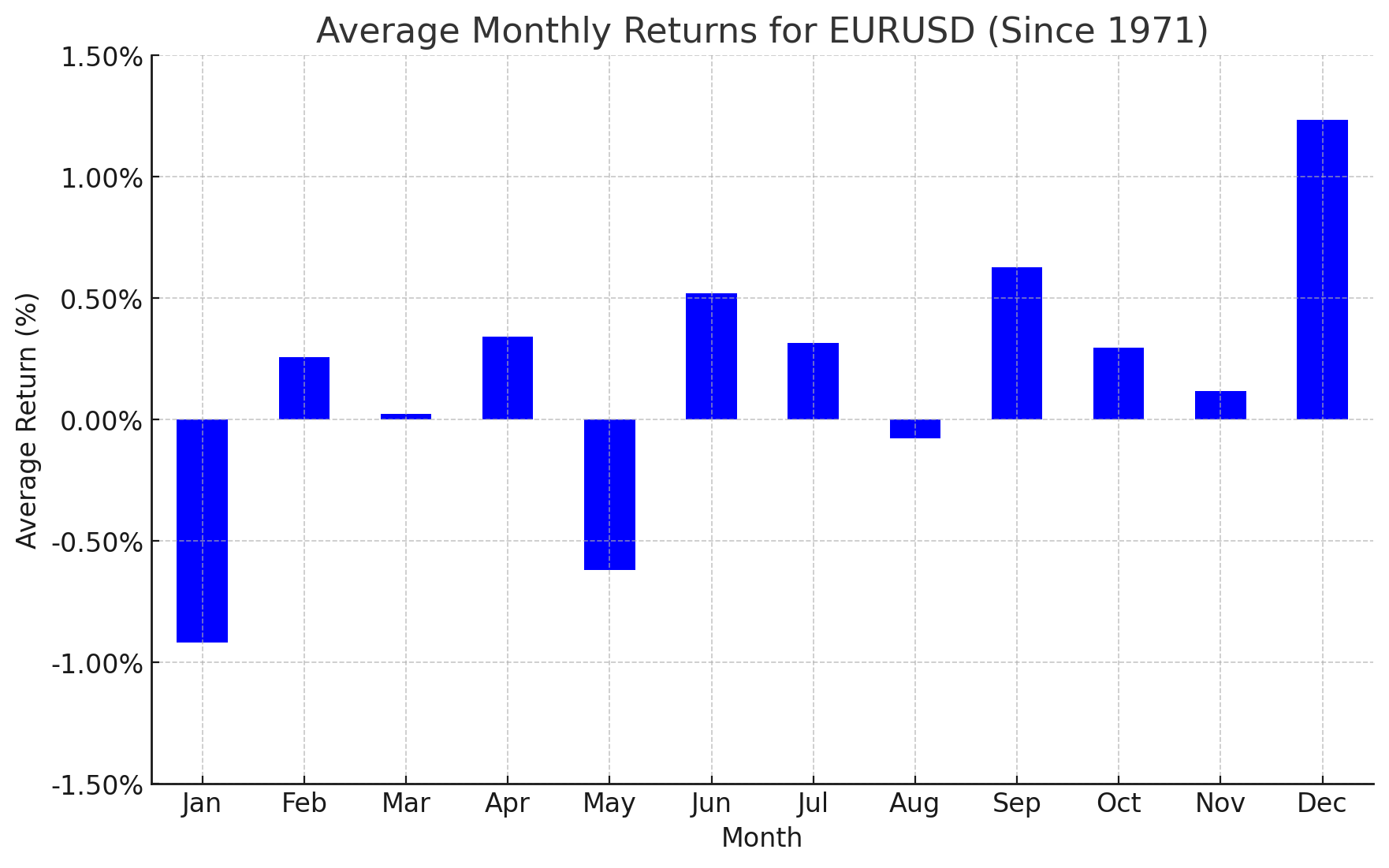
Historically, February has been a middle-of-the-road month for EUR/USD, with the world’s most widely-traded currency pair sporting an average return of +0.26% over the last 50+ years. In January, EUR/USD bucked its historical trend for weakness, closing near flat after testing key support at 1.0200 midway through the month. For this month, traders will be hoping for a breakout from the pair’s new range between 1.02-1.06, though the seasonal chart above suggests we may ultimately see more consolidation.
British Pound Forex Seasonality – GBP/USD Chart
Source: TradingView, StoneX. Please note that past performance is not necessarily indicative of future results.
Looking at the above chart, GBP/USD has historically seen bearish price action in February, with average returns of around -0.33% since 1971. The British pound also fell sharply through the first couple weeks of the year before recovering heading into February. For this month, support in the 1.2250-1.2300 area will be the key “line in the sand” for bulls to defend to prevent steeper losses.
Japanese Yen Forex Seasonality – USD/JPY Chart
Source: TradingView, StoneX. Please note that past performance is not necessarily indicative of future results.
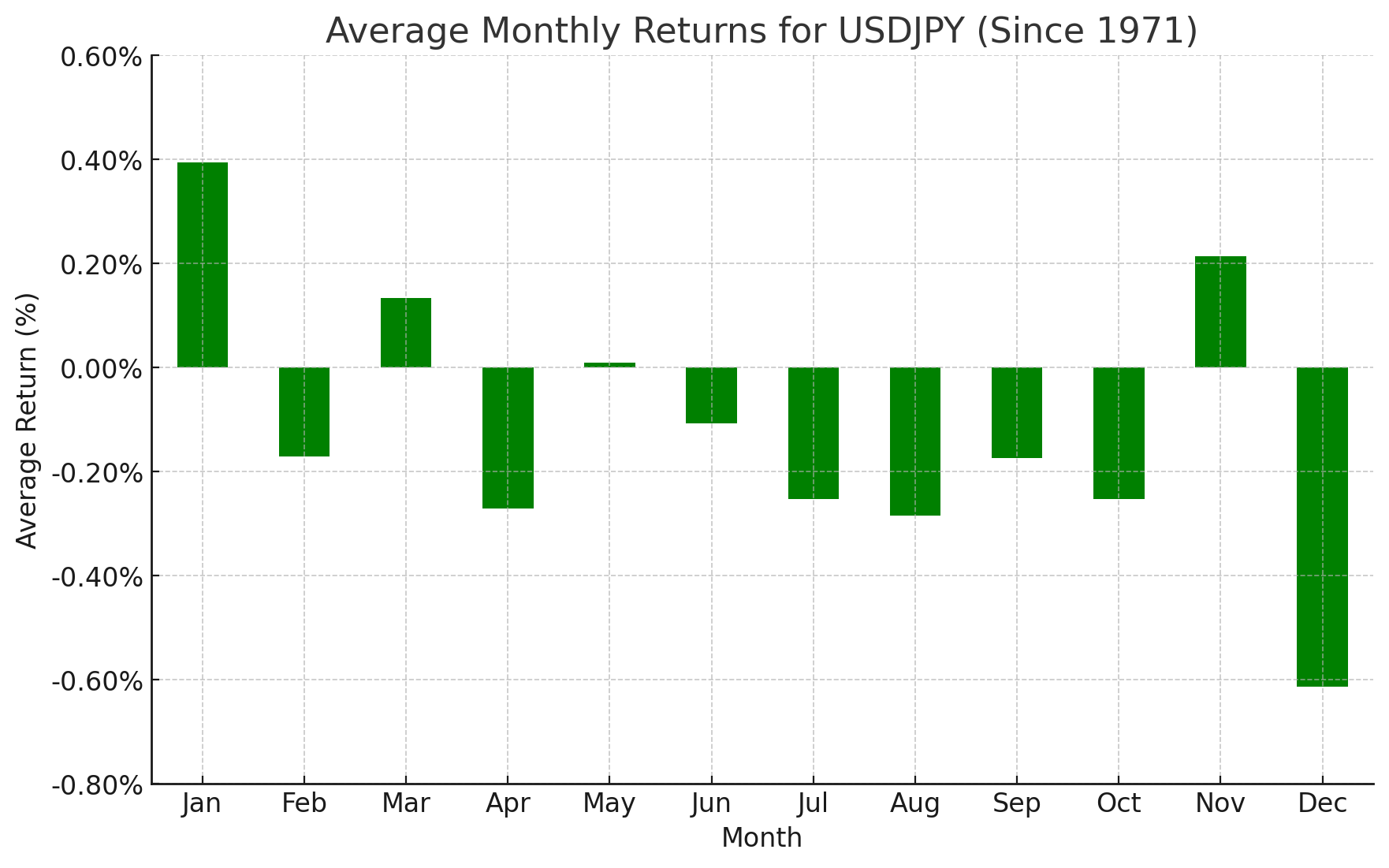
February has historically been a modestly bearish month for USD/JPY, with the pair falling by an average of -0.17% since the Bretton Woods agreement, though ultimately this is near the average of the pair’s moves across all months in the sample period (-0.11%). With the Bank of Japan finally starting to raise interest rates and USD/JPY potentially breaking a bullish trend line off the September lows, there’s potential for even more downside from a traditional technical analysis perspective.
Australian Dollar Forex Seasonality – AUD/USD Chart
Source: TradingView, StoneX. Please note that past performance is not necessarily indicative of future results.
Turning our attention Down Under, AUD/USD has also seen modest bearish returns in February, with an average loss of -0.19% across the month. Last month, AUD/USD just held above support at multi-year lows near 0.6170, raising bullish hopes for a bounce back in February; that said, a confirmed break of that support level would leave little in the way of near-term support until well below 0.6000.
Canadian Dollar Forex Seasonality – USD/CAD Chart
Source: TradingView, StoneX. Please note that past performance is not necessarily indicative of future results.
Last but not least, February has been a slightly bullish month for USD/CAD going back to 1971, with an average historical return of +0.17%. While it can be useful to understand the historical seasonal tendencies in certain environments, the North American pair faces much more significant pressure from the budding trade war between the US and Canada, and those headlines will likely be a bigger driver for USD/CAD this month than the (rather lackluster) seasonal trend.
As always, we want to close this article by reminding readers that seasonal tendencies are not gospel – even if they’ve tracked relatively closely so far this year – so it’s important to complement this analysis with an examination of the current fundamental and technical backdrops for the major currency pairs.
-- Written by Matt Weller, Global Head of Research
Check out Matt’s Daily Market Update videos on YouTube and be sure to follow Matt on Twitter: @MWellerFX
Related tags:


Open an account in minutes
Experience award-winning platforms with fast and secure execution, and enjoy tight spreads from 0.5 pts on FX and 0.3 pts on indices.
Economic calendar
Web Trader platform
Our sophisticated web-based platform is packed with features.
Related articles
EUR/USD forecast remains tilted lower with French bond troubles ahead of US jobs report
The EUR/USD has tagged a fresh year-to-date low as French public-finance concerns trigger a government bond sell-off. Today's US jobs report may change little, with resilient activity, elevated energy prices and hawkish Fed bets keeping the greenback supported. With the pair trapped below resistance at 1.1410, the risk to the near-term EUR/USD forecast is tilted to the downside.

What Stretched 10-Year Yields Mean for Major Currency Pairs in Q4
U.S. 10-year Treasury yields are nearing a long-term resistance zone with overbought RSI readings, raising near-term pullback risk for the dollar.


USD/CAD shooting star puts September surge on notice
USD/CAD has printed a clear bearish reversal pattern after an extraordinary September surge, but confirmation may depend heavily on how US Treasury yields react to Friday’s payrolls report.

This report is intended for general circulation only. It should not be construed as a recommendation, or an offer (or solicitation of an offer) to buy or sell any financial products. The information provided does not take into account your specific investment objectives, financial situation or particular needs. Before you act on any recommendation that may be contained in this report, independent advice ought to be sought from a financial adviser regarding the suitability of the investment product, taking into account your specific investment objectives, financial situation or particular needs.
StoneX Financial Pte. Ltd., may distribute reports produced by its respective foreign entities or affiliates within the StoneX group of companies or third parties pursuant to an arrangement under Regulation 32C of the Financial Advisers Regulations. Where the report is distributed to a person in Singapore who is not an accredited investor, expert investor or an institutional investor (as defined in the Securities Futures Act), StoneX Financial Pte. Ltd. accepts legal responsibility to such persons for the contents of the report only to the extent required by law. Singapore recipients should contact StoneX Financial Pte. Ltd. at 6826 9988 for matters arising from, or in connection with the report.
In the case of all other recipients of this report, to the extent permitted by applicable laws and regulations neither StoneX Financial Pte. Ltd. nor its associated companies will be responsible or liable for any loss or damage incurred arising out of, or in connection with, any use of the information contained in this report and all such liability is hereby expressly disclaimed. No representation or warranty is made, express or implied, that the content of this report is complete or accurate.
StoneX Financial Pte. Ltd. is not under any obligation to update this report.
Trading CFDs carries a high level of risk that may not be suitable for some investors. Consider your investment objectives, level of experience, financial resources, risk appetite and other relevant circumstances carefully. The possibility exists that you could lose some or all of your investments, including your initial deposits. If in doubt, please seek independent expert advice. Visit www.forex.com/en-sg/terms-and-policies for the complete Risk Disclosure Statement.