



Gilts gone wild!
The yield on the 30-year Gilt has moved from a high on the day of 5.092% down to a low of 3.869%.
Share this:

The Bank of England intervened in the Bond market on Wednesday. According to a Reuters “source”, the intervention was a response to issues with liability-driven investments and links to pension funds. The BOE has said that it would buy Gilts with maturities over 20 years, beginning today and lasting until October 14th. As a result, the yield on the 30-year Gilt has moved from a high on the day of 5.092% down to a low of 3.869%. Recall that it was just Thursday that the Bank of England announced a rate hike of 50bps to bring the overnight rate to 2.25% and that it would begin selling its holdings of Gilts at a rate of 80 billion Pounds per year. This sale has been pushed back and will now begin on October 31st. The opening level on the 30-year Gilt on Thursday was 3.535%. However, note the volatility in 30-year Gilt yield since then, which has been more directly related to the fear of new PM Truss’s fiscal policies than fear of the BOE’s monetary policy. 30-year Gilt yields moved up 134bps since Friday’s open and has retraced almost all of that back today!

Source: Tradingview, Stone X
GBP/USD made an intra-day high at 1.1738 on September 13th, just over 2 weeks ago. The pair has been moving aggressively lower since. On Friday morning, GBP/USD opened at 1.1252 and by Monday, the pair had traded to an all-time low of 1.0357. GBP/USD bounced to just above resistance at the 38.2% Fibonacci retracement level from the highs of September 13th to the lows of Monday, near 1.0931. GBP/USD oscillated between 1.0650 and 1.0800 until today. When the BOE made its announcement, GBP/USD rallied 200 pips to 1.0848, before falling to 1.0539 as traders digested the new information. At the end of the day on Wednesday, GBP/USD was trading near its daily highs at 1.0915.

Source: Tradingview, Stone X
As my colleague Fawad Razaqzada points out, the intervention may not be good for the Pound in the long-term. However, as we have seen today, the BOE may have “saved the Pound” in the short-term. If the pair continues to move higher, the first horizontal resistance is near 1.1020. Above there, the pair can move to the 50% Fibonacci retracement level from the above-mentioned timeframe near 1.1047, then a downward sloping trendline from the September 13th highs near 1.1135. First support is at the spike high after the BOE announcement at 1.0838. Below there, GBP/USD can fall to today’s low of 1.0539, then the all-time low at 1.0357.
Did the Bank of England succeed in saving the Gilt market and thus, saving the Pound? It may have worked in the short-term as the yield on the 30-year Gilt fell over 100bps today and GBP/USD closed up over 150 pips on the day. However, in the long-term, the intervention may not be sustainable, and GBP/USD could end up moving to parity or below!
The Bank of England intervened in the Bond market on Wednesday. According to a Reuters “source”, the intervention was a response to issues with liability-driven investments and links to pension funds. The BOE has said that it would buy Gilts with maturities over 20 years, beginning today and lasting until October 14th. As a result, the yield on the 30-year Gilt has moved from a high on the day of 5.092% down to a low of 3.869%. Recall that it was just Thursday that the Bank of England announced a rate hike of 50bps to bring the overnight rate to 2.25% and that it would begin selling its holdings of Gilts at a rate of 80 billion Pounds per year. This sale has been pushed back and will now begin on October 31st. The opening level on the 30-year Gilt on Thursday was 3.535%. However, note the volatility in 30-year Gilt yield since then, which has been more directly related to the fear of new PM Truss’s fiscal policies than fear of the BOE’s monetary policy. 30-year Gilt yields moved up 134bps since Friday’s open and has retraced almost all of that back today!

Source: Tradingview, Stone X
GBP/USD made an intra-day high at 1.1738 on September 13th, just over 2 weeks ago. The pair has been moving aggressively lower since. On Friday morning, GBP/USD opened at 1.1252 and by Monday, the pair had traded to an all-time low of 1.0357. GBP/USD bounced to just above resistance at the 38.2% Fibonacci retracement level from the highs of September 13th to the lows of Monday, near 1.0931. GBP/USD oscillated between 1.0650 and 1.0800 until today. When the BOE made its announcement, GBP/USD rallied 200 pips to 1.0848, before falling to 1.0539 as traders digested the new information. At the end of the day on Wednesday, GBP/USD was trading near its daily highs at 1.0915.
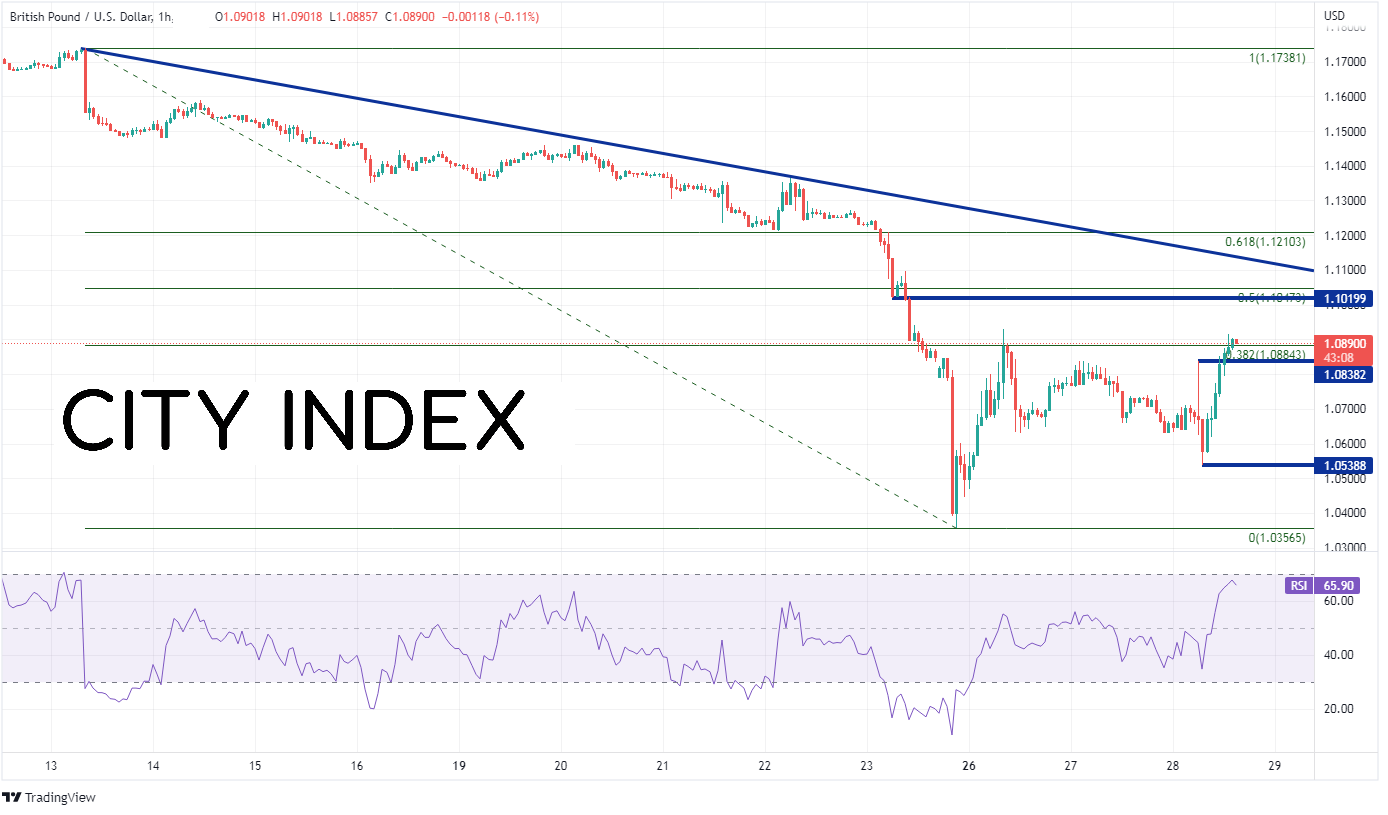
Source: Tradingview, Stone X
Trade GBP/USD now: Login or Open a new account!
• Open an account in the UK
• Open an account in Australia
• Open an account in Singapore
As my colleague Fawad Razaqzada points out, the intervention may not be good for the Pound in the long-term. However, as we have seen today, the BOE may have “saved the Pound” in the short-term. If the pair continues to move higher, the first horizontal resistance is near 1.1020. Above there, the pair can move to the 50% Fibonacci retracement level from the above-mentioned timeframe near 1.1047, then a downward sloping trendline from the September 13th highs near 1.1135. First support is at the spike high after the BOE announcement at 1.0838. Below there, GBP/USD can fall to today’s low of 1.0539, then the all-time low at 1.0357.
Did the Bank of England succeed in saving the Gilt market and thus, saving the Pound? It may have worked in the short-term as the yield on the 30-year Gilt fell over 100bps today and GBP/USD closed up over 150 pips on the day. However, in the long-term, the intervention may not be sustainable, and GBP/USD could end up moving to parity or below!
Learn more about forex trading opportunities.
Related tags:
Latest market news



Open an account in minutes
Experience award-winning platforms with fast and secure execution, and enjoy tight spreads from 0.5 pts on FX and 0.3 pts on indices.
Economic calendar
Web Trader platform
Our sophisticated web-based platform is packed with features.
Related articles
EUR/USD weekly outlook: Oil, inflation and NFP in focus
After coming under significant pressure in recent weeks, the EUR/USD came off its lows to finish the week on a positive note on Friday, albeit with only a mild rebound. That was not enough to prevent the exchange rate falling for the third consecutive week, as the US dollar and bond yields rallied across the board.

Gold Q4 2026 outlook: Resilience in the face of rallying dollar and yields
As we headed towards the latter stages of Q3 and into Q4, the Fed had just hiked rates in a hawkish FOMC meeting, while the likes of the ECB and BoJ had also tightened their respective policies. Oil prices remained elevated amid the prolonged US-Iran conflict. Meanwhile, bond yields were breaking out, and the dollar was higher across the board. Yet, remarkably, gold was still holding in the positive territory for the third quarter, even if it had weakened somewhat in September.

EUR/USD Q4 2026 Outlook: Euro at a Crossroads as Fed, ECB Tighten 9 25 2026
EUR/USD enters Q4 at a pivotal inflection point as competing Fed-ECB policy paths and persistent inflation risks collide with major technical support.
This report is intended for general circulation only. It should not be construed as a recommendation, or an offer (or solicitation of an offer) to buy or sell any financial products. The information provided does not take into account your specific investment objectives, financial situation or particular needs. Before you act on any recommendation that may be contained in this report, independent advice ought to be sought from a financial adviser regarding the suitability of the investment product, taking into account your specific investment objectives, financial situation or particular needs.
StoneX Financial Pte. Ltd., may distribute reports produced by its respective foreign entities or affiliates within the StoneX group of companies or third parties pursuant to an arrangement under Regulation 32C of the Financial Advisers Regulations. Where the report is distributed to a person in Singapore who is not an accredited investor, expert investor or an institutional investor (as defined in the Securities Futures Act), StoneX Financial Pte. Ltd. accepts legal responsibility to such persons for the contents of the report only to the extent required by law. Singapore recipients should contact StoneX Financial Pte. Ltd. at 6826 9988 for matters arising from, or in connection with the report.
In the case of all other recipients of this report, to the extent permitted by applicable laws and regulations neither StoneX Financial Pte. Ltd. nor its associated companies will be responsible or liable for any loss or damage incurred arising out of, or in connection with, any use of the information contained in this report and all such liability is hereby expressly disclaimed. No representation or warranty is made, express or implied, that the content of this report is complete or accurate.
StoneX Financial Pte. Ltd. is not under any obligation to update this report.
Trading CFDs carries a high level of risk that may not be suitable for some investors. Consider your investment objectives, level of experience, financial resources, risk appetite and other relevant circumstances carefully. The possibility exists that you could lose some or all of your investments, including your initial deposits. If in doubt, please seek independent expert advice. Visit www.forex.com/en-sg/terms-and-policies for the complete Risk Disclosure Statement.