


Gold outlook: seasonal tailwind offers hope with XAU/USD below $4,000
A historically stronger seasonal window and steady central bank buying are offering gold some hope after its slide to a fresh 2026 low. Reclaiming the 4,000 mark is the first sign that the metal may have found a floor.
Share this:

Precious metals have come under heavy pressure along with Bitcoin and other cryptocurrencies in recent days. But a historically strong seasonal window is opening for gold just as the metal languishes some $100 below the $4,000 level (at a fresh low for 2026 this week), offering some hope that the selling may be running its course. A firmer dollar, rising rate expectations and fading haven demand have all taken their toll, while central banks continue to buy. Until $4,000 is reclaimed, however, the near-term gold forecast remains tilted to the downside.
- XAU/USD has fallen to a fresh 2026 low below $4,000 as the dollar strengthens and haven demand fades.
- November through to January has historically been a stronger period for gold, while central bank buying adds structural support.
- A sustained move back above $4,000 would provide the first sign that gold may have found a floor.
Watch the full video
Dollar and rate expectations weigh on gold
This week's selling has been driven by a combination that has hindered the metals for months. The dollar staged a strong rally on Wednesday and has since extended those gains, helped by that strong CPI print and after the Fed Governor Christopher Waller suggested that further monetary tightening is necessary and indicated that he was open to a larger 50-basis-point move. Gold, as a non-yielding asset, becomes less attractive when interest rate expectations move higher, and that has proved to be the case once again.
Hot US inflation has reinforced that concern and today we will get some more inflation data in the form of PPI. Sticky inflation strengthens the case for the Federal Reserve to maintain a restrictive stance, or potentially raise rates further, increasing the opportunity cost of holding gold.
Meanwhile, some of the safe-haven premium has been unwound as markets grow more optimistic about an agreement between the US and Iran. Oil prices have reflected that shift, although the decline in crude has stalled over the past couple of sessions, as fresh doubts grow over a quick resolution amid hawkish talk from both sides.
Against that backdrop, I am not entirely surprised to see gold trading where it is. But a stronger dollar, higher rate expectations and fading haven demand explain the latest weakness rather than undermine the longer-term case for the metal.
Central banks keep the structural bid alive
Central banks are continuing to accumulate gold for their reserves, providing an important structural source of demand that does not hinge on day-to-day swings in rate expectations. That is one reason I think the longer-term bullish case for gold remains intact, even as the immediate technical picture deteriorates. Put another way, the macro story is still there for gold. What is missing is evidence that buyers are ready to act on it.
Seasonality turns more supportive for gold
Historically, November through to January or February has been a relatively strong period for gold. There are several reasons for that, including year-end positioning, seasonal jewellery demand and festival-related buying, particularly in India and China. January has historically been one of gold's strongest calendar months, although the size of the average gain varies depending on the period and dataset examined.
By contrast, gold has tended to struggle during parts of the spring and early summer, with June often one of the weaker months. Prices have then typically stabilised around June or July before recovering into the autumn. The current sell-off is therefore arriving just as the calendar turns more favourable.
Of course, seasonality is not a timing signal in itself, and it certainly does not guarantee that prices will turn higher. But with gold having already suffered a substantial correction, it does provide another reason to watch the current levels closely for signs that the selling pressure is fading.
Technical gold forecast and key levels to watch
From a technical analysis point of view, gold was looking relatively encouraging last week after breaking above its short-term bearish trend line. However, the breakout failed to attract follow-through buying, and resistance between $4,106ish and $4,140ish proved difficult to overcome. Since then, the metal has turned lower again to hit a fresh low for 2026. The area between roughly $3,942 and $4,000 previously acted as both support and resistance, and gold has now broken below it. A sustained move back above $4,000 would suggest that sellers who went short beneath that former support are starting to get caught out, providing the first indication that gold may have found a floor.
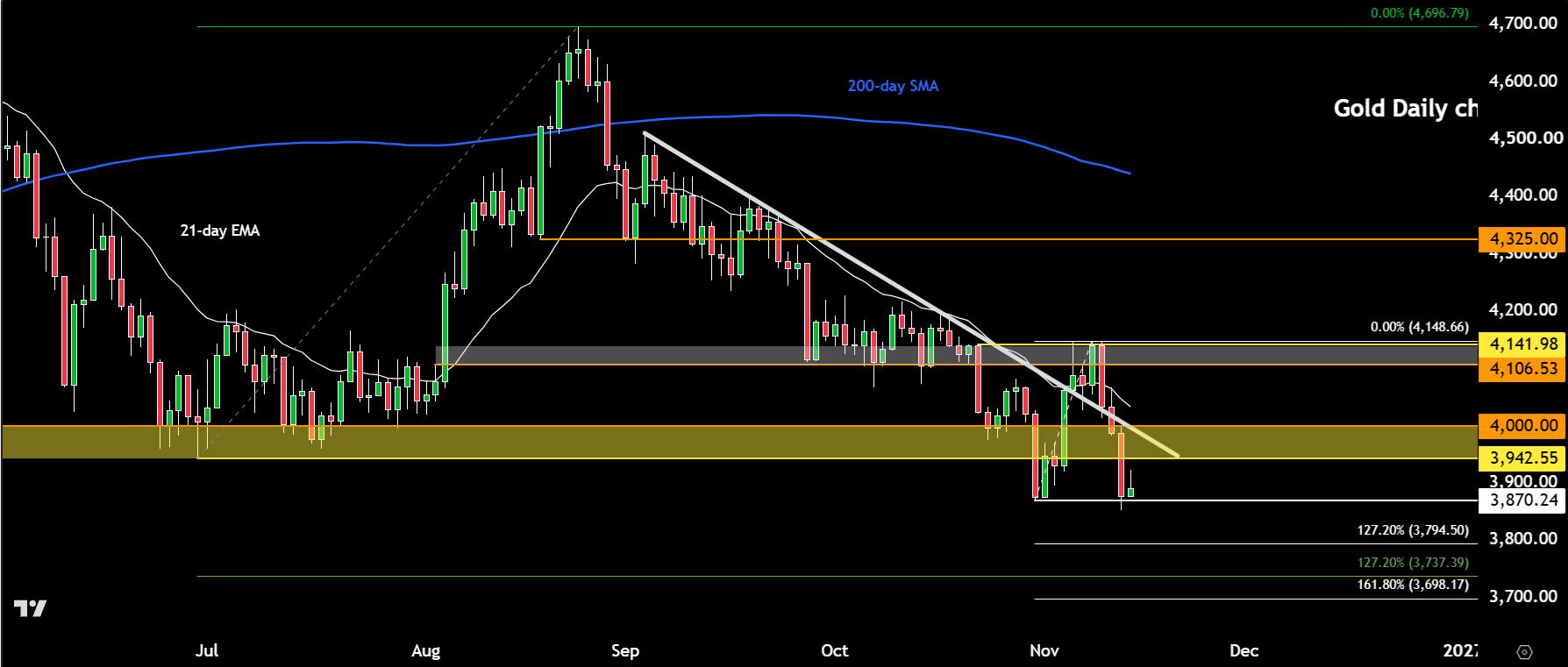
For now, though, there is little evidence of a meaningful reversal, so I would rather wait for one than try to pick a bottom. The seasonal tailwind and central bank demand offer hope, but until $4,000 is back in the rear-view mirror, the near-term gold forecast stays tilted to the downside.
Frequently asked questions
Is gold entering a seasonally strong period?
Yes. November through to January or February has historically been one of the stronger stretches of the year for gold, helped by year-end positioning and jewellery and festival demand, particularly in India and China. That said, seasonality offers no guarantee of a recovery.
What level does gold need to reclaim to signal a bottom?
A sustained move back above $4,000 would be the first sign that gold has bottomed. The $3,942 to $4,000 zone previously acted as both support and resistance, so reclaiming it would suggest that sellers are getting trapped.
Are central banks still buying gold?
Central banks are continuing to add gold to their reserves. That structural demand underpins the longer-term bullish case, even though it has not been enough to stop the latest sell-off.
-- Written by Fawad Razaqzada, Market Analyst | Follow Fawad on Twitter @Trader_F_R

Related tags:


Open an account in minutes
Experience award-winning platforms with fast and secure execution, and enjoy tight spreads from 0.5 pts on FX and 0.3 pts on indices.
Economic calendar
Web Trader platform
Our sophisticated web-based platform is packed with features.
Related articles
Gold outlook: seasonal tailwind offers hope with XAU/USD below $4,000
A historically stronger seasonal window and steady central bank buying are offering gold some hope after its slide to a fresh 2026 low. Reclaiming the 4,000 mark is the first sign that the metal may have found a floor.

Bitcoin, Gold Outlook: Bullish Hold or Bearish Shift?
Bitcoin, Gold Outlook: The dollar’s surge to new 2026 highs and approach toward nine-month resistance are raising near-term reversal risks across precious metals and currency markets. This follows recent declines that pushed Bitcoin below $70,000 and gold below $3,870.

AUD/USD Outlook: Historic yield squeeze leaves Aussie bears in control
Australian bond yields have fallen below their US equivalents as the Fed's hawkish repricing gathers momentum. With the Aussie weakening broadly, technical signals suggest sellers remain in control.

This report is intended for general circulation only. It should not be construed as a recommendation, or an offer (or solicitation of an offer) to buy or sell any financial products. The information provided does not take into account your specific investment objectives, financial situation or particular needs. Before you act on any recommendation that may be contained in this report, independent advice ought to be sought from a financial adviser regarding the suitability of the investment product, taking into account your specific investment objectives, financial situation or particular needs.
StoneX Financial Pte. Ltd., may distribute reports produced by its respective foreign entities or affiliates within the StoneX group of companies or third parties pursuant to an arrangement under Regulation 32C of the Financial Advisers Regulations. Where the report is distributed to a person in Singapore who is not an accredited investor, expert investor or an institutional investor (as defined in the Securities Futures Act), StoneX Financial Pte. Ltd. accepts legal responsibility to such persons for the contents of the report only to the extent required by law. Singapore recipients should contact StoneX Financial Pte. Ltd. at 6826 9988 for matters arising from, or in connection with the report.
In the case of all other recipients of this report, to the extent permitted by applicable laws and regulations neither StoneX Financial Pte. Ltd. nor its associated companies will be responsible or liable for any loss or damage incurred arising out of, or in connection with, any use of the information contained in this report and all such liability is hereby expressly disclaimed. No representation or warranty is made, express or implied, that the content of this report is complete or accurate.
StoneX Financial Pte. Ltd. is not under any obligation to update this report.
Trading CFDs carries a high level of risk that may not be suitable for some investors. Consider your investment objectives, level of experience, financial resources, risk appetite and other relevant circumstances carefully. The possibility exists that you could lose some or all of your investments, including your initial deposits. If in doubt, please seek independent expert advice. Visit www.forex.com/en-sg/terms-and-policies for the complete Risk Disclosure Statement.