



Silver 2026 outlook: The trade to watch
As per my gold 2026 outlook, I am not feeling super bullish on the yellow metal after its staggering almost 70% gains this year. Silver has had an even better 2025, exploding higher by nearly 150% — putting both metals on course for their strongest annual showing since 1979. Will silver break even more records after a historic 2025, or will gravity weigh on the white metal?
Share this:
When writing this article just before Christmas, I was wondering what the year ahead would holds for gold and silver. My soon-to-be-published gold 2026 outlook suggests I am not feeling super bullish on the yellow metal after its staggering almost 70% gains this year. Silver has had an even better 2025, exploding higher by nearly 150% — putting both metals on course for their strongest annual showing since 1979. The move for gold hasn’t come out of nowhere, but with silver it has been a remarkable rally after years of pain for silver bulls. The white metal’s rally has been turbocharged by speculative inflows and ongoing supply disruptions across key trading hubs, lingering fallout from October’s historic short squeeze. But will that momentum carry into 2026, and will we see even more records broken?
What has been behind the precious metals rally?
At the macro level, the backdrop couldn’t be more supportive. The US Federal Reserve is widely expected to deliver more rate cuts in 2026 after and that’s historically a green light for precious metals. Lower rates reduce the appeal of cash and short-term bonds, weaken the US dollar, and push investors towards hard assets perceived as stores of value. Gold was the first beneficiary, but silver quickly followed — and then accelerated.
Central banks have been steady buyers, while ETF inflows have quietly done a lot of the heavy lifting – especially for gold. Gold-backed ETF holdings have increased in every month this year bar May, underlining just how persistent demand has been. Politics has also played its part. President Donald Trump’s aggressive push to rewire global trade, alongside repeated jabs at the Federal Reserve’s independence, poured extra fuel on the rally earlier in the year. At the same time, investors have evidently been stepping away from sovereign bonds and fiat currencies amid growing concerns that rising debt levels will steadily erode their real value. This has been my long-standing argument for being bullish on gold and silver.
There’s also a clear spillover effect at play. Gold’s rally pushed prices above $4,500 an ounce, forcing some investors to look for cheaper alternatives. Silver, with its tighter market and higher volatility, naturally became the next target. Once momentum kicked in, price action did the rest.
But unlike gold, silver isn’t just a financial hedge — it’s an industrial workhorse. Demand from the technology sector has exploded, particularly from electric vehicles, solar panels, advanced batteries, and electronics. Silver is the best electrical conductor available, and for many applications, there’s simply no easy substitute. As EV adoption rises and renewable energy investment continues, silver demand isn’t cyclical — it’s structural.
That’s where the real problem emerges: supply. Silver production has struggled to keep pace for years. Most silver is mined as a by-product of other metals like copper, lead, and gold, which means output can’t be ramped up quickly even when prices surge. Declining ore grades, environmental restrictions, and limited new projects in major producing countries such as Mexico, Peru, and China have only tightened the squeeze. Global demand has now outpaced mine supply for five consecutive years.
Add geopolitics to the mix, and the pressure intensifies. Fears that the US could impose tariffs on silver — especially after it was added to the US Geological Survey’s list of critical minerals — triggered aggressive stockpiling. Large volumes of silver flowed into Comex-linked vaults in New York, draining inventories in London, the world’s main spot trading hub. At the same time, silver-backed ETFs absorbed over 100 million ounces, further reducing available supply.
The result was a market that simply seized up. Borrowing costs for silver spiked to record levels, liquidity evaporated, and prices surged as buyers scrambled for physical metal. Unlike gold, silver has no central-bank backstop — there’s no lender of last resort when inventories run thin. That makes price moves sharper, faster, and far more explosive.
Silver has also benefited from broader concerns around debt, currency debasement, and political uncertainty. Heavy debt loads in the US, Europe, and Japan — combined with a lack of appetite to fix them — have pushed investors toward alternative assets. Silver, cheaper and more accessible than gold, has become a natural beneficiary of this trend.
After going almost vertical in 2025, what does the future hold for silver?
Silver has quietly gone from being gold’s cheaper cousin to the star of the precious metals complex in 2025 — and the move hasn’t been subtle. Prices have surged to record highs above $70 an ounce and comfortably outperforming gold. While gold’s rally laid the groundwork, silver’s breakout has been driven by a perfect storm of macro, market structure, and real-world supply constraints.
Looking ahead, the fundamentals remain stretched. Industrial demand shows no sign of slowing, inventories are near historic lows, and supply constraints are structural rather than temporary. As long as rates are falling, the dollar remains under pressure, and geopolitical risks stay elevated, silver prices are likely to remain elevated — and volatile.
But that doesn’t mean prices will continue to rise at the same pace as in 2025. In fact, there is an increased risk we could see a sharp reversal soon.
What could hold silver back in 2026?
Silver heads into 2026 after an exceptional run. However, after such a powerful rally, the outlook is no longer one-sided. While the longer-term bullish case remains intact, the macro backdrop looks more finely balanced, with much of the easing cycle already priced in, bond yields still elevated and geopolitical risks showing tentative signs of stabilisation. While supply remained tight, this could ease in 2026, potential resulting in a correction. As a result, 2026 is shaping up as a year of two-way price action rather than a repeat of 2025’s explosive gains. Still, we would favour looking for bullish opportunities on the back of any sizeable corrections in 2026.
A key uncertainty for the year ahead is how gold will play out given the two metals’ close relationship. The yellow metal has been propped up by central bank demand, particularly from China. Although buying has remained solid, the pace has slowed at higher price levels, and there are signs that some central banks have already started trimming reserves. If Chinese demand cools further for gold, the market could be vulnerable to profit-taking, and this could spillover into silver especially given how stretched positioning has become.
At the same time, expectations for further rate cuts have faded, with several major central banks signalling a pause or even a tilt back towards tighter policy, making it harder for precious metals to push significantly higher without fresh catalysts in 2026.
Silver technical analysis
From a technical perspective, the trend remains constructive, but risks are rising. Silver was holding comfortably above key support levels, at the time of writing. As long as higher highs and higher lows remain intact, aggressive bearish bets are hard to justify. That said, with momentum stretched - the RSI on all major time frames is flashing big warning signs (not that this mattered for gold in 2025), the correction potential is growing.
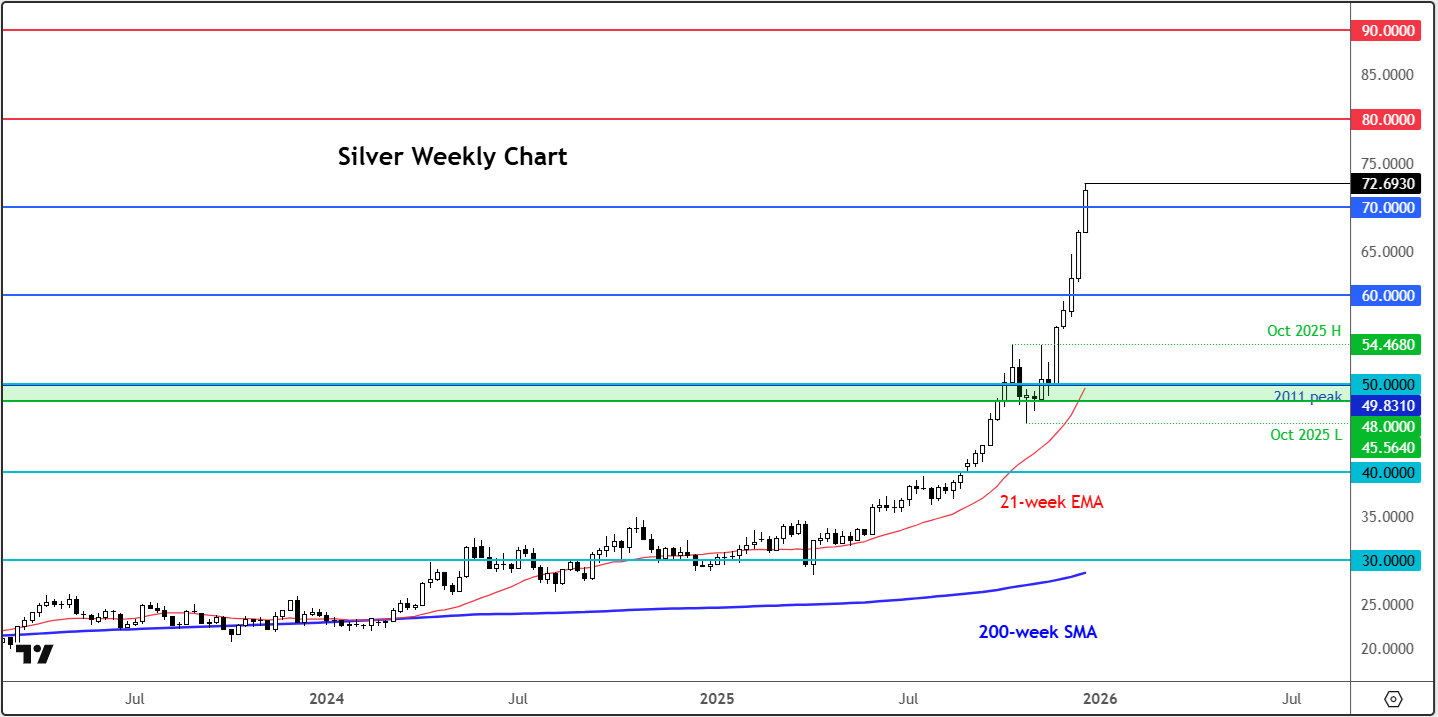
There are now lots of support levels to watch on any short or long-term correction. Key levels include those big round handles such as $60 and $70. But the most important one to watch, should prices pullback that far, is around $50, which ties in with the long-term breakout zone and close to where prices had peaked in the 1980s and in 2011. An additional level to watch for a possible bounce is around $54.50, roughly corresponding with the October 2025 high.
On the upside, there are no prior reference points to watch, making it difficult to identify any potential resistance levels. So, it is best to let price action tell us where resistance lies.
Summary
In short, silver may stay elevated in 2026, but extending the rally sharply will likely require either renewed supply stress or a clear dovish shift from central banks. We would favour a correction to arise and then look for dips to be bought.


-- Written by Fawad Razaqzada, Market Analyst
Follow Fawad on Twitter @Trader_F_R
How to trade with City Index
You can trade with City Index by following these four easy steps:
- Open an account, or log in if you’re already a customer
• Open an account in the UK
• Open an account in Australia
• Open an account in Singapore
- Search for the company you want to trade in our award-winning platform
- Choose your position and size, and your stop and limit levels
- Place the trade
Related tags:



Open an account in minutes
Experience award-winning platforms with fast and secure execution, and enjoy tight spreads from 0.5 pts on FX and 0.3 pts on indices.
Economic calendar
Web Trader platform
Our sophisticated web-based platform is packed with features.
Related articles

Gold Price Outlook: XAU/USD Resistance at $4200 Sets Up for NFP
It was a strong sell-off to start the week in gold and despite a Tuesday bounce, sellers are continuing to push following a resistance hit at the $4200 level.


Gold Forecast: Are Bears Regaining Control of XAU/USD?
The start of the trading week has not been particularly favorable for gold. This can be seen in recent XAU/USD price action, with the metal falling nearly 4.00% over the last two trading sessions and bringing renewed attention to a bearish bias within the market.

Gold outlook: XAU/USD hammered, stretched and vulnerable to a sharp rebound
Gold is getting hammered for solid fundamental reasons, but history suggests extreme four-hourly oversold conditions can produce violent countertrend rallies.

This report is intended for general circulation only. It should not be construed as a recommendation, or an offer (or solicitation of an offer) to buy or sell any financial products. The information provided does not take into account your specific investment objectives, financial situation or particular needs. Before you act on any recommendation that may be contained in this report, independent advice ought to be sought from a financial adviser regarding the suitability of the investment product, taking into account your specific investment objectives, financial situation or particular needs.
StoneX Financial Pte. Ltd., may distribute reports produced by its respective foreign entities or affiliates within the StoneX group of companies or third parties pursuant to an arrangement under Regulation 32C of the Financial Advisers Regulations. Where the report is distributed to a person in Singapore who is not an accredited investor, expert investor or an institutional investor (as defined in the Securities Futures Act), StoneX Financial Pte. Ltd. accepts legal responsibility to such persons for the contents of the report only to the extent required by law. Singapore recipients should contact StoneX Financial Pte. Ltd. at 6826 9988 for matters arising from, or in connection with the report.
In the case of all other recipients of this report, to the extent permitted by applicable laws and regulations neither StoneX Financial Pte. Ltd. nor its associated companies will be responsible or liable for any loss or damage incurred arising out of, or in connection with, any use of the information contained in this report and all such liability is hereby expressly disclaimed. No representation or warranty is made, express or implied, that the content of this report is complete or accurate.
StoneX Financial Pte. Ltd. is not under any obligation to update this report.
Trading CFDs carries a high level of risk that may not be suitable for some investors. Consider your investment objectives, level of experience, financial resources, risk appetite and other relevant circumstances carefully. The possibility exists that you could lose some or all of your investments, including your initial deposits. If in doubt, please seek independent expert advice. Visit www.forex.com/en-sg/terms-and-policies for the complete Risk Disclosure Statement.