



USD/JPY Slammed to Start the Week, then Gets a Bounce
USD/JPY is the center of the macro landscape at the moment after a widely publicized picture over the weekend highlighted the US Treasury Secretary’s desire to buy Japanese Yen.
Share this:

USD/JPY Talking Points:
- Last week had both the Fed and the BoJ, but it was something that happened outside of those rate decisions that drove the major volatility in USD/JPY.
- The currency pair dropped dramatically on Thursday and Friday and that extended through this week’s open, but prices have since started to bounce just above a key level at the 155.00 area.

While fundamentals and headlines can often show direct drive in a market, the only thing that really matters is the actual act of buying and selling. To be sure, fundamentals do often carry impact on price but that relationship is imperfect, to the point that it can sometimes be straight up counter-intuitive.
This is both obvious and mysterious, at least if we judge market participants by what they say or what they often follow against what they do. While it’s data prints and central banks that usually drive the headlines, the fact of the matter is that in a market where anyone willing and able to be long already is, well it doesn’t matter how great the news might be, there’s simply no buyers left to hit the bid.
And sometimes, when a market does get incredibly one-sided, even the slightest hint or whiff of change can compel a monstrous counter-trend move as longs head for the exits. This doesn’t necessarily mean that a reversal is afoot, and the past five years in USD/JPY has episodes that had staying power as well as those that were temporary blips. But this highlights the fact that, while fundamentals often determine long-term trajectory they don’t always dictate short-term directional moves.
In USD/JPY, the fundamentals remain tilted to the long side in the pair, owed to the interest rate disparity between the two economies. If Japan did want to narrow that, they could, by hiking interest rates. But, as I looked at multiple times over the past couple weeks, that comes at a cost, and with risks, and it’s apparent at this point that the Bank of Japan does not want to face those risks. With an aging population that’s expected to decline considerably in the coming decades, choking off growth runs the risk of another deflationary spiral, similar to what showed in recent years in Japan which led to only larger demographic issues and political volatility.
To be sure this isn’t the first time that the Bank of Japan was faced with this dilemma. They’ve intervened multiple times in the past four years and each has seemingly failed. Sure, those interventions did serve to run stops on longs while pushing prices back to support, but they were functionally unable to reverse the trend as the backing fundamental divergence remained in-place.
What’s different about this current episode is that Japan is not going at it alone, as they now seem to have the assistance of the US Treasury Department. I wrote about this on Friday going into the weekend and since then, there was an item that went viral across social media, as US Treasury Secretary Scott Bessent had his notepad in view of reporters, and on it was a memo to buy Japanese Yen, to the tune of five to ten billion.
At this point we don’t know if they did or not. There were circulating rumors on Friday that the Treasury Department asked the New York Fed to call into banks to as about rate quotes on the Yen. This is often seen as a pre-cursor to a possible intervention as both the New York Fed and US Treasury Department can already see quotes and they certainly have access to an EBS system. The act of actually calling can be seen as trying to sound somewhat threatening, which led to the additional rumor on Friday morning that the New York Fed had went as far as to warn banks that there may be action taken in the Japanese Yen market.
To be sure, this is a lot of headline hunting and rumor mongering, but it comes on the heels of Scott Bessent talking up the prospect of a Bretton Woods 2.0, which was essentially a currency fixing regime, and given the timeline of everything, it all seems to fit and make sense.
But perhaps the bigger and more pertinent question, is how aggressively will they hit the intervention. The 155.00 level is a massive spot in USD/JPY and that’s already almost come into play, nearly 900 pips away from last week’s high. Traders can still earn rollover on the long side of the pair by buying the higher yielder of the USD and selling the lower yielder of the Japanese Yen. But, there’s something else to consider which I’ll touch on below the next chart.
USD/JPY Weekly: Crowded Trades, Crowded Exits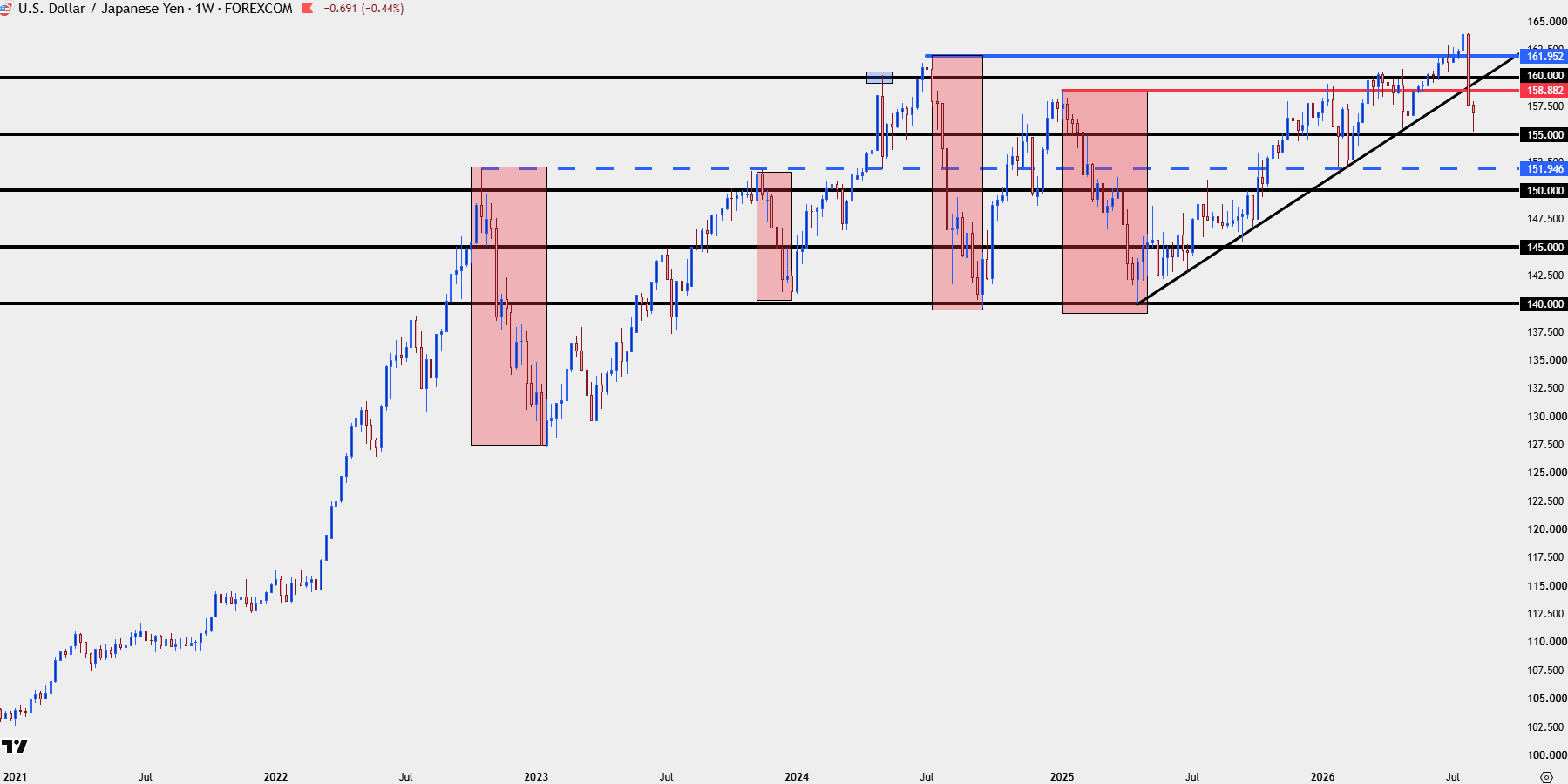
Chart prepared by James Stanley; data derived from Tradingview
USD/JPY What’s Behind the Carry Trade?
Thinking of the matter from a rollover perspective is helpful, but it’s also remiss to consider only the retail side of the matter.
The large bulk of the lift from the carry trade comes from institutions employing a degree of rate arbitrage between economies. If rates in Japan are low or near zero while rates in the US are lifting and getting higher, there’s an increasingly attractive opportunity there, as a pension or hedge fund can go to a Japanese bank, get a cheap loan, and then invest that capital elsewhere.
The only problem with that is the currency exposure as the pension or hedge fund getting the loan gets the loan in Yen, and if the JPY is weakening on the basis of loose monetary policy unable to keep up with tightening elsewhere, the profits can essentially go up in smoke on the basis of that currency weakness alone.
So, these institutions will often look to hedge that risk and one way to do so is by buying another currency and selling Japanese Yen in the marketplace to offset that risk. And then, not only does that institution effectively eliminate their currency risk from the loan that they received, they also bring on the possibility of capital appreciation in the hedge itself.
But – if we get to a space where it become somewhat obvious that the hedge may go in the other direction, as a crowded trade brings on a crowded exit whether its from an intervention or worsening US data or a threat of rate hikes out of Japan, well, there’s less reason to hold that hedge and, instead, absorb the currency risk.
This is one reason those trades in USD/JPY can go the other way so quickly. But it’s also one of the reasons why the trend has persisted for so long even with Japanese policymakers taking numerous shots at bringing on a reversal.
So perhaps the operative question at this point is whether policymakers from the US and/or Japan are finished or whether they take another shot at speculators by trying to run stops below 155.00. If they do, the next logical place to look for support is the 152 area which is, perhaps ironically, the level that the BoJ initially tried to defend in this cycle of interventions back in 2022.
USD/JPY Daily Chart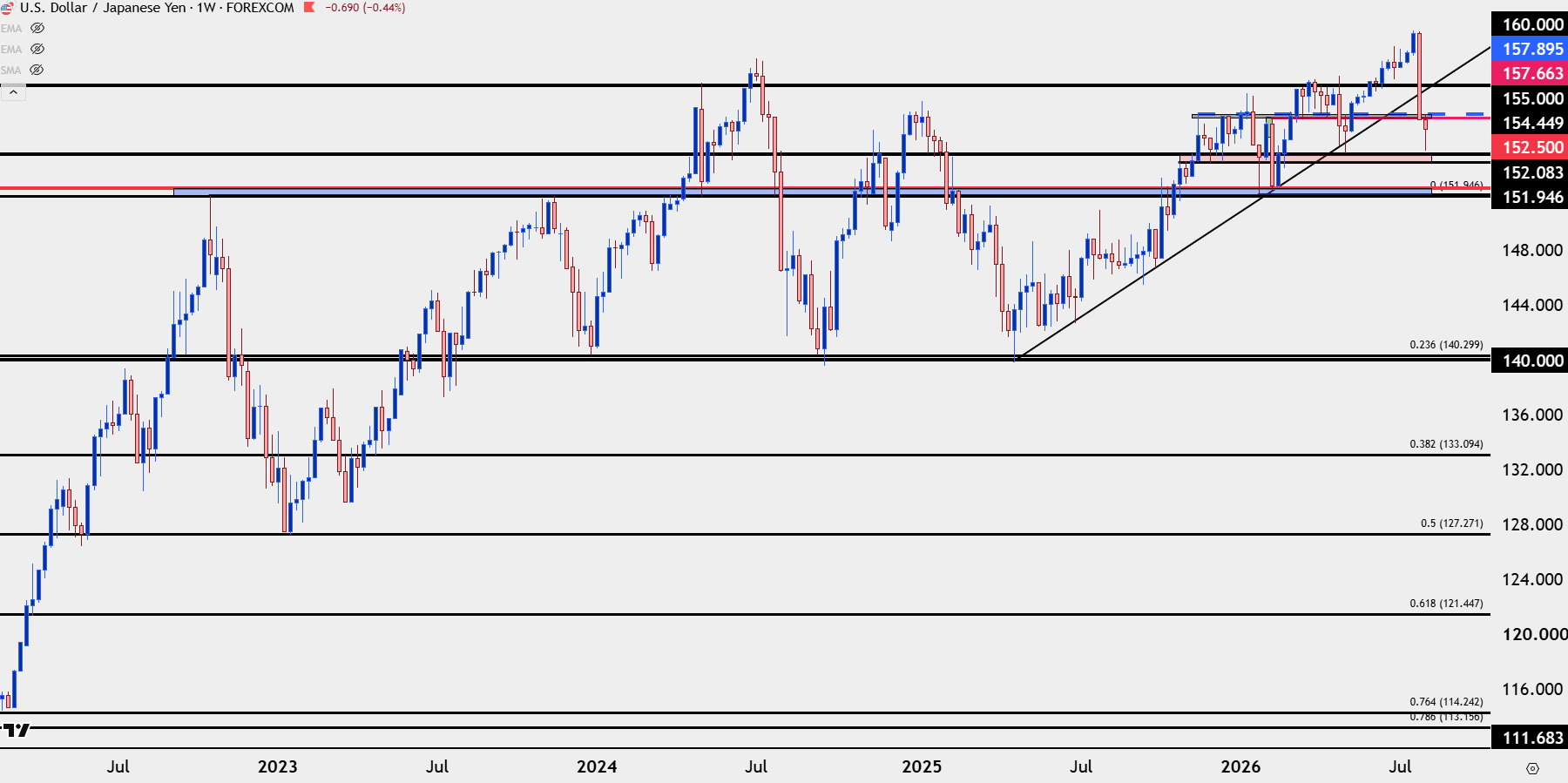
Chart prepared by James Stanley; data derived from Tradingview
--- written by James Stanley, Senior Market Analyst, Global Macro
Related tags:
Latest market news




Open an account in minutes
Experience award-winning platforms with fast and secure execution, and enjoy tight spreads from 0.5 pts on FX and 0.3 pts on indices.
Economic calendar
Web Trader platform
Our sophisticated web-based platform is packed with features.
Related articles
EUR/USD Clings to Support as Lagarde Announces Early Departure
EUR/USD has been mired in a steep sell-off as worries have built around French yields, but continued support around the 1.1100 level give hope for a bounce that could possibly turn into something more.

US Dollar Price Action Setups: EUR/USD, GBP/USD, USD/JPY
The US Dollar was up this week through a slew of Central Banks but next week sees the focus shift to mid-term elections and the week after brings inflation.

Nasdaq 100, S&P 500 Smashed as AI Bubble Fears Run Risk Aversion
It’s been a rocky few weeks for stocks starting with a bearish engulf in NVDA a few weeks ago and then the same formation in the S&P 500 two weeks ago. Sellers have since chewed through supports and fear is starting to spread, but is this the beginning of the end for the AI rally?
This report is intended for general circulation only. It should not be construed as a recommendation, or an offer (or solicitation of an offer) to buy or sell any financial products. The information provided does not take into account your specific investment objectives, financial situation or particular needs. Before you act on any recommendation that may be contained in this report, independent advice ought to be sought from a financial adviser regarding the suitability of the investment product, taking into account your specific investment objectives, financial situation or particular needs.
StoneX Financial Pte. Ltd., may distribute reports produced by its respective foreign entities or affiliates within the StoneX group of companies or third parties pursuant to an arrangement under Regulation 32C of the Financial Advisers Regulations. Where the report is distributed to a person in Singapore who is not an accredited investor, expert investor or an institutional investor (as defined in the Securities Futures Act), StoneX Financial Pte. Ltd. accepts legal responsibility to such persons for the contents of the report only to the extent required by law. Singapore recipients should contact StoneX Financial Pte. Ltd. at 6826 9988 for matters arising from, or in connection with the report.
In the case of all other recipients of this report, to the extent permitted by applicable laws and regulations neither StoneX Financial Pte. Ltd. nor its associated companies will be responsible or liable for any loss or damage incurred arising out of, or in connection with, any use of the information contained in this report and all such liability is hereby expressly disclaimed. No representation or warranty is made, express or implied, that the content of this report is complete or accurate.
StoneX Financial Pte. Ltd. is not under any obligation to update this report.
Trading CFDs carries a high level of risk that may not be suitable for some investors. Consider your investment objectives, level of experience, financial resources, risk appetite and other relevant circumstances carefully. The possibility exists that you could lose some or all of your investments, including your initial deposits. If in doubt, please seek independent expert advice. Visit www.forex.com/en-sg/terms-and-policies for the complete Risk Disclosure Statement.