



USD/JPY Analysis: What comes next for the yen after the US CPI release?
A new trading week begins, and one of the factors that continues to stand out is the neutrality of the Japanese yen. Japan’s currency has struggled to recover consistent short-term appeal, something reflected in USD/JPY price action, with the pair moving around 0.1% over the last two sessions near the reference area of 160 yen per dollar.
Share this:

A new trading week begins, and one of the factors that continues to stand out is the neutrality of the Japanese yen. Japan’s currency has struggled to recover consistent short-term appeal, something reflected in USD/JPY price action, with the pair moving around 0.1% over the last two sessions near the reference area of 160 yen per dollar.
This phase of indecision is taking place as markets wait for the release of US CPI inflation data tomorrow. If the figures come in higher than expected, they could bring renewed strength to the US dollar and reactivate buying pressure in USD/JPY, a dynamic that has dominated over the past few weeks and could remain relevant in the coming sessions.


Inflation data day approaches
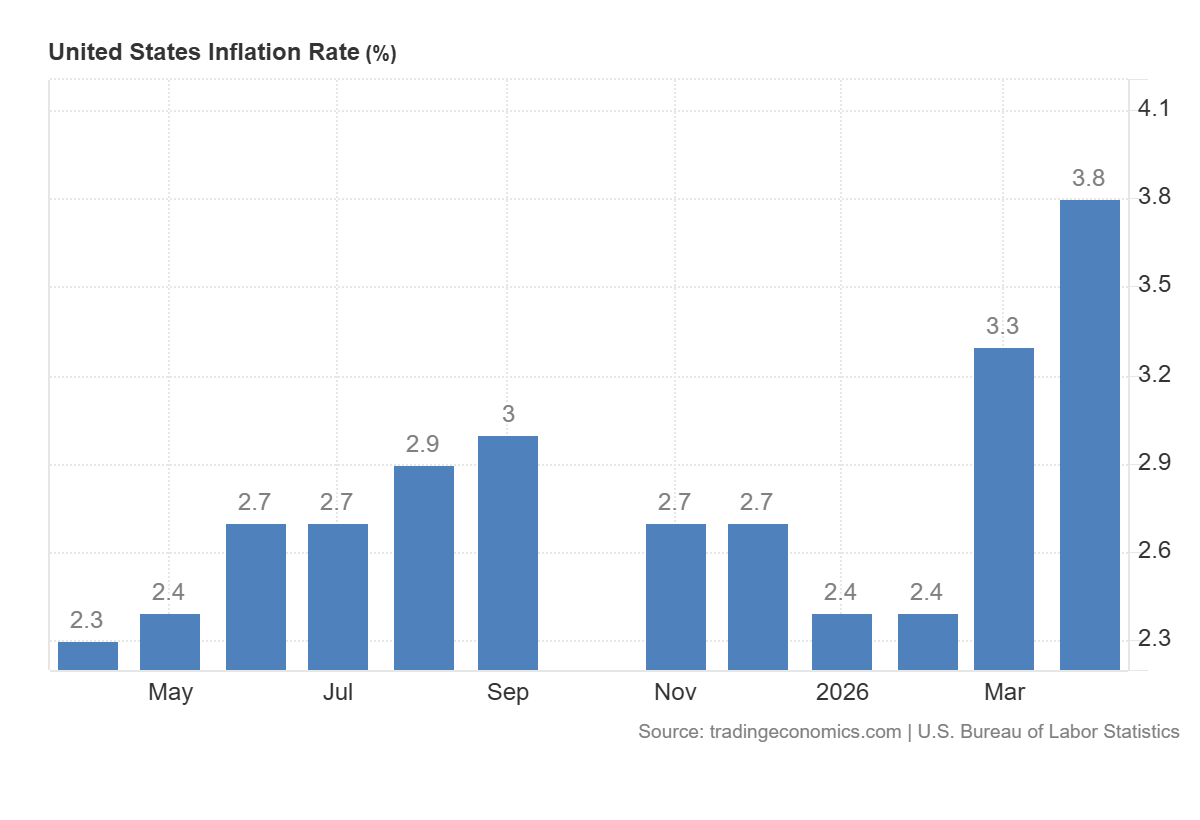
Tomorrow, June 10, the United States is expected to release its CPI y/y inflation data. So far, expectations point to a figure above 4.00% for the first time since May 2023, with an estimated reading of 4.2%, above the previous 3.8% print.
What matters is that this data could reaffirm the inflation acceleration that has started to appear this year, after inflation reached lows near 2.4% in February. In this context, an even higher-than-expected reading could increase market concern and become especially relevant for the Federal Reserve in the short term.
Source: TradingEconomics
For this reason, the economic data will be key for the US monetary policy outlook. Last week, the labor market already surprised with an NFP reading of 172,000 jobs created in May, increasing the perception of possible inflationary pressures. Now, another upside surprise in CPI could reinforce that view and push markets to price in a more aggressive Federal Reserve over the coming months.
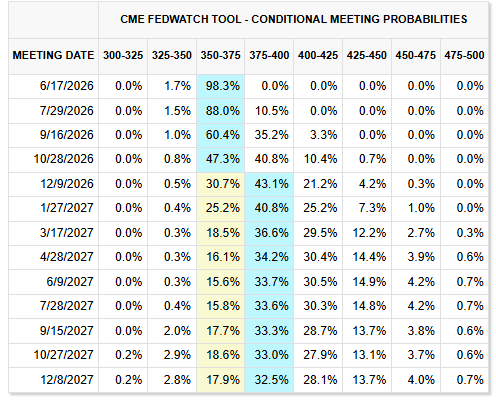
This scenario is already starting to show up in the Federal Reserve probability table, where there is now a probability above 43.00% that, by December 2026, the interest rate could rise from the current 3.75% level toward a new area near 4.00%. If inflation surprises to the upside, markets could start anticipating higher rates earlier than expected, especially if the Fed sees the need to control inflation pressures more actively to return to its annual 2.00% target.
Source: CMEGROUP
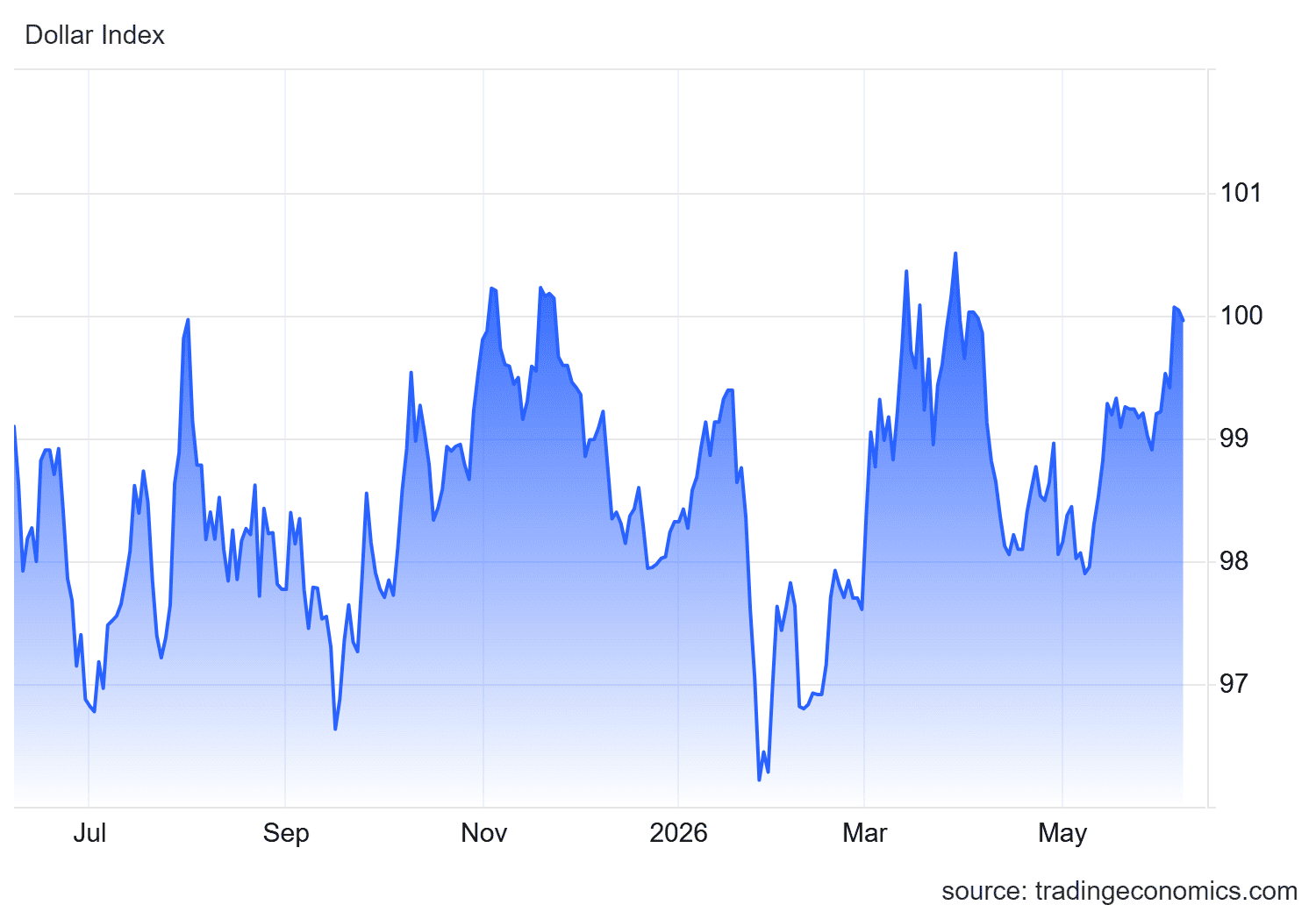
This entire backdrop is key for the US dollar, a currency that tends to gain strength when markets begin pricing in a more restrictive monetary policy stance. For now, DXY, the index that measures dollar strength, has shown some neutrality during the first sessions of the week, trading slightly below the 100-point area.
However, this pause may be related to the market waiting for tomorrow’s inflation data. In addition, the recent upward slope in DXY remains relevant, suggesting that dollar strength continues to be an important factor and could limit the yen’s ability to recover as a rival currency in the short term.
Source: TradingEconomics
Overall, the most important macroeconomic driver is now centered on the CPI release. If the data comes in above expectations and increases fears of inflationary pressures, the dollar could strengthen its short-term demand and generate renewed buying pressure in USD/JPY, similar to what has been observed over the past few weeks. On the other hand, if inflation shows a meaningful slowdown, the yen could find some room to recover ground in the following sessions.
Is the Bank of Japan still relevant?
The Bank of Japan has its next meeting scheduled for June 15 and 16, and markets remain focused on the direction its monetary policy could take over the coming months. For now, there is still some uncertainty around the path the central bank wants to follow.
The latest inflation data in Japan continues to show a consistent reading below the 2.00% area. Even so, markets are considering the possibility of a 0.25% rate increase at the next decision. However, it is still not clear whether this move would mark the start of a more sustained tightening cycle or whether the bank would prefer to return to a period of stable rates.
In this scenario, it is important to keep in mind that one of the factors that has kept pressure on the yen against its main rivals is the low level of Bank of Japan rates compared with other central banks. Even with a possible increase, Japan’s rate would be near 1.00%, still well below the Federal Reserve’s reference rate, which currently stands at 3.75%.
For this reason, unless markets begin to expect a much more aggressive Bank of Japan than in previous months, the yen could continue to face difficulties recovering demand in a consistent way. This could also keep buying pressure relevant in USD/JPY over the coming weeks.
Technical outlook for USD/JPY
Source: StoneX, Tradingview
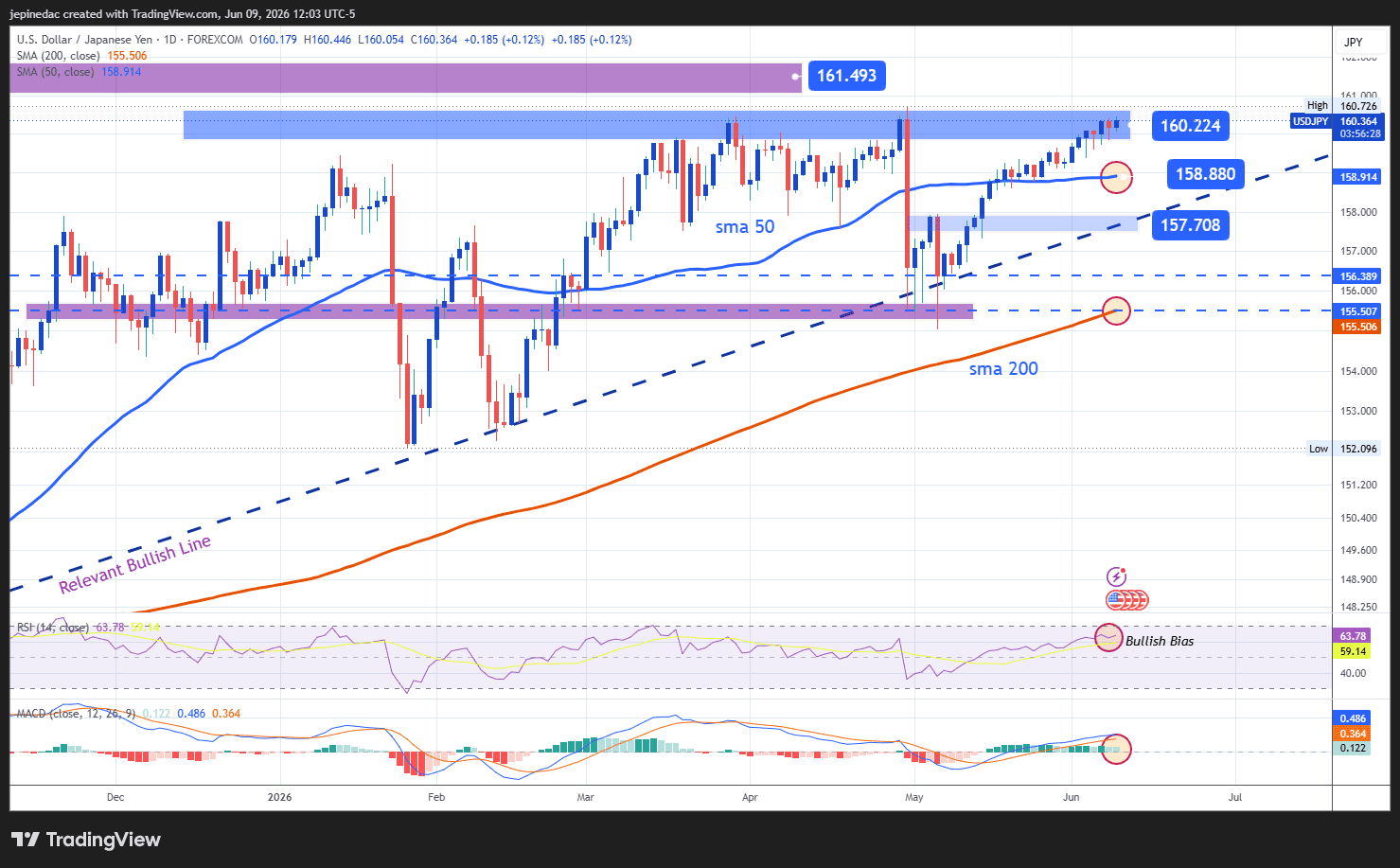
- The uptrend reaches relevant highs: For several months, the most important technical structure in USD/JPY has been a long-term bullish trendline. So far, given the lack of major bearish corrections, this remains the dominant technical pattern. For this reason, if buying pressure continues over the coming sessions, the extension of this trendline could remain relevant for short-term price action.
- RSI: Now, RSI continues to hold consistent readings above the neutral 50 level, suggesting that the average momentum over the last 14 sessions still shows a relevant buying bias. If this behavior continues, bullish pressure could remain in place over the coming trading sessions.
- MACD: A similar scenario can be seen in MACD, as the histogram remains consistently above the 0 level. This indicates that bullish strength is still present in the average of short-term moving averages and reinforces the importance of the current buying bias.
Key levels:
- 161.493 – Key resistance: Relevant upside barrier that coincides with an important high from July 2024. Moves above this level could reinforce a short-term buying bias and continue to give room for the bullish trendline to remain the dominant pattern over the coming weeks.
- 158.880 – Near-term barrier: Neutral zone aligned with the 50-period moving average. Price movements too close to this level could reinforce a phase of indecision or even the formation of a short-term sideways range.
- 157.708 – Main support: Nearby low that coincides with the base of the long-term bullish trendline. Moves toward this level could begin to put this structure at risk and highlight a more dominant selling bias over the following sessions.
Written by Julian Pineda, CFA, CMT – Market Analyst
Follow him on: @julianpineda25
Latest market news




Open an account in minutes
Experience award-winning platforms with fast and secure execution, and enjoy tight spreads from 0.5 pts on FX and 0.3 pts on indices.
Economic calendar
Web Trader platform
Our sophisticated web-based platform is packed with features.
Related articles
USD/CHF Feels the Weight of US Midterms, USD/CAD Clings to Support
US midterms threaten fresh dollar volatility as USD/CHF tests technical support and USD/CAD clings to 1.3940 ahead of election results.

US Dollar, GBP/USD, USD/CAD, USD/CHF, Gold Weekly Technical Outlook 11 2 2026
Sr. Technical Strategist Michael Boutros highlights the levels that matter on the USD Majors, commodities, and equity indices charts this week.

US Midterm Forecast: The Key Risks for Traders to Watch Through the US Elections
Prediction markets are pricing in nearly 75% odds of a Democratic sweep in this week’s US midterm elections, a development that would result in a split from the single party Republican rule of the past two years - what will it mean for markets?

This report is intended for general circulation only. It should not be construed as a recommendation, or an offer (or solicitation of an offer) to buy or sell any financial products. The information provided does not take into account your specific investment objectives, financial situation or particular needs. Before you act on any recommendation that may be contained in this report, independent advice ought to be sought from a financial adviser regarding the suitability of the investment product, taking into account your specific investment objectives, financial situation or particular needs.
StoneX Financial Pte. Ltd., may distribute reports produced by its respective foreign entities or affiliates within the StoneX group of companies or third parties pursuant to an arrangement under Regulation 32C of the Financial Advisers Regulations. Where the report is distributed to a person in Singapore who is not an accredited investor, expert investor or an institutional investor (as defined in the Securities Futures Act), StoneX Financial Pte. Ltd. accepts legal responsibility to such persons for the contents of the report only to the extent required by law. Singapore recipients should contact StoneX Financial Pte. Ltd. at 6826 9988 for matters arising from, or in connection with the report.
In the case of all other recipients of this report, to the extent permitted by applicable laws and regulations neither StoneX Financial Pte. Ltd. nor its associated companies will be responsible or liable for any loss or damage incurred arising out of, or in connection with, any use of the information contained in this report and all such liability is hereby expressly disclaimed. No representation or warranty is made, express or implied, that the content of this report is complete or accurate.
StoneX Financial Pte. Ltd. is not under any obligation to update this report.
Trading CFDs carries a high level of risk that may not be suitable for some investors. Consider your investment objectives, level of experience, financial resources, risk appetite and other relevant circumstances carefully. The possibility exists that you could lose some or all of your investments, including your initial deposits. If in doubt, please seek independent expert advice. Visit www.forex.com/en-sg/terms-and-policies for the complete Risk Disclosure Statement.