



USD/JPY Forecast: The Japanese Yen Weakens Amid BOJ Outlook
As the week comes to an end, the USD/JPY has started to consolidate a bullish bias in favor of the U.S. dollar, with a short-term gain of around 0.4%. For now, buying pressure persists as no significant changes are expected in the stance of the Bank of Japan (BoJ).
Share this:

As the week comes to an end, the USD/JPY has started to consolidate a bullish bias in favor of the U.S. dollar, with a short-term gain of around 0.4%. For now, buying pressure persists as no significant changes are expected in the stance of the Bank of Japan (BoJ). The lack of signals regarding potential rate hikes keeps the yen under pressure, preventing it from achieving a consistent recovery. As long as the BoJ shows no willingness to adjust its monetary policy, the dollar is likely to maintain an advantage over the Japanese currency in the short term.


What to Expect from the Bank of Japan’s Decision
The BoJ’s rate decision is scheduled for September 18–19, and the consensus points to keeping the current 0.5% level unchanged. The central bank believes that although Japan’s economy has partially withstood the effects of U.S. tariffs, risks of economic slowdown still persist in the coming months.
Regarding the start of a cycle of higher rates, there is no consensus. Some suggest it could arrive toward the end of 2025 or early 2026. For this reason, the comments accompanying the upcoming decision will be crucial in confirming or dismissing that possibility.
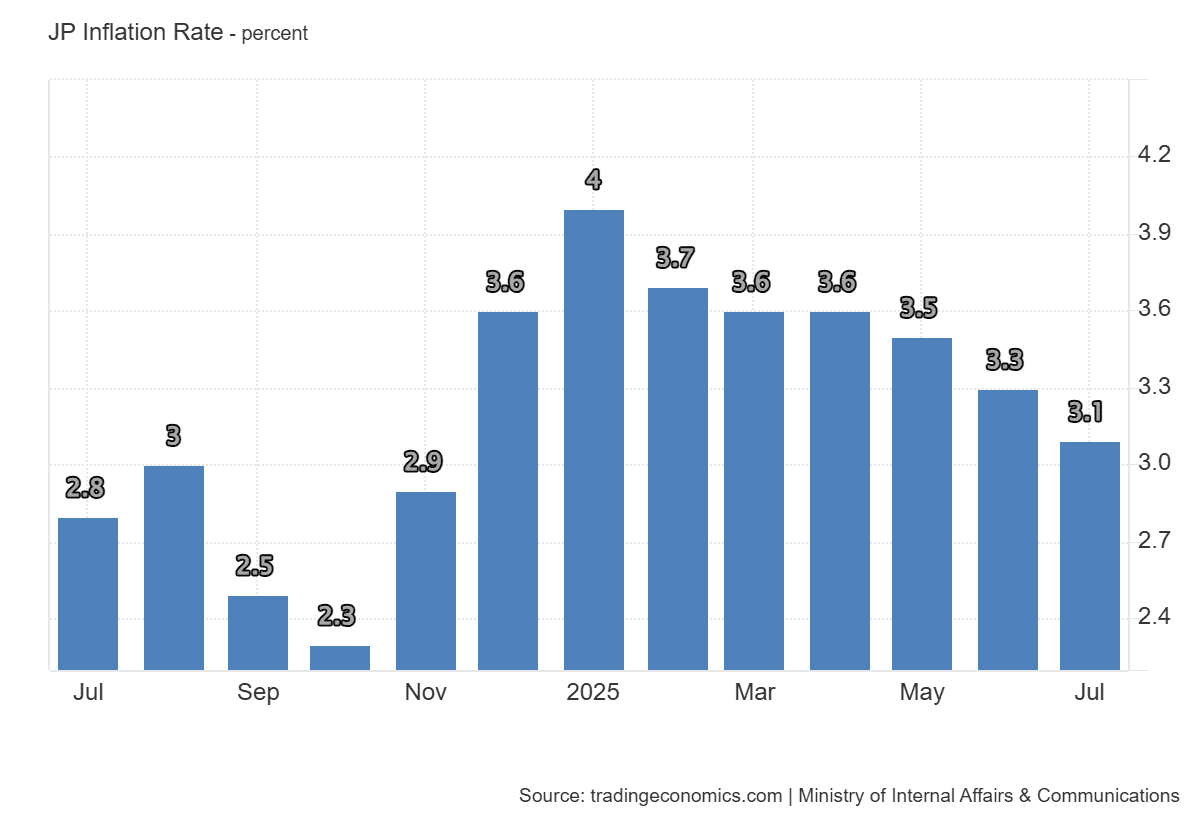
From a macroeconomic perspective, inflation in Japan has shown a downward trend. In January it stood at 4.0%, but by July it had fallen to 3.1%, moving closer to the 2.0% target. This decline reduces the margin for an immediate rate hike, as monetary tightening could undermine economic recovery, something the bank aims to protect.
Source: TradingEconomics
Still, internal voices warn of risks. The former Vice Minister of Finance noted that current rates are too low and have contributed to the yen’s weakness. This depreciation makes imports more expensive, potentially creating additional inflationary pressures. If this effect materializes and begins to show up in the data, the BoJ would need to consider rate hikes to avoid an acceleration in imported inflation.
In conclusion, the bank faces a dilemma: keep rates low to support growth or tighten policy to curb yen weakness and contain inflation risks. This may become much clearer once comments are released after the BoJ’s upcoming decision. In the meantime, the wide gap between Japan (0.5%) and the U.S. (4.5%) reinforces the attractiveness of dollar-denominated assets over yen assets. This differential serves as a structural barrier to yen appreciation in the short term, keeping buying pressure on USD/JPY.
Is the U.S. Dollar Recovering?
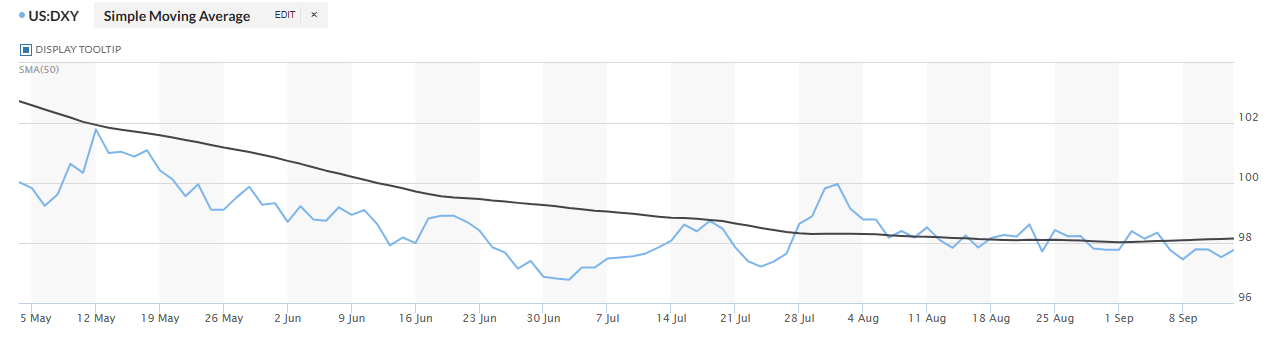
Amid ongoing discussions about lower rates in the U.S. and inflation data that came in as expected, the dollar had been experiencing a steady downtrend. However, in recent days it has started to show signs of recovery. The DXY, which measures its strength against a basket of currencies, is moving back toward the 98-point level, reflecting renewed confidence in the greenback.
Source: MarketWatch
This movement suggests an exhaustion of selling pressure on the dollar. If it continues, it could consolidate a neutral-to-bullish environment until the Fed’s meeting on September 17. This recovery limits the yen’s ability to advance and strengthens buying pressure on USD/JPY, which could intensify in the sessions ahead.
USD/JPY Technical Forecast

Source: StoneX, Tradingview
- A New Trend Emerges: Since late April, USD/JPY has been posting higher lows, forming a bullish trendline. This movement has repeatedly tested the 200-period simple moving average, highlighting its role as a technical barrier. As long as buying pressure holds, the pair could reach new highs, confirming the consolidation of a solid uptrend in the short term.
- RSI: The RSI line maintains a positive slope and sits above the 50 level, confirming that buyers remain in control. If it continues to rise steadily, bullish pressure could intensify, further consolidating the pair’s upward bias.
- MACD: The MACD histogram remains near the zero line but has started to oscillate above it. This indicates that the strength of short-term moving averages is beginning to lean toward greater buying momentum.
Key Levels:
- 148.679 – Main Resistance: Aligns with the 200-period simple moving average and stands as the most important barrier for buyers. A clear and sustained break above this level would reinforce the bullish trend and open the way for broader recovery.
- 147.557 – Nearby Support: Level where the Ichimoku cloud and the 50-period moving average converge. As long as the price remains above, a neutral short-term environment could be maintained.
- 146.367 – Final Support: Corresponds to recent lows. A sustained drop to this area would put the current uptrend at risk and open the door to a more relevant bearish bias.
Written by Julian Pineda, CFA – Market Analyst
Follow him: @julianpineda25
Related tags:




Open an account in minutes
Experience award-winning platforms with fast and secure execution, and enjoy tight spreads from 0.5 pts on FX and 0.3 pts on indices.
Economic calendar
Web Trader platform
Our sophisticated web-based platform is packed with features.
Related articles

Tankan Backs BOJ Tightening, but Yen Rate Expectations Ease
Japan’s Tankan supports further BOJ tightening, although softer rate expectations could limit support for the Japanese yen.


Japanese Yen Outlook: USD/JPY, GBP/JPY, AUD/JPY Setups
USD/JPY and GBP/JPY show signs of stabilising, while AUD/JPY remains vulnerable as yen crosses deliver mixed technical signals.

Japanese Yen Technical Analysis: USD/JPY Support Test into Core PCE
USD/JPY has been a battlefield for the past two months as the force of intervention and the threat of more have given sellers an advantage, even as buyers have continued to bid support on pullbacks. This sets the stage for a massive finish to the week with Core PCE and Non-farm Payrolls.

This report is intended for general circulation only. It should not be construed as a recommendation, or an offer (or solicitation of an offer) to buy or sell any financial products. The information provided does not take into account your specific investment objectives, financial situation or particular needs. Before you act on any recommendation that may be contained in this report, independent advice ought to be sought from a financial adviser regarding the suitability of the investment product, taking into account your specific investment objectives, financial situation or particular needs.
StoneX Financial Pte. Ltd., may distribute reports produced by its respective foreign entities or affiliates within the StoneX group of companies or third parties pursuant to an arrangement under Regulation 32C of the Financial Advisers Regulations. Where the report is distributed to a person in Singapore who is not an accredited investor, expert investor or an institutional investor (as defined in the Securities Futures Act), StoneX Financial Pte. Ltd. accepts legal responsibility to such persons for the contents of the report only to the extent required by law. Singapore recipients should contact StoneX Financial Pte. Ltd. at 6826 9988 for matters arising from, or in connection with the report.
In the case of all other recipients of this report, to the extent permitted by applicable laws and regulations neither StoneX Financial Pte. Ltd. nor its associated companies will be responsible or liable for any loss or damage incurred arising out of, or in connection with, any use of the information contained in this report and all such liability is hereby expressly disclaimed. No representation or warranty is made, express or implied, that the content of this report is complete or accurate.
StoneX Financial Pte. Ltd. is not under any obligation to update this report.
Trading CFDs carries a high level of risk that may not be suitable for some investors. Consider your investment objectives, level of experience, financial resources, risk appetite and other relevant circumstances carefully. The possibility exists that you could lose some or all of your investments, including your initial deposits. If in doubt, please seek independent expert advice. Visit www.forex.com/en-sg/terms-and-policies for the complete Risk Disclosure Statement.