





ECB What did we learn today EURUSD
Pandemic Emergency Purchase Program (PEPP) purchases over the next quarter will be significantly faster.
Share this:

The ECB had their March Interest Rate Decision meeting earlier. Expectations ranged across the board; however, nothing was too significant. The main takeaway from the meeting and the press conference was as expected, not too significant. The ECB said that given the uptick in inflation and inflation expectations recently, Pandemic Emergency Purchase Program (PEPP) purchases over the next quarter will be significantly faster. In addition, PEPP will run at least through the end on March 2022. ( This did not change, though some expected them to increase the duration.) Recall that one of the main benefits of PEPP is that the ECB is not tied to any specific amount they need to purchase at one time. The ECB has 1.85 trillion Euros to spend, at their discretion, to keep yields low. This differs from the FED, which is committed to buying $80 billion of Treasuries and $40 billion of MBS per month. Christine Lagarde said PEPP is not Yield Curve Control. (However, it essentially is. The ECB will buy bonds in the part of the yield curve where yields are rising the most.)
Theoretically, buying more bonds should decrease yields, which should bring down the value of the Euro. If the ECB is now buying MORE bonds than they were previously, and the Fed is buying the SAME amount, EUR/USD should move lower.
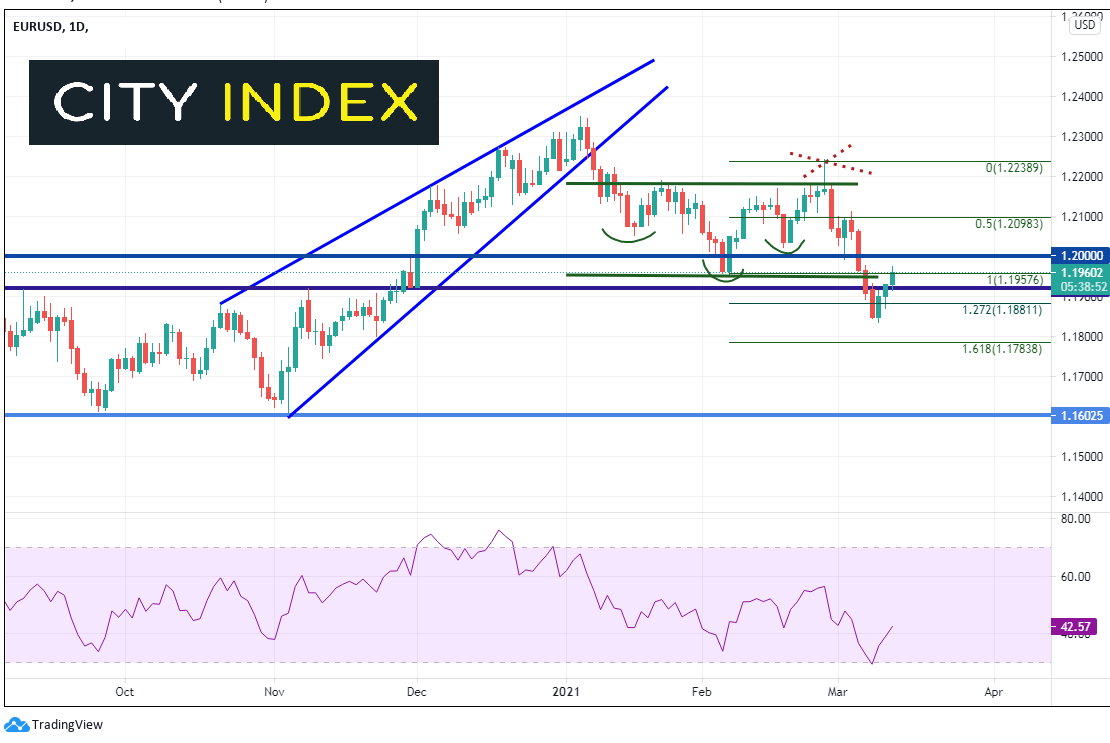
EUR/USD has been moving lower since February 25th, when the US 7-year note action went poorly. The pair moved to the 127.2% Fibonacci extension from the February 5th lows to the February 25th highs near 1.1840, and bounce to today’s highs near 1.1975. Resistance sits just above at 1.1990 and the psychological round number resistance at 1.2000.
Source: Tradingview, City Index
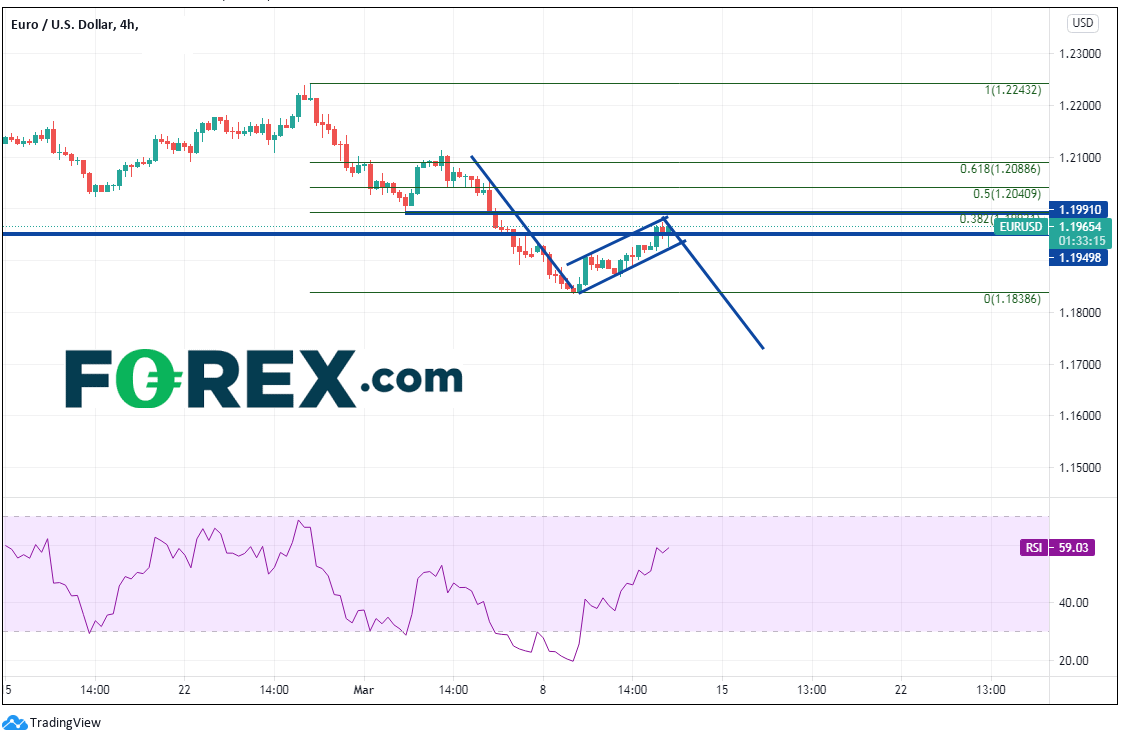
On a 240-minute timeframe, EUR/USD has formed a flag pattern. Notice that the top trendline of the flag pattern confluences with horizontal resistance (from the daily) and the 38.2% Fibonacci retracement from the highs of February 25th to the lows of March 9th near 1.1990. The target for flag pattern is the length of the flagpole added to the breakout point, which is currently near 1.1730. First support is back at the March 9th lows near 1.1838. Below there is the 161.8% Fibonacci extension from the timeframe mentioned on the daily chart neat 1.1738, and then the November 4th lows near 1.1602.
Source: Tradingview, City Index
The FOMC meets next week. If the ECB accelerates the pace of their bond purchases and the FOMC continues its bond buying program at $80 billion in Treasuries and $40 billion in MBS per month, it should cause European yields (bunds) to move lower relative to those from the US. This would cause the Euro to move lower relative to the US Dollar.
It’s time to start thinking about the FOMC meeting results on March 17th!
Learn more about forex trading opportunities.
The ECB had their March Interest Rate Decision meeting earlier. Expectations ranged across the board; however, nothing was too significant. The main takeaway from the meeting and the press conference was as expected, not too significant. The ECB said that given the uptick in inflation and inflation expectations recently, Pandemic Emergency Purchase Program (PEPP) purchases over the next quarter will be significantly faster. In addition, PEPP will run at least through the end on March 2022. ( This did not change, though some expected them to increase the duration.) Recall that one of the main benefits of PEPP is that the ECB is not tied to any specific amount they need to purchase at one time. The ECB has 1.85 trillion Euros to spend, at their discretion, to keep yields low. This differs from the FED, which is committed to buying $80 billion of Treasuries and $40 billion of MBS per month. Christine Lagarde said PEPP is not Yield Curve Control. (However, it essentially is. The ECB will buy bonds in the part of the yield curve where yields are rising the most.)
Theoretically, buying more bonds should decrease yields, which should bring down the value of the Euro. If the ECB is now buying MORE bonds than they were previously, and the Fed is buying the SAME amount, EUR/USD should move lower.
EUR/USD has been moving lower since February 25th, when the US 7-year note action went poorly. The pair moved to the 127.2% Fibonacci extension from the February 5th lows to the February 25th highs near 1.1840, and bounce to today’s highs near 1.1975. Resistance sits just above at 1.1990 and the psychological round number resistance at 1.2000.
Source: Tradingview, FOREX.com
On a 240-minute timeframe, EUR/USD has formed a flag pattern. Notice that the top trendline of the flag pattern confluences with horizontal resistance (from the daily) and the 38.2% Fibonacci retracement from the highs of February 25th to the lows of March 9th near 1.1990. The target for flag pattern is the length of the flagpole added to the breakout point, which is currently near 1.1730. First support is back at the March 9th lows near 1.1838. Below there is the 161.8% Fibonacci extension from the timeframe mentioned on the daily chart neat 1.1738, and then the November 4th lows near 1.1602.
Source: Tradingview, FOREX.com
The FOMC meets next week. If the ECB accelerates the pace of their bond purchases and the FOMC continues its bond buying program at $80 billion in Treasuries and $40 billion in MBS per month, it should cause European yields (bunds) to move lower relative to those from the US. This would cause the Euro to move lower relative to the US Dollar.
It’s time to start thinking about the FOMC meeting results on March 17th!
Learn more about forex trading opportunities.



Open an account in minutes
Experience award-winning platforms with fast and secure execution.
Economic calendar
Web Trader platform
Our sophisticated web-based platform is packed with features.
Related articles
US Dollar Breakout Has History on Its Side
The US dollar is breaking higher as financial conditions tighten at a historically rapid pace. Both history and the charts suggest the rally may have further to run.

GBP/USD, GBP/JPY, GBP/AUD: Sterling Eyes UK Inflation Catalyst
Sterling faces a pivotal UK inflation test as traders weigh BoE tightening, Fed minutes and Australian employment data across GBP/USD, GBP/JPY and GBP/AUD.


USD/MXN Forecast: Is Super Peso Making a Comeback?
The latest trading sessions have once again highlighted the strength of the Mexican peso. The currency has managed to regain a consistent appreciation trend in the short term, even despite the renewed strength displayed by the U.S. dollar in recent sessions.

StoneX Financial Ltd (trading as "FOREX.com") is an execution-only service provider. This material, whether or not it states any opinions, is for general information purposes only and it does not take into account your personal circumstances or objectives. This material has been prepared using the thoughts and opinions of the author and these may change. However, FOREX.com does not plan to provide further updates to any material once published and it is not under any obligation to keep this material up to date.
This material is short term in nature and may only relate to facts and circumstances existing at a specific time or day. Nothing in this material is (or should be considered to be) financial, investment, legal, tax or other advice and no reliance should be placed on it. No opinion given in this material constitutes a recommendation by FOREX.com or the author that any particular investment, security, transaction or investment strategy is suitable for any specific person.
The material has not been prepared in accordance with legal requirements designed to promote the independence of investment research. Although FOREX.com is not specifically prevented from dealing before providing this material, FOREX.com does not seek to take advantage of the material prior to its dissemination. This material is not intended for distribution to, or use by, any person in any country or jurisdiction where such distribution or use would be contrary to local law or regulation. For further details see our full non-independent research disclaimer and quarterly summary.