


USD/MXN Forecast: Is Super Peso Making a Comeback?
The latest trading sessions have once again highlighted the strength of the Mexican peso. The currency has managed to regain a consistent appreciation trend in the short term, even despite the renewed strength displayed by the U.S. dollar in recent sessions.
Share this:

The latest trading sessions have once again highlighted the strength of the Mexican peso. The currency has managed to regain a consistent appreciation trend in the short term, even despite the renewed strength displayed by the U.S. dollar in recent sessions. This can be seen in the performance of USD/MXN, which has posted three consecutive bearish trading sessions and fallen nearly 1.0%, underscoring the momentum the Mexican peso has begun to recover.
For now, this dynamic appears to be driven by the inflation data released in Mexico last week, which has been followed by somewhat more hawkish comments from Banco de México (Banxico). These remarks suggest that the institution could maintain a more restrictive monetary policy stance than previously expected. Mexico’s wide interest rate differential relative to other economies has helped peso-denominated investments regain their appeal, and as this new perspective continues to gain relevance around Banxico, the selling pressure recently observed in USD/MXN could remain an important factor over the coming trading sessions.

Is Banxico Shifting Toward a More Restrictive Policy Stance?
Several sessions have now passed since Mexico’s latest inflation figures were released, and the trend observed over recent months shows that inflationary pressures have once again become more relevant. After reaching a low of 3.12% in July, annual inflation has gradually moved higher to 3.75% in October. This suggests that inflationary pressures have started to build again, bringing inflation closer to the upper limit of Banxico’s target range near 4.00%, highlighting that inflation risks remain an important consideration for the Mexican economy in the near term.
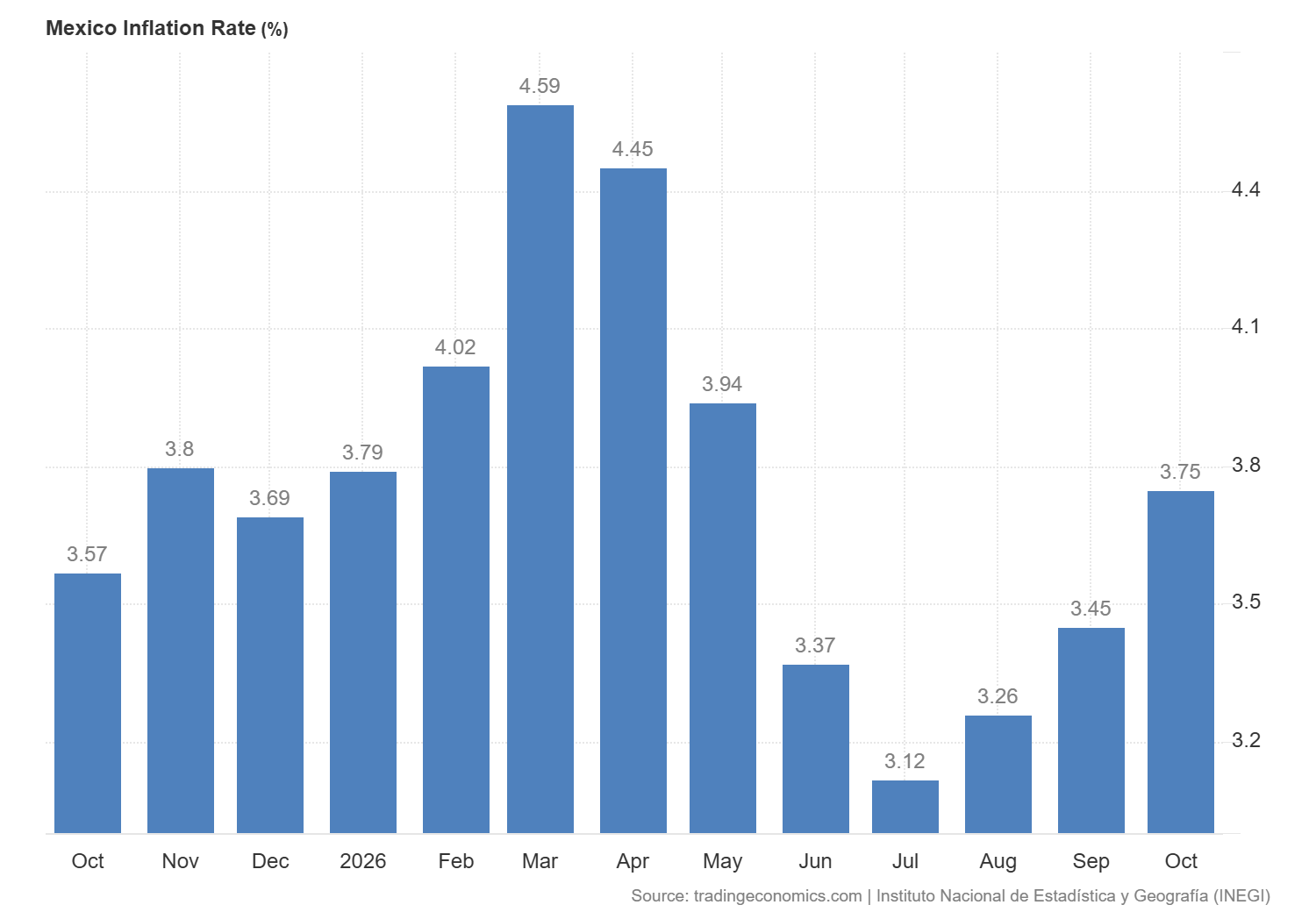
Source: TradingEconomics
What is particularly important is that comments from members of Banco de México have started to shift following the release of these economic data. Recently, Galia Borja, one of the institution’s deputy governors, stated that it may still be too early to determine how long the pause in the rate-cutting cycle could last after the central bank lowered its benchmark rate to 6.25%. She also emphasized that inflation in Mexico continues to face meaningful risks that could complicate the path toward lower interest rates over the coming months.
These comments are relevant because they suggest that a central bank which previously appeared ready to resume an easing cycle may now be considering a stance focused on keeping interest rates elevated for a longer period, partly due to the recent evolution of inflation.
In addition, market participants are awaiting the release of Banco de México's meeting minutes later this week. Investors will be looking for indications that policymakers are leaning toward maintaining the benchmark rate around 6.25% without the need to accelerate additional rate cuts in the months ahead.
All of this has become increasingly important for the Mexican peso because only a few weeks ago the market was pricing in a scenario of greater monetary easing and progressively lower interest rates. However, the shift in expectations reflected in recent comments has begun to alter the dynamics of Mexico’s bond market. Throughout much of November, yields on Mexico’s 10-year government bonds have recovered above the 9.00% level, maintaining a meaningful advantage over U.S. 10-year Treasury yields, which continue to trade near 5.1%.
What stands out is that Mexico has managed to preserve an attractive yield differential even as U.S. yields have recovered. This continues to support the appeal of peso-denominated investments and could remain a positive catalyst for the Mexican currency in the weeks ahead.
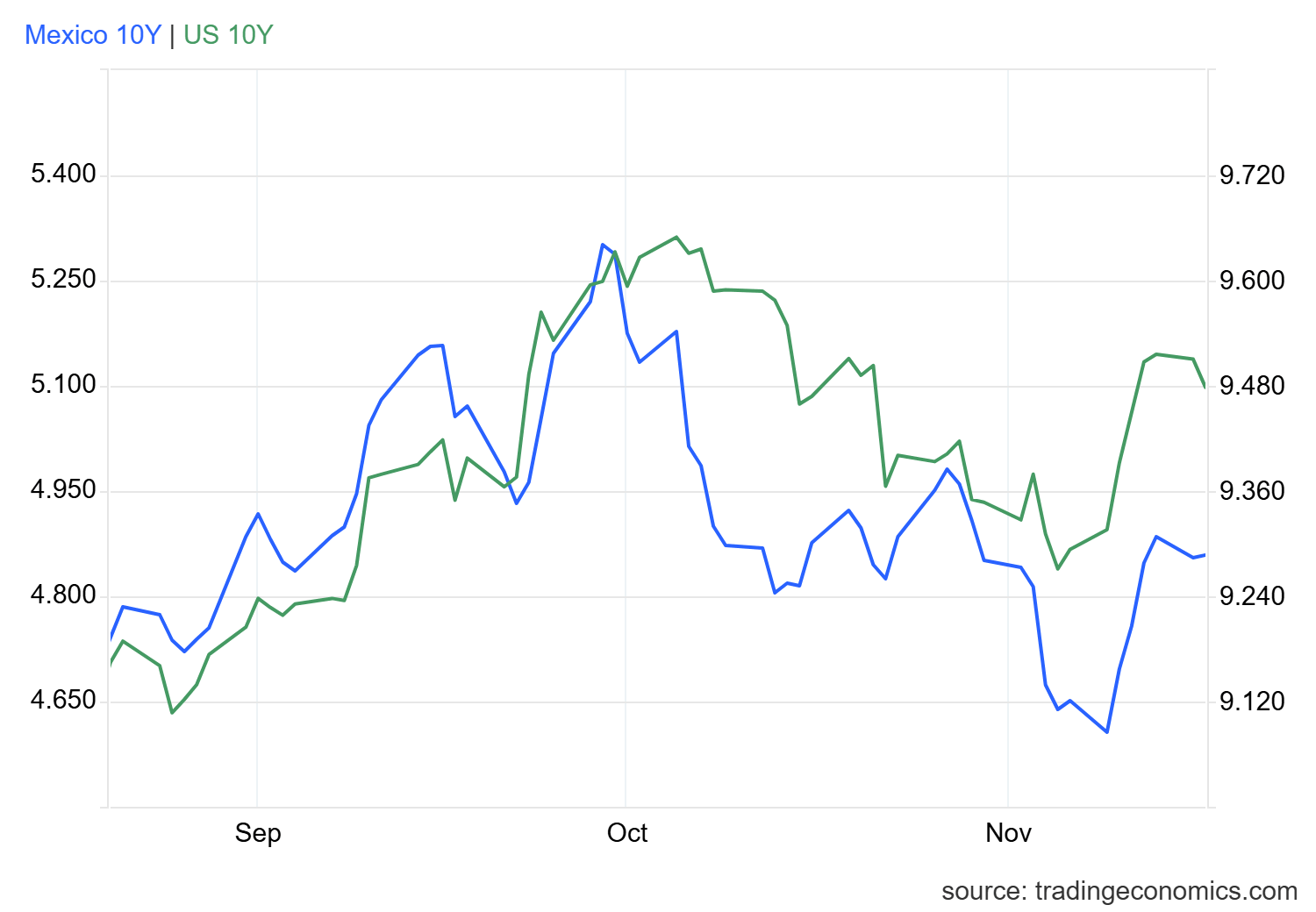
Source: TradingEconomics
Taking all of this into account, market expectations have begun to shift in a meaningful way. Investors are no longer as convinced that Banco de México will embark on a significant rate-cutting cycle, largely due to the inflation data published in recent weeks and the latest comments from policymakers. These factors have helped restore some of the appeal of peso-denominated investments and have allowed the Mexican currency to regain ground in a more consistent manner.
As long as this evolving outlook continues to highlight the wide interest rate differential that Mexico maintains relative to economies such as the United States, it could remain an important source of support for the peso. In fact, the Mexican currency has been one of the few major currencies to recover ground against the recent strength of the U.S. dollar, a dynamic that could continue to favor downside pressure in USD/MXN over the coming sessions.
USD/MXN Technical Forecast
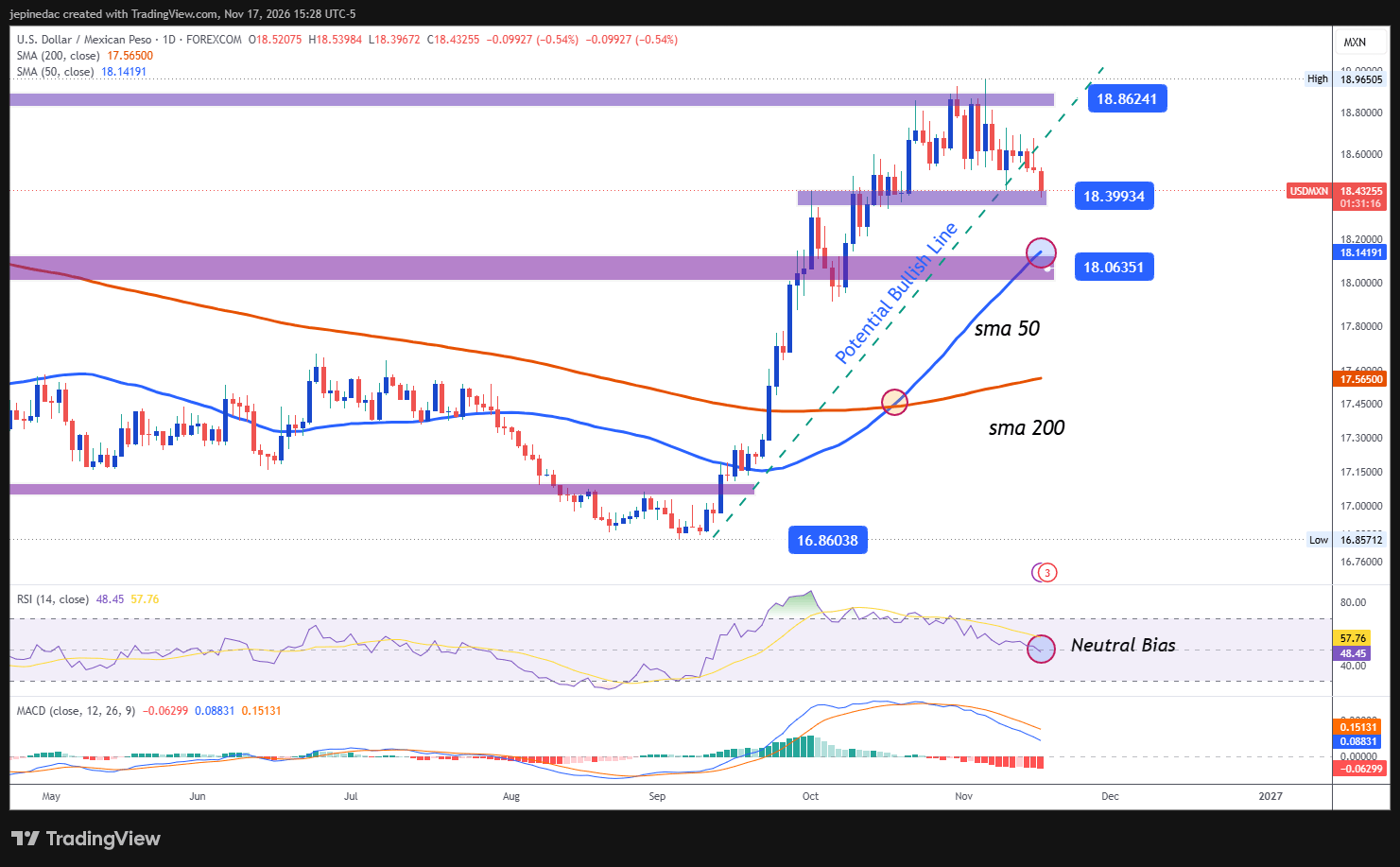
Source: StoneX, Tradingview
- Selling pressure begins to stand out again: Despite attempts by USD/MXN to maintain a potential bullish trendline since September, selling pressure has recently begun to break this structure and open the door to a broader period of indecision or even a more consistent bearish phase in the near term. As a result, the overall chart structure could begin to place greater emphasis on a defined trading range or potentially a stronger bearish setup over the coming sessions.
- MACD: The MACD histogram continues to move below its neutral line, suggesting that bearish momentum remains present across short-term moving averages. This indicates that a bearish bias has become dominant on the chart and could continue to remain relevant in the sessions ahead while this dynamic persists.
- RSI: The RSI is showing a somewhat different picture. The indicator continues to fluctuate around its neutral 50 level, suggesting a balanced relationship between buying and selling pressure in USD/MXN. This behavior also highlights that a period of indecision remains relevant and can still be observed in recent price action.
Key Levels:
- 18.86 – Major Resistance: This area corresponds to the highs established over recent months and remains the most important upside barrier to monitor. Price action that moves back toward this level could revive a bullish bias that has recently lost momentum and restore the relevance of the previous upward trendline as an important technical structure in the weeks ahead.
- 18.40 – Current Barrier: This neutral level corresponds to an area where repeated price reversals have occurred in recent weeks and currently serves as a key reference point for the market’s lack of direction. Price action that continues to develop around this level could reinforce the current indecisive environment and pave the way for a more defined trading range over the coming sessions.
- 18.00 – Key Support: This area marks the lows established in previous weeks and remains the most important downside barrier on the chart. In addition to representing an important psychological level, it also coincides with the 50-period simple moving average. Price action that begins to challenge this area could reflect increasingly dominant bearish momentum and potentially support the formation of a short-term downward trendline on the daily USD/MXN chart.
Written by Julian Pineda, CFA, CMT – Market Analyst
Follow him on: @julianpineda25
Latest market news




Open an account in minutes
Experience award-winning platforms with fast and secure execution.
Economic calendar
Web Trader platform
Our sophisticated web-based platform is packed with features.
Related articles
USD/MXN Forecast: Is Super Peso Making a Comeback?
The latest trading sessions have once again highlighted the strength of the Mexican peso. The currency has managed to regain a consistent appreciation trend in the short term, even despite the renewed strength displayed by the U.S. dollar in recent sessions.
US Dollar Price Action Setups: EUR/USD, USD/JPY, GBP/USD, USD/CAD
In a wide ranging webinar multiple USD pairs were in focus, continuing last week’s rally in DXY as EUR/USD tests 1.1000 and USD/JPY tests the 160.00 level.

EUR/USD outlook: euro back above 1.1000 as dollar rally loses steam
EUR/USD has recovered back above 1.1000 after a brief break lower, a sign the dollar's inflation-driven rally may be losing momentum. With a December Fed hike largely priced in and oil a potential tailwind for the euro, the risks are starting to tilt to the upside.

StoneX Financial Ltd (trading as "FOREX.com") is an execution-only service provider. This material, whether or not it states any opinions, is for general information purposes only and it does not take into account your personal circumstances or objectives. This material has been prepared using the thoughts and opinions of the author and these may change. However, FOREX.com does not plan to provide further updates to any material once published and it is not under any obligation to keep this material up to date.
This material is short term in nature and may only relate to facts and circumstances existing at a specific time or day. Nothing in this material is (or should be considered to be) financial, investment, legal, tax or other advice and no reliance should be placed on it. No opinion given in this material constitutes a recommendation by FOREX.com or the author that any particular investment, security, transaction or investment strategy is suitable for any specific person.
The material has not been prepared in accordance with legal requirements designed to promote the independence of investment research. Although FOREX.com is not specifically prevented from dealing before providing this material, FOREX.com does not seek to take advantage of the material prior to its dissemination. This material is not intended for distribution to, or use by, any person in any country or jurisdiction where such distribution or use would be contrary to local law or regulation. For further details see our full non-independent research disclaimer and quarterly summary.