


USD/CAD Forecast: Canadian Dollar Remains Under Pressure After Inflation Data
As the end of 2026 draws closer, one of the most notable themes in the currency market remains the weakness of the Canadian dollar against its U.S. counterpart. Over the past five trading sessions alone, USD/CAD has gained nearly 0.8%, highlighting the consistent strength that the U.S. dollar has continued to display.
Share this:

As the end of 2026 draws closer, one of the most notable themes in the currency market remains the weakness of the Canadian dollar against its U.S. counterpart. Over the past five trading sessions alone, USD/CAD has gained nearly 0.8%, highlighting the consistent strength that the U.S. dollar has continued to display.
For now, this buying momentum is largely driven by the fact that Canada’s latest inflation data failed to reinforce expectations of a more aggressive Bank of Canada in the near term. At the same time, markets continue to focus on the prospect of a more restrictive Federal Reserve, a dynamic that remains supportive of the U.S. dollar. As long as this backdrop remains in place, buying interest in USD/CAD could continue to be a key market theme over the coming trading sessions.

Is the Bank of Canada Becoming More Neutral?
Yesterday's session proved particularly important for the outlook of the Bank of Canada and, by extension, for the Canadian dollar. The focus was on the release of the latest CPI inflation figures for the Canadian economy.
Annual inflation came in at 3.1%, below the 3.2% expected by the market, reinforcing the view that inflationary pressures have continued to moderate in recent months. In addition, October's reading matched September's result, showing no further acceleration that would suggest a renewed build-up in inflation pressures. As a result, inflation remains close to the upper end of the central bank's target range, with policymakers still aiming for inflation around 3.0% in the near term.
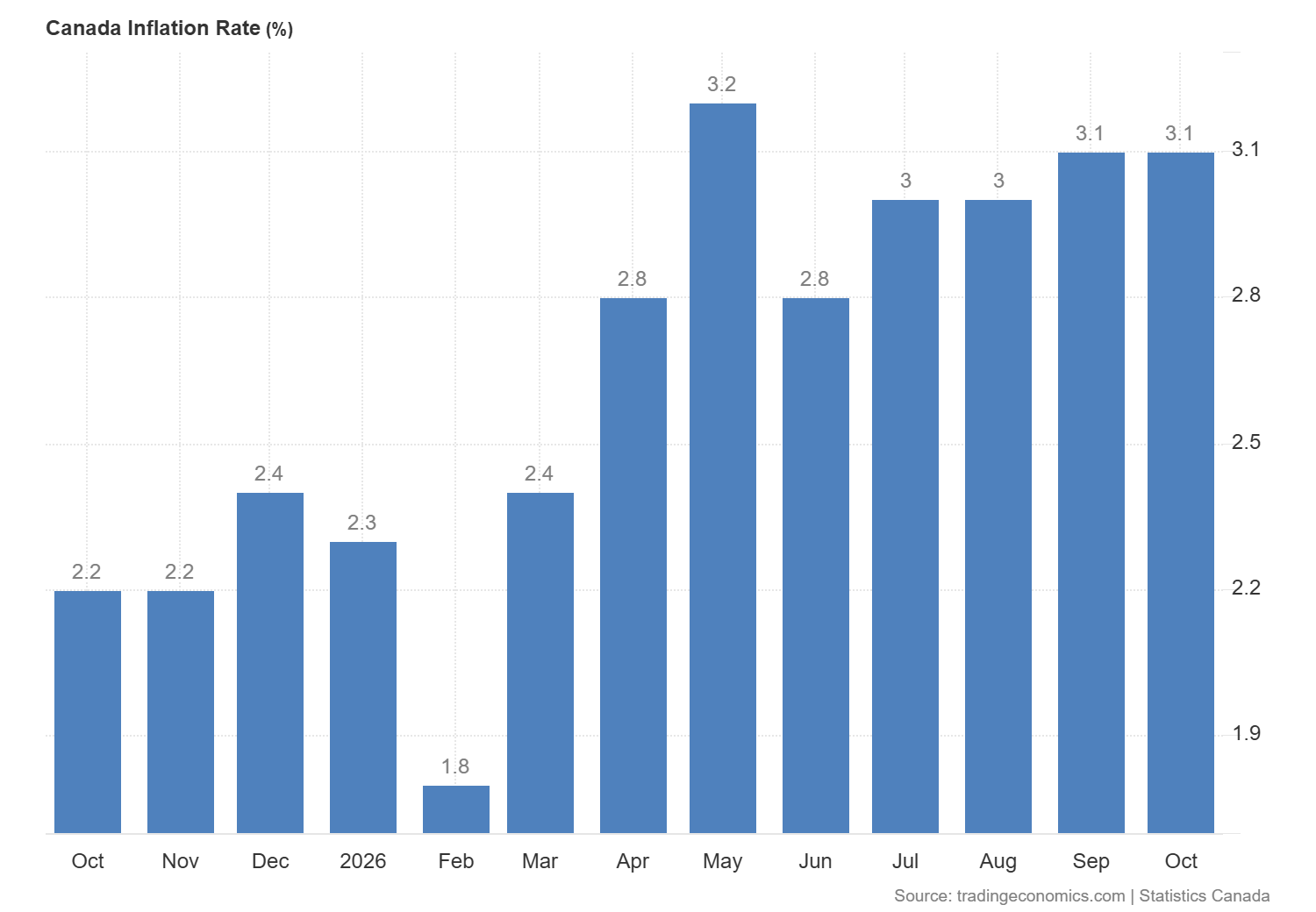
Source: TradingEconomics
These inflation figures are particularly relevant because they play a key role in shaping the Bank of Canada’s monetary policy decisions. With inflation failing to show a meaningful rebound over the past month, expectations for a more aggressive policy stance have gradually faded.
In fact, market pricing for the December 9 meeting now implies roughly a 51% probability of an interest rate hike in Canada. This stands in contrast to the situation in the United States, where inflationary pressures have remained relatively more persistent. Current expectations show a greater than 90% probability of another rate hike by the Federal Reserve at the same meeting, reinforcing the perception of a more hawkish Fed compared with a Bank of Canada that may be shifting toward a more cautious stance before the end of 2026.
This divergence matters because central bank expectations indirectly influence the relative attractiveness of each currency. The effect can be seen in sovereign bond markets, where U.S. Treasury yields continue to show resilience while Canadian government bond yields have lost momentum in recent sessions.
As shown below, U.S. 10-year Treasury yields continue to hold an upward bias, while Canadian 10-year bond yields have maintained a more moderate profile. The spread remains significant, with yields near 5.1% in the United States compared with approximately 3.8% in Canada. This differential continues to support the appeal of U.S. dollar-denominated assets, increasing demand for USD investments and making it more difficult for the Canadian dollar to stage a sustained recovery in the near term.
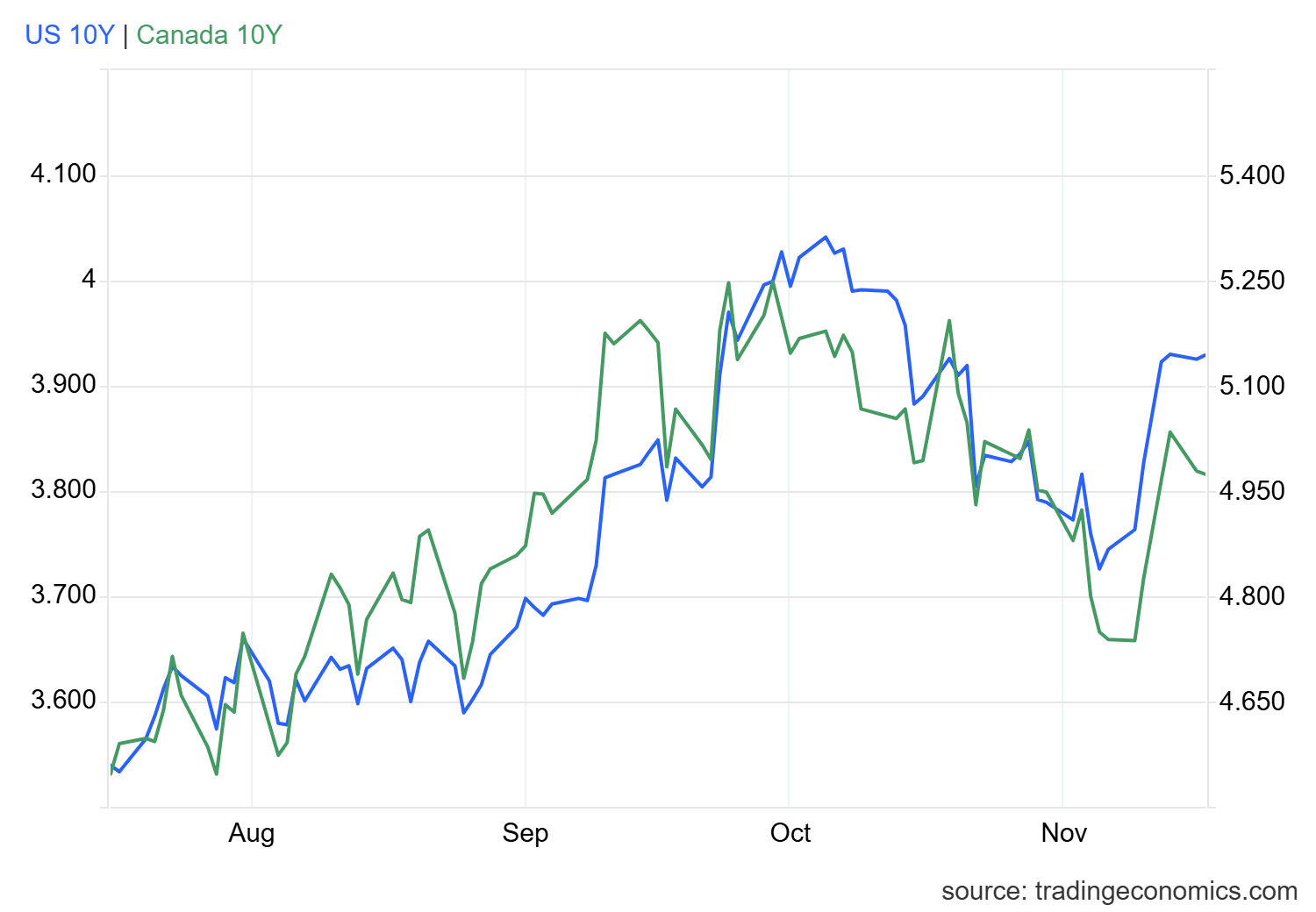
Source: TradingEconomics
Taking all of this into account, Canada’s latest inflation figures have not acted as a bullish catalyst for the Canadian dollar. Instead, they have strengthened the view that a more cautious Bank of Canada could become increasingly relevant in the near term. This dynamic is also limiting the relative attractiveness of the Canadian bond market, which continues to weigh on demand for Canadian dollar-denominated assets.
As a result, the CAD continues to struggle to regain ground against the U.S. dollar. If the divergence between the policy outlooks of both central banks persists, buying pressure in USD/CAD could remain an important feature of the market over the coming weeks.
USD/CAD Technical Forecast
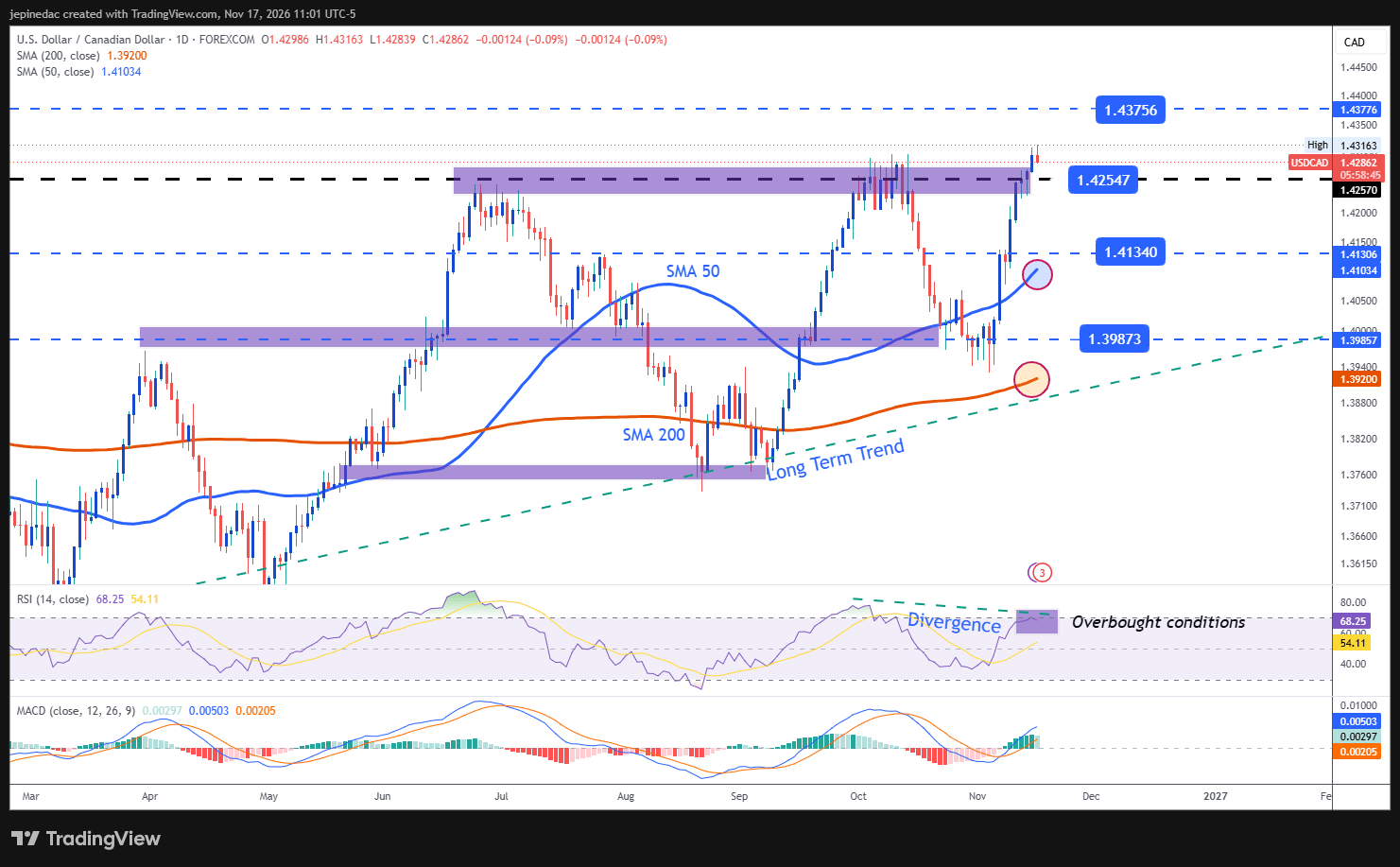
Source: StoneX, Tradingview
- Long-term trend regains relevance: Since February of this year, USD/CAD has gradually been developing a long-term bullish trendline. Although this structure lost some relevance during previous months, the recovery seen in recent weeks has brought it back into focus. As price approaches key highs on the daily chart once again, this trendline could become the most important technical structure to monitor in the weeks ahead.
- MACD: The indicator continues to display a histogram that remains firmly above the neutral level. This suggests that short-term moving averages continue to reflect bullish momentum, highlighting a dominant buying bias that could remain relevant in the coming weeks.
- RSI: The RSI presents a slightly different picture. The indicator continues to trade near the overbought threshold around 70, while USD/CAD keeps posting higher highs as the RSI records lower highs. This development highlights a short-term bearish divergence, suggesting that buying momentum may be becoming overstretched and potentially opening the door to corrective pullbacks over the next few sessions.
Niveles clave:
- 1.43756 – Key resistance: This area marks highs not seen since April 2025 and currently represents the most important upside barrier on the chart. A move closer to this level could reinforce the dominant bullish bias and further strengthen the significance of the long-term upward trendline.
- 1.42547 – Near-term barrier: This zone corresponds to highs recorded in previous months and may now serve as the nearest pullback reference on the chart. The level could become increasingly important if short-term corrective declines begin to develop.
- 1.41340 – Critical support: This area marks lows established in previous weeks and aligns with the 50-period simple moving average. It remains the most important downside level to watch, as a move back toward this zone could weaken the recent recovery and highlight a broader period of market indecision.
Written by Julian Pineda, CFA, CMT – Market Analyst
Follow him on: @julianpineda25
Latest market news




Open an account in minutes
Experience award-winning platforms with fast and secure execution.
Economic calendar
Web Trader platform
Our sophisticated web-based platform is packed with features.
Related articles
USD/CAD Forecast: Canadian Dollar Remains Under Pressure After Inflation Data
As the end of 2026 draws closer, one of the most notable themes in the currency market remains the weakness of the Canadian dollar against its U.S. counterpart. Over the past five trading sessions alone, USD/CAD has gained nearly 0.8%, highlighting the consistent strength that the U.S. dollar has continued to display.
British Pound Technical Outlook: GBP/USD Tests Pivotal Support—Breakdown Risk Rises 11 17 2026
Sterling bears are pressing critical support near the yearly lows, with the next reaction likely to determine whether the broader trading range survives.


NZD/USD Forecast: Kiwi faces historic breakdown as RBNZ survey looms
NZD/USD is teetering above support that held through the pandemic and Liberation Day turmoil. With RBNZ hawks repeatedly disappointed, today's inflation expectations survey could open the door to a slide towards the GFC lows.

StoneX Financial Ltd (trading as "FOREX.com") is an execution-only service provider. This material, whether or not it states any opinions, is for general information purposes only and it does not take into account your personal circumstances or objectives. This material has been prepared using the thoughts and opinions of the author and these may change. However, FOREX.com does not plan to provide further updates to any material once published and it is not under any obligation to keep this material up to date.
This material is short term in nature and may only relate to facts and circumstances existing at a specific time or day. Nothing in this material is (or should be considered to be) financial, investment, legal, tax or other advice and no reliance should be placed on it. No opinion given in this material constitutes a recommendation by FOREX.com or the author that any particular investment, security, transaction or investment strategy is suitable for any specific person.
The material has not been prepared in accordance with legal requirements designed to promote the independence of investment research. Although FOREX.com is not specifically prevented from dealing before providing this material, FOREX.com does not seek to take advantage of the material prior to its dissemination. This material is not intended for distribution to, or use by, any person in any country or jurisdiction where such distribution or use would be contrary to local law or regulation. For further details see our full non-independent research disclaimer and quarterly summary.