



GBPJPY arrives at critical juncture as Brexit vote looms
Next week’s major market risk event is most likely to be the UK parliament’s so-called “meaningful vote” on the withdrawal agreement Prime Minister Theresa May negotiated with the European Union at the back end of last year.
Share this:

Next week’s major market risk event is most likely to be the UK parliament’s so-called “meaningful vote” on the withdrawal agreement Prime Minister Theresa May negotiated with the European Union at the back end of last year. The deal covers the terms of Britain’s departure from the EU and the framework of future relations with the bloc. It was originally scheduled to take place in December but Mrs May decided to delay the vote after it became obvious MPs would vote against it. The embattled PM has since made little progress, if any, to win support. Brexit proponents argue that this deal is not what people actually voted for in 2016 as it could keep the UK tied to the EU indefinitely, without any say over its rules. Remainers are obviously against any Brexit deal, but some from this camp also argue that under this deal, the UK will be worse off than staying within the EU. Therefore, it is likely that MPs would still vote against May’s deal on Tuesday, which could lead to more uncertainty and confusion, and volatility in the markets. The impact of the vote is obviously going to be felt on UK assets first and foremost, but such is the importance of the vote that it could impact the global markets as well. If, for example, it triggers a sell-off in the stock markets then we could see haven assets such as gold and Japanese yen gain further support.
As far as today is concerned, well the pound has risen on the back of a report from the Evening Standard, which suggested that a Brexit delay beyond March 29 looks increasingly likely, citing Cabinet ministers on the matter. The pound’s positive reaction suggests investors are betting that the potential delay in the official exit date means the chance for a no-deal outcome would decrease.
But as it stands, the UK is scheduled to leave the EU on March 29, with or without a deal. However, things could change dramatically next week, depending on the outcome of the vote. It is possible, for example, that Mrs May might resign if the parliament rejects her deal, which could pave the way for a whole host of possibilities and uncertainties. But Mrs May is likely to fight her corner even if defeated. So, instead of immediately resigning, she may come up with plan B - but the PM will then only have three parliamentary days to do so. That would take us to Monday 21st for a potential second parliamentary vote. If her plan B is also then defeated, she may either resign or call for a general election. Other options include leaving the EU without a deal, which is the worst-case outcome for the pound, while calling another EU referendum is an alternative scenario. Unless May’s Brexit proposal passes the vote, any other options would probably involve delaying the official exit date of March 29, provided the EU agrees to it.
As we approach Tuesday’s eagerly-awaited vote, the pound is likely to turn even more headline-driven and volatile as some speculators try to pre-empt the outcome of the vote, as we have seen today with GBP spiking higher. Meanwhile those who have existing positions on sterling may decide to take profit, further exacerbating GBP’s stability. The potential for increased volatility is not necessarily a bad thing though for scalping and other short-term term trading strategies, but speculators who like to take longer-term directional views on the pound may be better off waiting for the outcome of the vote before deciding on a trade. On the other end of scale, aggressive traders may wish to buy as close to support or sell as close to resistance if they want to be in the market in the lead up to the vote, although we don’t recommend this strategy as it can be very risky.
Among the pound crosses, the GBP/JPY is among the most volatile pairs anyway but will be more so should the outcome of Tuesday’s vote triggers a risk-off response in the markets. So, the GBP/JPY has the potential to drop sharply if Mrs May’s Brexit deal is rejected by the parliament. However, if the vote somehow passes then this pair could absolutely surge, for Mrs May’s Brexit vision is seen as being a market-friendly deal. In other words, her deal, if approved, would represent a “soft” exit from the EU, which could limit the damage the UK economy might face in the short to medium term, compared to say, a no-deal, Brexit. This would encourage the Bank of England to hike interest rates to combat inflation, thus sending yield-seeking investors into the pound.
The GBP/JPY has staged an impressive rally off its 2019 low at 131.95 which it hit on the January 2. Ahead of the Brexit vote, it has now reached the pivotal technical area between 139.35 and 140.00. This range was the last support prior to the latest breakdown. Once support, this region could turn into resistance going forward. But if the bulls reclaim this resistance zone then rates could push further higher in the short-term, with the next potential resistance coming in at 141.60. Meanwhile, the next support levels come in at 137.65 and 136.80 respectively. If the latter breaks, say, on the back of the Brexit vote on Tuesday, then we wouldn’t rule out a potential drop towards the next psychological level around 130.00. In any case, traders need to be extra vigilant to the prospects of price spikes, flash crashes, and indeed flash melt ups, and take appropriate measures to minimise these risks. Good traders are, above all, good risk managers.
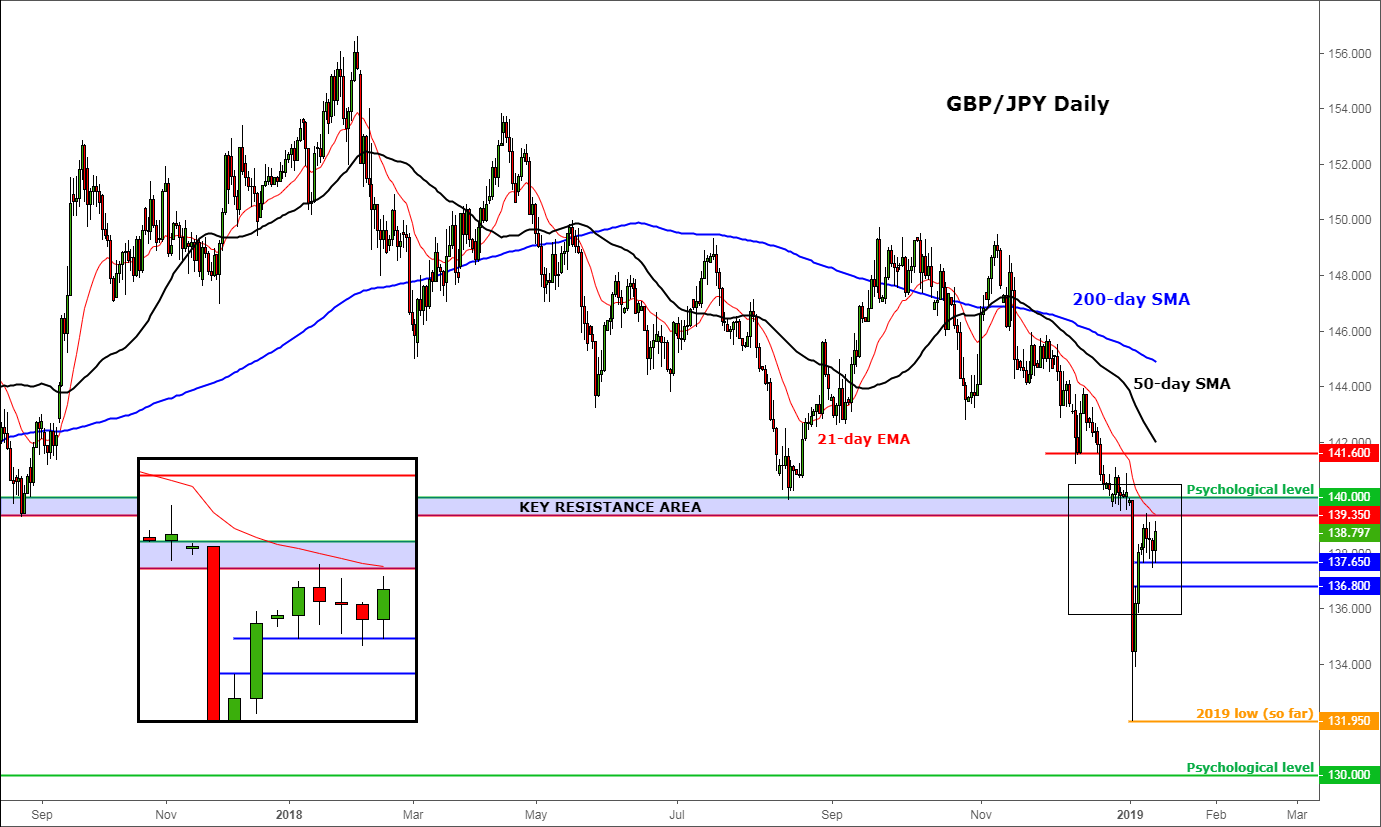
Source: TradingView and FOREX.com.
Related tags:



Open an account in minutes
Experience award-winning platforms with fast and secure execution.
Economic calendar
Web Trader platform
Our sophisticated web-based platform is packed with features.
Related articles
US Dollar Breakout Has History on Its Side
The US dollar is breaking higher as financial conditions tighten at a historically rapid pace. Both history and the charts suggest the rally may have further to run.

GBP/USD, GBP/JPY, GBP/AUD: Sterling Eyes UK Inflation Catalyst
Sterling faces a pivotal UK inflation test as traders weigh BoE tightening, Fed minutes and Australian employment data across GBP/USD, GBP/JPY and GBP/AUD.


USD/MXN Forecast: Is Super Peso Making a Comeback?
The latest trading sessions have once again highlighted the strength of the Mexican peso. The currency has managed to regain a consistent appreciation trend in the short term, even despite the renewed strength displayed by the U.S. dollar in recent sessions.

StoneX Financial Ltd (trading as "FOREX.com") is an execution-only service provider. This material, whether or not it states any opinions, is for general information purposes only and it does not take into account your personal circumstances or objectives. This material has been prepared using the thoughts and opinions of the author and these may change. However, FOREX.com does not plan to provide further updates to any material once published and it is not under any obligation to keep this material up to date.
This material is short term in nature and may only relate to facts and circumstances existing at a specific time or day. Nothing in this material is (or should be considered to be) financial, investment, legal, tax or other advice and no reliance should be placed on it. No opinion given in this material constitutes a recommendation by FOREX.com or the author that any particular investment, security, transaction or investment strategy is suitable for any specific person.
The material has not been prepared in accordance with legal requirements designed to promote the independence of investment research. Although FOREX.com is not specifically prevented from dealing before providing this material, FOREX.com does not seek to take advantage of the material prior to its dissemination. This material is not intended for distribution to, or use by, any person in any country or jurisdiction where such distribution or use would be contrary to local law or regulation. For further details see our full non-independent research disclaimer and quarterly summary.