



Gold undermined dollar underpinned as US 10y yield hits 3pc
This week has been a mixed one for the dollar, and by extension gold. Sentiment towards the greenback turned slightly negative in mid-week following the release of some weaker-than-expected US inflation figures.
Share this:

This week has been a mixed one for the dollar, and by extension gold. Sentiment towards the greenback turned slightly negative in mid-week following the release of some weaker-than-expected US inflation figures. A rebound for the euro and pound, and a pause in the selling of some emerging market currencies also weighed on the dollar. However, as we head into the weekend, the dollar was making a comeback, which meant gold was falling. Benchmark government bond yields – led by the US – were on the rise again, reducing the appeal of non- and low-interest bearing assets such as gold, yen and to a lesser degree the euro.
Retail sales weakest in six months but good summer for industrial output
The dollar shrugged off a weaker-than-expected retail sales report on Friday, which posted its weakest gain six months in August. On a month-over-month basis, headline retail sales rose by just 0.1% instead of 0.4% expected while core sales also missed the mark with a 0.3% gain. On top of this, import prices fell unexpectedly sharply by 0.6% month-over-month. However, the dollar still managed to rise, in part because of another decent showing from industrial output. In August, it rose 0.4% and the reading for July was also revised to show a 0.4% rise instead of 0.1% reported initially. With industrial output in June also rising more robustly at 1.0%, it has been a good summer for industrial production in the US.
Weak US inflation unlikely to stop Fed hikes
While US PPI and CPI inflation measures were weaker, they are unlikely to influence the Fed’s rate decision at the end of this month and possibly that in December – meaning the central bank still remains on course to hike two more times before the year is out. However, it may have some implications on future policy decisions if inflation and wage pressures were to remain stubbornly low.
Other central banks turning hawkish could weigh on dollar
But could the dollar go down anyway? Well, the bears point to the fact other central banks are turning hawkish and that this could support foreign currencies in favour of the dollar. The warning yesterday from Mario Draghi that the ECB projects significantly stronger core inflation for the Eurozone may have been an early indication for a sooner-than-expected rate hike there. At the moment, the ECB expects to raise rates after the next summer, although QE is going to be tapered at the end of this month before being stopped at the end of the year. One way or another, monetary conditions are slowly tightening in the Eurozone. In the UK, the Bank of England has already raised rates and once a Brexit deal is reached we should see a few more hikes. The Bank of Canada has also started to raise rates and soon we could see the likes of the RBA and RBNZ joining the race.
US 10-year bond yields hit 3%
The dollar’s resilience could be because of the fact the 10-year US Treasury yields are on the rise and on the brink of a potential breakout above the key 3.00 hurdle. As can be seen, the yield has been making higher lows of late and the break outside of the converging trend lines suggests it could embark on another rally at least towards the most recent high at 3.13. If yields continue to rise, it is difficult to see how things like gold and silver will be able to cope, while it could also exacerbate the emerging market turmoil.
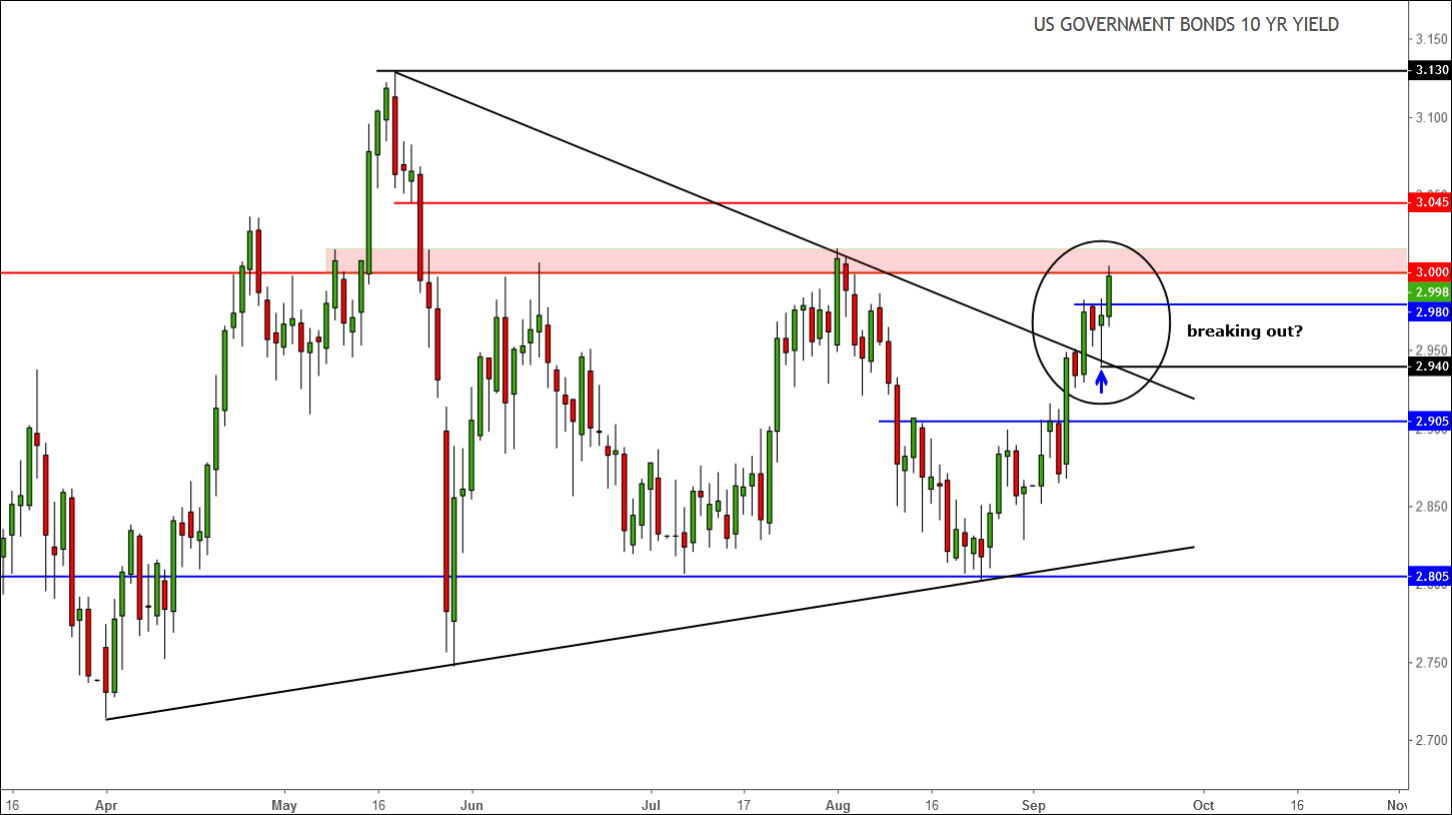
Source: TradingView.com and FOREX.com. Please note, this product is not available to US clients

Open an account in minutes
Experience award-winning platforms with fast and secure execution.
Economic calendar
Web Trader platform
Our sophisticated web-based platform is packed with features.
Related articles

NZD/USD Forecast: Kiwi faces historic breakdown as RBNZ survey looms
NZD/USD is teetering above support that held through the pandemic and Liberation Day turmoil. With RBNZ hawks repeatedly disappointed, today's inflation expectations survey could open the door to a slide towards the GFC lows.

USD/JPY, AUD/JPY: Central Bank Divergence Creates Two-Way Risk
USD/JPY eyes a breakout above 160, while AUD/JPY faces further losses as Fed, RBA and BoJ interest rate expectations diverge.


DXY, GBP/USD, AUD/USD, USD/CAD, USD/JPY, Gold Weekly Technical Outlook 11 16 2026
Sr. Technical Strategist Michael Boutros highlights the levels that matter on the USD Majors, commodities, and equity indices charts this week.

StoneX Financial Ltd (trading as "FOREX.com") is an execution-only service provider. This material, whether or not it states any opinions, is for general information purposes only and it does not take into account your personal circumstances or objectives. This material has been prepared using the thoughts and opinions of the author and these may change. However, FOREX.com does not plan to provide further updates to any material once published and it is not under any obligation to keep this material up to date.
This material is short term in nature and may only relate to facts and circumstances existing at a specific time or day. Nothing in this material is (or should be considered to be) financial, investment, legal, tax or other advice and no reliance should be placed on it. No opinion given in this material constitutes a recommendation by FOREX.com or the author that any particular investment, security, transaction or investment strategy is suitable for any specific person.
The material has not been prepared in accordance with legal requirements designed to promote the independence of investment research. Although FOREX.com is not specifically prevented from dealing before providing this material, FOREX.com does not seek to take advantage of the material prior to its dissemination. This material is not intended for distribution to, or use by, any person in any country or jurisdiction where such distribution or use would be contrary to local law or regulation. For further details see our full non-independent research disclaimer and quarterly summary.