



Jumpy oil market fears slipping demand
‘Quicker than thought’ Saudi production recovery would be a double-edged sword
Share this:

Updated 18th September 2019
‘Quicker than thought’ Saudi production recovery would be a double-edged sword
The oil market’s latest drama saw prices accelerating lower in reaction to Saudi Arabia’s Tuesday signal that oil output could ‘return to normal quicker than thought’. Reuters cited an unidentified Saudi source suggesting that Aramco’s Abqaiq and Khurais plants that were badly damaged by the attack would return to full production in the next two to three weeks, with up to 70% of lost production returning sooner.
Several hours later, and four days since the attack, the Kingdom, which is essentially OPEC’s lynchpin, finally gave concrete details of the scope of the damage whilst announcing partial restoration of operations. Saudi now says that production capacity will be back to normal within months. Nevertheless, repairs are progressing slower than initially expected. Officials had initially indicated that the majority of output would be restored within days. As such, an underlying bid has kept crude prices elevated this week.
The damage done by what was suspected to be a drone of unknown origin carrying munitions reportedly reduced output from the plants by half, jeopardising as much as 10% of global output. So far, with efforts focused on the Abqaiq plant, processing capacity has been restored to 2 million barrels a day, according to Aramco, with capacity expected to rise to 4.9 million barrels a day by the end of September, or roughly half of the whole complex’s rate at the end of last week.
Understandably, markets remain jumpy. After the worst-ever single disruption of global oil supply, participants are prone to over-reacting to little news, as seen on Tuesday, when Brent slumped 5% within minutes. The sudden drop corroborates widely suspected concerns about the demand outlook. With geopolitical events having done such heavy lifting in recent days, prices are set to return to sub-$60/bbl. levels seen over the last month or so, when upward price pressures fade.
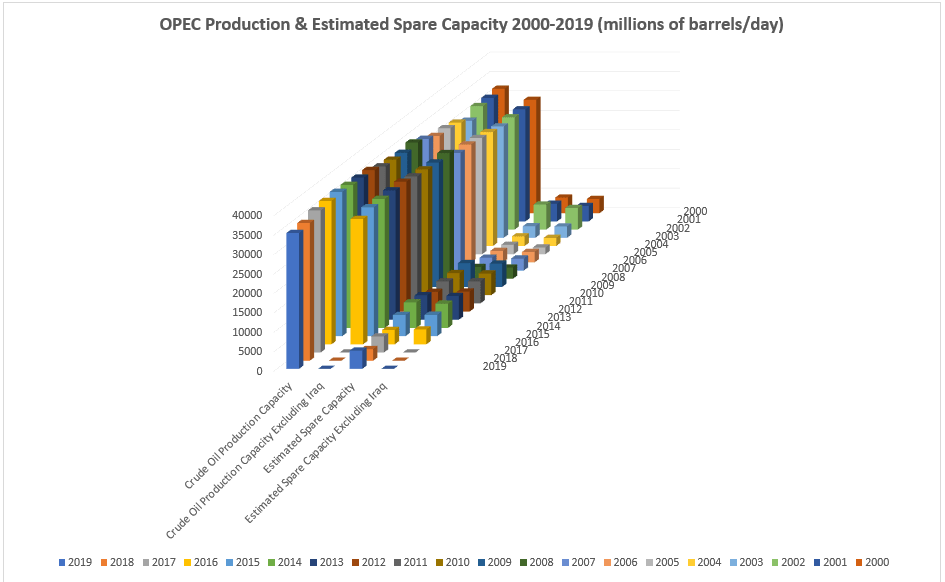
As we’ve seen though, the most important geopolitical influence on price has been the attack and its fallout. The disruption was sufficiently large to warrant talk of intervention by the United States’ Strategic Petroleum Reserve. Reserves of other countries could be deployed too. But data suggests that the global spare capacity required to replace lost Saudi output on a sustained basis would not currently be available. The graphic below depicts annual OPEC production rates going back to 2019. For clarity, historically unstable Iraqi production is broken out separately.
Source: Bloomberg/City Index
Spare production capacity may be running at the lowest in almost 20 years. That would be a knock-on effect of two years of OPEC production cuts and sanctions of producers like Iran and Venezuela. Against that backdrop, the sustained production outage now forecast by Saudi Arabia should underpin prices around their current levels, with any unexpected delays pointing to a price recovery back towards $70/bbl.-plus highs seen immediately following the attack.
Updated 18th September 2019
‘Quicker than thought’ Saudi production recovery would be a double-edged sword
The oil market’s latest drama saw prices accelerating lower in reaction to Saudi Arabia’s Tuesday signal that oil output could ‘return to normal quicker than thought’. Reuters cited an unidentified Saudi source suggesting that Aramco’s Abqaiq and Khurais plants that were badly damaged by the attack would return to full production in the next two to three weeks, with up to 70% of lost production returning sooner.
Several hours later, and four days since the attack, the Kingdom, which is essentially OPEC’s lynchpin, finally gave concrete details of the scope of the damage whilst announcing partial restoration of operations. Saudi now says that production capacity will be back to normal within months. Nevertheless, repairs are progressing slower than initially expected. Officials had initially indicated that the majority of output would be restored within days. As such, an underlying bid has kept crude prices elevated this week.
The damage done by what was suspected to be a drone of unknown origin carrying munitions reportedly reduced output from the plants by half, jeopardising as much as 10% of global output. So far, with efforts focused on the Abqaiq plant, processing capacity has been restored to 2 million barrels a day, according to Aramco, with capacity expected to rise to 4.9 million barrels a day by the end of September, or roughly half of the whole complex’s rate at the end of last week.
Understandably, markets remain jumpy. After the worst-ever single disruption of global oil supply, participants are prone to over-reacting to little news, as seen on Tuesday, when Brent slumped 5% within minutes. The sudden drop corroborates widely suspected concerns about the demand outlook. With geopolitical events having done such heavy lifting in recent days, prices are set to return to sub-$60/bbl. levels seen over the last month or so, when upward price pressures fade.
As we’ve seen though, the most important geopolitical influence on price has been the attack and its fallout. The disruption was sufficiently large to warrant talk of intervention by the United States’ Strategic Petroleum Reserve. Reserves of other countries could be deployed too. But data suggests that the global spare capacity required to replace lost Saudi output on a sustained basis would not currently be available. The graphic below depicts annual OPEC production rates going back to 2019. For clarity, historically unstable Iraqi production is broken out separately.
Source: Bloomberg/City Index
Spare production capacity may be running at the lowest in almost 20 years. That would be a knock-on effect of two years of OPEC production cuts and sanctions of producers like Iran and Venezuela. Against that backdrop, the sustained production outage now forecast by Saudi Arabia should underpin prices around their current levels, with any unexpected delays pointing to a price recovery back towards $70/bbl.-plus highs seen immediately following the attack.




Open an account in minutes
Experience award-winning platforms with fast and secure execution.
Economic calendar
Web Trader platform
Our sophisticated web-based platform is packed with features.
Related articles

Tankers Still Get Hit but Brent Crude Oil Keeps Falling
Brent crude oil has turned bearish after breaking its uptrend, as de-escalation signals outweigh tanker strikes near the Strait of Hormuz.


Crude Oil, DXY Outlook: Geopolitical Risks Halt Sell-Offs in the Dollar and Oil
The U.S. Dollar Index, Brent and WTI are rebounding from key support levels and oversold conditions after steep sell-offs. U.S.–Iran tensions, inflation risks and rate expectations remain in focus.

Crude Oil Prices Fall, What the U.S. Midterms Mean for Brent
Crude oil prices have pulled back more than 11% from October highs, in line with U.S.-Iran negotiation hopes and shifting U.S. midterm expectations.
StoneX Financial Ltd (trading as "FOREX.com") is an execution-only service provider. This material, whether or not it states any opinions, is for general information purposes only and it does not take into account your personal circumstances or objectives. This material has been prepared using the thoughts and opinions of the author and these may change. However, FOREX.com does not plan to provide further updates to any material once published and it is not under any obligation to keep this material up to date.
This material is short term in nature and may only relate to facts and circumstances existing at a specific time or day. Nothing in this material is (or should be considered to be) financial, investment, legal, tax or other advice and no reliance should be placed on it. No opinion given in this material constitutes a recommendation by FOREX.com or the author that any particular investment, security, transaction or investment strategy is suitable for any specific person.
The material has not been prepared in accordance with legal requirements designed to promote the independence of investment research. Although FOREX.com is not specifically prevented from dealing before providing this material, FOREX.com does not seek to take advantage of the material prior to its dissemination. This material is not intended for distribution to, or use by, any person in any country or jurisdiction where such distribution or use would be contrary to local law or regulation. For further details see our full non-independent research disclaimer and quarterly summary.