



Porsche AG exits DAX: Causes & Consequences
Porsche AG will leave the German DAX and move to the MDAX after just three years. The reasons: shrinking market cap, structural challenges, and a free float of only 12%. ETFs will be forced to sell, adding short-term pressure on the share price. Beyond Porsche, the exit highlights the shrinking role of Germany’s auto industry in the DAX, once dominant but now overshadowed by tech, finance, and defense.
Share this:
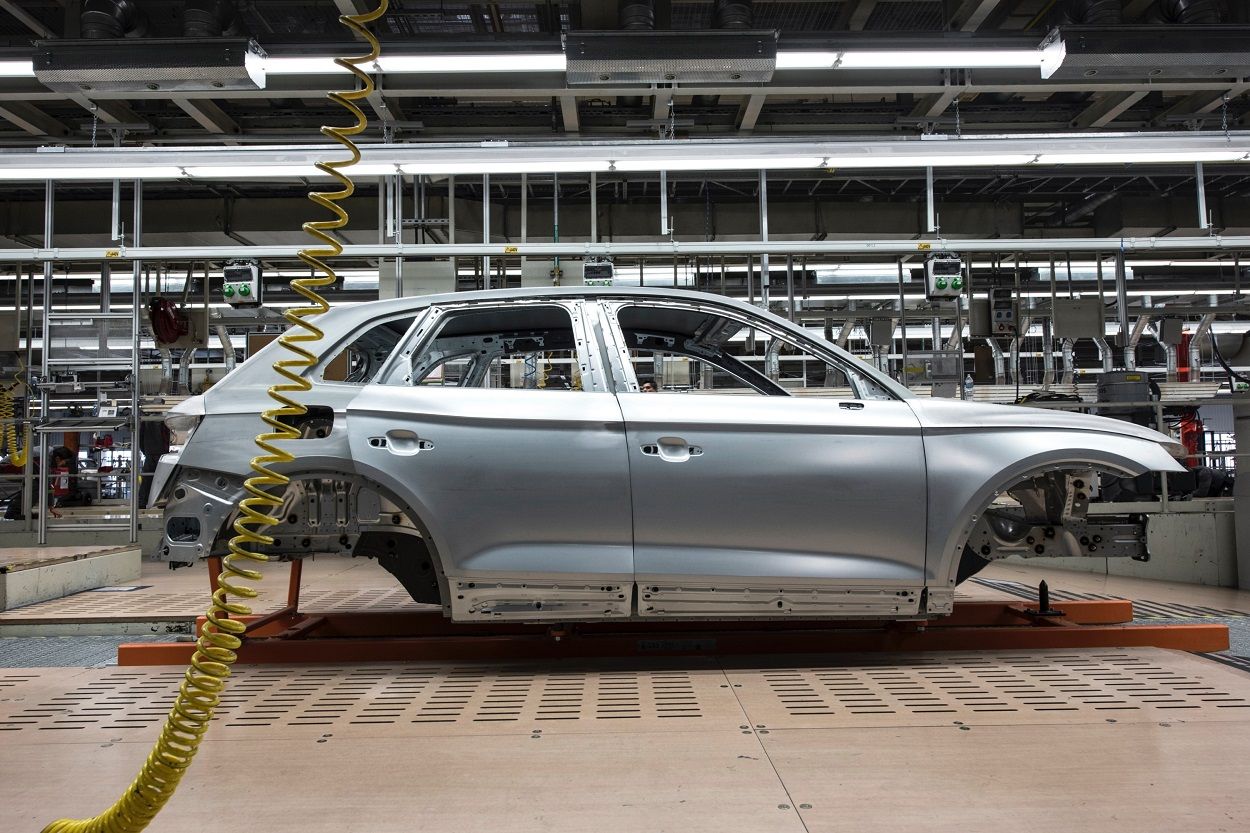
Porsche AG Leaves the DAX – Background and Consequences
After nearly three years in Germany’s leading stock index, the Porsche AG must now exit the DAX and move to the MDAX, the index for mid-sized companies. This decision by Deutsche Börse comes amid declining market capitalization and structural challenges for the car manufacturer.
Company Reactions
Porsche CEO Oliver Blume expressed disappointment over the removal, stating: “The DAX is losing one of its most valuable companies.” He emphasized the strength of the Porsche brand and announced intentions to return to the DAX as soon as possible. According to Blume, the exit is not due to fundamental weaknesses but rather technical criteria, such as the low free float: only around 12% of shares are publicly traded – a disadvantage compared to other DAX-listed firms.
Despite these explanations, Porsche is currently in crisis: profits are falling, cost-cutting programs have been announced, and Blume is under growing criticism for his dual role as CEO of both Porsche and Volkswagen.
Reasons for the DAX Exit
The DAX composition is reviewed quarterly, primarily based on market capitalization. Porsche’s market value has dropped significantly – particularly since the beginning of 2025, following a profit decline of about -22%. As a result, the company no longer ranks among the top 40.
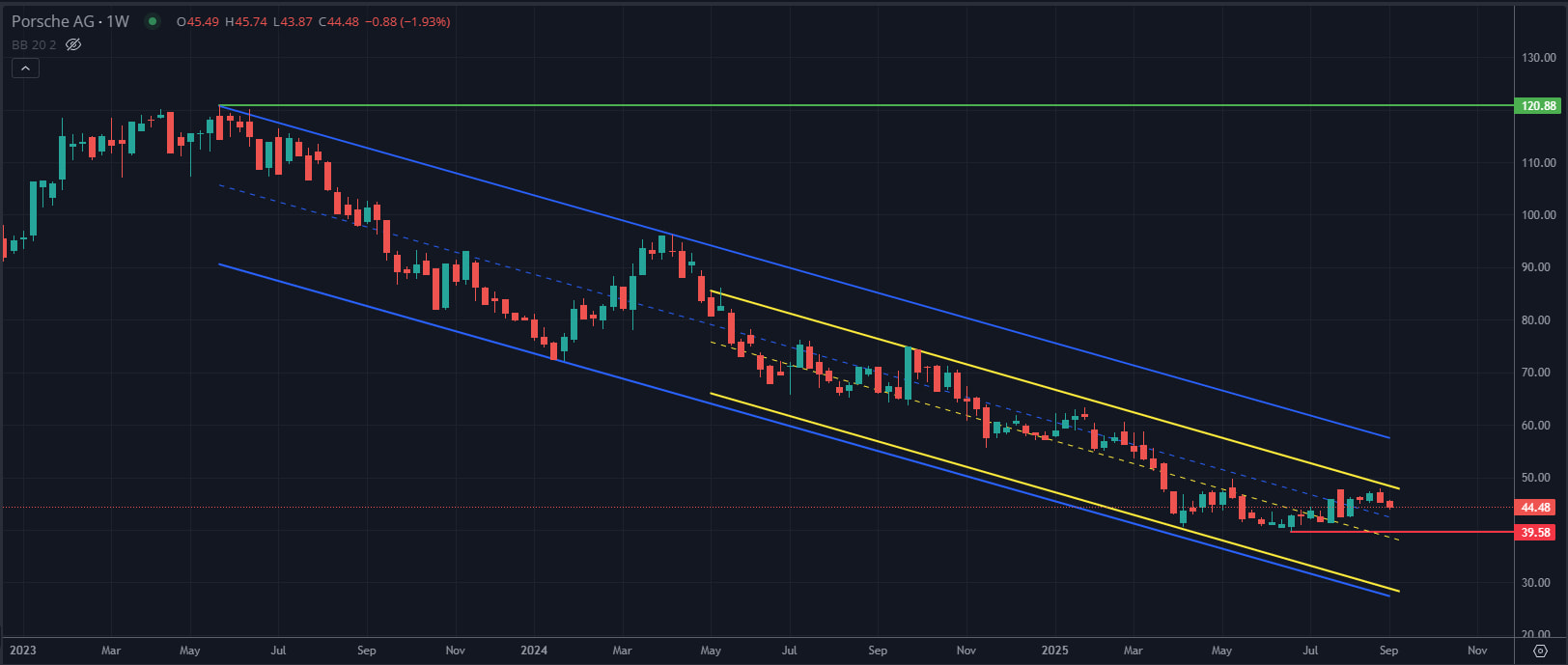
From a technical analysis standpoint, Porsche AG shows a clear and sustained downtrend that began around mid-2023 and continues through the end of 2025. The price movement follows two downward trend channels: a broader blue channel representing the long-term structure, and a narrower yellow channel indicating a steeper recent decline. Every attempt to recover was rejected near the upper boundaries of these channels, reflecting persistent selling pressure and a lack of bullish momentum.
The current price is around €44.48, just below the median line of the yellow channel and far below the upper limits of both – a clear sign of structural weakness in the market.
Despite some brief consolidations and recoveries (especially in March and July 2024), the stock failed to break out of the falling pattern. Present support lies around €39.58, which has held for several weeks and may indicate a short-term bottom. However, unless the stock breaks decisively above the yellow channel and past highs around €48–50, the downtrend remains intact. A distant green line at €120.88, the previous high, marks a psychologically important long-term resistance, highlighting how far the stock has fallen.
Despite this, the descent may not be permanent. Other firms like Beiersdorf have been removed from and returned to the DAX multiple times. Currently, however, Porsche lacks the positive signals needed for a near-term comeback.
Impact on Shareholders and Stock
The changes take effect on September 22. In the short term, Porsche’s share price is expected to remain under pressure, as index funds (ETFs) must sell their holdings. This results in oversupply and falling prices.
Still, a long-term collapse is unlikely. Porsche remains fundamentally a profitable company, with €2.163 billion in earnings and a market capitalization of €40.57 billion. The future share price will depend largely on the company’s operational performance.
Symbolism for the DAX and German Economy
According to experts at DekaBank, the DAX's profile won’t change significantly due to this adjustment, as Porsche’s weighting was too small. Nonetheless, the removal is symbolic of the broader transformation in the German economy. Whereas the automotive sector once accounted for more than 15% of the DAX, it now contributes less than 5%. Increasingly, the index is dominated by IT, finance, infrastructure, and defense companies.
What It Means for Porsche
Being part of the DAX brings prestige and visibility, especially among international investors. Leaving the index therefore results in a loss of image. However, Porsche SE – the holding company of the Porsche and Piëch families – remains in the DAX.
Current Challenges Facing the Company
Porsche is battling global sales issues: the important Chinese market has weakened, tariffs in the U.S. make exports less attractive, and EVs are not selling well in Germany. The company plans to cut around 1,900 jobs by 2029, with additional austerity measures already announced.
A leadership change is also on the horizon: Blume is expected to step down as Porsche CEO, and a successor is being sought.
Criticism and Outlook
Auto expert Ferdinand Dudenhöffer criticizes Blume’s dual role and points to strategic missteps in Porsche’s electric vehicle strategy. The Taycan, for instance, is considered too expensive in China. He also views the investment in proprietary battery cell production (Cellforce) as highly risky.
Dudenhöffer argues that Porsche must open up to strategic partnerships with leading technology firms and internationalize its production structures. Only through such reorientation and collaboration can Porsche hope to recover and potentially rejoin the DAX in the future.
--By Philip Papageorgiou – EU Market Analyst
-Follow me on X ex Twitter: PhilipForexCom
Latest market news




Open an account in minutes
Experience award-winning platforms with fast and secure execution.
Economic calendar
Web Trader platform
Our sophisticated web-based platform is packed with features.
Related articles

Nikkei swings harder than Nasdaq as AI fears deepen
Nikkei 225 volatility is running well ahead of Nasdaq 100, with the index construction and Japan's heavy exposure to AI manufacturing potentially explaining the difference.


S&P 500, Nasdaq 100 Claw Back But NVDA Cloud Looms Overhead
Last week was green for both the Nasdaq and S&P 500 but given the sell-off that led into that bounce there’s still a very real question as to whether bears still have a statement to make. And the NVDA situation presents a very real threat.


Nasdaq 100 forecast: Nvidia troubles put AI recovery into question
The recovery for major indices this week has helped repair much of the technical damage inflicted by last week’s sell-off, but the latest developments with Nvidia suggest investors are not quite ready to put the underlying risks behind them. The Nasdaq 100 led other US index futures lower overnight, with falls of around 0.8%.

StoneX Financial Ltd (trading as "FOREX.com") is an execution-only service provider. This material, whether or not it states any opinions, is for general information purposes only and it does not take into account your personal circumstances or objectives. This material has been prepared using the thoughts and opinions of the author and these may change. However, FOREX.com does not plan to provide further updates to any material once published and it is not under any obligation to keep this material up to date.
This material is short term in nature and may only relate to facts and circumstances existing at a specific time or day. Nothing in this material is (or should be considered to be) financial, investment, legal, tax or other advice and no reliance should be placed on it. No opinion given in this material constitutes a recommendation by FOREX.com or the author that any particular investment, security, transaction or investment strategy is suitable for any specific person.
The material has not been prepared in accordance with legal requirements designed to promote the independence of investment research. Although FOREX.com is not specifically prevented from dealing before providing this material, FOREX.com does not seek to take advantage of the material prior to its dissemination. This material is not intended for distribution to, or use by, any person in any country or jurisdiction where such distribution or use would be contrary to local law or regulation. For further details see our full non-independent research disclaimer and quarterly summary.