




Rio Tinto bullish for 2020
Rio Tinto, along with the FTSE350 mining index as a whole, has had a roller coaster year.
Share this:

Rio Tinto, along with the FTSE350 mining index as a whole, has had a roller coaster year.
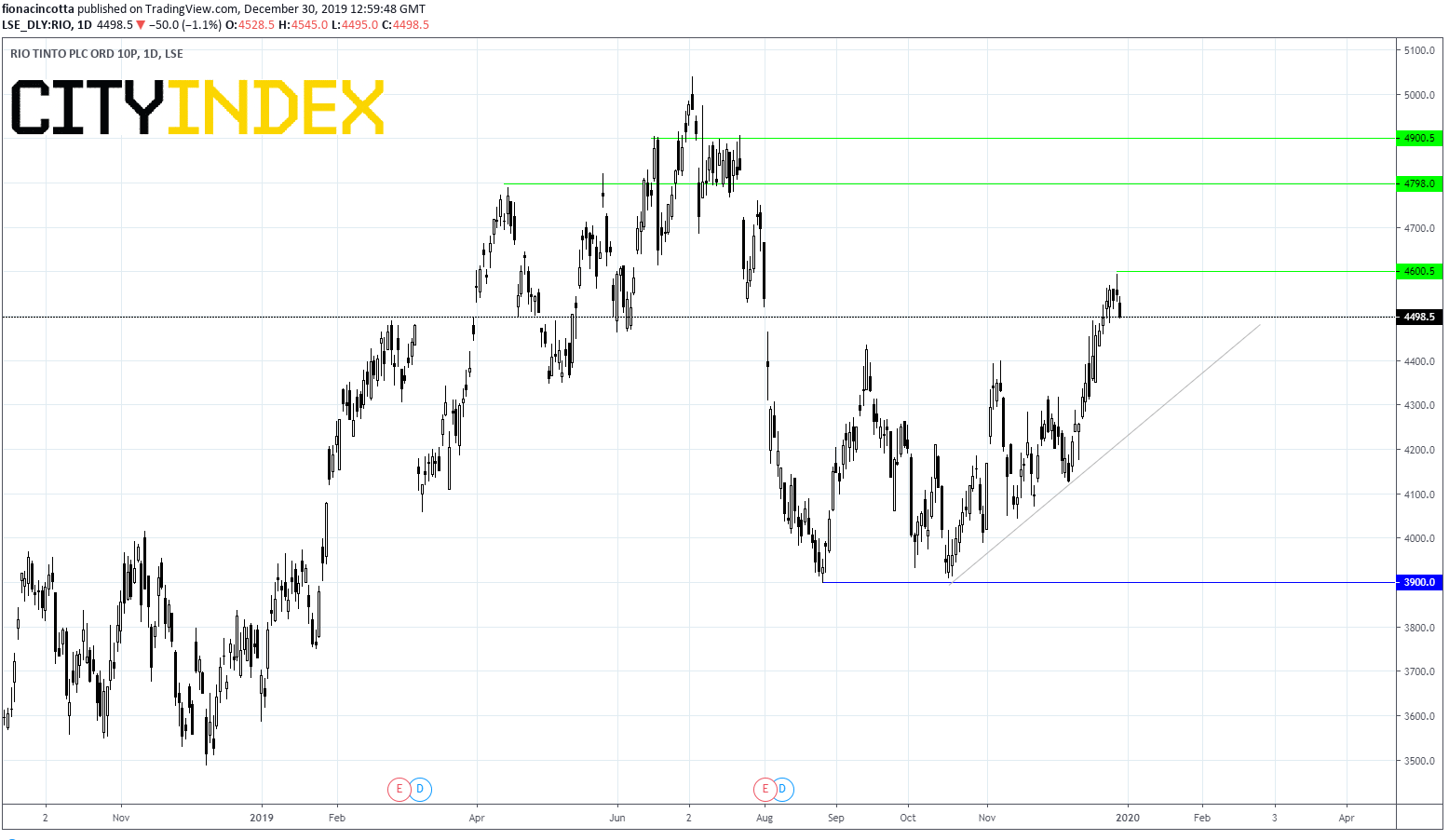
Rio Tinto rallied an impressive 39% across the start of the year, hitting an all-time high of 5039 in early July on rising commodity prices. The stock slumped across the summer months amid elevated US – China trade tensions and has since put in a bit of a rebound as global risks, particularly US – China trade tensions have eased towards the end of 2019.
Rio Tinto is ending 2019 up 27%, outperforming the FTSE100 which gained 12%. With the US - China first phase trade deal potentially being signed in early 2020 Rio Tinto could have more upside.
Metals for the global economy
The three metals that the global economy needs the most are iron ore (an important component of steel which is used in construction, cars, machinery etc), aluminium and copper. The importance of these metals plays right into Rio Tinto’s hand, as it is a global leader in iron ore production, a leader in aluminium and in the top 10 producers of copper.
When the global economy is growing strongly and the prospect of further growth is high, demand and the demand outlook for these metals increases, boosting prices and lifting the share price of the miners.
As trade tensions eased between US and China, and the outlook for the global economy improved and Rio Tinto pushed higher, benefitting greatly from the recent rebound in commodity prices, most notably iron ore.
Low production costs
Production costs are incredibly low. At the flagship Pilbara mines production costs are under $15 a tonne, average market prices were five times higher in the region of $80 per tonne. Mining and then selling on for 5 times the cost is always an attractive proposition.
Low net debt
Rewind 3 to 4 years and Rio Tinto had a mountain of debt and embarked on a brutal cost cutting exercise, the benefits of which are apparent today. Rio has $4.9 billion of net debt as from mid 2019, which is small given its $95 billion enterprise value.
With debt back under control Rio is free to use the cash flow it generates to give back to shareholders and reinvest to grow the business.
Risks
Given that Rio is heavily reliant on iron ore (62% of underlying EBITDA) it’s high exposure to that market can also be a risk. Should the price off iron ore weaken, Rio Tinto would be more at risk than other diversified miners.
Conclusion
Rio Tinto has a lot to offer as the outlook for the global economy improves. Low production costs of key industrial metals and low debt levels mean it is well positioned to prosper.
Rio Tinto, along with the FTSE350 mining index as a whole, has had a roller coaster year.
Rio Tinto rallied an impressive 39% across the start of the year, hitting an all-time high of 5039 in early July on rising commodity prices. The stock slumped across the summer months amid elevated US – China trade tensions and has since put in a bit of a rebound as global risks, particularly US – China trade tensions have eased towards the end of 2019.
Rio Tinto is ending 2019 up 27%, outperforming the FTSE100 which gained 12%. With the US - China first phase trade deal potentially being signed in early 2020 Rio Tinto could have more upside.
Metals for the global economy
The three metals that the global economy needs the most are iron ore (an important component of steel which is used in construction, cars, machinery etc), aluminium and copper. The importance of these metals plays right into Rio Tinto’s hand, as it is a global leader in iron ore production, a leader in aluminium and in the top 10 producers of copper.
When the global economy is growing strongly and the prospect of further growth is high, demand and the demand outlook for these metals increases, boosting prices and lifting the share price of the miners.
As trade tensions eased between US and China, and the outlook for the global economy improved and Rio Tinto pushed higher, benefitting greatly from the recent rebound in commodity prices, most notably iron ore.
Low production costs
Production costs are incredibly low. At the flagship Pilbara mines production costs are under $15 a tonne, average market prices were five times higher in the region of $80 per tonne. Mining and then selling on for 5 times the cost is always an attractive proposition.
Low net debt
Rewind 3 to 4 years and Rio Tinto had a mountain of debt and embarked on a brutal cost cutting exercise, the benefits of which are apparent today. Rio has $4.9 billion of net debt as from mid 2019, which is small given its $95 billion enterprise value.
With debt back under control Rio is free to use the cash flow it generates to give back to shareholders and reinvest to grow the business.
Risks
Given that Rio is heavily reliant on iron ore (62% of underlying EBITDA) it’s high exposure to that market can also be a risk. Should the price off iron ore weaken, Rio Tinto would be more at risk than other diversified miners.
Conclusion
Rio Tinto has a lot to offer as the outlook for the global economy improves. Low production costs of key industrial metals and low debt levels mean it is well positioned to prosper.
Latest market news



Open an account in minutes
Experience award-winning platforms with fast and secure execution.
Economic calendar
Web Trader platform
Our sophisticated web-based platform is packed with features.
Related articles

SK Hynix IPO: Everything You Need to Know About SK Hynix
Learn everything you need to know about the SK Hynix IPO, including its Nasdaq listing, valuation, financials, ownership, competitors and investment risks.


FTSE 100 and GBP/USD forecast: UK data gives BoE March cut a further boost
The FTSE 100 edged higher to close in on last week’s record, as the pound weakened following the release of UK wages and Jobs data that puts a March rate cut firmly on the table, barring any surprises in tomorrow’s inflation report. Unless we see a sharp turnaround in data, I would be expecting another rate cut in June, and possibly more in the summer if inflation risks ease. This should keep the longer term FTSE 100 forecast firmly supported and keep a lid on sterling.

FTSE 100 forecast - Indices weekend outlook | February 16, 2026
With the US out on Monday for Presidents’ Day and China celebrating Spring Festival all week, it makes sense to focus on European markets to start the week off. So the FTSE 100 forecast is in focus for this week’s weekend indices outlook. We have plenty of UK, European and US earnings to look forward to as the week progresses, while key data from the UK and US will make rate cut expectations a key talking point on both sides of the pond.
StoneX Financial Ltd (trading as "FOREX.com") is an execution-only service provider. This material, whether or not it states any opinions, is for general information purposes only and it does not take into account your personal circumstances or objectives. This material has been prepared using the thoughts and opinions of the author and these may change. However, FOREX.com does not plan to provide further updates to any material once published and it is not under any obligation to keep this material up to date.
This material is short term in nature and may only relate to facts and circumstances existing at a specific time or day. Nothing in this material is (or should be considered to be) financial, investment, legal, tax or other advice and no reliance should be placed on it. No opinion given in this material constitutes a recommendation by FOREX.com or the author that any particular investment, security, transaction or investment strategy is suitable for any specific person.
The material has not been prepared in accordance with legal requirements designed to promote the independence of investment research. Although FOREX.com is not specifically prevented from dealing before providing this material, FOREX.com does not seek to take advantage of the material prior to its dissemination. This material is not intended for distribution to, or use by, any person in any country or jurisdiction where such distribution or use would be contrary to local law or regulation. For further details see our full non-independent research disclaimer and quarterly summary.