



Two Key Ways the Dollar Drives US Stock Market Performance
In complex adaptive systems like modern financial markets, a change the price of any one market has a spillover effect into other markets. One of the best understood and most straightforward of these intermarket relationships is the impact of the US dollar on US stocks. In short, a strong dollar tends to boost the performance of domestic stocks at the expense of foreign rival, as well as the performance of importers at the expense of exporters.
Share this:

In complex adaptive systems like modern financial markets, a change the price of any one market has a spillover effect into other markets. One of the best understood and most straightforward of these intermarket relationships is the impact of the US dollar on US stocks. In short, a strong dollar tends to boost the performance of domestic stocks at the expense of foreign rival, as well as the performance of importers at the expense of exporters.
Foreign vs. Domestic
Intuitively, fluctuations in the value of the dollar directly impact the returns that US investors see on the foreign stock investments. To take a trite example, if the UK’s FTSE index rallies 20% in a year in local currency terms, a UK investor would see the value of his holdings (in pound sterling) rise by 20%. However, if the value of the dollar also rose by 10% against the pound over the course of the year, a US investor’s return on his FTSE investment would be closer to 10%.
Of course, corporate executives are well aware of this connection. As an example, FactSet found that two-thirds of the companies in the Dow Jones Industrial Average cited foreign exchange as a headwind for their earnings in Q3 2018, following a sharp 9% surge in the value of the dollar index over the last six months.
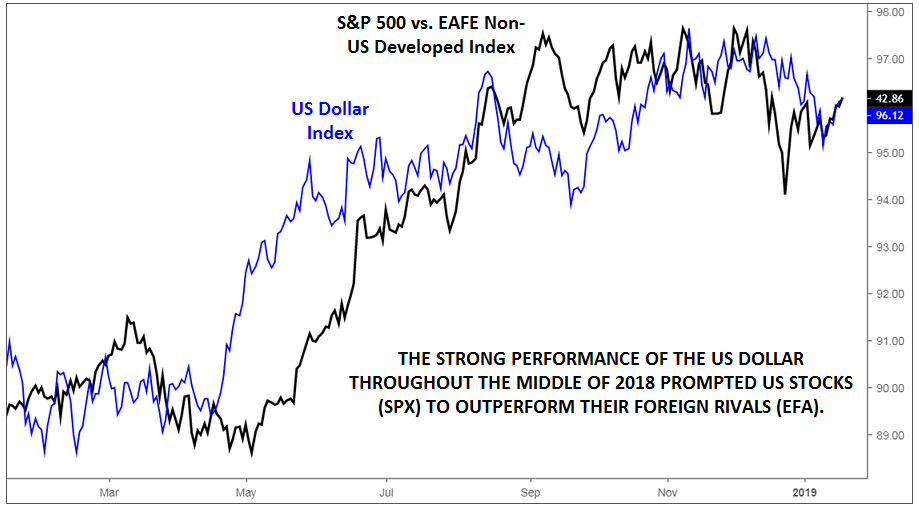
This direct, mechanical relationship can help traders determine how aggressively to allocate to foreign stocks. For instance, if the dollar has just experienced a strong year, sentiment is frothy, and the buck appears overvalued on historically-reliable metrics like purchasing power parity, a US investor may consider increasing his allocation to foreign stocks, reasoning that the greenback is more likely to fall than rise moving forward. The chart below underscores this point, showing the relative performance of the S&P 500 (SPX) against foreign stocks (EFA). As the dollar rose throughout the middle of 2018, US stocks outperformed their foreign rivals:
Source: TradingView, FOREX.com
As you can see, it’s critical that global stock investors monitor FX market fluctuations, even if they’re not trading FX directly themselves.
Importers vs. Exporters
Even for investors who trade exclusively domestic stocks, the foreign exchange market can have a major impact. Given the economy’s global nature, businesses are increasingly coordinating (and competing) with rivals across oceans, not just in the next town over.
Fluctuations in the FX market have a direct business impact on the operations of importers and exporters. If the value of the dollar rises relative to its rivals, the dollar cost of foreign imports falls. For companies that are net importers, this directly decreases expenses, increasing margins and by extension, profits at such firms. The converse occurs with net exporters: a rising dollar makes their goods more expensive for foreign buyers, forcing the company to either cut prices or see sales decline.
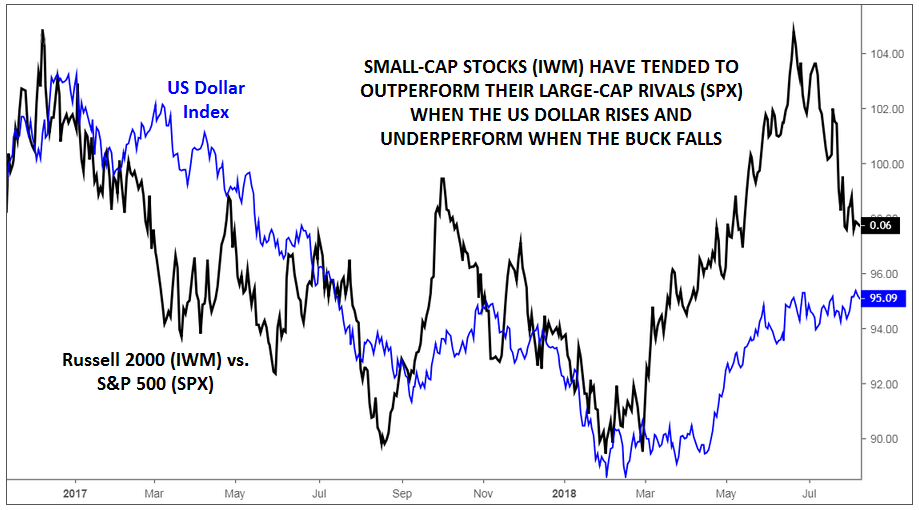
Because small-capitalization stocks derive more of their revenue from the US than their large-capitalization rivals, traders can use the performance of small- and large-capitalization stocks as a proxy for importers and exporters. As the chart below shows, small-cap stocks (IWM) have tended to outperform their large-cap brethren in periods when the US dollar rises and underperform when the greenback falls:
Source: TradingView, FOREX.com
In today’s global economy, trading stocks without at least a cursory knowledge of developments in the FX market is akin to driving with one eye closed. On the other hand, experience trading one market can give readers a big leg up in learning to trade the another.


Open an account in minutes
Experience award-winning platforms with fast and secure execution.
Economic calendar
Web Trader platform
Our sophisticated web-based platform is packed with features.
Related articles

S&P, Nasdaq Slide as NVDA, AI Worries Continue to Build
It was a busy weekend in the headlines as a campaign to bring back Jensen Huang atop NVDA gained steam, even with accusations of possible treason and a circular funding model that has started to raise questions.


Nasdaq 100 Forecast: NDX falls ahead of Nvidia’s earnings & Anthropic’s debut this week
U.S. stocks are heading for a weaker open amid a challenging macro backdrop and with AI-linked stocks once again under pressure ahead of Nvidia's results later this week. Attention is also turning to Anthropic's highly anticipated IPO.


S&P 500, Nasdaq 100 Claw Back But NVDA Cloud Looms Overhead
Last week was green for both the Nasdaq and S&P 500 but given the sell-off that led into that bounce there’s still a very real question as to whether bears still have a statement to make. And the NVDA situation presents a very real threat.
StoneX Financial Ltd (trading as "FOREX.com") is an execution-only service provider. This material, whether or not it states any opinions, is for general information purposes only and it does not take into account your personal circumstances or objectives. This material has been prepared using the thoughts and opinions of the author and these may change. However, FOREX.com does not plan to provide further updates to any material once published and it is not under any obligation to keep this material up to date.
This material is short term in nature and may only relate to facts and circumstances existing at a specific time or day. Nothing in this material is (or should be considered to be) financial, investment, legal, tax or other advice and no reliance should be placed on it. No opinion given in this material constitutes a recommendation by FOREX.com or the author that any particular investment, security, transaction or investment strategy is suitable for any specific person.
The material has not been prepared in accordance with legal requirements designed to promote the independence of investment research. Although FOREX.com is not specifically prevented from dealing before providing this material, FOREX.com does not seek to take advantage of the material prior to its dissemination. This material is not intended for distribution to, or use by, any person in any country or jurisdiction where such distribution or use would be contrary to local law or regulation. For further details see our full non-independent research disclaimer and quarterly summary.