



USD/JPY forecast: hot US CPI lifts the pair above its 200-day average
Hotter-than-expected US inflation has pushed USD/JPY above its 200-day moving average, putting 160 and the risk of Bank of Japan intervention back in focus. The breakout still needs to hold, and a failure could send the pair sharply lower.
Share this:

The USD/JPY has broken above its 200-day moving average after a hotter-than-expected US inflation report revived bets on further Federal Reserve rate hikes. The pair had spent several sessions coiling just beneath that average ahead of the data, and the CPI release has now supplied the catalyst, lifting Treasury yields and the dollar alike. With the breakout under way and 160.00 back in view, the near-term USD/JPY forecast is tilted to the upside.
- USD/JPY clears its 200-day moving average as hot CPI revives Fed hike bets.
- Higher Treasury yields keep the dollar supported against the yen.
- 160.00 is the next big test, and the level where the Bank of Japan may step in.
Watch the Full Video
Before turning to what the CPI numbers mean for the Fed and the Bank of Japan, let's have a quick look at the chart first.
Technical USD/JPY forecast and key levels to watch
From a technical analysis point of view, the picture has improved now that USD/JPY has pushed above the 200-day moving average and taken out the highs of its recent range. That said, the pair is not out of the woods just yet. The 200-day, those range highs and prior support all converge in the same zone, and USD/JPY needs to climb clear of it to confirm the breakout. If it does, a run towards the 160.00 handle is on the cards. A failed breakout, on the other hand, would carry more weight. Slip back below and a sharp move towards 157.00, possibly even 155.00, could follow in the days and weeks ahead.
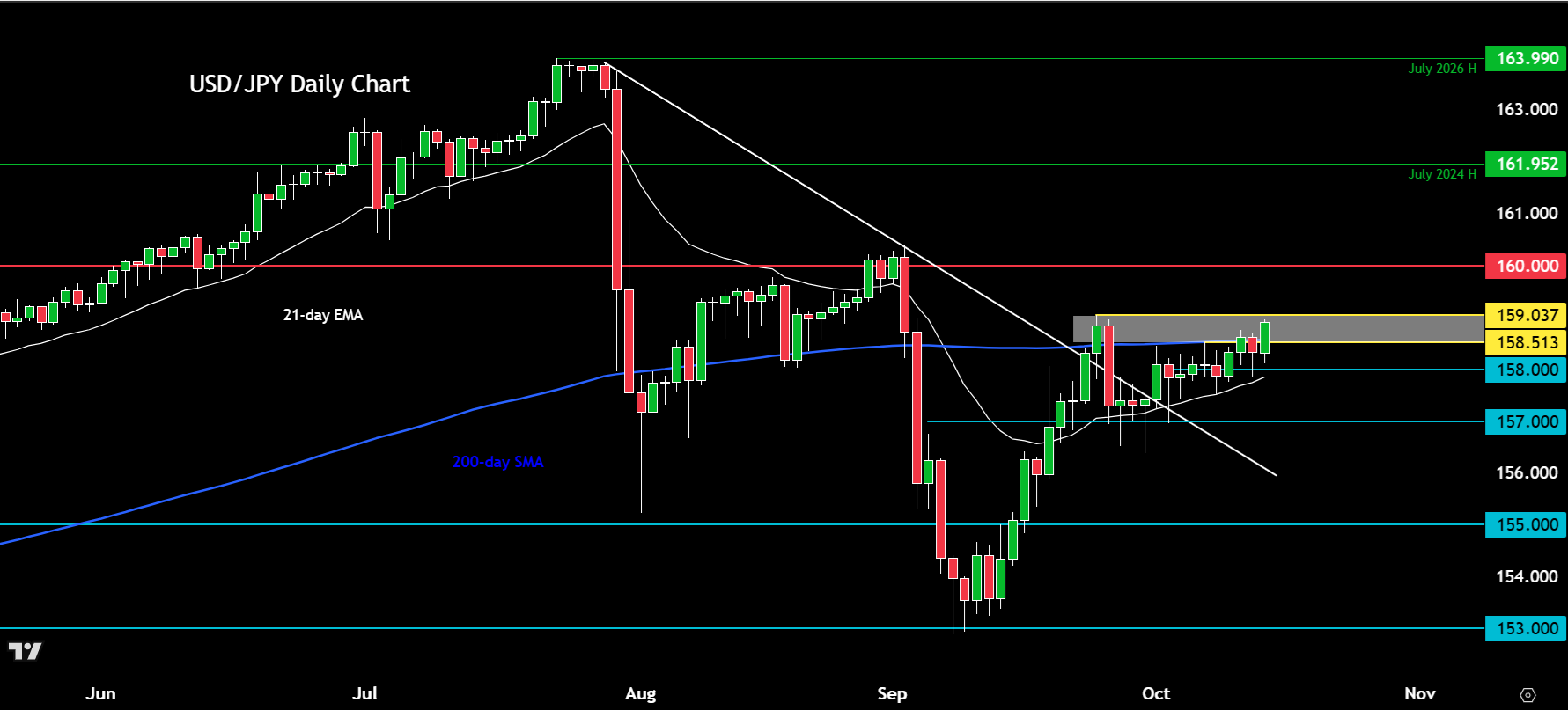
Much for the USD/JPY currency pair will now hinge on how far the market is prepared to push Fed pricing, and on how much yen weakness Tokyo is willing to tolerate.
Hot CPI strengthens the case for Fed hikes
Headline CPI rose to 3.7% year-on-year in September, up from 3.4% in August and ahead of the 3.6% consensus. Core CPI also came in hotter at 2.6%, while monthly core inflation held at 0.3% rather than easing to the expected 0.2%. A 9.1% surge in gasoline prices accounts for part of the overshoot, but price rises in recreation, used cars, education, airline fares, medical care and apparel suggest the pressure is broader, and potentially stickier, than a simple energy story.
The timing could hardly have been better for USD/JPY bulls. The pair had been treading water just below its 200-day moving average for several sessions, as if waiting for a reason to move. The CPI report provided one, and that tight range now looks less like indecision and more like a market gathering itself for a breakout.
Markets price a more hawkish Fed than the Fed itself
Rate expectations have shifted sharply. Markets now see around a 45% chance of an October hike, up from just 20% before the data, and roughly 85% for December, with at least three 25-basis-point hikes priced over the next 12 months. That is a good deal more aggressive than anything the Federal Reserve has been signalling. New York Fed President John Williams, for one, expects only one more hike this year and none in 2027.
Treasury yields and the dollar have both climbed, with the 10-year yield up around 4 basis points at 5.25%, and the yen is once again bearing the brunt. If elevated oil prices and a still-resilient US economy keep inflation on the boil, the market may have to price an even steeper path, and there are several Fed speakers still to come, including Chair Kevin Warsh.
Why the 200-day moving average matters for USD/JPY
The 200-day moving average is a significant technical indicator in any market, but USD/JPY has been unusually responsive to it, reacting each time it has come into play. That is why the break above it matters, and why a swift return below it would matter just as much.
The Bank of Japan is the main obstacle near 160
The 160.00 handle is a psychologically important level, and it is where the Bank of Japan may once again step in. That makes the upside less straightforward than the chart alone would suggest, as a push towards 160.00 would put intervention risk firmly back on the table.
Barring a major intervention, though, USD/JPY could certainly head a lot higher from there. With US yields rising and the market pricing several more Fed hikes, the yen's fate rests more with Tokyo than with the market. For now, the path of least resistance remains to the upside.

Frequently Asked Questions
Why is USD/JPY rising after the US CPI report?
Headline CPI rose to 3.7% in September, ahead of the 3.6% consensus, reviving bets on further Federal Reserve rate hikes. The resulting rise in Treasury yields has helped USD/JPY break above its 200-day moving average.
Could USD/JPY reach 160?
If the pair confirms its breakout above the 200-day moving average, a run towards the 160.00 handle is on the cards. That psychologically important level is where the Bank of Japan may once again step in.
Where could USD/JPY fall if the breakout fails?
A failed breakout would carry real weight. In that case, a sharp move towards 157.00, possibly even 155.00, could follow in the days and weeks ahead.
Related tags:
Latest market news




Open an account in minutes
Experience award-winning platforms with fast and secure execution.
Economic calendar
Web Trader platform
Our sophisticated web-based platform is packed with features.
Related articles
US Dollar Price Action Setups into PCE: EUR/USD, GBP/USD, USD/JPY, USD/CAD
USD/JPY has continued to hold below the 160.00 level but it’s the EUR/USD sell-off below 1.1000 that’s been most attention grabbing around the USD complex.
Canadian Dollar Forecast: USD/CAD Rally Stalls at Yearly High—Correction Risk Builds 11 24 2026
USD/CAD’s November rebound faces its first meaningful setback, with buyers defending trend support as momentum divergence warns of fatigue.

EUR/USD outlook: Fed hawkishness priced in as Ifo hits 3-year high
The euro is bouncing from the 61.8% Fibonacci retracement as the dollar takes a breather after Monday's surge. With Fed hawkishness largely priced in and Germany's Ifo at a three-year high, a close above 1.1000 would signal a near-term low.
StoneX Financial Ltd (trading as "FOREX.com") is an execution-only service provider. This material, whether or not it states any opinions, is for general information purposes only and it does not take into account your personal circumstances or objectives. This material has been prepared using the thoughts and opinions of the author and these may change. However, FOREX.com does not plan to provide further updates to any material once published and it is not under any obligation to keep this material up to date.
This material is short term in nature and may only relate to facts and circumstances existing at a specific time or day. Nothing in this material is (or should be considered to be) financial, investment, legal, tax or other advice and no reliance should be placed on it. No opinion given in this material constitutes a recommendation by FOREX.com or the author that any particular investment, security, transaction or investment strategy is suitable for any specific person.
The material has not been prepared in accordance with legal requirements designed to promote the independence of investment research. Although FOREX.com is not specifically prevented from dealing before providing this material, FOREX.com does not seek to take advantage of the material prior to its dissemination. This material is not intended for distribution to, or use by, any person in any country or jurisdiction where such distribution or use would be contrary to local law or regulation. For further details see our full non-independent research disclaimer and quarterly summary.