



AUD/JPY outlook: Jobs volatility puts RBA repricing in focus
AUD/JPY has surged on risk appetite and hawkish RBA repricing, but the next move may hinge on Australia’s volatile jobs report. Could stretched bullish positioning leave the Aussie exposed?
Share this:

- AUD/JPY strongly correlated with yield spreads and risk appetite in December
- Fed liquidity boost adds tailwind for risk assets into year-end
- RBA pricing flipped from cuts to multiple hikes in 2025
- Labour data volatility poses key risk to bullish Aussie positioning
Summary
AUD/JPY has ridden a wave of risk appetite and hawkish RBA repricing, but the rally faces a critical test with Australia’s jobs report. With bullish positioning stretched and technical signals flashing caution near 104.00, even a marginally weak print could trigger a sharp reversal. For traders, the focus now shifts to whether the data reinforces the tightening narrative or wrongfoots markets entirely.
Rate Differentials, Risk Appetite Power Bullish Move
AUD/JPY and relative central bank expectations for Australia and Japan continue to move in near lockstep, with risk appetite another important factor underpinning recent gains. The graphic below shows a strong and sustained positive correlation with two-year yield differentials between Australia and Japan in December, sitting at 0.94 over the past fortnight. It’s only slightly less for Nasdaq 100 futures at 0.86 over the same period, and 0.72 with Nikkei 225 futures.

Source: TradingView
With the Fed delivering anything other than a hawkish cut at the December FOMC meeting, lowering the funds rate by 25 basis points and signalling another two this cycle while simultaneously forecasting accelerated economic growth and declining unemployment, it’s gone a long way to underpin risk appetite for the remainder of the year. Resuming purchases of short-term Treasury bills is a cherry on top, with about $40 billion planned over the next month. The Fed is doing this to keep cash flowing and rates steady. For markets, it means liquidity stays supportive, adding another tailwind for risk appetite.
Unless we see an abrupt turnaround in sentiment, it suggests that for anyone trading AUD/JPY, the key swing factor looking forward may be shifts in the relative interest rate outlook for Australia and Japan. With a 25-point hike from the BOJ next week now bordering on a lock among traders, Australian economic data looks particularly important, especially after the significant hawkish repricing we’ve seen over the past two months.
Source: Bloomberg
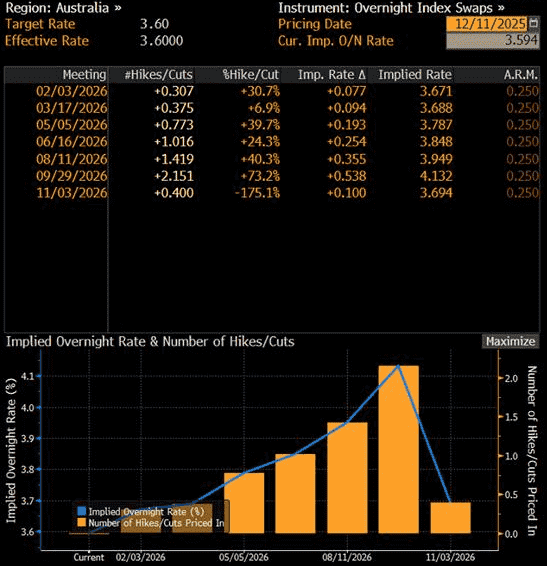
As things stand, implied probability based on swaps pricing sees around a one-in-three chance of a rate hike from the RBA in February, with a full move priced by June. Fast forward another three months and more than two hikes are now priced in. It wasn’t that long ago that markets were pricing in multiple cuts next year, now it’s multiple hikes.


Jobs volatility puts Aussie bulls on notice
While the incoming data flow totally justifies the shift in pricing, the abruptness of the move leaves the Aussie vulnerable to any information that casts doubt on the need to begin tightening policy. Australia’s labour force survey, long known for its extremely volatile nature, screens as one such event that could put a major dent in hawkish pricing should it print even marginally weak. Such an outcome would likely wrongfoot markets, creating the potential for an abrupt move lower in the Aussie given likely stretched, near-term bullish positioning.
That’s the key risk heading into the data, likely resulting in a far larger move than if the data prints strong. The median economist looks for a 20,000 increase in employment in November, which would lift the unemployment rate to 4.4% should participation hold at 67% as expected. History suggests it’s the employment change that markets tend to react to first, generally because it sometimes resembles a random number generator, creating volatility. But it’s the unemployment rate that matters most for the RBA, along with measures such as underutilisation, youth unemployment and hours worked, which the bank likes to monitor for turning points in the labour market.
AUD/JPY Bullish Run Stalls

Source: TradingView
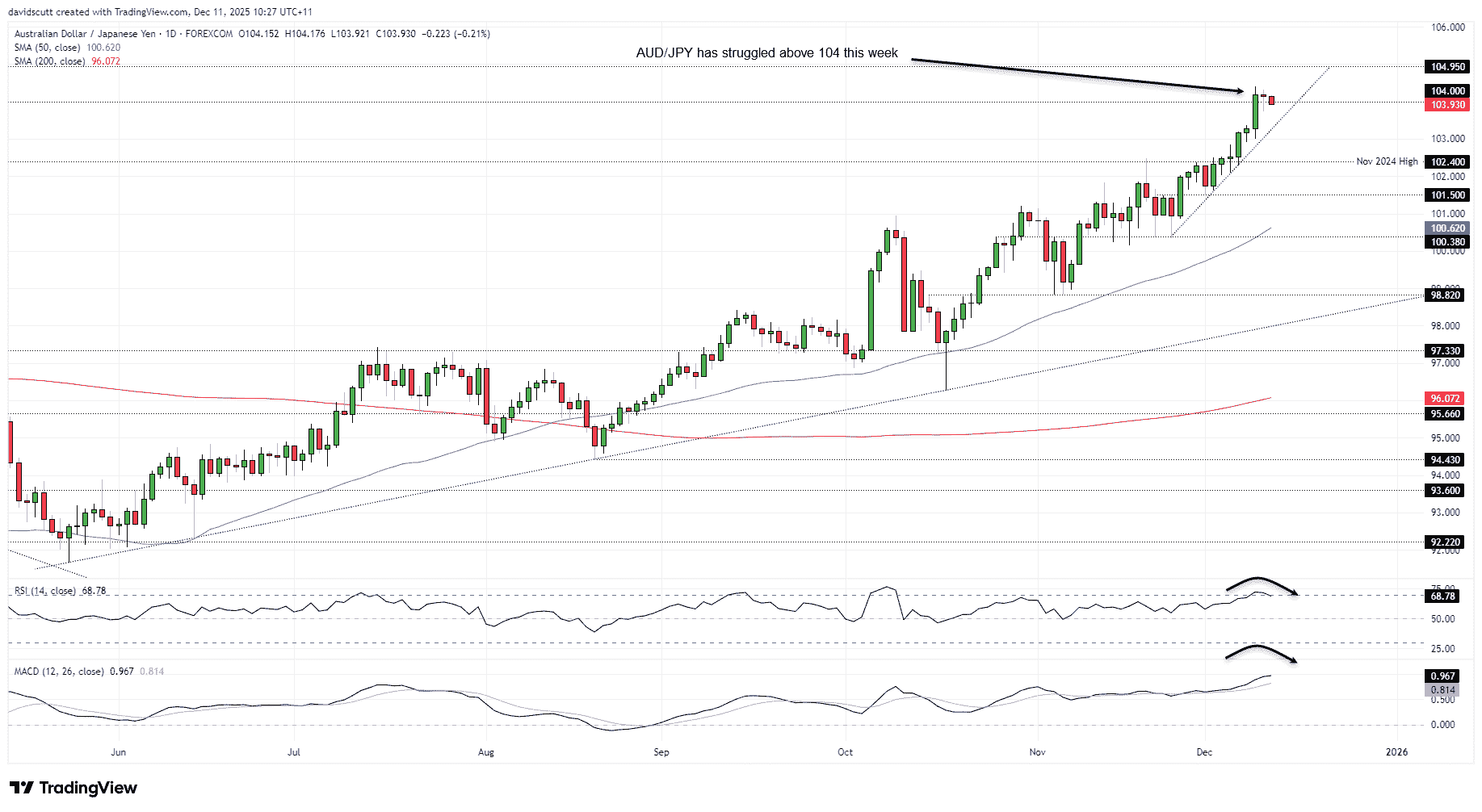
Looking at AUD/JPY on the daily chart, the pair has struggled above 104.00 over the past three days, failing to build upon the impressive bullish move seen since May. Wednesday’s doji candle despite the positive risk-on environment is also notable, suggesting a reluctance among traders to add to long positions. Combined with Tuesday’s bullish candle, it has the makings of a possible evening star bearish reversal pattern, depending on what unfolds today. We’re already seeing a pullback into the data, so a further extension on the downside would deliver a signal that a deeper pullback may be on the cards.
With RSI (14) rolling over from overbought territory, it suggests we may have seen the peak for upside strength, a view enhanced by MACD, which is also showing signs of rolling over towards the signal line. It’s not a bearish message by any stretch, but it does point to the need for caution if you’re considering buying the dip.
104.00 can be used to build setups around depending on how the price action evolves following the jobs data, allowing for a stop to be placed on the opposite side to entry for protection. On the topside, a move beyond Tuesday’s high would put resistance at 104.95 on the radar. On the downside, 103.00 brought out bids earlier this week, making it a reference point before uptrend support established in mid-November. If the latter were to be broken cleanly, 102.40 and 101.50 loom as potential downside targets for bears.
Latest market news




The complete CFD trading experience
Award-winning platforms, competitive spreads, low commissions and dedicated support.
We live and breathe the markets and are dedicated to helping traders realise their ambitions as we continue to set the industry bar.
Economic calendar
Web Trader platform
Our sophisticated web-based platform is packed with features.
Related articles
US Dollar Short-term Outlook: USD Rally on the Line as Midterms, NFP Loom 11 3 2026
DXY is testing pivotal support, with the weekly range breakout likely to determine the next major leg of the trend as key event risk unfolds.

Nasdaq 100 forecast: Stocks rebound but AI concerns linger
The Nasdaq 100 was finding some support at 28,000 after recent sell-off amid concerns about the AI trade. Even with oscillators oversold, the risk to the near-term forecast is tilted to the downside.

USD/JPY Analysis: Rising U.S. Yields Leave the Yen on the Defensive
As the first week of November progresses, renewed weakness in the Japanese yen is once again becoming evident in the short term. This dynamic can be seen in the recent performance of USD/JPY, which has posted two consecutive bullish sessions and gained more than 0.7%, reflecting a return of buying interest in the dollar while the yen continues to lose momentum.
StoneX Europe Ltd may make third party material available on this website which may contain information included but not limited to the conditions of financial markets. The material is for information purposes only and does not contain, and should not be construed as containing, investment advice and/or investment recommendation and/or an investment research and/or an offer of or solicitation for any transactions in financial instruments; any decision to enter into a specific transaction shall be made by the client following an assessment by him/her of their situation.
StoneX Europe Ltd makes no representation or warranty and assumes no liability as to the accuracy or completeness of the information provided, nor any loss arising from any investment based on a recommendation, forecast or other information supplied. You should always seek independent advice as to your suitability to speculate in any related markets and your ability to assume the associated risks, if you are at all unsure. We are not under any obligation to update any such material. Any opinion made may be personal to the author and may not reflect the opinion of StoneX Europe Ltd.