



Bank of Canada ends Quantitative Easing Program
The Bank of Canada surprised markets today by reducing its bond purchase program from $C2 billion per week to C$0
Share this:

The Bank of Canada surprised markets today by reducing its bond purchase program from $C2 billion per week to C$0, ending its Quantitative Easing Program. Expectations were that the BOC would cut bond purchases in half, by lowering them to $C1 billion per week. Bond purchases now will only be made to match maturities. In addition, the Bank of Canada moved forward its guidance on interest rate increases from the second half of 2022 to “the middle quarters” of 2022. Before the meeting, markets had been pricing in Canada’s first rate hike in April 2022. After the meeting, a rate hike for January 2022 was 64% priced in and 100% priced in for March 2022.
Your guide to the Bank of Canada
The BOC also lowered is guidance for GDP for this year to 5% from 6%, before falling to 4.25% in 2022 (previously 4.6%) and 3.75% in 2023 (previously 3.3%). The central bank also said they expect inflation to remain at elevated levels longer than they had expected, moderating to 2% by late 2022.
Trade USD/CAD now: Login or open a new account!
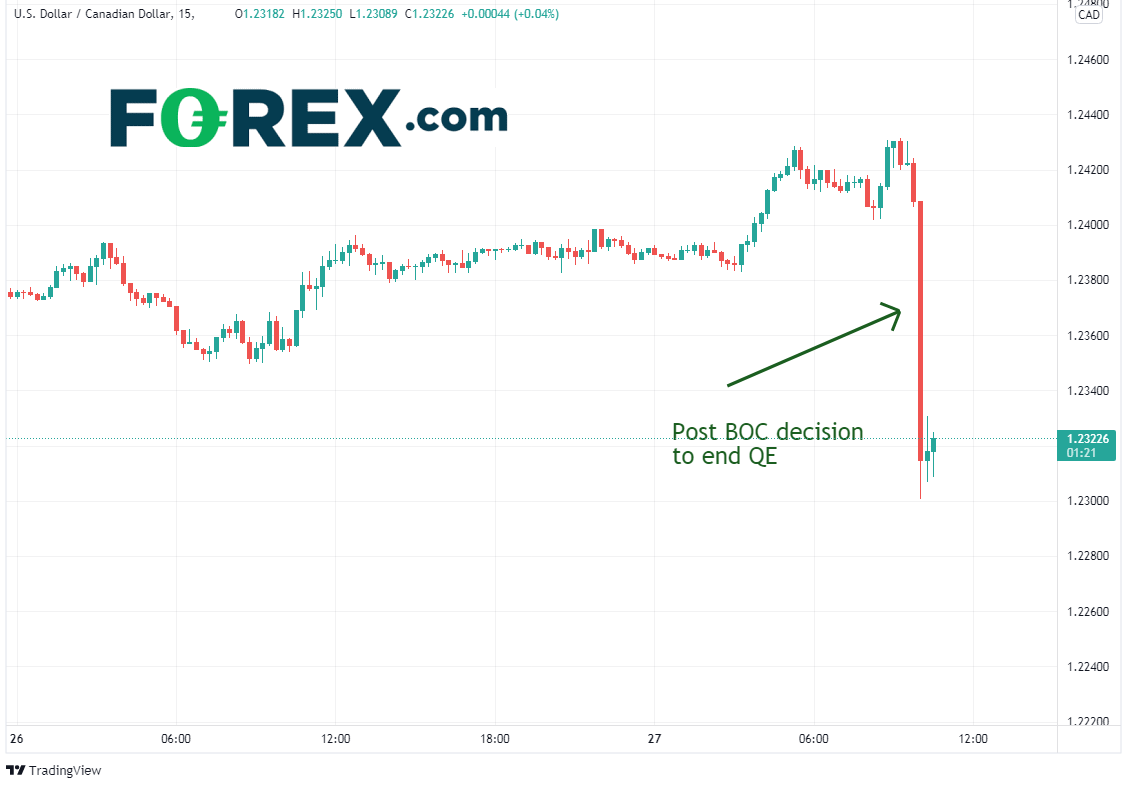
On a 15-minute timeframe, the pair dropped immediately following the surprise from roughly 1.2408 down to 1.2301, an indication most market participants were not expecting the announcement:
Source: Tradingview, Stone X
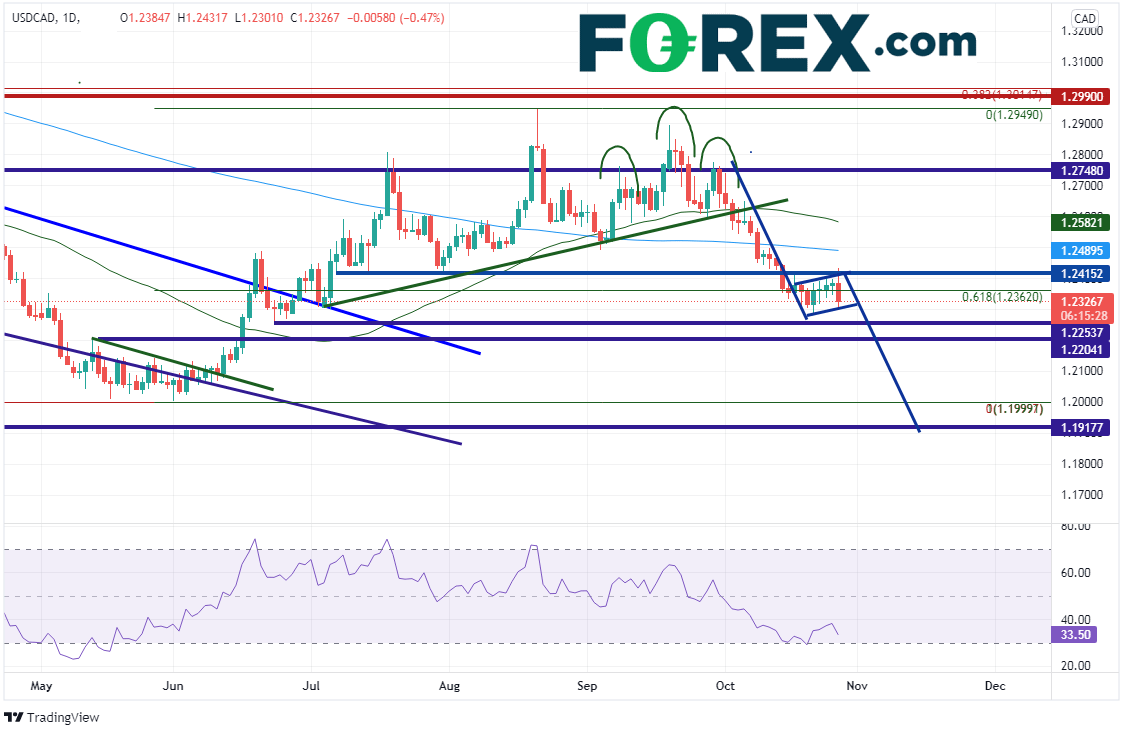
However, despite the large drop in USD/CAD, the pair failed to take out the previous lows of 1.2288 from October 12th. What price action did do though, was set up a flag pattern on the daily timeframe, which target’s near support at the May 2015 lows of 1.1918. If prices close today below 1.2350, it will have created a bearish engulfing candle, a sign that the previous move lower will continue. If USD/CAD is to reach the target, it must first pass through horizontal support at 1.2254 and 1.2204. Resistance is at a convergence at the top of the flag trendline, today’s highs, and horizontal resistance at 1.2415. Further resistance is at the 200 Day Moving Average near 1.2490.
Source: Tradingview, Stone X
Trade EUR/CAD now: Login or open a new account!
As discussed in the Currency Pair of the Week, EUR/CAD had the potential for volatility this week with both the BOC and the ECB (tomorrow) meeting. Indeed, just as USD/CAD sold off, so did EUR/CAD. If price closes below 1.4337, the daily candlestick will be a bearish engulfing candle on the daily timeframe. In addition, if price closes the week below 1.4319, it will have created a bearish engulfing candle on the weekly timeframe! Support below is at the February 2020 lows of 1.4264. Below there, price can fall the way down to 2017 lows at 1.3784! Resistance isn’t until back at today’s highs near 1.4443. Keep in mind that the ECB meets tomorrow!

Source: Tradingview, Stone X
With the Bank of Canada ending their Quantitative Easing Program and moving their rate guidance forward to the middle quarters of 2022, USD/CAD and EUR/CAD have dropped precipitously. However, with US FOMC next week and the ECB meeting tomorrow, along with any volatility in oil prices (due to the high correlation of the Canadian Dollar and oil prices), and USD/CAD and EUR/CAD could be in for quite a ride over the next few weeks!
Learn more about forex trading opportunities.
The Bank of Canada surprised markets today by reducing its bond purchase program from $C2 billion per week to C$0, ending its Quantitative Easing Program. Expectations were that the BOC would cut bond purchases in half, by lowering them to $C1 billion per week. Bond purchases now will only be made to match maturities. In addition, the Bank of Canada moved forward its guidance on interest rate increases from the second half of 2022 to “the middle quarters” of 2022. Before the meeting, markets had been pricing in Canada’s first rate hike in April 2022. After the meeting, a rate hike for January 2022 was 64% priced in and 100% priced in for March 2022.
Your guide to the Bank of Canada
The BOC also lowered is guidance for GDP for this year to 5% from 6%, before falling to 4.25% in 2022 (previously 4.6%) and 3.75% in 2023 (previously 3.3%). The central bank also said they expect inflation to remain at elevated levels longer than they had expected, moderating to 2% by late 2022.
Trade USD/CAD now: Login or Open a new account!
• Open an account in the UK
• Open an account in Australia
• Open an account in Singapore
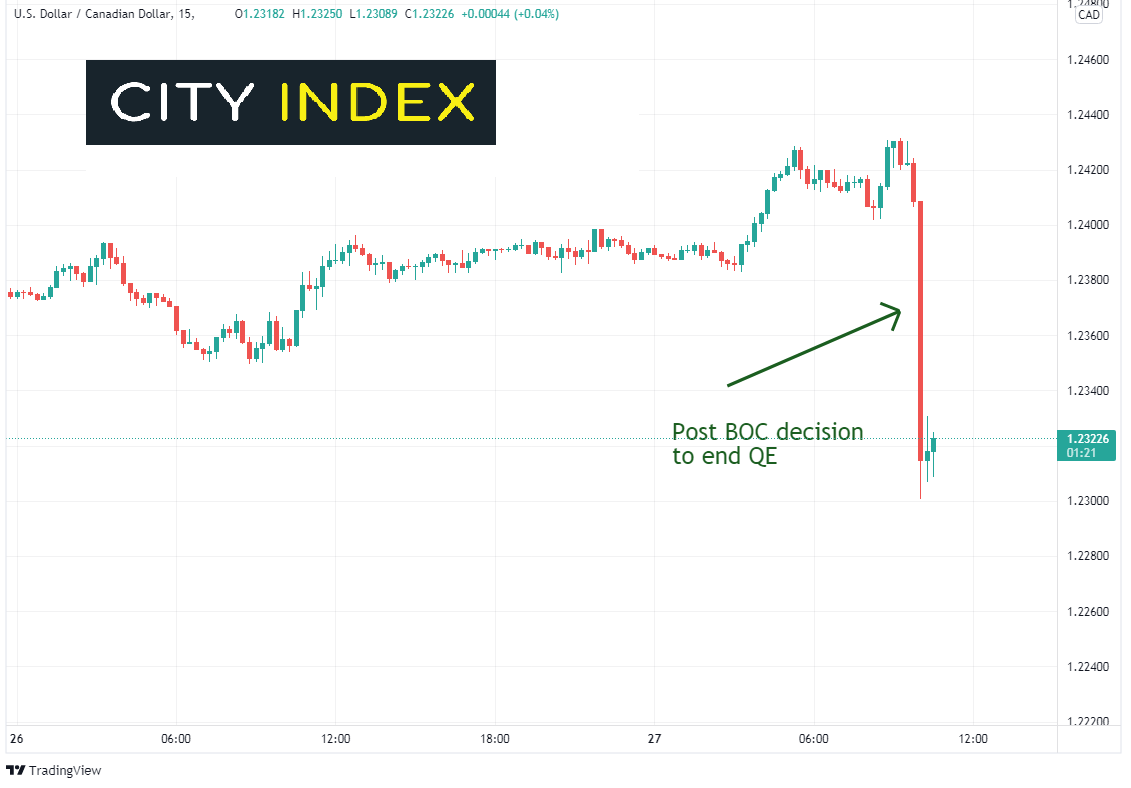
On a 15-minute timeframe, the pair dropped immediately following the surprise from roughly 1.2408 down to 1.2301, an indication most market participants were not expecting the announcement:
Source: Tradingview, Stone X
However, despite the large drop in USD/CAD, the pair failed to take out the previous lows of 1.2288 from October 12th. What price action did do though, was set up a flag pattern on the daily timeframe, which target’s near support at the May 2015 lows of 1.1918. If prices close today below 1.2350, it will have created a bearish engulfing candle, a sign that the previous move lower will continue. If USD/CAD is to reach the target, it must first pass through horizontal support at 1.2254 and 1.2204. Resistance is at a convergence at the top of the flag trendline, today’s highs, and horizontal resistance at 1.2415. Further resistance is at the 200 Day Moving Average near 1.2490.

Source: Tradingview, Stone X
Trade EUR/CAD now: Login or Open a new account!
• Open an account in the UK
• Open an account in Australia
• Open an account in Singapore
As discussed in the Currency Pair of the Week, EUR/CAD had the potential for volatility this week with both the BOC and the ECB (tomorrow) meeting. Indeed, just as USD/CAD sold off, so did EUR/CAD. If price closes below 1.4337, the daily candlestick will be a bearish engulfing candle on the daily timeframe. In addition, if price closes the week below 1.4319, it will have created a bearish engulfing candle on the weekly timeframe! Support below is at the February 2020 lows of 1.4264. Below there, price can fall the way down to 2017 lows at 1.3784! Resistance isn’t until back at today’s highs near 1.4443. Keep in mind that the ECB meets tomorrow!

Source: Tradingview, Stone X
With the Bank of Canada ending their Quantitative Easing Program and moving their rate guidance forward to the middle quarters of 2022, USD/CAD and EUR/CAD have dropped precipitously. However, with US FOMC next week and the ECB meeting tomorrow, along with any volatility in oil prices (due to the high correlation of the Canadian Dollar and oil prices), and USD/CAD and EUR/CAD could be in for quite a ride over the next few weeks!
Learn more about forex trading opportunities.
Related tags:
Latest market news




The complete CFD trading experience
Award-winning platforms, competitive spreads, low commissions and dedicated support.
We live and breathe the markets and are dedicated to helping traders realise their ambitions as we continue to set the industry bar.
Economic calendar
Web Trader platform
Our sophisticated web-based platform is packed with features.
Related articles
EUR/USD weekly outlook: FOMC and ECB to set the tone
The current backdrop is modestly bearish. On Friday, the EUR/USD closed modestly lower, down for the third consecutive day. The pair also posted a weekly decline after staging a modest recovery attempt in the previous week. Out of the past 8 weeks, the EUR/USD has fallen on 6 occasions. There is not much supporting factors for the single currency right now. So, the upside remains capped.

USD/JPY Forecast: Is Rising Japanese Inflation Supporting the Yen?
As the trading week comes to an end, one of the most relevant developments in the FX market has been the renewed strength of the Japanese yen. This can be seen in the recent performance of USD/JPY, which has fallen nearly 1.0% over the last two trading sessions, highlighting a meaningful recovery in the Japanese currency against the U.S. dollar.


US Dollar Price Action Setups: EUR/USD, USD/JPY, GBP/USD, USD/CAD
The Dollar is working on its second consecutive red week and while sellers didn’t exactly pounce on fresh lows, there’s an opening door for bears to make a move.

StoneX Europe Ltd may make third party material available on this website which may contain information included but not limited to the conditions of financial markets. The material is for information purposes only and does not contain, and should not be construed as containing, investment advice and/or investment recommendation and/or an investment research and/or an offer of or solicitation for any transactions in financial instruments; any decision to enter into a specific transaction shall be made by the client following an assessment by him/her of their situation.
StoneX Europe Ltd makes no representation or warranty and assumes no liability as to the accuracy or completeness of the information provided, nor any loss arising from any investment based on a recommendation, forecast or other information supplied. You should always seek independent advice as to your suitability to speculate in any related markets and your ability to assume the associated risks, if you are at all unsure. We are not under any obligation to update any such material. Any opinion made may be personal to the author and may not reflect the opinion of StoneX Europe Ltd.