


Crypto Outlook: Why Is Demand Failing to Recover?
With just one week left in October, the cryptocurrency market continues to struggle to regain consistent demand. Although there was an attempt to recover earlier in the week, the move failed to gain traction and the market quickly returned to a more cautious tone, even as some competing markets began to lose part of their appeal.
Share this:

With just one week left in October, the cryptocurrency market continues to struggle to regain consistent demand. Although there was an attempt to recover earlier in the week, the move failed to gain traction and the market quickly returned to a more cautious tone, even as some competing markets began to lose part of their appeal.
This situation appears to reflect a combination of factors. On one hand, demand continues to struggle to establish a consistent recovery and, on the other, alternative markets remain successful at attracting a significant share of capital flows in the short term. As long as this dynamic remains in place and demand fails to stabilize, the current phase of indecision could continue to play an important role across the cryptocurrency market in the weeks ahead.

Is Demand Struggling to Stabilize?
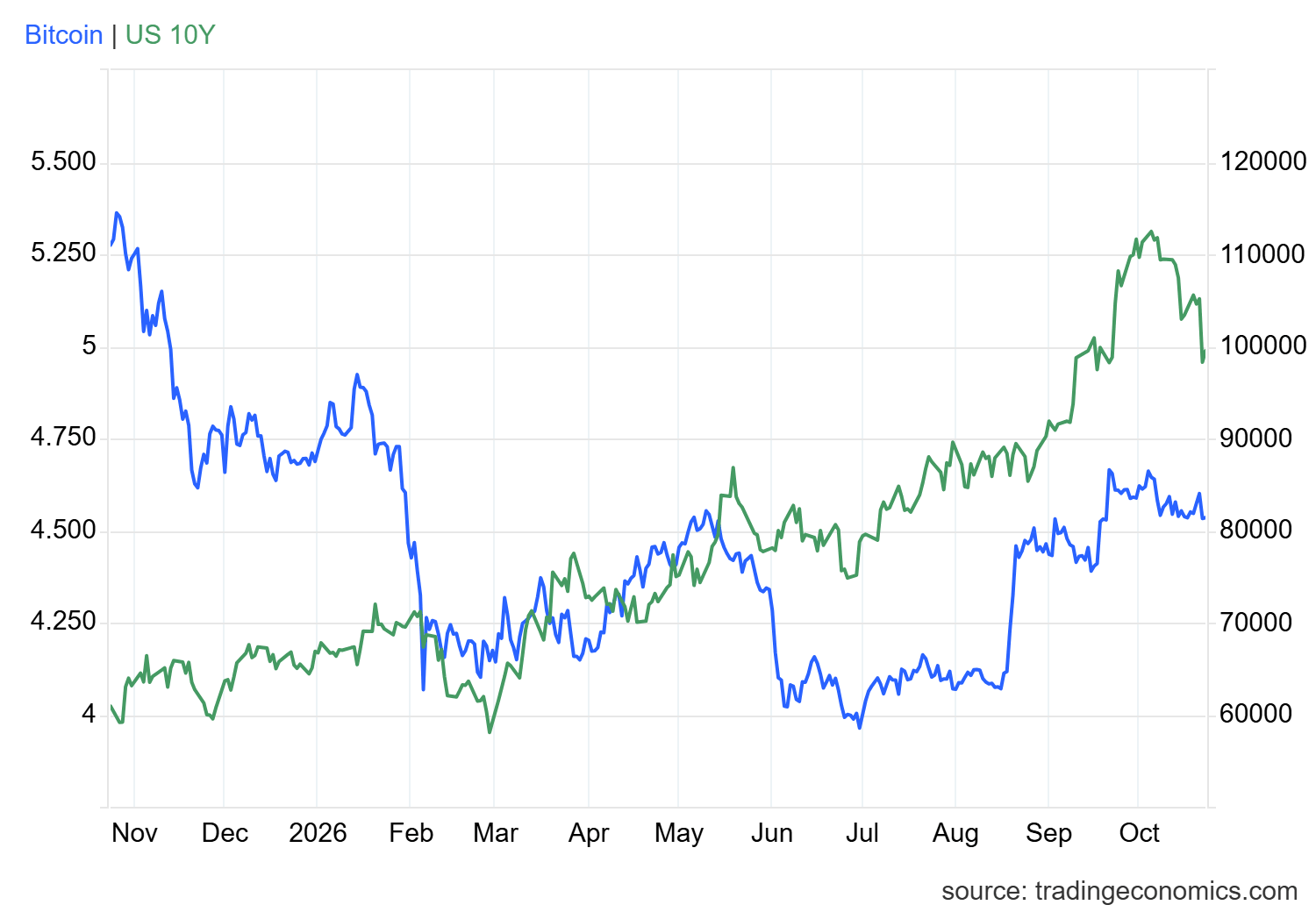
This week was marked by an important development in one of Bitcoin’s main competing markets: the U.S. Treasury market. During recent sessions, yields on the 10-year Treasury moderated consistently and even traded temporarily below the 5.00% level.
This move is particularly important because, throughout previous months, there had been a relatively clear relationship between rising Treasury yields and increasing pressure on risk assets such as cryptocurrencies. As bonds offered more attractive returns, demand shifted toward more defensive assets, limiting Bitcoin’s ability to attract capital.
However, the recent dynamic has been different. Despite lower yields, Bitcoin has been unable to generate a sustained recovery or a meaningful improvement in investor demand. This suggests that the decline in yields alone is not enough to redirect capital back into the crypto market.
One possible explanation is that part of the decline in yields is actually being driven by stronger demand for Treasuries themselves. When investors increase purchases of government bonds, prices rise and yields tend to move lower. Under this scenario, falling yields do not necessarily reflect a loss of interest in bonds, but rather a greater preference for defensive assets.
This helps explain why Bitcoin has struggled to benefit from lower Treasury yields. The cryptocurrency continues to face difficulties attracting consistent demand while a portion of capital flows remains concentrated in more defensive segments of the market.
Source: TradingEconomics
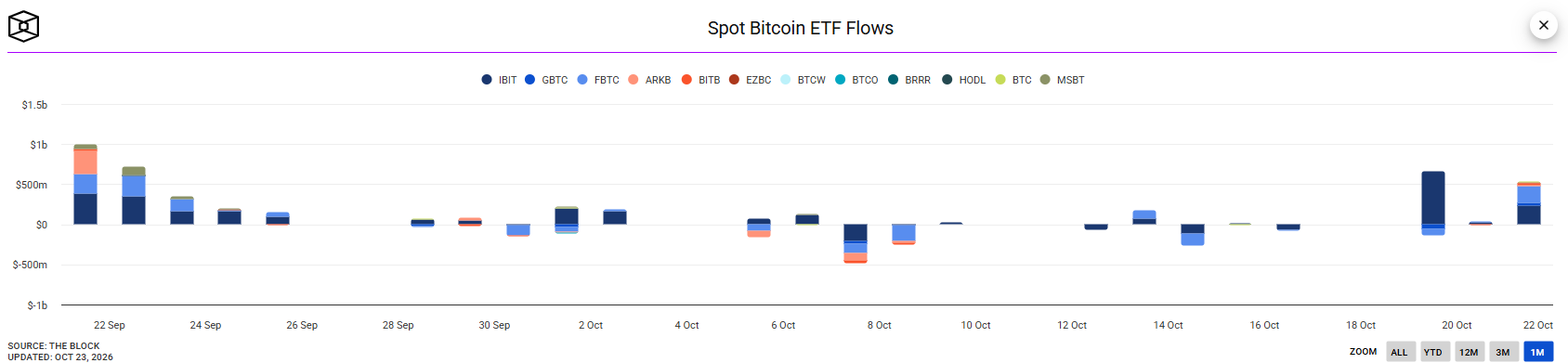
What is particularly important is that this environment has also been accompanied by a lack of consistency in Bitcoin demand. Initially, there was a positive reaction as pressure from elevated bond yields began to ease, something that was reflected in Bitcoin ETF inflows exceeding $665 million at the beginning of the week.
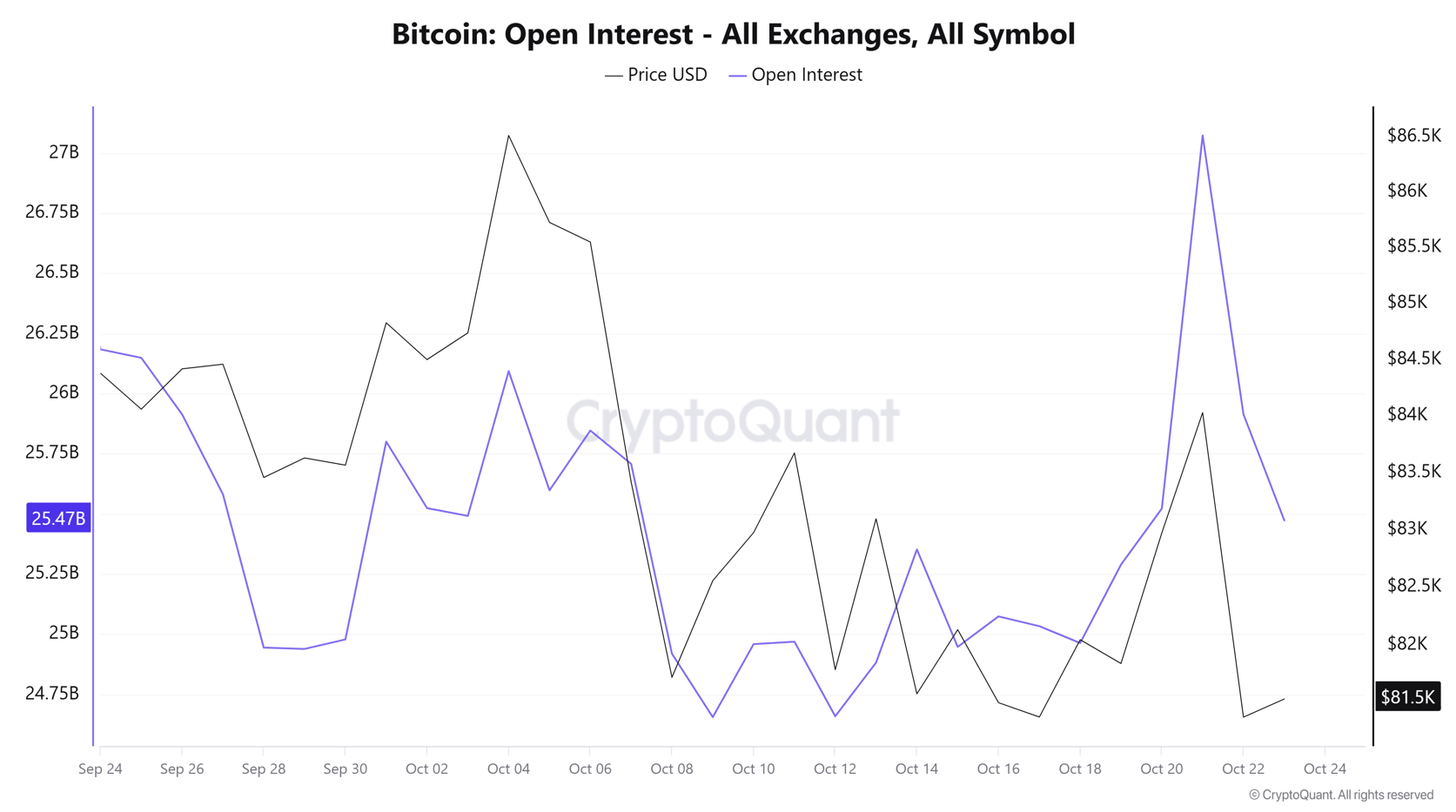
However, that momentum quickly faded. Sessions with significantly weaker capital flows followed, and by the end of the week selling pressure had once again become more evident. This can also be observed through the recent behavior of Open Interest, the indicator that measures the total number of open positions within the derivatives market.
During the first part of the week, Open Interest climbed to its highest level in more than a month, a relevant signal because it suggested the entry of fresh positions and stronger market participation. However, by the end of the week the indicator had retreated back toward the $25 billion area, a move that was accompanied by a decline in Bitcoin prices.
This suggests that while the market initially experienced an important increase in long positioning, a significant portion of those positions was later unwound. As a result, demand has not been able to fully consolidate and Bitcoin continues to struggle to establish a consistent level of investor interest, even as some competing markets lose part of their appeal.
Source: Theblock
Source: Cryptoquant
With all of this in mind, the situation across the cryptocurrency market is beginning to look more challenging. Demand attempted to recover, but failed to maintain momentum, while lower Treasury yields were not enough to generate a more meaningful recovery in Bitcoin interest.
This continues to reflect a relatively cautious environment in which the market is struggling to rebuild a more consistent demand profile. Until a stronger recovery in participation develops, the current phase of indecision could remain an important feature of crypto market behavior in the sessions ahead.
Bitcoin Versus Other Markets
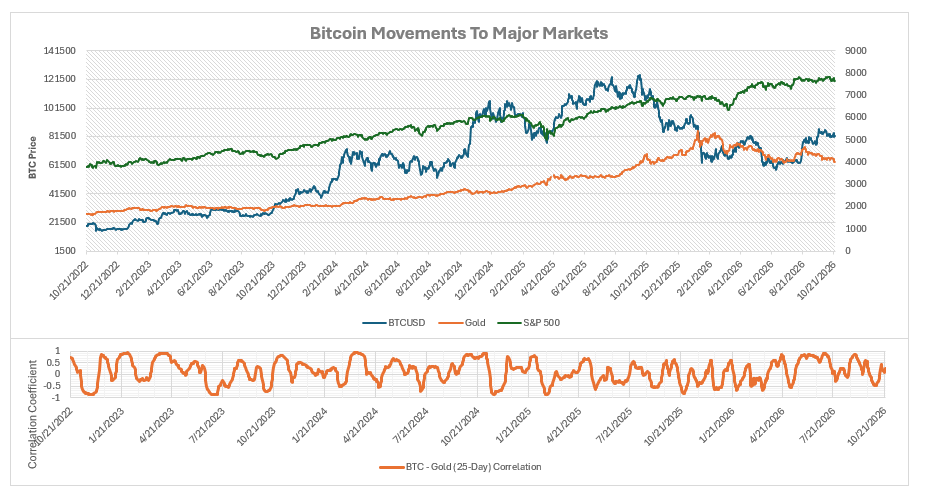
Another interesting development is Bitcoin’s increasingly close relationship with gold. Currently, the correlation coefficient between both markets remains in positive territory and continues to show a relatively consistent alignment over the last 25 trading sessions. It is important to remember, however, that correlations can change over time.
Source: Data – TVC, StoneX, TradingView
This relationship is particularly relevant because gold has also been displaying signs of caution in recent sessions. Despite developments across bond and equity markets, the precious metal has failed to attract especially strong demand and continues to trade within a relatively directionless environment.
As the relationship between both markets has strengthened, it is possible that some of the same factors limiting gold’s recovery are also affecting Bitcoin in the short term. In this environment, Bitcoin does not appear to be establishing itself clearly as either a defensive asset or a particularly attractive risk asset. Instead, a significant portion of capital flows appears to be concentrating in other markets that currently offer greater confidence and stability. This may be reflected both in the relatively stable demand observed in the bond market and in the recovery seen across some defensive equity sectors.
With this in mind, if Bitcoin continues to mirror gold's recent behavior and both assets remain unable to generate a consistent recovery in demand, it could reinforce the view that the crypto market is moving through a phase of indecision similar to the one recently observed across precious metals. It also suggests that capital flows remain concentrated in specific markets, leaving less room for both Bitcoin and gold to rebuild investor confidence in the short term. As long as investors continue to find greater appeal in more defensive or established segments of the market, Bitcoin may continue to struggle to develop stronger directional moves.
Confidence Continues to Struggle
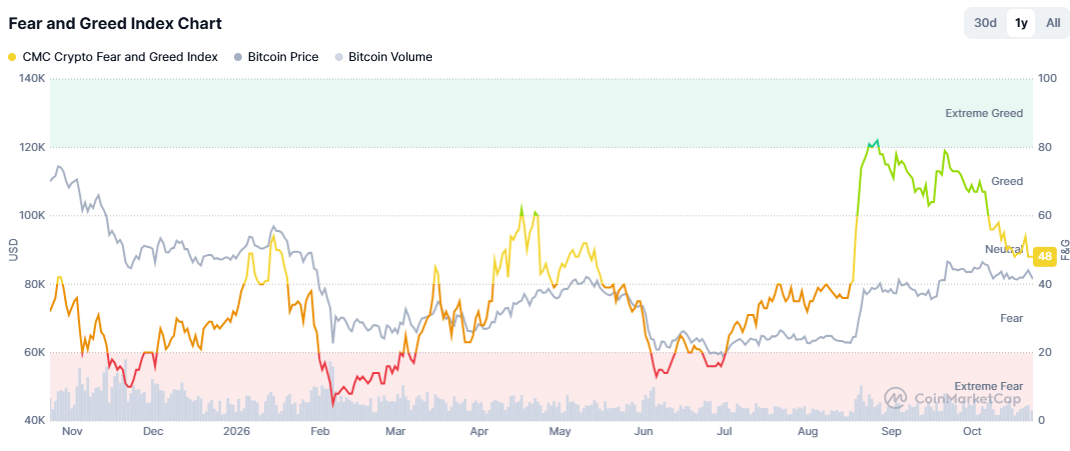
Recent movements in the Fear & Greed Index continue to reflect a more cautious tone across the market. The indicator is currently trading near 48 points, returning to a neutral zone that had not been observed for several weeks.
This remains important because it highlights a gradual loss of the enthusiasm that had developed earlier. The recovery in confidence observed during previous weeks has lost momentum, allowing neutrality to regain relevance within the cryptocurrency market.
Source: Coinmarketcap
The evolution of this indicator remains important because it functions as a measure of overall risk appetite within the crypto market. If confidence continues struggling to recover, it could limit the market’s ability to sustain stronger demand and reinforce the notion that part of investor interest continues to shift toward alternative opportunities.
Under this scenario, the loss of momentum in market confidence could continue to support a phase of indecision and relative weakness that is becoming increasingly relevant across cryptocurrencies and could remain an important theme in the sessions ahead.
Written by Julian Pineda, CFA, CMT – Market Analyst
Follow him on: @julianpineda25
Latest market news




The complete CFD trading experience
Award-winning platforms, competitive spreads, low commissions and dedicated support.
We live and breathe the markets and are dedicated to helping traders realise their ambitions as we continue to set the industry bar.
Economic calendar
Web Trader platform
Our sophisticated web-based platform is packed with features.
Related articles
Crypto Outlook: Why Is Demand Failing to Recover?
With just one week left in October, the cryptocurrency market continues to struggle to regain consistent demand. Although there was an attempt to recover earlier in the week, the move failed to gain traction and the market quickly returned to a more cautious tone, even as some competing markets began to lose part of their appeal.
USD/JPY Weekly Outlook: AI earnings could overshadow the Fed and BoJ
AI sentiment has become a major driver of US Treasury yields and USD/JPY. With Microsoft, Alphabet and Amazon reporting this week, central bank decisions may have competition for traders' attention.


Bitcoin Forecast: Is Buying Demand Making a Comeback?
Recent trading sessions have once again highlighted a meaningful improvement in demand dynamics around Bitcoin. In fact, over the last two sessions the leading cryptocurrency has gained nearly 3.0%, bringing buying momentum back into focus after losing strength in previous weeks.
StoneX Europe Ltd may make third party material available on this website which may contain information included but not limited to the conditions of financial markets. The material is for information purposes only and does not contain, and should not be construed as containing, investment advice and/or investment recommendation and/or an investment research and/or an offer of or solicitation for any transactions in financial instruments; any decision to enter into a specific transaction shall be made by the client following an assessment by him/her of their situation.
StoneX Europe Ltd makes no representation or warranty and assumes no liability as to the accuracy or completeness of the information provided, nor any loss arising from any investment based on a recommendation, forecast or other information supplied. You should always seek independent advice as to your suitability to speculate in any related markets and your ability to assume the associated risks, if you are at all unsure. We are not under any obligation to update any such material. Any opinion made may be personal to the author and may not reflect the opinion of StoneX Europe Ltd.