


US dollar outlook: DXY finds fresh support as risk aversion deepens
The dollar is finding fresh support as risk aversion drives investors out of emerging-market and commodity currencies. With tariff threats mounting and today's PCE data in focus, the 104.53 high and 104.60 resistance are back in play.
Share this:
The US dollar is finding fresh support as a broad unwinding of risk positions drives investors back towards defensive currencies. The strongest defensive currency is the Swiss franc, followed by the US dollar and the Japanese yen. Uncertainty over the US technology sector, expectations of further Federal Reserve tightening and renewed tariff threats are all continuing to weigh heavily on emerging-market and commodity-linked currencies like the Australian and New Zealand dollars. With the dollar index holding just below recent highs ahead of today's PCE report, the risk to the near-term US dollar outlook remains tilted to the upside.
- Risk aversion is pulling capital out of emerging-market and commodity currencies and back towards the dollar
- A Wall Street Journal report says the US is preparing tariffs of around 5–10% on manufactured exports from China, the EU and many other partners
- A firm core PCE reading could bring this week's 104.53 high and resistance at 105.00 back into view
Risk aversion puts the dollar back in demand
The investment backdrop remains distinctly unfavourable for risk-sensitive currencies. Uncertainty surrounding the US technology sector, expectations of further Fed tightening and renewed tariff concerns are combining to drive a broader unwind of risk-seeking positions. Emerging-market and commodity-linked currencies are bearing the brunt of it, and there is little reason to expect a sustained recovery while these headwinds persist.
That unwinding provides the dollar another source of support, even if the greenback looks stretched relative to short-term interest-rate differentials. While investors continue to cut their exposure to higher-beta assets, the greenback is unlikely to be hit by the narrowing of the rate differentials. That partly explains why it has remained supported despite the big drop in crude oil prices and bond yields – factors that had previously helped to propel the currency, when oil and yields were surging higher.
Tariff threat piles pressure on commodity currencies
Reports of the latest tariff threat exacerbate uncertainty. According to a Wall Street Journal report, the US administration is preparing fresh levies following Section 301 investigations into excess manufacturing capacity overseas, with tariffs of around 5–10% possible on manufactured exports from China, the EU and many other trading partners.
If the report is true, it would be particularly bad news for economies exposed to global trade and industrial commodities. Copper has already taken a beating, while weakness across the broader industrial metals complex is reinforcing concerns about the global growth outlook.
AUD/USD price action highlights current sentiment
Look no further than the Australian dollar to get a feel for what's happening. The AUD/USD initially rallied overnight after a stronger-than-expected October inflation report reinforced expectations that the Reserve Bank of Australia would keep policy restrictive. That advance quickly unravelled, however, with the pair falling more than 1% to close in on the 0.65 handle. The failure to hold onto those gains despite firmer inflation suggests that broader risk sentiment is currently outweighing domestic monetary policy.
PCE data could reinforce Fed tightening bets
Today's PCE report could add to the dollar's momentum, should the data come in largely as expected or beat. Following Tuesday's stronger US consumer confidence reading, an expected 0.3% monthly rise in core inflation would do little to reassure policymakers that price pressures are easing. The combination of resilient activity and sticky inflation could therefore encourage markets to price in a more restrictive path for the Federal Reserve.
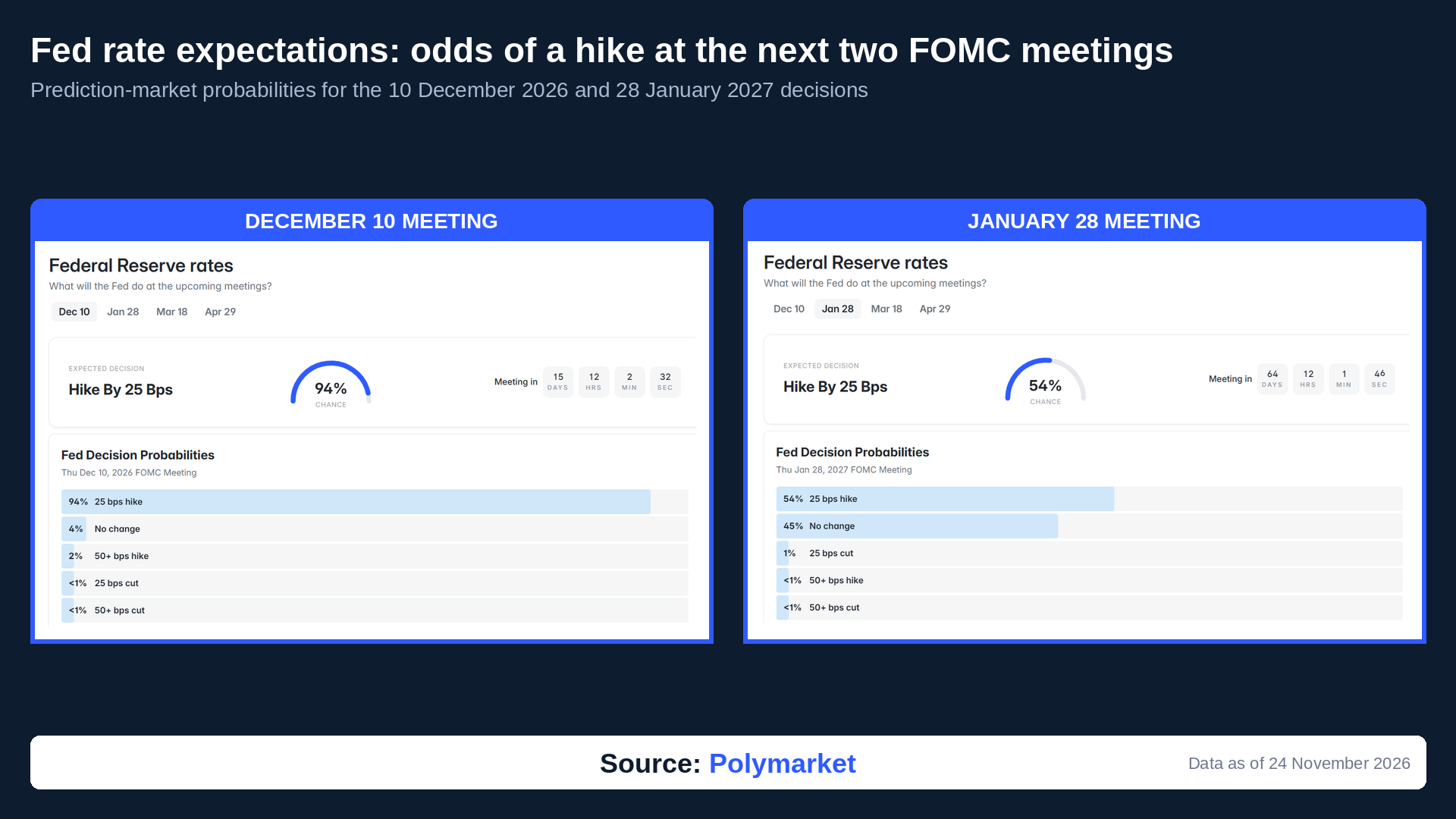
Markets are already pricing an almost certain 25bp rate increase in December, leaving scope for speculation over whether a larger move might eventually be required should inflation continue to surprise to the upside.
Technical analysis: DXY key levels to watch
From a technical analysis point of view, the dollar index is in a strong bullish trend. It is now up for the third consecutive month and on a 5-week winning run. Clearly, the RSI and other momentum indicators are flashing overbought signals. But so far, we haven't seen any clear signs of a reversal.
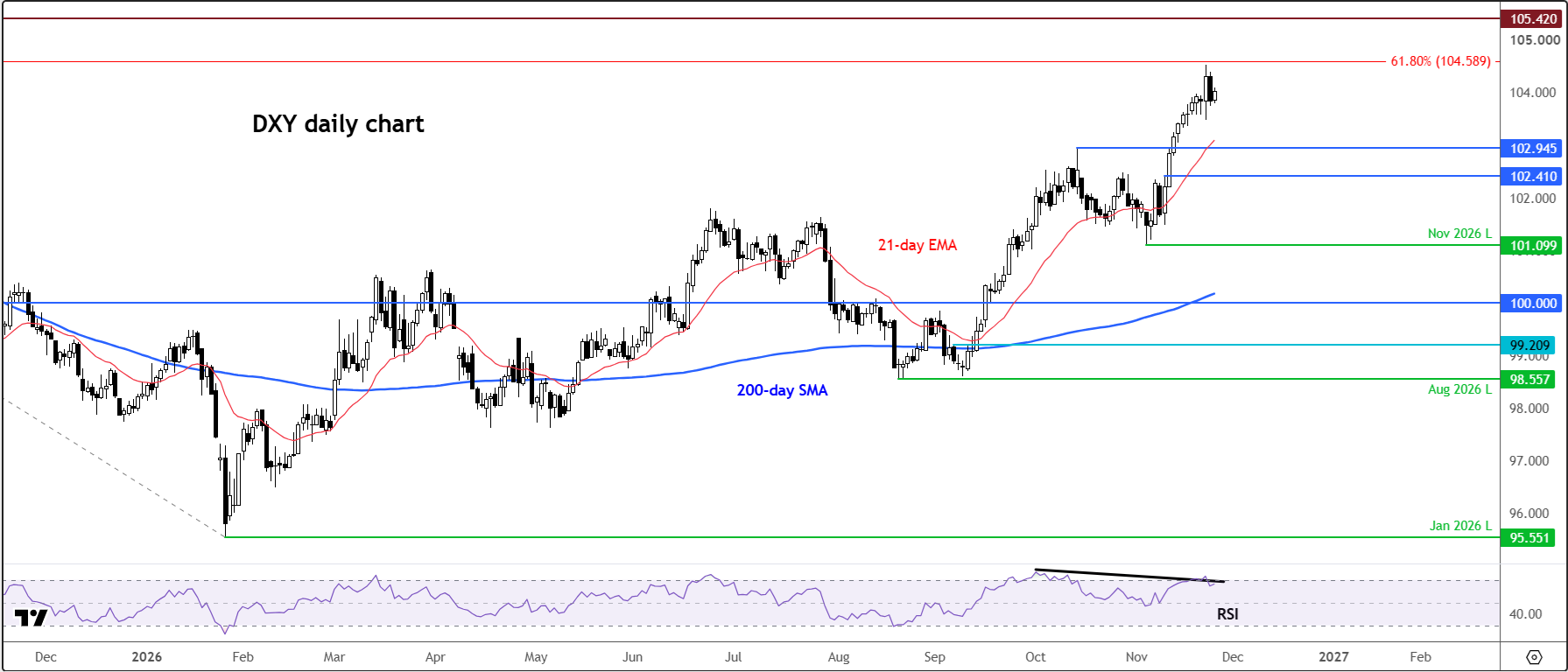
At the time of writing, the DXY was holding just above the 104.00 handle, having eased back from the multi-year high of 104.53 reached earlier this week. A stronger-than-expected inflation reading could bring that high back into view, with 105.00 likely to be the next important resistance area just above, followed by 105.42/45, an old support level. For now, the preference therefore remains for defensive currencies, particularly the US dollar, Japanese yen and Swiss franc, while the Australian and New Zealand dollars, alongside emerging-market currencies, are likely to remain vulnerable as long as the broader risk-off environment persists.
In terms of support levels to watch, 102.95 and 102.40ish were the previous resistance levels that were taken out during the current rally. These levels could turn into support upon re-test from above. The line in the sand is now at 101.10, marking the low prior to the latest rally, hit earlier this month. Bearish below that.
Frequently asked questions
Why is the US dollar rising?
Investors are unwinding risk-seeking positions amid uncertainty over US tech, expectations of further Fed tightening and fresh tariff threats. That favours defensive currencies such as the dollar, the yen and the Swiss franc.
Can the dollar index break above 105.00?
A stronger-than-expected PCE reading could bring this week's 104.53 high back into view, with 105.00 the key resistance to watch above it.
Why are commodity currencies falling?
Tariff threats and weakness in industrial metals are weighing on growth-sensitive currencies such as the Australian dollar, which has slipped towards the 0.65 handle.
-- Written by Fawad Razaqzada, Market Analyst | Follow Fawad on X @Trader_F_R
Related tags:



The complete CFD trading experience
Award-winning platforms, competitive spreads, low commissions and dedicated support.
We live and breathe the markets and are dedicated to helping traders realise their ambitions as we continue to set the industry bar.
Economic calendar
Web Trader platform
Our sophisticated web-based platform is packed with features.
Related articles
US dollar outlook: DXY finds fresh support as risk aversion deepens
The dollar is finding fresh support as risk aversion drives investors out of emerging-market and commodity currencies. With tariff threats mounting and today's PCE data in focus, the 104.53 high and 104.60 resistance are back in play.

AUD/USD Outlook: Hot Inflation No Match for Global Risk Aversion
With inflation pressures broadening and the labour market deteriorating, the RBA faces an unenviable task. But for AUD/USD traders, developments offshore may matter far more right now.


NZD/USD Outlook: Reversal Signals Emerge as AI Trade Falters
Kiwi prints a reversal signal comes as cracks appear in the US economic exceptionalism story. An orderly rotation away from AI could provide favourable conditions for a rebound, but another brutal risk-off episode may have the opposite effect.
StoneX Europe Ltd may make third party material available on this website which may contain information included but not limited to the conditions of financial markets. The material is for information purposes only and does not contain, and should not be construed as containing, investment advice and/or investment recommendation and/or an investment research and/or an offer of or solicitation for any transactions in financial instruments; any decision to enter into a specific transaction shall be made by the client following an assessment by him/her of their situation.
StoneX Europe Ltd makes no representation or warranty and assumes no liability as to the accuracy or completeness of the information provided, nor any loss arising from any investment based on a recommendation, forecast or other information supplied. You should always seek independent advice as to your suitability to speculate in any related markets and your ability to assume the associated risks, if you are at all unsure. We are not under any obligation to update any such material. Any opinion made may be personal to the author and may not reflect the opinion of StoneX Europe Ltd.