

Germany’s 2025 elections
Germany’s federal election on 23 February could shake up financial markets. Learn everything you need to know to trade the event as it happens.
Share this:

When will Germany’s election take place?
Germany heads to the polls on 23 February 2025, months ahead of schedule following the collapse of its three-party coalition government late last year. These snap elections will soon determine the new Bundestag and Chancellor of Europe’s largest economy. This vote will also be accompanied by local and state elections.
Who are the German Chancellor candidates?
The main parties in the running include the Social Democrats, the CDU/CSU alliance, the Greens, and the far-right AfD party, notably backed by Elon Musk.
The current candidates for Chancellor are:
- Olaf Scholz, the Social Democrats (SPD)
- Friedrich Merz, the Christian Democrats (CDU/CSU)
- Robert Habeck, the Greens (Die Grünen)
- Alice Weidel, the Alternative for Germany (AfD)
- Christian Lindner, the Free Democrats (FDP)
- Jan van Aken and Heidi Reichinnek, the Left (Die Linke)
- Sahra Wagenknecht, the Bündnis Sahra Wagenknecht (BSW)
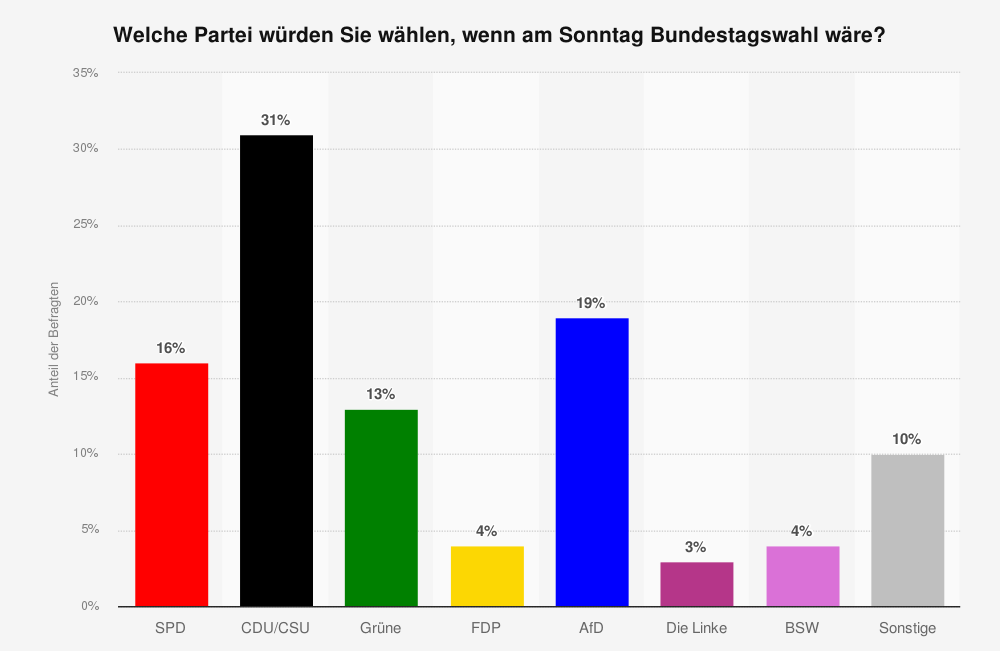
Recent polls indicate that the centre-right CDU/CSU are in pole position, which would make Friedrich Mertz the next Chancellor of Germany. Closely followed in second spot are the far-right AfD party backed by Elon Musk, with the SPD and incumbent Chancellor Olaf Scholz trailing further behind in voter support. One of their coalition partners, the Greens, sit fourth in the polls.
Source: statista.com
Coalition governments are common in the German voting system, and it is likely that two or more candidates end up governing together. However, it remains to be seen whether any major party would accept a coalition with the politically isolated AfD.
How does the German election system work?
German voters don't directly elect their Chancellor. Instead, the leading candidate from the winning party will be anointed Chancellor by the Federal president. Then, the newly elected parliament formally confirms their position with a ballot.
Germany's electoral system is complex, blending direct and proportional representation. The Bundestag consists of 598 seats, evenly divided between two distinct voting systems:
- The Erststimme (first vote) is a first-past-the-post system. Voters choose from individual district representatives, with each elected candidate securing a seat.
- The Zweitstimme (second vote) uses proportional representation, in which voters choose a political party instead of a single candidate. The party with the largest share of votes get the most seats in the Bundestag.
This hybrid system allows greater electoral flexibility. Voters can support one candidate in district elections while backing a completely different party in the proportional vote.
Parties must secure a minimum of 5% of votes to enter parliament – this has historically been a strategic safeguard against extremist political groups.
Markets to watch this election
Germany’s political shake-up could trigger movements across German stocks, the Euro and major indices like the DAX.
Here are some of the key financial markets likely to face volatility before and after the 23 February election.
Forex
Key Euro pairs could see volatility surrounding the election period, including:
- EUR/USD
- EUR/GBP
- EUR/AUD
- EUR/JPY
- EUR/CHF
Learn more about trading forex or open an account to get started.
Stocks
A potential CDU coalition could spark pro-growth reforms, which may create favourable conditions for the stock market. Meanwhile, the SPD has proposed a temporary tax deduction on German-made electric cars, which would boost the Volkswagen Group and Daimler. A win for the Greens would rally sustainability stocks. Conversely, these stocks would be hurt if AfD came to power, with the party committed to cutting spending on climate protection.
Indices
The DAX, Germany’s leading stock index, is most likely to experience the most significant market movements during this election season. Other Deutsche Börse indices like the MDAX, TecDAX, and SDAX might also face volatility.
How to trade the German election
Trade the latest market action around the German elections with FOREX.com:
- Open a FOREX.com account, or log in if you’re already a client
- Search for your desired asset on our award-winning platform
- Choose your position and size, then your stop and limit levels
- Place your trade and monitor the market
Related tags:
Latest market news



The complete CFD trading experience
Award-winning platforms, competitive spreads, low commissions and dedicated support.
We live and breathe the markets and are dedicated to helping traders realise their ambitions as we continue to set the industry bar.
Economic calendar
Web Trader platform
Our sophisticated web-based platform is packed with features.
Related articles
EURUSD, DXY Outlook: Politics, Geopolitics, and Inflation
EURUSD, DXY Outlook: the EURUSD and DXY are currently on a market hold, influenced by German deflation risks, U.S. inflation concerns, ongoing Russia-Ukraine peace negotiations, and Germany’s evolving political landscape.

DAX forecast: German election lifts sentiment, but gains likely capped
Lingering tensions between the US and Europe could temper risk appetite, particularly after last week’s cautious trading, when concerns over US President Donald Trump’s stance on tariffs, coupled with stretched valuations, unsettled investors. For these reasons, we maintain a cautious DAX forecast despite a positive start to the week.

EUR/USD, GBP/USD Forecast: Two trades to watch
EUR/USD rises as investors cheer the German election result. GBP/USD rises ahead of Trump & BoE Ramsden's speeches.

StoneX Europe Ltd may make third party material available on this website which may contain information included but not limited to the conditions of financial markets. The material is for information purposes only and does not contain, and should not be construed as containing, investment advice and/or investment recommendation and/or an investment research and/or an offer of or solicitation for any transactions in financial instruments; any decision to enter into a specific transaction shall be made by the client following an assessment by him/her of their situation.
StoneX Europe Ltd makes no representation or warranty and assumes no liability as to the accuracy or completeness of the information provided, nor any loss arising from any investment based on a recommendation, forecast or other information supplied. You should always seek independent advice as to your suitability to speculate in any related markets and your ability to assume the associated risks, if you are at all unsure. We are not under any obligation to update any such material. Any opinion made may be personal to the author and may not reflect the opinion of StoneX Europe Ltd.