








Japanese Yen Forecast: USD/JPY Downtrend Intact as Yen Sensitivity to BoJ Grows
Yen traders take note—USD/JPY has been moving more in step with Japanese rates than US yields. With key Japanese data and BoJ speakers on deck, could this spark the next leg lower?
Share this:

- USD/JPY moves show a stronger correlation with Japanese bond yields than US rates
- Japan GDP and inflation data, along with BoJ commentary, may spark volatility
- US calendar is light, with Fed speeches unlikely to shift market expectations significantly
- USD/JPY remains in downtrend, with support at 151.30 and resistance near 154.30
Summary
Interest rate differentials between the United States and Japan look set to continue driving USD/JPY moves this week, putting central bank speeches and geopolitical developments in focus in the absence of major economic data from either nation. However, recent yen gyrations have been more aligned with shorter-dated Japanese bond yields rather than the US monetary policy outlook, suggesting Japan’s rate path may be of greater interest to traders in the near term.
Changing of the Guard?
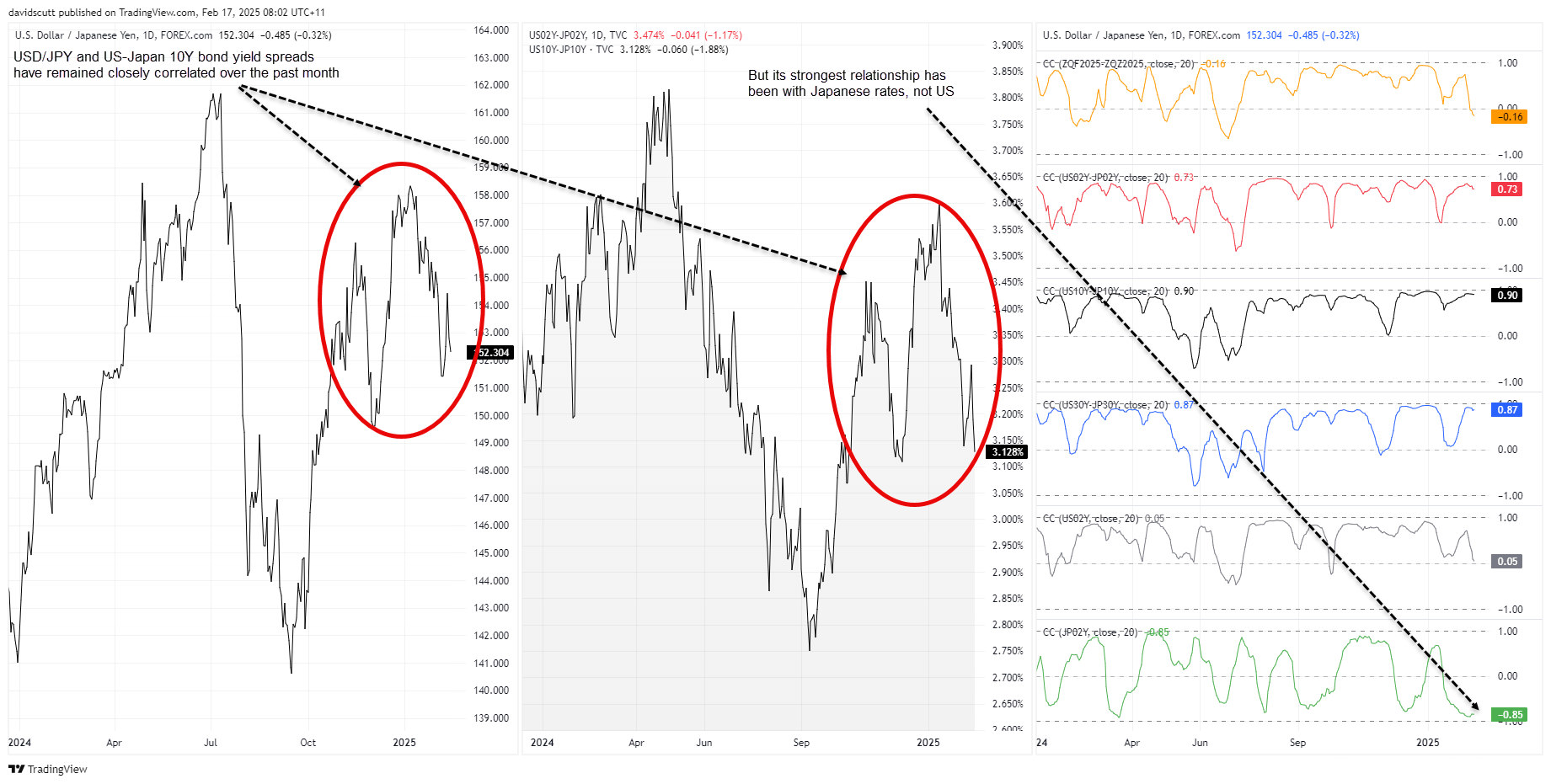
Correlation analysis is a useful tool for identifying what’s been driving USD/JPY moves over a given period, filtering out relationships that are merely coincidental from those with a stronger causal link. The chart below does just that, showing the rolling 20-day correlation coefficient between USD/JPY and various interest rate markets—a known driver of dollar-yen movements.
Source: TradingView
As has been the case in recent months, a strong positive correlation remains with bond yield spreads between the US and Japan, particularly at the long end of the curve with maturities of 10 years or more.
However, what stands out this time is that when looking at rate moves individually in the US and Japan, it’s the latter that has shown a far stronger and more significant relationship with USD/JPY over the past month.
The green line highlights this, showing a rolling correlation coefficient of -0.85 with Japanese two-year yields—a strong negative relationship. In contrast, the correlation with US two-year yields is just 0.05 over the same period, indicating no meaningful relationship. The same applies to market pricing for Fed rate cuts in 2025 (yellow line), which has a correlation score of -0.16.
Whether looking at short or long-dated Japanese rates, the correlation with USD/JPY has been far stronger than with US rates over the past month. That suggests Japanese data and events may play a more significant role in determining directional risks this week.
USD/JPY Event Risk
The US calendar is light on major event risk, featuring only second-tier data releases and FOMC minutes from a meeting that was arguably one of the least anticipated in months, if not years. While there are numerous Fed speakers—potentially creating volatility—it’s debatable whether their messaging will diverge meaningfully from recent guidance that there’s no rush to recalibrate policy settings further.
Source: TradingView
While the US calendar is quiet, and holiday-shortened due to President’s Day on Monday, Japan’s calendar screens as far more important with GDP data due Monday and inflation figures on Friday.
Also worth watching is Bank of Japan (BoJ) board member Hajime Takata’s speech on Tuesday for clues on the potential path for further rate hikes. He’s regarded as an interest rate hawk, and given that other BoJ members have recently used speeches to soften markets up for further rate increases this year, his remarks could inject volatility into USD/JPY.
Source: TradingView
Outside of scheduled events, US trade policy headlines remain a wildcard. Historically, escalating trade tensions have pushed USD/JPY higher, reflecting the increased risk that inflationary pressures could limit or delay Fed rate cuts. Conversely, signs of a willingness to negotiate tend to have the opposite effect. While the reaction function is unlikely to shift meaningfully, a genuine escalation in the trade war could lead to heightened volatility and potential unwinding of yen carry trades, amplifying USD/JPY downside risks.
USD/JPY Downside Bias Retained
Source: TradingView
The USD/JPY weekly chart provides one of the clearest signals on near-term directional risks, with the pair remaining in a downtrend established late last year. Five consecutive lower highs have now been recorded, and last week’s inverted hammer candle suggests sellers remain active at higher levels. MACD and RSI (14) are generating bearish signals, reinforcing an overall downside bias.
For now, support at 151.30 is holding, preventing a deeper unwind. If that level gives way, a push towards the December swing low of 148.65 may follow. On the topside, the 50-week moving average and downtrend resistance are key levels to watch, with the latter currently around 154.30.
-- Written by David Scutt
Follow David on Twitter @scutty
How to trade with City Index
You can trade with City Index by following these four easy steps:
- Open an account, or log in if you’re already a customer
• Open an account in the UK
• Open an account in Australia
• Open an account in Singapore
- Search for the market you want to trade in our award-winning platform
- Choose your position and size, and your stop and limit levels
- Place the trade


The complete CFD trading experience
Award-winning platforms, competitive spreads, low commissions and dedicated support.
We live and breathe the markets and are dedicated to helping traders realise their ambitions as we continue to set the industry bar.
Economic calendar
Web Trader platform
Our sophisticated web-based platform is packed with features.
Related articles
USD/JPY weekly outlook: Quarter turn scrambles rates regime
USD/JPY’s tight relationship with front-end US rates broke down sharply last week, but quarter-turn flows and positioning suggest the disconnect may prove temporary.

USD/CAD forecast: rally could accelerate above June highs at 1.4250
USD/CAD recovered quickly after weaker US jobs data, keeping the bullish trend in focus. A move above the June highs could accelerate the rally as inflation keeps the Fed under pressure.


USD Sets Fresh Yearly High as EUR/USD Drops Dramatically, USD/JPY Stable
Well, it was a week of USD strength that wasn’t entirely pushed by USD/JPY, as a strong sell-off in EUR/USD has pushed the major pair to its most oversold state in a decade.

StoneX Europe Ltd may make third party material available on this website which may contain information included but not limited to the conditions of financial markets. The material is for information purposes only and does not contain, and should not be construed as containing, investment advice and/or investment recommendation and/or an investment research and/or an offer of or solicitation for any transactions in financial instruments; any decision to enter into a specific transaction shall be made by the client following an assessment by him/her of their situation.
StoneX Europe Ltd makes no representation or warranty and assumes no liability as to the accuracy or completeness of the information provided, nor any loss arising from any investment based on a recommendation, forecast or other information supplied. You should always seek independent advice as to your suitability to speculate in any related markets and your ability to assume the associated risks, if you are at all unsure. We are not under any obligation to update any such material. Any opinion made may be personal to the author and may not reflect the opinion of StoneX Europe Ltd.