



Markets pricing in central bank rate increases over the next year
Traders should watch the change in expectations of interest rates vs current rates.
Share this:

As inflation continues to rise around the globe, central banks are trying to combat rising prices by ending their respective asset purchase programs and by increasing interest rates. Most of the major central banks have ended their Quantitative Easing programs, with the exception of the ECB and the BOJ (however the ECB is expected to end it very soon). That leaves raising interest rates as the primary tool for combating inflation.
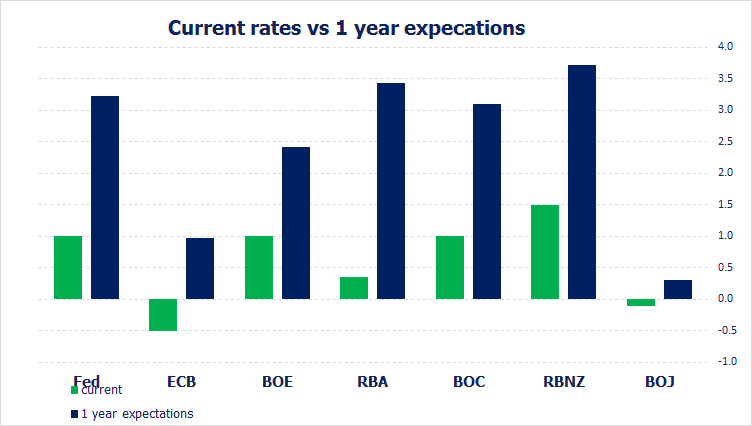
The chart below shows where some of the major central banks currently have interest rates and where the markets expect them to be in one year.
Source: Stone X
The ECB is the farthest behind in terms of raising rates at -0.50. However, markets expect rates to be near 1.0% in 1-year. With inflation in the Eurozone pushing 7.5% YoY, ECB members, including ECB President Christine Lagarde, have been on the wires the past few weeks discussing the possibility of hiking rates as soon as July.
The Bank of Japan also has ultra-low rates at -0.10, however markets only expect to see rates in Japan rise to 0.3% in 1-years’ time. This is primarily due to the deflationary pressures that Japan has been facing. Indeed, as part of the BOJ’s central bank QE, it continues to buy ETFs in the market and pegs the 10-year yield at 0.25%. If yields rise to that level, the central bank will step in and buy JGBs to keep yields low.
The Fed currently has the Fed Funds rate at 1.0%. However, markets are anticipating that the Fed will raise rates to 3.22% in 1 year. With inflation near 40-year highs at 8.3% YoY, several Fed members have suggested that it they may have to raise rates above what the Fed considers neutral, roughly 2.5%, in order to bring inflation down. It should be noted that the Fed targets 2% inflation, so there is a long way to go before inflation reaches the Fed’s target level.
The BOE currently has rates set at 1.0%. Markets see rates rising to “only” 2.41% in 1-year. Although inflation in the UK is high, as with other countries, the MPC is taking a more cautious approach. The BOE knows it must raise rates to combat inflation, however at the same time the central bank is concerned about the effect inflation and rising interest rates will have on household incomes and growth. Indeed, March’s GDP reading was -0.1%, suggesting that the BOE may be on to something!
The BOC, RBA, and RBNZ are in similar situations. Everyone is facing high inflation but is also concerned about slowing growth. If one throws the recent lockdowns in China into the mix, there is even more of a chance of a global slowdown.
Traders should watch the change in expectations of rates vs current rates. Since foreign exchange rates are affected by the difference between 2 countries interest rates, having an idea of where interest rates may be headed can be one tool investors can use to help determine where fx rates may be going next!
As inflation continues to rise around the globe, central banks are trying to combat rising prices by ending their respective asset purchase programs and by increasing interest rates. Most of the major central banks have ended their Quantitative Easing programs, with the exception of the ECB and the BOJ (however the ECB is expected to end it very soon). That leaves raising interest rates as the primary tool for combating inflation.
The chart below shows where some of the major central banks currently have interest rates and where the markets expect them to be in one year.
Source: Stone X
The ECB is the farthest behind in terms of raising rates at -0.50. However, markets expect rates to be near 1.0% in 1-year. With inflation in the Eurozone pushing 7.5% YoY, ECB members, including ECB President Christine Lagarde, have been on the wires the past few weeks discussing the possibility of hiking rates as soon as July.
Everything you need to know about the ECB
The Bank of Japan also has ultra-low rates at -0.10, however markets only expect to see rates in Japan rise to 0.3% in 1-years’ time. This is primarily due to the deflationary pressures that Japan has been facing. Indeed, as part of the BOJ’s central bank QE, it continues to buy ETFs in the market and pegs the 10-year yield at 0.25%. If yields rise to that level, the central bank will step in and buy JGBs to keep yields low.
Everything you need to know about the BOJ
The Fed currently has the Fed Funds rate at 1.0%. However, markets are anticipating that the Fed will raise rates to 3.22% in 1 year. With inflation near 40-year highs at 8.3% YoY, several Fed members have suggested that it they may have to raise rates above what the Fed considers neutral, roughly 2.5%, in order to bring inflation down. It should be noted that the Fed targets 2% inflation, so there is a long way to go before inflation reaches the Fed’s target level.
Everything you need to know about the Federal Reserve
The BOE currently has rates set at 1.0%. Markets see rates rising to “only” 2.41% in 1-year. Although inflation in the UK is high, as with other countries, the MPC is taking a more cautious approach. The BOE knows it must raise rates to combat inflation, however at the same time the central bank is concerned about the effect inflation and rising interest rates will have on household incomes and growth. Indeed, March’s GDP reading was -0.1%, suggesting that the BOE may be on to something!
Everything you need to know about the BOE
The BOC, RBA, and RBNZ are in similar situations. Everyone is facing high inflation but is also concerned about slowing growth. If one throws the recent lockdowns in China into the mix, there is even more of a chance of a global slowdown.
Traders should watch the change in expectations of rates vs current rates. Since foreign exchange rates are affected by the difference between 2 countries interest rates, having an idea of where interest rates may be headed can be one tool investors can use to help determine where fx rates may be going next!
Learn more about forex trading opportunities.
Related tags:
Latest market news




The complete CFD trading experience
Award-winning platforms, competitive spreads, low commissions and dedicated support.
We live and breathe the markets and are dedicated to helping traders realise their ambitions as we continue to set the industry bar.
Economic calendar
Web Trader platform
Our sophisticated web-based platform is packed with features.
Related articles
Gold Q4 2026 outlook: Resilience in the face of rallying dollar and yields
As we headed towards the latter stages of Q3 and into Q4, the Fed had just hiked rates in a hawkish FOMC meeting, while the likes of the ECB and BoJ had also tightened their respective policies. Oil prices remained elevated amid the prolonged US-Iran conflict. Meanwhile, bond yields were breaking out, and the dollar was higher across the board. Yet, remarkably, gold was still holding in the positive territory for the third quarter, even if it had weakened somewhat in September.

EUR/USD Q4 2026 Outlook: Euro at a Crossroads as Fed, ECB Tighten 9 25 2026
EUR/USD enters Q4 at a pivotal inflection point as competing Fed-ECB policy paths and persistent inflation risks collide with major technical support.


USD/JPY Q4 2026 Outlook: Hawkish Fed Pricing Clashes With Intervention Risk
The year-end tug-of-war is clear: hawkish Fed pricing supports USD/JPY, while intervention risk limits the upside.

StoneX Europe Ltd may make third party material available on this website which may contain information included but not limited to the conditions of financial markets. The material is for information purposes only and does not contain, and should not be construed as containing, investment advice and/or investment recommendation and/or an investment research and/or an offer of or solicitation for any transactions in financial instruments; any decision to enter into a specific transaction shall be made by the client following an assessment by him/her of their situation.
StoneX Europe Ltd makes no representation or warranty and assumes no liability as to the accuracy or completeness of the information provided, nor any loss arising from any investment based on a recommendation, forecast or other information supplied. You should always seek independent advice as to your suitability to speculate in any related markets and your ability to assume the associated risks, if you are at all unsure. We are not under any obligation to update any such material. Any opinion made may be personal to the author and may not reflect the opinion of StoneX Europe Ltd.