



Markets Tumble as Tariff Shock Overshadows NFP
Markets dive as Trump’s reciprocal tariffs ignite fears of inflation, recession, and global trade fragmentation. With U.S. stocks down sharply and global equities sliding, the usually pivotal NFP report is now sidelined. Inflation risks rise, the dollar hits a 6-month low, and investors seek safety in gold and sovereign bonds. The message is clear: volatility is here to stay.
Share this:
Markets React to Reciprocal Tariffs: Growth Fears and Inflation Risks Dominate
The announcement of sweeping reciprocal import tariffs by U.S. President Donald Trump has sent shockwaves through global markets. Experts call these measures the most significant disruption to global trade in decades, and the consequences are already becoming evident: global equities are falling, bond yields are declining, the U.S. dollar is weakening, and even gold is feeling it albeit at elevated levels. Amid this backdrop, a normally market-moving event—the monthly U.S. jobs report (Non-Farm Payrolls, or NFP)—is taking a back seat.
Global Market Reaction: Uncertainty, Risk Aversion, Price Shock
Starting April 5, a flat 10% tariff will be imposed on all imports into the U.S., with country-specific penalties of up to 54% on goods from nations deemed by the White House to be major trade offenders. These “reciprocal tariffs” aim to correct trade imbalances and penalize not only import duties but also non-tariff barriers like VAT, subsidies, and regulatory constraints.
While President Trump celebrated the move in the White House Rose Garden as a “Day of Independence” for American industry, markets responded with a sharp sell-off. U.S. stock futures plummeted in after-hours trading, and extended the loss into yesterday’s market close with losses since announcement being:
- S&P 500: -4.0%,
- Nasdaq: -3.9%,
- Russell 2000: -5.5%.
Global equities also saw steep declines, including:
- Nikkei 225: -6.2%,
- Germany 40: -3.5%,
- HSCEI (Hong Kong): -2.6%,
- FTSE 100: -2.5%,
- ASX 200 (Australia): -3.7%.
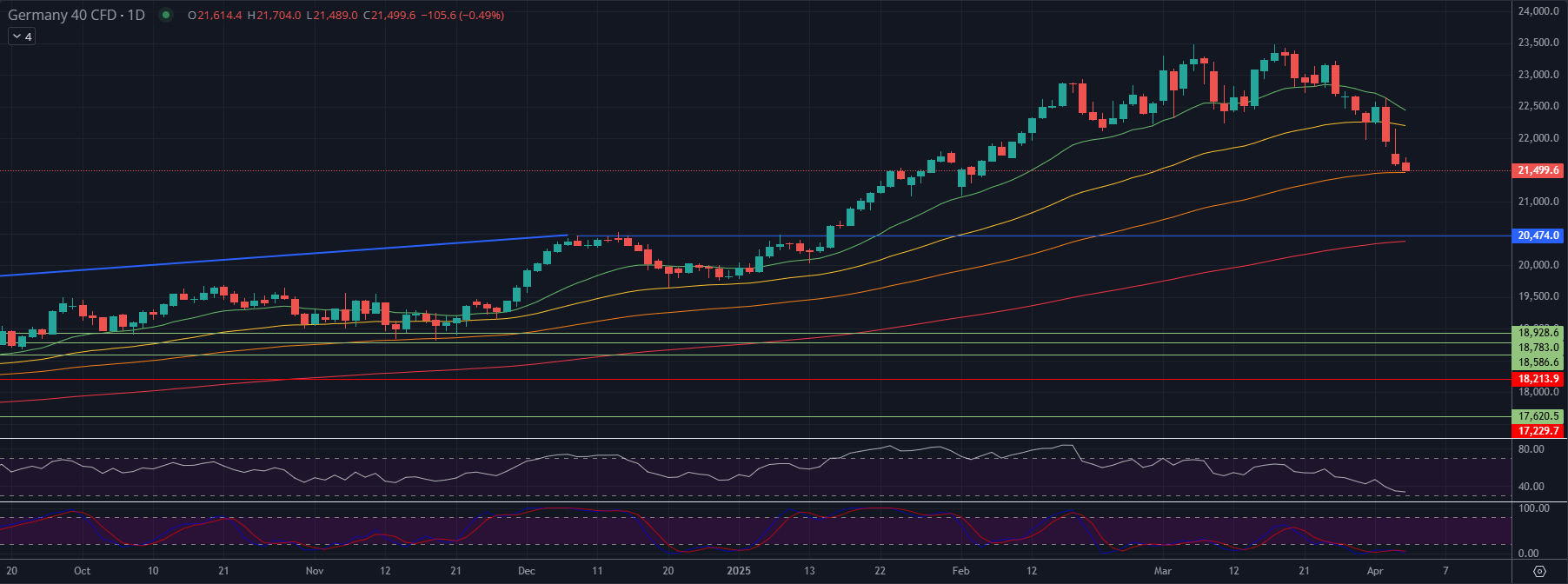
Germany 40 1 Day technical analysis
The Germany 40 (DAX) daily chart continues to extend its short-term correction, closing at 21,499.6 and sitting directly on the 100 EMA (21,463.6). This zone is crucial, as a decisive break below could trigger a deeper retracement in the uptrend that began in late 2023.
Bearish Momentum in Focus:
Price action: Now well below the 20 and 50 EMAs — confirming loss of bullish structure.
RSI at 37: Entering oversold territory, signaling bearish pressure but also the potential for a technical bounce.
Stochastic RSI: Has flatlined at the bottom (0.00/4.73), indicating a deeply oversold condition — often a prelude to a near-term bounce, but not a reversal by itself.
Key Levels to Watch:
Immediate support:
21,463 (100 EMA – currently being tested)
21,300–21,200 zone: Minor structure zone from November-December 2023
20,474: Major horizontal level and previous breakout point
Resistance (in case of a bounce):
22,000–22,200: First major supply zone, also former support
22,660–22,800: Confluence of 20 & 50 EMAs
Summary:
The DAX has now corrected roughly 6% from the March high and is at a make-or-break level.
If the 100 EMA holds, we could see a relief rally back toward 22,000+.
A daily close below 21,463 would likely confirm continued downside momentum, with 20,474 as the next realistic target.
Bias: Bearish in the short term, with bounce potential increasing — but confirmation is needed. Reclaiming 22k would be a first sign bulls are regaining control.
Economic Fallout: Inflation and Supply Chain Shifts
The reciprocal tariffs are already triggering economic shifts. Companies are relocating production to less efficient regions and increasingly depending on government protection, potentially curbing long-term innovation. Projections suggest that U.S. economic growth could fall to just 1%, while inflation could rise to 3.5%, measured by the PCE price index.
This creates a policy dilemma for the Federal Reserve, which must balance inflation control with the need to support economic growth. Markets are already pricing in additional rate cuts for 2025–2026, with analysts like Wells Fargo and Barclays forecasting a recession in the U.S., the UK, and the EU in the second half of 2025 if current policies persist.
NFP Report: Overshadowed by Tariff Shock
The March NFP report, scheduled for Friday, April 3, at 8:30 a.m. ET, is expected to show a moderate gain of 137,000 jobs, 0.3% m/m earnings growth, and a steady unemployment rate of 4.1%.
While the U.S. labor market remains resilient, some early indicators suggest that the ripple effects of tariff-related economic stress may soon appear. For example, layoff announcements surged 60% last month, reaching post-COVID highs. Analysts anticipate federal downsizing and contractor layoffs could contribute to broader job losses over the next 12 months.
Leading NFP indicators show a mixed picture:
- ISM Manufacturing Employment Index: down to 44.7
- ISM Services Employment Index: fell to 46.2
- ADP Report: 155,000 new jobs (up from 84,000 last month)
- 4-week average jobless claims: stable at 222,000
Despite a stable labor outlook, the U.S. Dollar Index (DXY) has dropped to a 6-month low at 102, with little technical support until 100.25.
Conclusion: Uncertainty Dominates – NFP Plays Second Fiddle
Trump’s tariff shock has changed the game. While the NFP report usually plays a central role in shaping market sentiment, this time it’s been relegated to the sidelines. The economic, political, and financial consequences of the trade policy shift are too massive to ignore.
The coming weeks promise heightened volatility—but also selective opportunities. The key question remains: Can diplomacy de-escalate the brewing trade war, or are we heading toward a prolonged period of global economic fragmentation? Until that becomes clear, the strategy is simple: embrace volatility, manage risks, and stay alert.
Related tags:
Latest market news


The complete CFD trading experience
Award-winning platforms, competitive spreads, low commissions and dedicated support.
We live and breathe the markets and are dedicated to helping traders realise their ambitions as we continue to set the industry bar.
Economic calendar
Web Trader platform
Our sophisticated web-based platform is packed with features.
Related articles
USD Sets Fresh Yearly High as EUR/USD Drops Dramatically, USD/JPY Stable
Well, it was a week of USD strength that wasn’t entirely pushed by USD/JPY, as a strong sell-off in EUR/USD has pushed the major pair to its most oversold state in a decade.
USD Sets Fresh Yearly High as EUR/USD Drops Dramatically, USD/JPY Stable
Well, it was a week of USD strength that wasn’t entirely pushed by USD/JPY, as a strong sell-off in EUR/USD has pushed the major pair to its most oversold state in a decade.
Dow Jones Slide Shows What Rate Hike Bets Mean for Stocks
The Dow Jones support breakdown shows rising bond yields and rate hike bets hitting U.S. stocks while tech giants prop up the Nasdaq.

StoneX Europe Ltd may make third party material available on this website which may contain information included but not limited to the conditions of financial markets. The material is for information purposes only and does not contain, and should not be construed as containing, investment advice and/or investment recommendation and/or an investment research and/or an offer of or solicitation for any transactions in financial instruments; any decision to enter into a specific transaction shall be made by the client following an assessment by him/her of their situation.
StoneX Europe Ltd makes no representation or warranty and assumes no liability as to the accuracy or completeness of the information provided, nor any loss arising from any investment based on a recommendation, forecast or other information supplied. You should always seek independent advice as to your suitability to speculate in any related markets and your ability to assume the associated risks, if you are at all unsure. We are not under any obligation to update any such material. Any opinion made may be personal to the author and may not reflect the opinion of StoneX Europe Ltd.