



RBA Hikes, Signals More to Come as Inflation Stays Sticky
The RBA is back hiking, lifting rates to 3.85% as expected. With inflation forecasts refusing to cooperate, markets are now bracing for more tightening as Governor Bullock prepares to face the media.
Share this:

- RBA Cash rate lifted 25bp to 3.85%, first hike since Nov 2023
- Inflation forecasts signal price pressures remain sticky
- Markets now price further hikes this year
- AUD jumps back above 0.7000
- Bullock presser at 3.30pm the next key risk even
The RBA is back hiking. A 25bp move lifts the cash rate to 3.85% for the first time since November 2023, as expected, but the real signal sits in the forecasts. With inflation projected to stay sticky, the door is open to multiple hikes this cycle, putting extra focus on Governor Michele Bullock’s 3.30pm press conference.
RBA Hawks Circle
On inflation, the RBA’s language clearly hardened relative to December. Then, the Board stressed uncertainty, saying inflation had “picked up more recently,” with only “some signs” of a broader lift and an emphasis on monitoring persistence. In February, that conditional framing is gone. Inflation is now described as having “picked up materially in the second half of 2025,” with the increase tied directly to “greater capacity pressures” and an explicit judgement that inflation is “likely to remain above target for some time.”
The labour market story has also shifted. December acknowledged conditions were “a little tight” but leaned on easing dynamics, pointing to rising unemployment, slower employment growth and “further modest easing” ahead. February removes that bias. Labour market conditions are deemed still “a little tight,” but are now said to have “stabilised,” with unemployment “a little lower than expected.” References to easing or slowing momentum were dropped.
On productivity, December relied on indirect signals, but February was more direct. While productivity is still not mentioned explicitly, the Board now says growth in the economy’s “supply capacity remains limited,” and that capacity pressures are “greater than previously assessed,” shifting constraints from a risk to a reality.
Finally, its language on economic growth strengthened noticeably. December framed activity as a recovery, with private demand having “strengthened” and momentum better than expected. February sharpens this materially, saying private demand has strengthened “substantially more than expected” and is “growing more quickly than expected,” explicitly linking stronger growth to rising capacity pressures.
Inflation Sticky, Higher for Longer
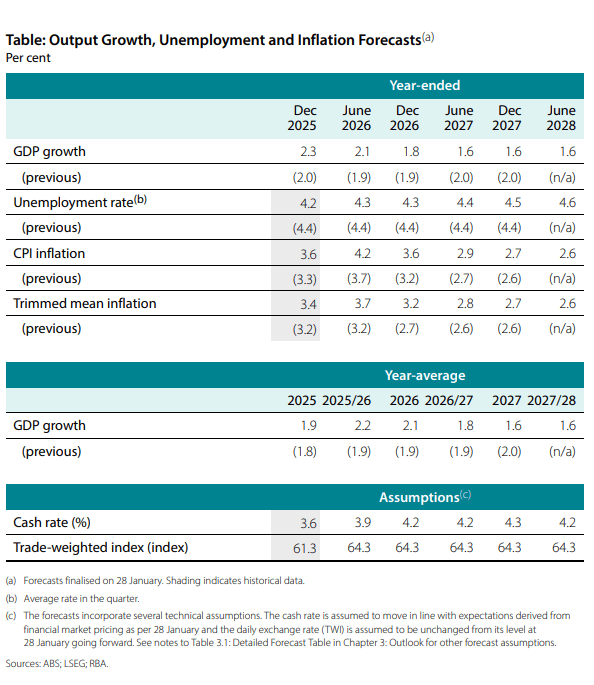
That firmer assessment is reflected clearly in the updated forecasts, which quietly point to a more extended tightening phase than the February hike alone would suggest.
Source: RBA
The big takeaway is that February looks unlikely to be a one-and-done. The RBA’s updated trimmed mean inflation forecasts do not show inflation returning to the 2.5% midpoint of its 2–3% target range by mid-2028, even after factoring in a stronger Australian dollar, lower crude oil prices and an assumption that the cash rate peaks at 4.3% in the final quarter of 2027.
Notably, the profile implies trimmed mean inflation running at 0.9% in each of the next two quarters, underlining the Bank’s concern that disinflation remains slow.
With the cash rate at 3.85%, that forecast path implies the Bank may ultimately unwind all three rate reductions delivered in 2024.
Consistent with policy remaining restrictive for longer, the RBA has revised down its GDP forecasts, with growth expected to slow to 1.6% from the middle of next year, down from 2% previously. The unemployment rate is forecast to drift higher over the projection period, reaching 4.6% by mid-2028, although the outlook for this year was trimmed slightly to 4.3%.
While the Bank is using market pricing to generate these forecasts, the detail sends a clear implicit signal: returning inflation to target under current conditions is likely to require more than a single rate hike.
Markets Price Multiple Rate Hikes
Source: Bloomberg
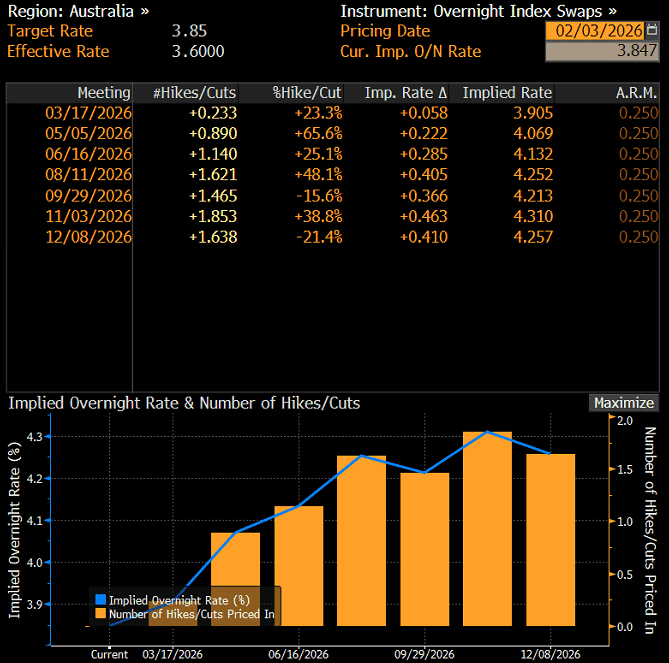
Markets have moved quickly to price a longer tightening cycle. By the RBA’s May meeting, when the Q1 inflation data is available, a follow-up 25bp hike is bordering on a lock at 89%, according to swaps markets. That’s not unusual given the RBA has often delivered multiple moves early in a cycle following quarterly inflation reports.
By August, when the Q2 data is available, an additional hike to 4.35% is seen as a roughly two-in-three chance. That looks about right given the run of data recently, which has come in on the firm side of expectations more often than not for key indicators.
The risk around whether we see fewer or more hikes this cycle appears premised on fiscal policy decisions in the federal budget, labour market trends and developments offshore.
Neutral policy settings, where inflation and unemployment are stable, arguably sit above the current cash rate. That raises the risk the RBA may need to deliver more hikes than are currently priced to re-establish equilibrium in the economy.
AUD/USD Surges, Reclaiming .7000

Source: TradingView
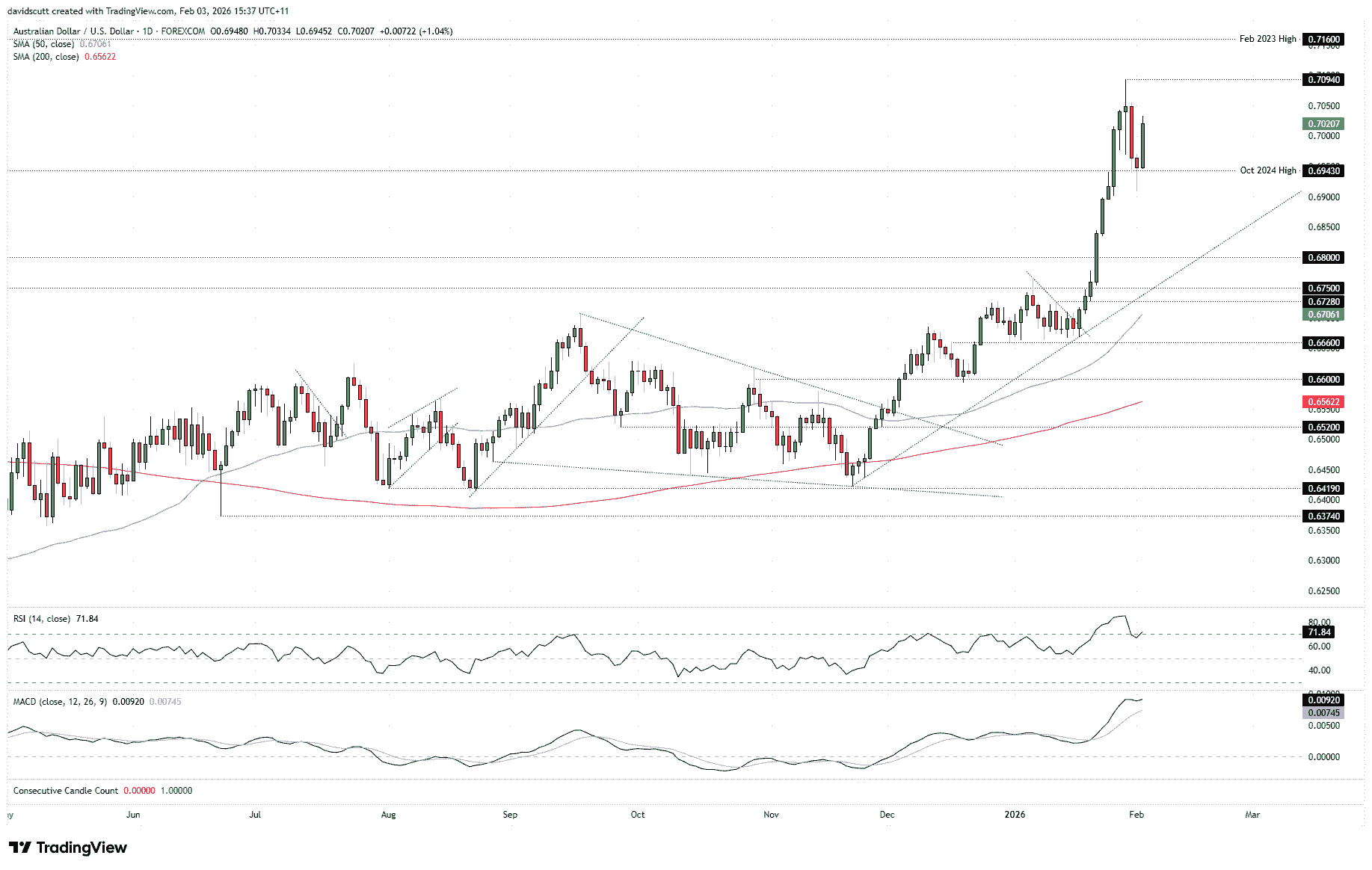
Naturally, the RBA’s hawkish hike delivered a sharp upside response in AUD/USD, pushing the pair back above the psychologically important 0.7000 level. Momentum indicators are confirming the move, with both RSI (14) and MACD showing upside strength accelerating. From here, bulls will be eyeing a retest of the January 29 high at 0.7094, particularly after the failed bearish break below the October 2024 high earlier this week, which produced a clear hammer candle on the daily chart.
While there is little to dislike about the Aussie from a domestic perspective, broader risk appetite remains fragile, which may limit how far the rally can extend in the near term, especially with the pair already looking somewhat stretched. That said, a sustained break above 0.7094 would put a retest of the February 2023 high back into play, with the 0.7250–0.7280 zone another key area to watch after marking multiple failed bullish breakout attempts in prior years.
On the downside, initial support sits at 0.6943, with 0.6900 and 0.6800 next on the radar should we see a deeper pullback. For now, the technical picture continues to favour buying dips rather than chasing strength.
The complete CFD trading experience
Award-winning platforms, competitive spreads, low commissions and dedicated support.
We live and breathe the markets and are dedicated to helping traders realise their ambitions as we continue to set the industry bar.
Economic calendar
Web Trader platform
Our sophisticated web-based platform is packed with features.
Related articles
Crude Oil, DXY Outlook: Geopolitical Risks Halt Sell-Offs in the Dollar and Oil
The U.S. Dollar Index, Brent and WTI are rebounding from key support levels and oversold conditions after steep sell-offs. U.S.–Iran tensions, inflation risks and rate expectations remain in focus.

dax-record-high-banks-cyclicals-election-relief-rally-european-stocks
The DAX has surged to fresh record highs as investors continue to rotate into banks, industrials and cyclical stocks following the US midterm elections. Falling bond yields, lower oil prices and improving sentiment have supported risk appetite across Europe, helping the index move decisively above 26,000. The focus now shifts from political relief to whether earnings and macroeconomic data can justify the rally's next leg higher.


Silver's bullish breakout case builds as bond yields retreat
The Democratic blue wave has sent crude and Treasury yields sharply lower, improving the outlook for precious metals. With gold already breaking higher, could silver be next?
StoneX Europe Ltd may make third party material available on this website which may contain information included but not limited to the conditions of financial markets. The material is for information purposes only and does not contain, and should not be construed as containing, investment advice and/or investment recommendation and/or an investment research and/or an offer of or solicitation for any transactions in financial instruments; any decision to enter into a specific transaction shall be made by the client following an assessment by him/her of their situation.
StoneX Europe Ltd makes no representation or warranty and assumes no liability as to the accuracy or completeness of the information provided, nor any loss arising from any investment based on a recommendation, forecast or other information supplied. You should always seek independent advice as to your suitability to speculate in any related markets and your ability to assume the associated risks, if you are at all unsure. We are not under any obligation to update any such material. Any opinion made may be personal to the author and may not reflect the opinion of StoneX Europe Ltd.