



US Consumers Are Confident (That Things Could Get Worse)
A preliminary report of consumer confidence is showing signs that consumers may have less appetite to consume, given their inflation expectations and financial concerns.
Share this:

Consumer sentiment fell to a 10-year low, according to the preliminary University of Michigan Consumer report. Citing the Delta variant, supply chain shortages and reduced expectations from the government’s economic policies, the report suggests consumer spending will remain lower though 2022.
Some observations from October’s survey:
- Net price increases were cited more frequently than any other time since inflation peaked at 10% in 1978-1980.
- Buying conditions of durable goods hit its third lowest level on record, behind the 1980 recession and 2020 pandemic. Higher prices were provided as the most common reason for unfavourable buying conditions.
- 69% of consumers viewed conditions for buying vehicles “less favourably”, which is its most pessimistic read on the survey’s record.
- 43% think vehicle prices are high, which is three times more than those who deem pricing to be attractive.
- Consumers expected a year-ahead inflation rate of 4.8% in early October (it’s highest levels since 2008).
- 73% of consumers expect interest rates to rise next year.


The high levels of growth are not likely to be sustainable with the current levels of inflation. Furthermore, concerns of elongated levels of inflation could be enough to cut back consumer spending to weigh on growth, and to some degree inflation as well, as demand presumably dies down. This is counter to the logic that ‘anticipation of rising prices can result in higher demand now’, but we have two ideas as to why ‘this time it is different’.
- Many purchases have likely already been brought forward during lockdowns (boredom and easy money)
- Rising prices combined with longer waiting times (bottlenecks) will presumably see people change their buying habits when they deem the waiting time and price no longer worth the higher prices and longer waiting times.
Moreover, if consumers are concerned about the future, they’re more likely to cut back on spending which will ultimately weigh on growth, as they opt to save money instead of chasing inflationary prices. And data within this survey suggests this may be the case.
Historically, consumers mostly expected their finances to improve. Not anymore.
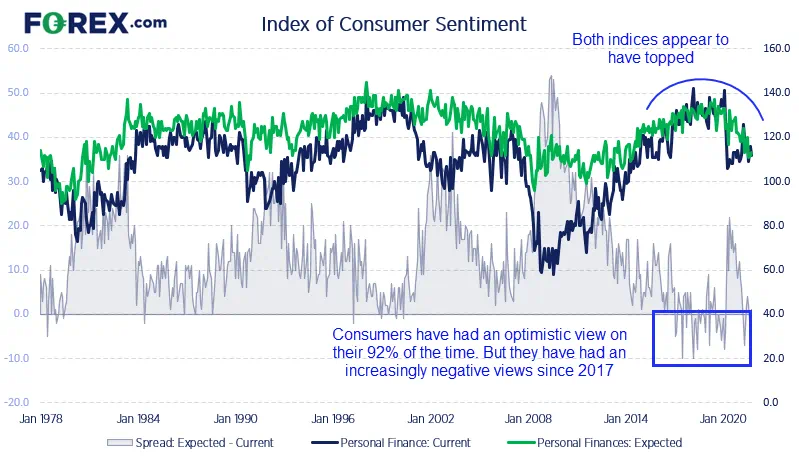
Taking the chart below, the two ‘personal finance’ indices have seemingly topped out on the long-term charts to suggest a long-term cycle peaked in Q4 2019. And if we look at the spread between the two (expected – current) it shows two clear patterns.
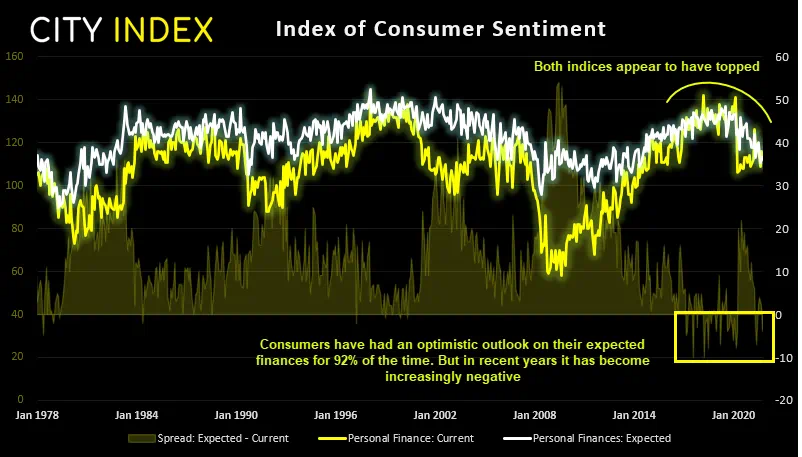
- Historically, consumers expected their finances to improve relative to their current financial position. 91.8% of the time, to be precise.
- Since 2017, personal finances have been expected to deteriorate a lot more frequently. 38% of the time, in fact.


Now let’s throw inflation expectations into the mix, as the 1-year outlook for inflation has risen to 4.8% (its highest level since 2008). Is that what consumers want to see if they’re concerned about their finances? Probably not. And it is a good reason to tighten the purse strings if so. However, we expect inflation expectations to rise notably in next month’s report as it would likely include the reaction of hot consumer prices, which were only released last Wednesday. We would not be surprised to see 1-year inflation expectation rise above 5%, and perhaps closer to 6% than 5%.
So, is inflation transitory?
Possibly, and lower demand would help diminish upside pressures, but it does not solve the supply side issue of bottlenecks in the system. For inflation to come back down to anywhere near 2% next year, supply chains need to be fully functional. And we doubt that to happen quickly enough.
Yet for us, the biggest takeaway from this report is that consumers are clearly concerned with their finances alongside higher prices. We therefore suspect consumption to drop and help take some of the sting out of consumer prices, yet weigh more heavily on growth figures. And that leaves the Fed in a tight spot as they’ll likely need to raise rates to fend inflation at elevated levels, yet may be hesitant to do so if growth suffers.
So, it may be worth keeping an eye on today’s retail sales report to see if demand is actually dwindling. Although we’d expect it to come in strong next month due to Black Friday sales. But as we head into next year we’d need to see a material improvement in sentiment (and retails sales) to turn this dismal ship around, and until then it looks like growth will suffer in 2022.
Last hurrah for the dollar?
Of course, anticipation of a hawkish Fed (having finally began tapering their balance sheet) has seen dollar bulls gain traction. The US dollar index is now at its highest level since July 2020 and seemingly a day or two’s trade away from 96.0. Bullish momentum has accelerated since the May lows and have respected a bullish trendline from the June low. Furthermore, a bullish engulfing candle formed yesterday to close above 95.0.


Over the near-term we fancy its chances of probing the resistance zone around 96.0 which also includes the upper trend channel. And perhaps it could even creep up that trendline and head for the 96.40 highs, assuming US yields continue to move higher with it. Yet now would be a good time to remember that December is traditionally a bearish month for the US dollar, and we could find that a correction is due as momentum peters out and Santa’s rally takes hold.
How to trade with City Index
You can trade easily trade with City Index by using these four easy steps:
- Open an account, or log in if you’re already a customer
• Open an account in the UK
• Open an account in Australia
• Open an account in Singapore
- Search for the company you want to trade in our award-winning platform
- Choose your position and size, and your stop and limit levels
- Place the trade
How to trade with FOREX.com
Follow these easy steps to start trading with FOREX.com today:
- Open a Forex.com account, or log in if you’re already a customer.
- Search for the pair you want to trade in our award-winning platform.
- Choose your position and size, and your stop and limit levels.
- Place the trade.
Latest market news




The complete CFD trading experience
Award-winning platforms, competitive spreads, low commissions and dedicated support.
We live and breathe the markets and are dedicated to helping traders realise their ambitions as we continue to set the industry bar.
Economic calendar
Web Trader platform
Our sophisticated web-based platform is packed with features.
Related articles
USD/CAD reversal risk builds as central bank showdown looms
USD/CAD has delivered a bullish reversal signal from established support, just as traders prepare for Fed and BoC decisions. Aggressive Canadian rate hike expectations and conflicting momentum signals make the coming session important.
EUR/USD weekly outlook: FOMC and ECB to set the tone
The current backdrop is modestly bearish. On Friday, the EUR/USD closed modestly lower, down for the third consecutive day. The pair also posted a weekly decline after staging a modest recovery attempt in the previous week. Out of the past 8 weeks, the EUR/USD has fallen on 6 occasions. There is not much supporting factors for the single currency right now. So, the upside remains capped.


USD/JPY Forecast: Is Rising Japanese Inflation Supporting the Yen?
As the trading week comes to an end, one of the most relevant developments in the FX market has been the renewed strength of the Japanese yen. This can be seen in the recent performance of USD/JPY, which has fallen nearly 1.0% over the last two trading sessions, highlighting a meaningful recovery in the Japanese currency against the U.S. dollar.

StoneX Europe Ltd may make third party material available on this website which may contain information included but not limited to the conditions of financial markets. The material is for information purposes only and does not contain, and should not be construed as containing, investment advice and/or investment recommendation and/or an investment research and/or an offer of or solicitation for any transactions in financial instruments; any decision to enter into a specific transaction shall be made by the client following an assessment by him/her of their situation.
StoneX Europe Ltd makes no representation or warranty and assumes no liability as to the accuracy or completeness of the information provided, nor any loss arising from any investment based on a recommendation, forecast or other information supplied. You should always seek independent advice as to your suitability to speculate in any related markets and your ability to assume the associated risks, if you are at all unsure. We are not under any obligation to update any such material. Any opinion made may be personal to the author and may not reflect the opinion of StoneX Europe Ltd.