



Equities 2026 Outlook: A Rare Alignment for SPX, NDX (Fundamental)
After an early year sell-off equities ripped with the Nasdaq gaining as much as 58.27% in a little more than six months, and a rare alignment of expansionary fiscal and soft monetary policy can continue to push trends in 2026.
Share this:

It was in last year’s US equities forecast that I made the connection between the frothy conditions of the AI boom to the Dot Com bubble thirty years earlier. By the end of 2025 that had become a much more common narrative and as we go into 2026, valuations are without a doubt concerning. But, as I said a year ago, a growing bubble doesn’t necessarily mean a market condition ready to ‘pop’ and as we push into the New Year, I remain of the mind that there’s more to go before we see reversion to the mean. And, for now, pullbacks are buying opportunities as stocks have continued to stretch towards fresh all-time-highs.

In my Q4 Forecast, I provided a year-end profit target of 6958 for SPX and as I write this with two weeks remaining in the year, that remains an attainable target. On October 29th, the date of the Fed’s second rate cut of the cycle, the index came within 0.5% of that level before pulling back. That pullback was ultimately driven by fear that the Fed might avoid a December rate cut, which ended up going through anyways, but that driver highlights what’s important for stocks as we push into 2026 trade.
SPX Weekly Price Chart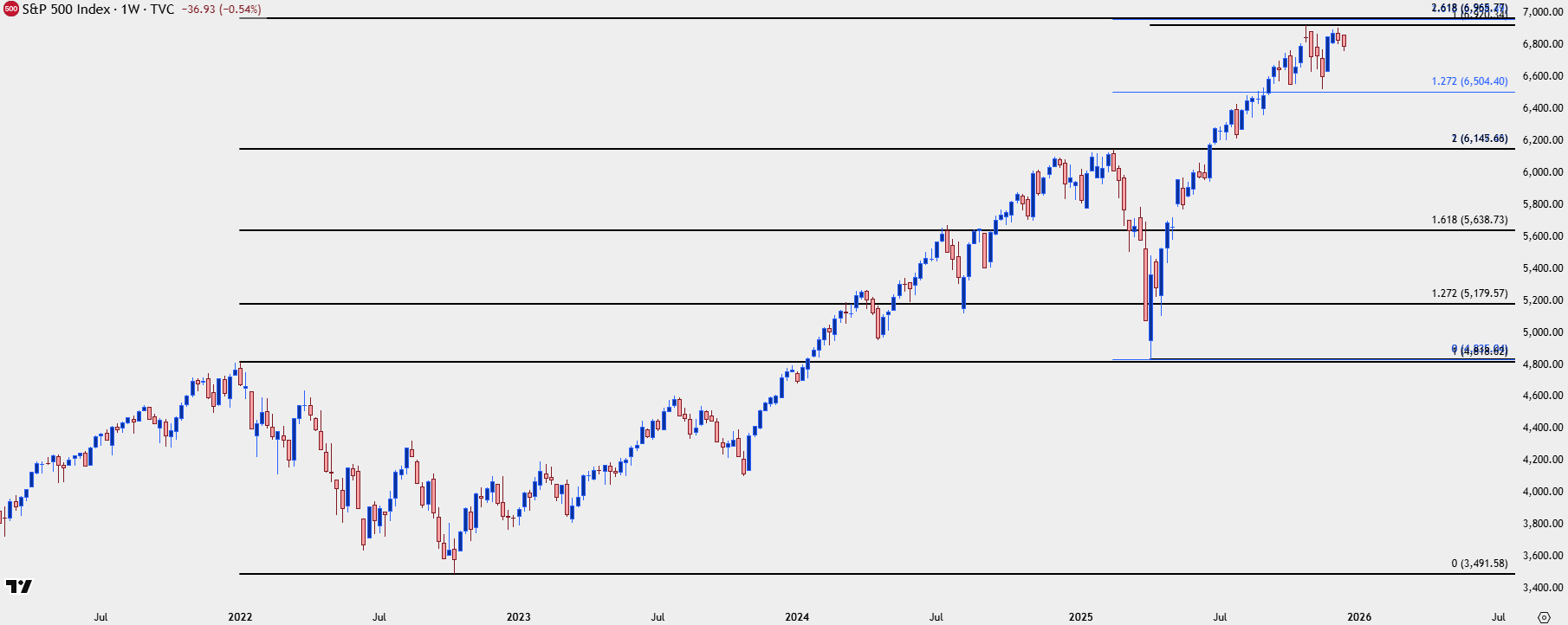
Chart prepared by James Stanley; data derived from Tradingview
Equities 2026 Forecast: Fundamentals - An Alignment of Drivers into 2026
We’re nearing a rare situation and one that really hasn’t been seen in quite some time, perhaps ever depending on your point of view. President Trump is nearing nomination of a new Federal Reserve Chair, and his comments have already indicated that rate cuts and willingness to soften policy are going to be a necessity for whomever he ultimately names. At this point, it seems down to two options with either Kevin Warsh or Kevin Hassett; and some of the more eye-catching comments have been that President Trump would like to see rates fall below 1% by the end of the year, and that he would like the next Fed Chair to consult with him before making rate decisions. He’s also said that an openness to rate cuts was a ‘litmus test’ in naming the next Fed Chair. And this is the very item that stands out as different this time, as the Federal Reserve’s independence seems to be as distant a prospect as it has since Arthur Burns; and perhaps even before that.
This doesn’t necessarily spell doom for equity markets however, and that rate softness, especially up front, can be argued as a strong factor for stocks as there’s a host of fiscal expansion measures coming online in 2026, and that will be coupled with what seems to be strong monetary accommodation - with the aim of setting up Trump and the Republican party for mid-term elections to be held in November. The linchpin to this is inflation data, as that’s ultimately the item that could compel the Fed to stop cutting rates and perhaps even eventually lean towards rate hikes. And to be sure, this may not even be an item that the Fed can stand in the way of as we saw in 2024 with rates markets pushing Treasury yields higher even as the Fed leaned deeper into rate cuts and softer policy.
Into 2026, the fear is weakness in the labor market, a fact obfuscated by the government shutdown slowing data to a trickle and forcing markets to infer perhaps more than usual on a limited number of factors. But provided inflation doesn’t surprise significantly to the upside, the door is open for a rare alignment of expansionary fiscal policy to go along with a rate cutting regime from the Federal Reserve and that can push growth rates higher, even with valuations already quite stretched.
And given that heavy one-sided positioning, this makes the prospect of chasing breakouts even more daunting, as managing risk on those strategies can be challenging with price so far away from nearby supports. But, as I said coming into 2025, pullbacks can be seen as opportunistic given that the large drivers behind fiscal and monetary expansion (Trump and his candidates for Fed Chair) seem keenly aware of the levers they need to push to make growth numbers continue higher.
Nasdaq 100 Weekly Chart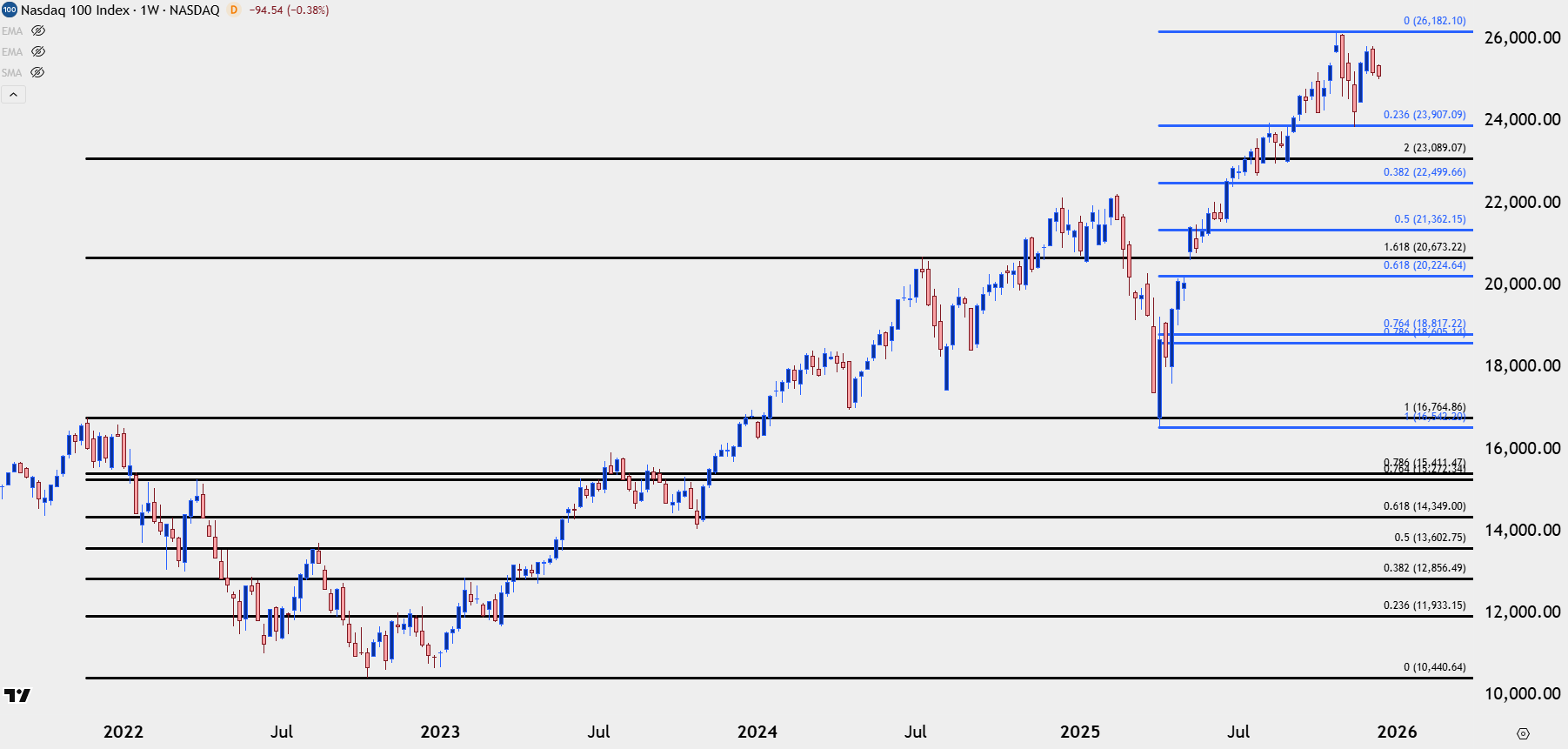
Chart prepared by James Stanley; data derived from Tradingview
Bad is Good, Good is Good-ish, but High Inflation is Terrible
Since the Fed began accumulating assets on the balance sheet there’s been a regular push towards the theme of ‘bad is good,’ driven by the idea that bad news keeps the Fed operating in the market which, in-turn, continues to push the rising tide that floats all boats.
The risk to this forecast is inflation, as higher levels of inflation could deter the Fed from more monetary softening and given the fiscal expansion measures that are online for next year, a turn at the Fed could soon be a necessity should inflation rise.
Going back to my 2025 Forecast for Equities, there’s many parallels between the AI boom today and the Dot Com boom from 30 years ago. Valuations are stretched, AI-names have been bid to massive levels as Dot Com names were back then, and valuations across indices have become quite stretched. But what ultimately popped the Tech bubble then was a series of interest rate hikes from the Federal Reserve in 1999 and 2000, capped by a 50 bp hike in May of 2000 when stocks had already peaked (although we didn’t quite know that yet). The year of 2001 was a dramatic series of rate cuts from the Fed as they tried to stem the bleeding of economic fallout. Those rate cuts then helped to build a bubble in the housing market in the US, which was then countered by more rate cuts and the introduction of QE which probably had a larger role in the macroeconomic backdrop than rate cuts did.
Since then – the Fed has been ultra cautious around causing economic disruption and this has seemingly been driven by the ‘wealth effect,’ which states that consumers feeling more flush with larger investment and retirement accounts are more apt to spend money, thereby helping to produce more growth, corporate profits, etc. The few episodes of reversion that have appeared since the Financial Collapse have large been addressed by the Fed’s extraordinary tools being employed in extraordinary ways.
This isn’t to say that the Fed is perfect because they’re not, and the 2021 ‘transitory’ episode is evidence of such. But even that highlights the fact that the bank will likely err towards the side of more growth than less inflation if necessary. And until there’s evidence that inflation must be addressed, such as we saw in 2022, I think that we’ll see the bank continue to push loose monetary policy which will drives equity prices higher.
The Bubble Talk
Also, from my 2025 Forecast on Equities was the Alan Greenspan ‘irrational exuberance’ story. Greenspan coined this term in December of 1996 in a speech talking about the excessive run in equity prices at the time, and in many recounts of Greenspan’s tenure atop the Fed, this is looked at as the first signs or indications that a bubble may be forming. The timing of that, however, was not great as it wasn’t until March of 2000 that equities ultimately topped and if Greenspan had opened a short position on his initial claim of irrational exuberance, he would’ve been in a difficult spot as stocks just continued to rise in a parabolic manner for years after.
Knowing that we’re in a bubble doesn’t necessarily help to dictate trading strategy and as we saw in late-2025 trade, it seems obvious that many think we’re in an AI-fueled bubble.
But there’s another thought here, which is the rational bubble paradox, an idea popularized by economist Robert Samuelson that describes how an asset’s price can rise far above its fundamental value even in a rational manner; because investors expect future prices to rise even higher which then create a self-fulfilling prophecy, even if detached from intrinsic value. This is why we can see equity prices continue higher even given the already-stretched valuations have pushed to levels that have historically created mean-reversion: If there’s not an inherent demand for investors to look elsewhere, they can continue the speculation chain of bidding prices even higher and higher.
Of course, this isn’t something that I would expect in perpetuity because at some point, inflation will demand the Fed to change tact and that’s when there could be a growing concern for ‘looking elsewhere.’ But guessing that point has historically been a point of folly as we can see from Greenspan’s 1996 speech on irrational exuberance; and in markets, timing matters.
The question here is whether that will take place in 2026 and this is where Trump’s gambit comes to question, as mid-terms later in the year are probably hanging in the balance. If we see inflation run and the Fed forced to hike, fueling a sell-off in equities and a negative spin from the wealth effect, those mid-terms can be more difficult for Republicans to win, setting Trump for a rough back-half of his second term.
But, from where I sit ahead of the 2026 open this is pure speculation as there’s no sign yet that equities are ready to turn over.
--- written by James Stanley, Senior Market Analyst, Global Macro
Related tags:
Latest market news




Open an account in minutes
Experience award-winning platforms with fast and secure execution, and enjoy tight spreads from 0.5 pts on FX and 0.3 pts on indices.
Economic calendar
Web Trader platform
Our sophisticated web-based platform is packed with features.
Related articles

Nasdaq 100 Coils Ahead of ASML Earnings as AI Leadership Faces a Test
The Nasdaq 100 consolidates ahead of ASML earnings as leadership fades, market breadth improves and traders await fresh clues on AI demand.


SP 500 Analysis SPX reaches 7500 points amid optimism over the US China meeting
The week remains positive in the short term for the S&P 500, which is currently showing a gain of more than 1.5% over the last two trading sessions. The index has also reached the 7,500-point area for the first time, marking a new all-time high.

Nasdaq 100: Bull Trend Ready to Resume? GOOG, MSFT, RKLB Signal Rebound
Nasdaq 100 holds firm ahead of FOMC as momentum improves. GOOG, MSFT and RKLB highlight potential bullish setups.
This report is intended for general circulation only. It should not be construed as a recommendation, or an offer (or solicitation of an offer) to buy or sell any financial products. The information provided does not take into account your specific investment objectives, financial situation or particular needs. Before you act on any recommendation that may be contained in this report, independent advice ought to be sought from a financial adviser regarding the suitability of the investment product, taking into account your specific investment objectives, financial situation or particular needs.
StoneX Financial Pte. Ltd., may distribute reports produced by its respective foreign entities or affiliates within the StoneX group of companies or third parties pursuant to an arrangement under Regulation 32C of the Financial Advisers Regulations. Where the report is distributed to a person in Singapore who is not an accredited investor, expert investor or an institutional investor (as defined in the Securities Futures Act), StoneX Financial Pte. Ltd. accepts legal responsibility to such persons for the contents of the report only to the extent required by law. Singapore recipients should contact StoneX Financial Pte. Ltd. at 6826 9988 for matters arising from, or in connection with the report.
In the case of all other recipients of this report, to the extent permitted by applicable laws and regulations neither StoneX Financial Pte. Ltd. nor its associated companies will be responsible or liable for any loss or damage incurred arising out of, or in connection with, any use of the information contained in this report and all such liability is hereby expressly disclaimed. No representation or warranty is made, express or implied, that the content of this report is complete or accurate.
StoneX Financial Pte. Ltd. is not under any obligation to update this report.
Trading CFDs carries a high level of risk that may not be suitable for some investors. Consider your investment objectives, level of experience, financial resources, risk appetite and other relevant circumstances carefully. The possibility exists that you could lose some or all of your investments, including your initial deposits. If in doubt, please seek independent expert advice. Visit www.forex.com/en-sg/terms-and-policies for the complete Risk Disclosure Statement.